This week’s review marks a new first for the blog, the first time I’ve re-reviewed a restaurant. Well, sort of: I’ve re-reviewed places before, but normally it’s because they’ve changed hands, even though the name has remained the same. This is often the case with pubs – so, for instance, I’ve reviewed the Lyndhurst three times, the Fisherman’s Cottage twice. The room and furniture were identical on all my visits, but the management, the team in the kitchen were completely different. So of course you’d view it as a separate business – just as, at some point, I’ll review the Corn Stores again, because what it offers now is a world away from what I ate when I went there last.
But some restaurants, particularly ones that stand the test of time, go through phases under the same ownership. The menu shifts and changes, the personnel in the kitchen will too, front of house stars will come and go and, over time, a restaurant can become the hospitality equivalent of Trigger’s broom. There are golden ages and doldrums. The best example I can think of is Mya Lacarte – in its prime, with Matt and Alex running the front of house and Remy Joly in the kitchen, it was an unbeatable place, but no incarnation after that managed to match those halcyon days.
When you’ve been at this lark as long as I have, the odds get shorter that places will change so much that a fresh look is overdue. Many places I’ve reviewed have since closed – correlation rather than causation, I promise – but many have made a go of it and flourished. Take Coconut, for example, or Valpy Street: are they really the same restaurant as they were when I first went there, not long after they opened? Is another visit in order?
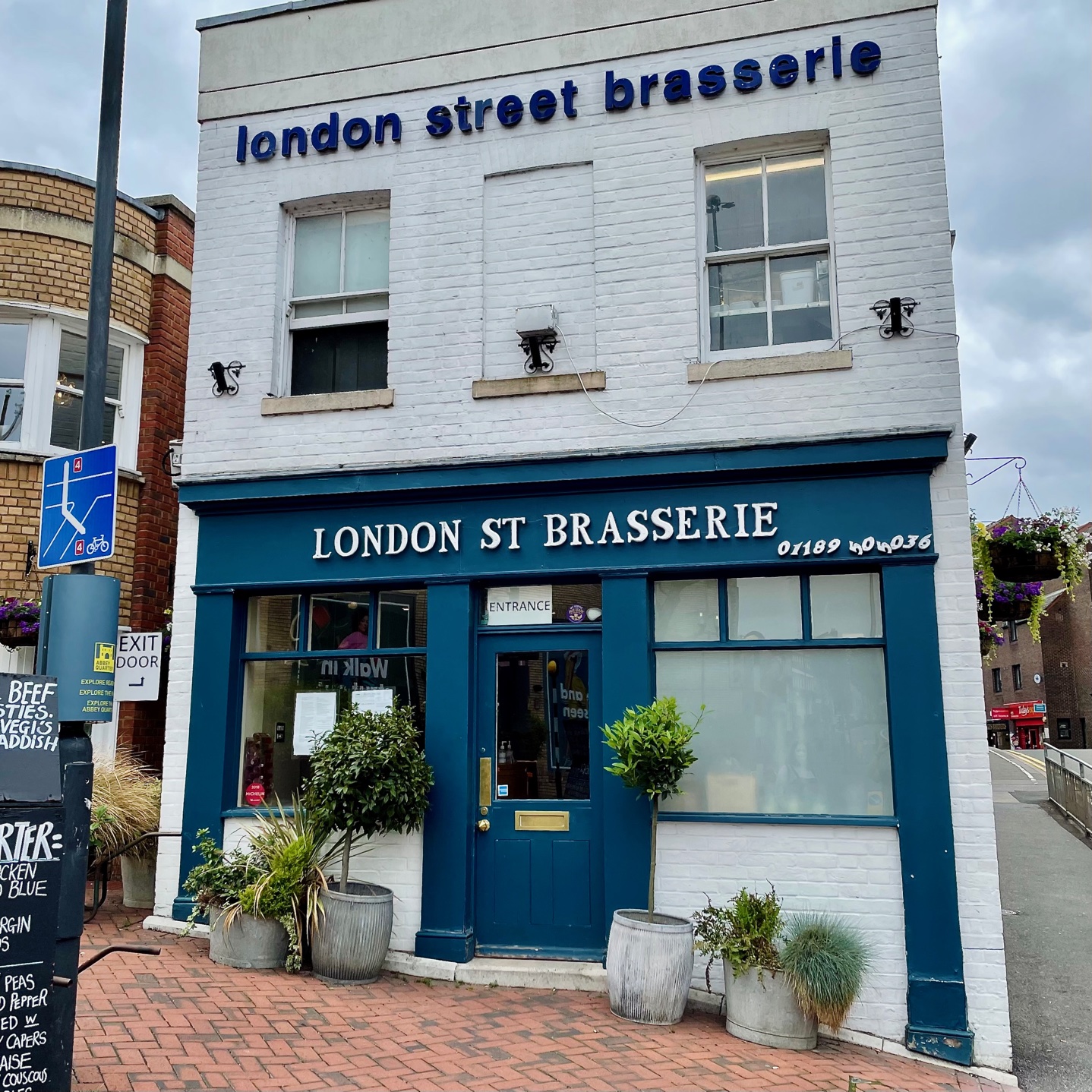
I can’t think of a better example of this than London Street Brasserie, the subject of the third review I ever wrote. Even by then, the restaurant had been going for more than ten years – now, in 2021, it’s over twenty years old. Many chefs and front of house have passed through its doors since 2000 and some have gone on to open or work in other restaurants, in Reading and beyond. It’s still probably the town’s best-known restaurant and the Reading venue people are most likely to consider a special occasion restaurant.
It’s also, as I discovered recently, a restaurant about which many people in Reading have an opinion. I went there in May with family, not long after it reopened, and when I posted pictures of my food on social media plenty of people had something to say. “I ate there recently and enjoyed it so much that we went again last week. Have the poached pear next time you go!” said one person. “I’m heading straight for the sticky toffee pudding once we’re double-vaxxed” said another. But it wasn’t unanimous: “I’ve never had a decent plate in all the times I’ve been” was a third opinion. My previous review is nearly eight years old – a lifetime ago, in so many ways – so it felt like the right time to head back, on a weekday lunchtime, with my other half Zoë.
Subscribe to continue reading
Become a paid subscriber to get access to the rest of this post and other exclusive content.
Nandana Syamala moved to the U.K. from India on Christmas Day 2004, and after living in London for over ten years she and her husband Sharat relocated to Reading to pursue their dream of opening a restaurant together. Clay’s Hyderabadi Kitchen opened on London Street in June 2018, and since then has firmly established itself as one of the jewels of Reading’s independent restaurant scene, winning awards and converting the town to now iconic dishes like kodi chips, squid pakora, crab fry, bhuna venison and its trademark clay pot biryanis.
Clay’s has spent some of the time since lockdown began cooking 100 meals a day for the Whitley Community Development Organisation. In the next couple of weeks they will launch a new service selling a brand new, regularly-changing menu of vacuum-packed, chilled meals for delivery, initially in Reading only but with plans to expand nationwide. A hot food delivery service in Reading is due to follow further down the line.
What are you missing most while we’re all in lockdown? Eating out at our favourite restaurants in our free time, and I also dearly miss all the happy hugs I get from our diners.
What’s your earliest memory of food? Chicken legs. My mom used to cook pan-fried chicken legs. We were three siblings and we got one each. My dad still tells stories to anyone who will listen (or even just pretend to listen) about how we used to hold our chicken leg, move into a corner of the room and eat it with so much concentration it was almost funny, like a cartoon. We were all under five years old.
How have you changed as a result of running a restaurant for nearly two years? I don’t know if this makes any sense but Clay’s is a brand new adventure for me and I’m not sure if running it has changed me, or whether I’m discovering parts of myself that were always there but had just never come to the surface. So I had to ask my friends for help with this question, as I couldn’t judge for myself. Some of them said they don’t get to see me enough to detect any changes, one said I have become modest (but he is known for his sarcasm!) The majority have said that I’ve become slightly more pragmatic and a little less idealistic, but there’s still a long way to go before they’re in balance! I’m not sure that’s where I want to end up, though.
What’s your favourite thing about Reading? The way it feels like a big city but also a community town at the same time. The way the people are so warm and helpful most of the time and the way all the independent businesses are so supportive of each other. I also love the fact that there are so many areas of outstanding natural beauty only ten to fifteen minutes’ drive away.
What is the worst job you’ve done? My first job, back when I was doing my bachelor’s degree. I worked at a pre-school and I was teaching the kids the English alphabet. I was having trouble with one girl and was trying really hard to make her trace a letter and suddenly she grabbed the ruler I had in my hand and hit me with it! I laugh out loud whenever I think of it now, but it was one of the hardest things I’ve ever done, and I hated it so much that I left within a month. I’ll forever have so much respect for people who do it so well. I did get to buy a birthday gift for my best friend and a watch for my younger brother though: it took me more than twenty years to buy something with my own money again for my brother, so I guess that job was also special in spite of it being the worst.
What one film can you watch over and over again? There are quite a few that have moved me, but I’ve watched The Godfather more times than I can count, and I can always watch it again. Everyone knows that it’s brilliant, but every time I watch it I find some new underlying meaning in a scene, something that I’ve previously missed. I love the book, too.
What’s the best meal you’ve ever eaten? There’s this place in France called Cap Ferret near Bordeaux . We were there a few years ago and had one of our best and happiest meals ever at one of the oyster shacks there. This was family run by the oyster farmer, his wife and his daughter. We sat there on the beach with basic seating and lots of wine while they kept on bringing the freshest of seafood – from oysters and shrimp to clams and mussels – along with some of the most beautiful bread and butter I’ve ever had. The food wasn’t showy, no modernist techniques, no gimmicks. I wish I could retire and eat that way every day.
What did you want to be when you were growing up? I have the most vivid imagination ever and believe me when I say, there hasn’t been a single thing in this world that I haven’t wanted to be at some point while growing up. A cleaner, a butler, an astronaut, an engineer, a superhero, a doctor or a film personality. I even wanted to be a holy woman doing meditation in the Himalayas. I don’t just mean a flash of imagination: I actually spent a few months daydreaming about each of them before moving on to the next. The biggest irony is that even though cooking always came naturally to me I don’t remember ever wanting to be a chef.
When you moved to England, what took the most adjusting to? I grew up reading Jane Austen, Agatha Christie and P.G. Wodehouse, and it was a bit disappointing at first that England didn’t feel like that. But the biggest thing to adjust to was the lack of street food like in India. I was used to eating street food almost every day as an evening snack, and it’s still the one thing I really find it hard to live without. There are street food markets happening more now in the UK but it’s not even 5% of the variety and abundance you see in India or Thailand.
Where will you go for your first meal out after lockdown? We’ve been thinking about this a lot, and even have a list of restaurants that we are missing from London, Bristol and Oxford. But I think it will most probably either be Pepe Sale or Côte.
What is your most unappealing habit? It could be the high-pitched nervous giggle I do when I get overexcited about something.
Who would play you in the film of your life? It’s extremely unlikely to happen, but someone said Shilpa Shetty (who won Celebrity Big Brother a long time ago) or Frieda Pinto. But knowing the control freak that I am, I might not let anyone else do it.
What’s the finest crisp (make and flavour)? I can only eat sea salt and black pepper Kettle Chips. Please don’t judge.
What have been the highest and lowest points of your time running Clay’s? The lowest was four days before we were due to open, when our builders left us in the lurch with lots of major things still needing fixing. We’d made the mistake of paying him 95% of his fee by then. He told us that the owner of another house he was working on had given him an ultimatum to finish their house faster, and he jumped ship because the owner was an architect and he expected more work and more money from them. We were a nobody to him.
It was a nightmare: we’d already postponed the opening date once and couldn’t do it again. I’d start crying the moment anyone so much as said hello to me. We went around all the hardware stores and electric stores, managed to find different handymen for different jobs, spent loads of extra money and finally managed to open with just £100 remaining in all our combined accounts. We had nothing left to even buy groceries for the next week. I can’t believe it’s not even two years since we went through all of that!
The highest was when a group of our regulars planned in secret to visit us on the date of our first anniversary to celebrate with us. They booked a big table without us having a clue; the happiness and thrill I got seeing each one walking into the restaurant and then realising they all belonged on the same table is indescribable. I don’t think anything will ever beat that and I am forever grateful to all of them (you know who you are) for giving us that moment.
What’s your guiltiest pleasure when it comes to food? Hyderabadi biryani and cut mirchi, ever since childhood. My family used to tease me that they would find a husband who cooks those two dishes. They did end up finding me someone who does the best biryani and I managed to master the other one, so it’s a win-win.
If your house was on fire, what’s the one thing you would save from it? Honestly, nothing, as long as Sharat and I are out and safe. Is it sad that I don’t possess anything I think is worth saving?
Clay’s has one of the best wine lists, beer lists and gin lists in Reading. What’s your drink of choice? Thank you so much for saying so: we really put so much effort into that. But coming to your question, it mostly depends on the mood, weather and the food but otherwise it would be a good full-bodied red.
Where is your happy place? Wherever all my family is, with all my nieces and nephews playing around.
Tell us something people might not know about you. I’m an introvert.
Describe yourself in three words. Honest. Content. Defective. That last one is Sharat’s word, and I’ve trained my mind to believe that he means it in a cute way!
Zest closed in August 2022. I’ve left the review up for posterity.
How good is your memory for faces? I was in Brighton over the summer, sitting outside a particularly patchouli-scented café in the Lanes, when I thought I recognised the woman walking past my table and nipping inside. It bugged me for about five minutes until I realised where I knew her from: she’d served me in Workhouse Coffee what must have been a couple of years ago. Reading is a small town, and the longer you live there the more chances you get to accumulate memories, or scraps of memories, and to spot people you dimly recognise from your past: that person used to work at the same office as me a few years ago; that person was briefly my housemate in 2001 and never used the shower; there’s a friend I lost in the divorce.
The reason I mention this is that when we turned up at Zest on an icy winter’s evening, the owner recognised me immediately as a former customer of hers. I used to eat at Zest’s town centre sibling restaurant, the sadly-missed LSQ2 (where Handmade Burger is now), but even so it was an impressive feat of recall: I frequented LSQ2 the best part of ten years ago, and I expect she has seen hundreds of diners since then. And yet here we both were – her still trading nicely out at Green Park and me a few pounds heavier, far older and greyer (if not necessarily wiser) but still alive and kicking.
LSQ2 closed in 2012 (the GetReading article announcing the news tried to suggest that every cloud had a silver lining because Cosmo was about to open on Broad Street) but Tony and Sally Cole’s first restaurant, since rebranded as Zest, has been operating at Green Park for fifteen years, offering a combination of classic modern British food and dishes which reflect their time spent in Australia and New Zealand. I still remember a dish of sashimi-grade tuna with a slick of sesame that LSQ2 used to do – I ordered it every time I went there, until they took it off the menu because they felt the tuna wasn’t sustainable.
There are a few reasons why I’d never got round to reviewing Zest before now. It never quite made it to the top of my to do list, and I think that’s because I always got the distinct impression that it was more intended for people working on the business park, and corporate diners, than members of the public. The opening hours, not entirely clear from the website, didn’t help. It’s only generally open Monday to Friday, but you get mixed messages – in one place on the site it says it’s open 5 until late, in another it says their menu is served until 9pm and if you try to book online the latest table it will give you is at 8pm (with a clear instruction that you need to place your order by 8.15, because the kitchen closes).
Arriving at half seven with my other half Zoë didn’t necessarily alter that impression – there were a few tables occupied, one of them a large booking, but all seemed to be coming to the end of their meals: we were the last new customers that evening. Zest is actually quite an attractive space, all dark wood and big windows looking out over water. In the thick fog, with light trying to break through from the nearby offices and car parks, it was all a bit Blade Runner, and if the furniture felt slightly chain hotel it didn’t put me off. The lighting, as you’ll see from the photos, was a little more intimate than I’d like, although it didn’t help that a few bulbs were out.
Zest was running a reduced à la carte menu alongside a Christmas menu when I visited, although the prices weren’t unreasonable for either and you were allowed to mix and match. The only real difference was that mains on the Christmas menu were a few pounds more expensive and came with roasted vegetables and Brussels sprouts, whether they went with the dish or not (but more of that later).
In general starters were seven or eight pounds and, if you visit outside the festive season, most mains will cost you around fifteen. It was a very good menu with more than a few tempting choices, and I’m glad to say that no compromises were made in bringing you this review. There’s definitely an Asian influence to an otherwise modern European menu with Thai and Indonesian dishes sitting alongside more traditional ones – we tried a little from both, in the interests of balance.
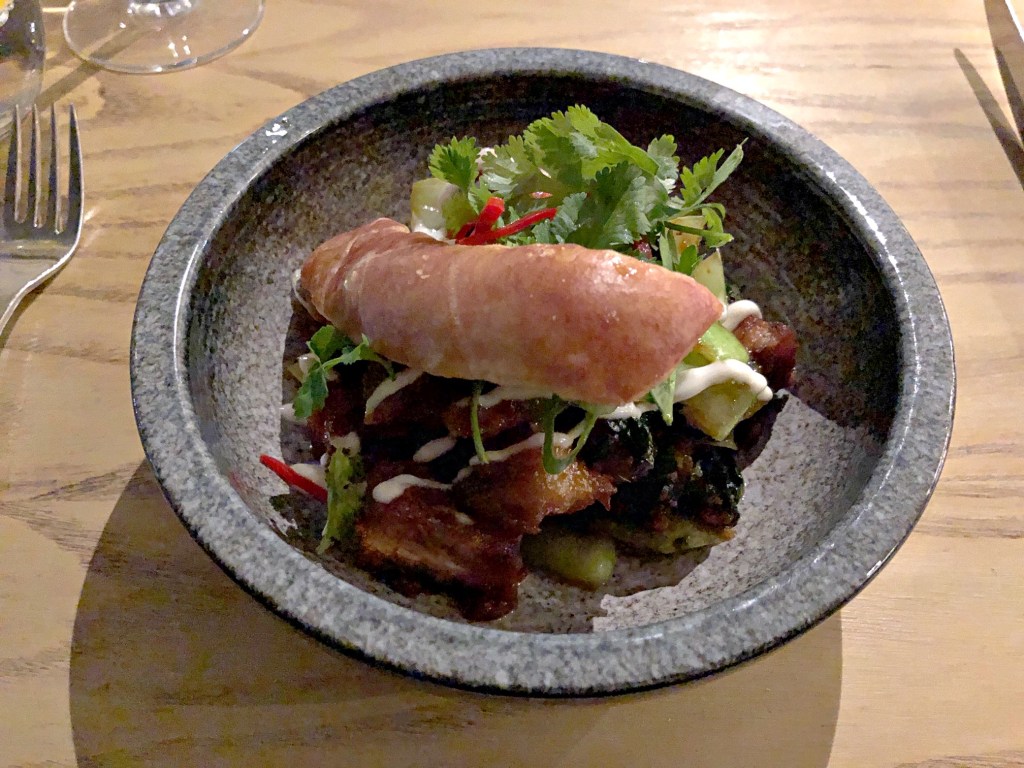
My starter was one of the nicest things I’ve eaten this year. Pork belly (triple-cooked according to the menu, although I saw no real evidence of that) came in generous cubes with tender meat and glossy fat, all coated in a gloriously funky, fishy XO sauce, with pak choi, spring onion and big, fragrant coriander leaves. There was a lime aioli advertised, and something that looked like that was definitely drizzled over the pork, but it couldn’t break through the stronger flavours in the dish, not that I cared in the slightest.
The only misfire was the crackling on top, which left me fearing for my fillings. A lighter touch would have been better, and in honesty the dish wouldn’t have missed it: it also ruined the picture below, or at least that’s my excuse. In any case, I was too delighted with everything else to mind. I let Zoë try a couple of pieces, partly because it was the season of goodwill but mainly because food that good deserves to be shared, regardless of whether it’s December or June.
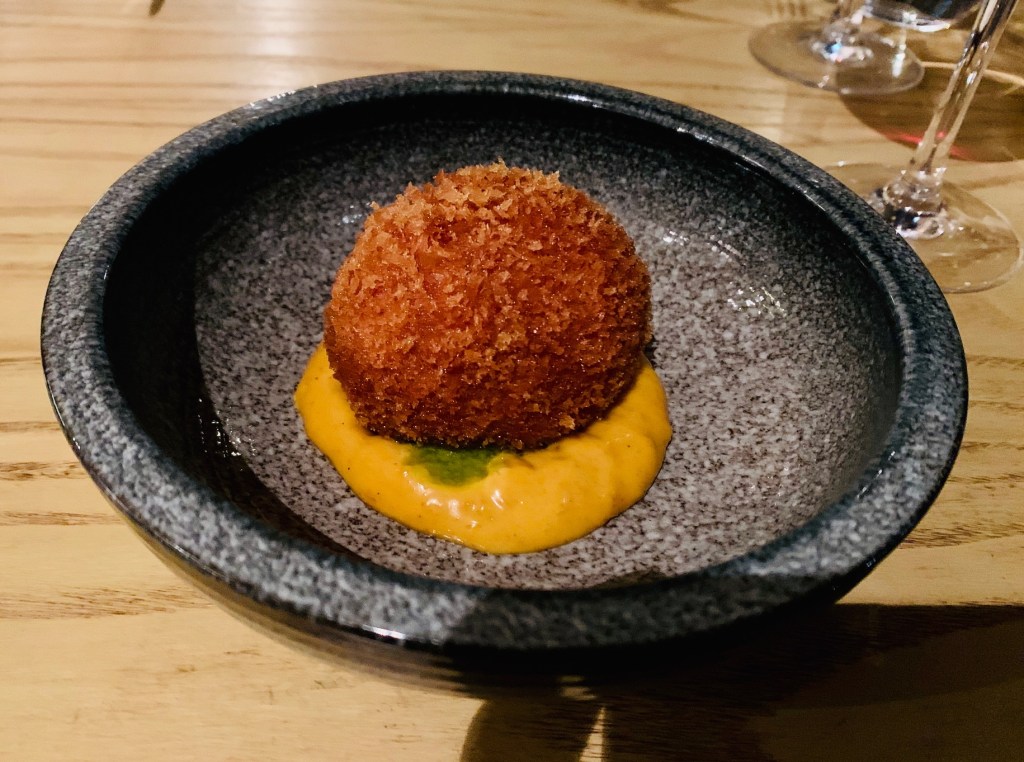
I had a sneaking suspicion that I’d won at starters, but Zoë was very happy with hers. “I want to try the Scotch egg because I’d had a few to compare it to”, she said, and it was a very attractive specimen, served on what was called “curry mayonnaise” but felt to me more like a katsu sauce, more fruity than fiery. It could have done with more of the advertised coriander salsa verde but even so I thought it was a really good example – what felt like panko breadcrumbs, beautiful texture, peppery sausagemeat and yolk at just the right consistency.
“Is it better than the Lyndhurst’s?” I asked Zoë.
“Better than the one they do now, and up there with the one the previous owners did” was the reply.
The wine list at Zest may reflect the fact that most of their diners drive home afterwards, with a compact selection: most of it is available by the glass, and only a couple of bottles north of thirty pounds. We had a very drinkable French pinot noir for twenty-eight pounds which I thoroughly enjoyed – although our waiter intervened to stop me pouring it myself, which felt a little unnecessary. He was the only person looking after us all evening and I couldn’t quite shift the fear that he resented us for making him work late: nice enough, but a little distant and slightly lacking in warmth.
Our main courses, both from the Christmas menu, came out a little quicker than I might have liked, adding to the feeling that we were keeping staff from their loved ones. It’s never easy, I suppose, for a kitchen to sit on their hands when they only have two dishes left to prepare, but I do wish they’d left it a little longer.
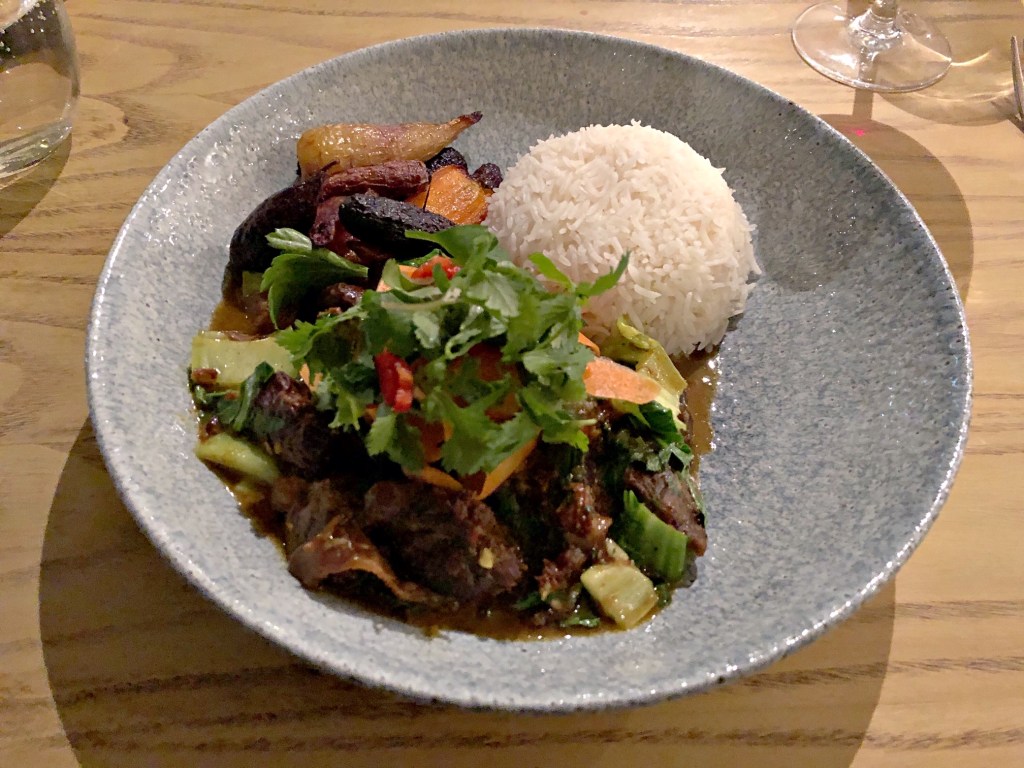
However, again, that felt like a minor quibble once I started eating the food. My beef rendang was truly beautiful. My previous experience of this dish had been at Newbury’s now-defunct Wau, and at the time I thought I’d had a very good rendang. This, though, was streets ahead – not sickly-sweet and overreliant on coconut but complex and aromatic, shot through with hints of star anise. Similarly, the beef hadn’t been cooked into mush – it was still in distinct pieces which only fell apart when you tried to load them onto a fork. Again, there was plenty of coriander and the sharp crunch of ribbons of lightly pickled carrot on top was an excellent touch.
This was a marvellous dish, perfect on a Baltic Reading evening, and I am pretty sure it is usually on Zest’s à la carte menu, so try it if you go. As it was on the Christmas menu it was served with a fair few roasted heritage carrots (many of them a pleasingly deep shade of purple), and although they didn’t go in the slightest with an Indonesian curry it didn’t stop them being delicious.
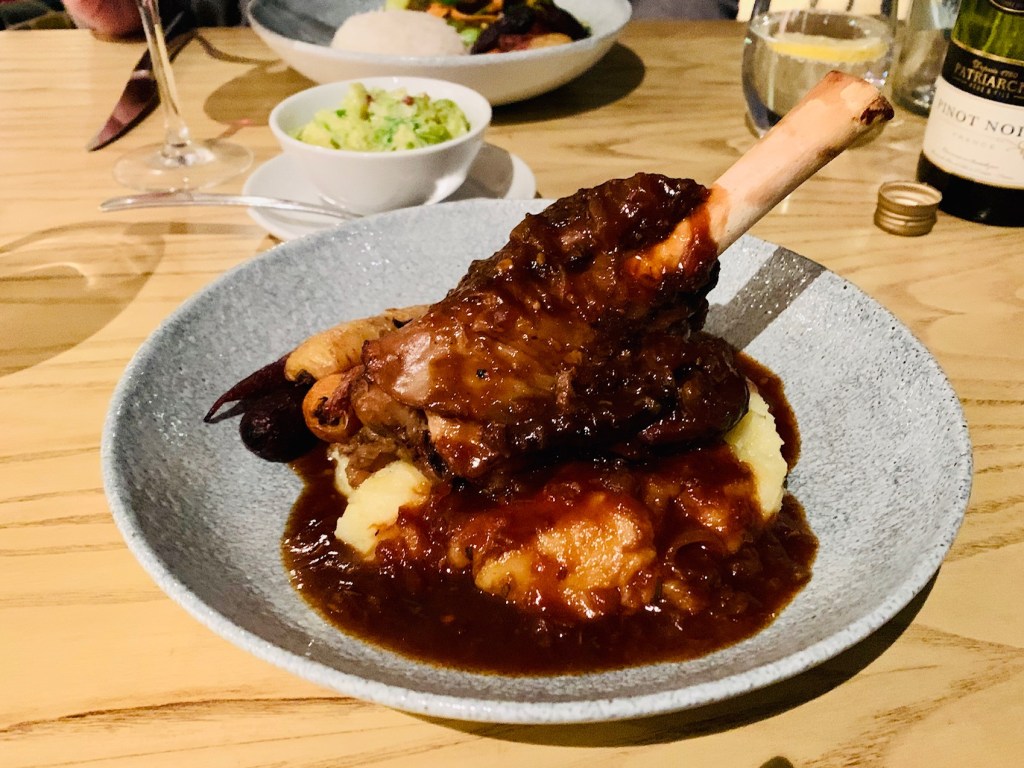
Zoë’s lamb shank was a more conventionally Christmassy affair, and very good it was too – a gigantic piece of meat, cooked into soft surrender. The sauce was deep, with a little sweetness from balsamic vinegar and soft onions and the mash was suitably creamy and smooth. This went much better with the roasted vegetables and with the surprisingly good Brussels sprouts, sliced thinly and served with cream and a little speckle of pancetta. I wouldn’t be at all surprised if this dish also features on the menu all year round, and it’s well worth ordering. I would have liked the advertised mint salsa to make an appearance, but the dish managed fine without it.
It took a while for the waiter to ask us if we wanted to look at the dessert menu, and I felt guilty about saying yes: he asked in the same way that I ask Zoë if she wants help hanging the laundry out i.e. hoping against hope that the answer will be no. But if they don’t want people to order dessert, Zest will have to make the menu a lot less tempting – even the usual suspects had twists that made you want to find out how they looked off the page and on the plate. It’s also worth mentioning that Zest’s cheeseboard is a veritable Greatest Hits of local cheeses – Barkham Blue, Waterloo, Wigmore and Spenwood, all for eight pounds fifty.
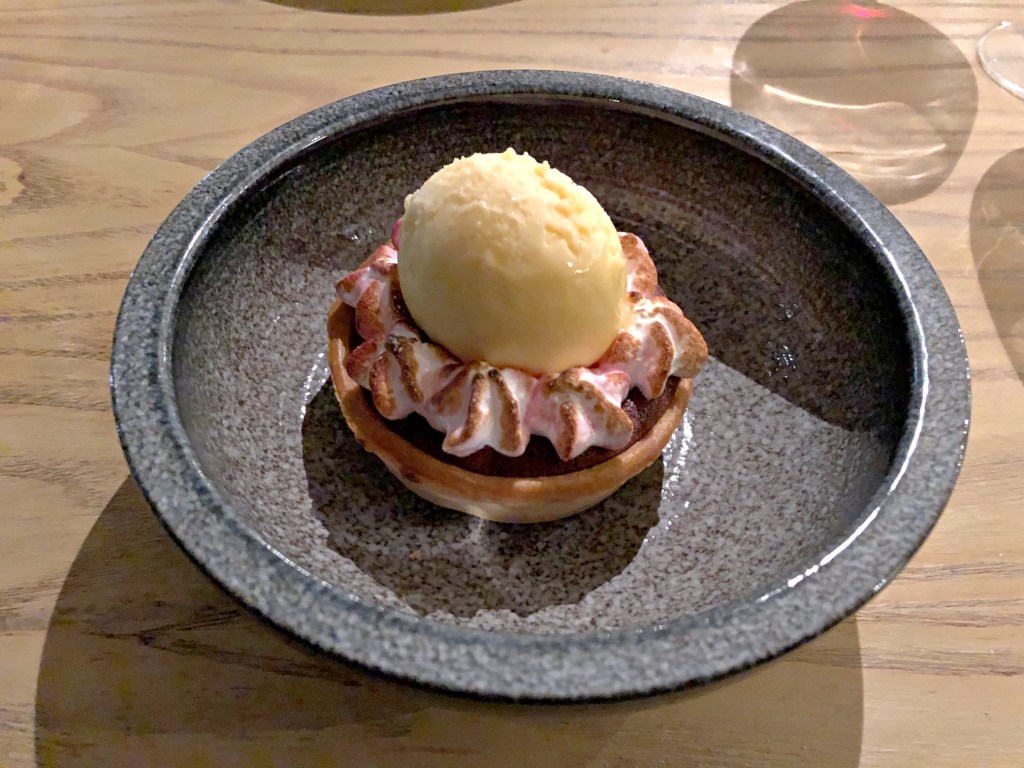
My dessert was probably the weak link of the meal. Chocolate tart with meringue and Clementine sorbet sounded beautiful, and the flavours were all present, correct and harmonious. But the texture was wrong – the chocolate was not the solid ganache I was expecting, but a molten pool, as if it had escaped from a fondant. It didn’t stop it being enjoyable, a rarified Terry’s chocolate orange encased in light buttery pastry, but it wasn’t quite what I had hoped.
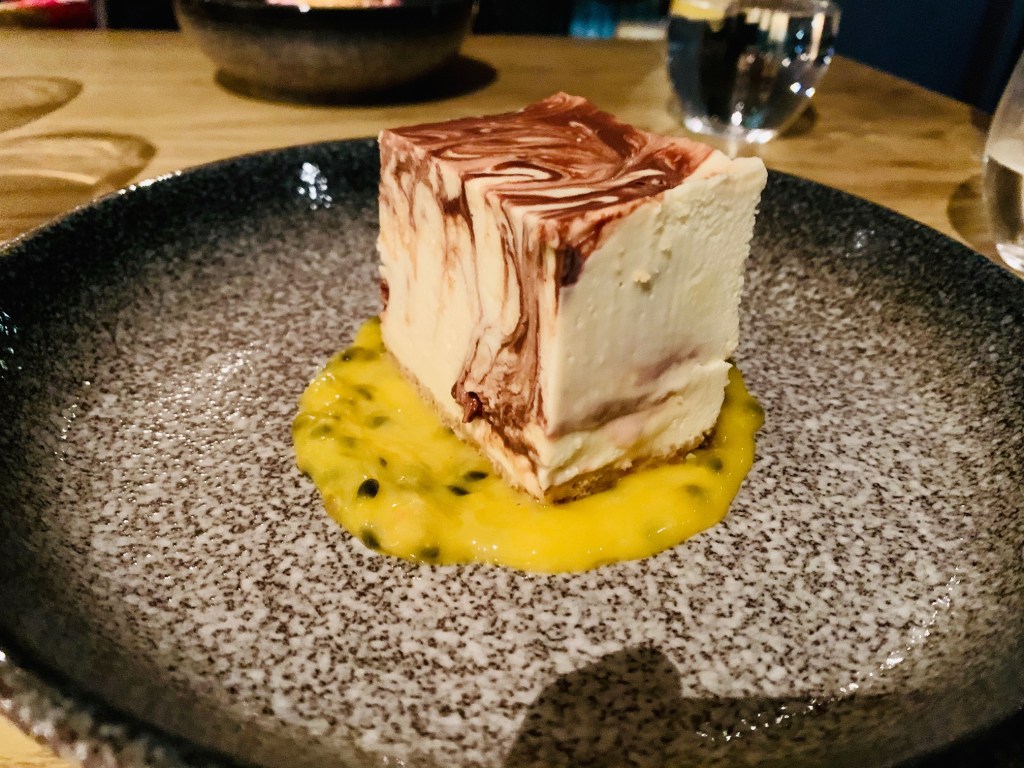
If I’d won out on starters, Zoë drew level with dessert. I feared a white chocolate and Bailey’s cheesecake would be too sickly but actually it was sweet but not excessively so, a big block of indulgence heavy on filling and light on base. The passionfruit curd underneath stopped the whole thing being too one-dimensional, but given that I was only allowed one small forkful it’s hard to comment further, beyond wishing that I’d ordered it myself.
Dinner for two, including a pre-added 10% service charge, came to just over a hundred pounds – and actually, ordering off the á la carte isn’t any more or less expensive than the three-courses-for-thirty-pounds festive menu. To my mind, that makes the latter remarkably generous and I left the restaurant with a full stomach, a spring in my step and a couple of money off vouchers for next month which I may well end up using.
It’s easy to get jaded when you review a restaurant every fortnight, easier still when it’s a Cozze, a Lemoni or a Pantry. So I’m delighted that, even if by accident rather than design, I’ve saved one of the best meals of 2019 until almost the very last. I didn’t come away from Zest convinced that they were necessarily packed on most weekday evenings, and that lack of clarity probably goes some way to explaining why the pacing of the meal was a little rushed and the service sometimes felt a tad diffident.
But – and this is far more important – I did come away from Zest wishing I had visited a long time ago, and convinced that I might have unearthed one of the best local restaurants you’ve never considered going to. It’s easily accessible by bus from the town centre, it’s affordable by taxi on the way home and it serves delicious, interesting food (it’s as if they’ve been doing it, without much fanfare, for the best part of fifteen years). There’s absolutely nothing wrong with Zest that a buzzier room full of more customers wouldn’t solve – and personally, I plan to play my own small role in helping with that in the New Year. I suspect if you went you’d find it memorable: chances are, they’d come to remember you too.
Zest – 8.0 Lime Square, 220 South Oak Way, Green Park, RG2 6UP 0118 9873702
This branch of Cozze closed for good in July 2022 and was replaced by San Sicario, which also subsequently closed. Masakali is there now. I’ve left this review up for posterity.
I’ve been reading a lot of other restaurant bloggers recently, and it’s made me think. These are proper restaurant reviewers in big cities, and they use impressive words like “bosky” and “friable” – both of which, I’m ashamed to say, I had to look up in a dictionary.
The other thing these reviewers do, which I’ve never done, is write in the present tense e.g. I bite into the burger. It has the deep flavour of well-tended cow and so on. This is a very striking way to write about food and it makes you feel like you’re there, in the moment, experiencing that bite with them.
I, on the other hand, tend to write in the past tense e.g. the burger was a bit bland. Recounting an event which has already happened makes it feel like you’re telling someone a story down the pub, but perhaps it lacks that immediacy. Maybe it puts a gap between the writer and the reader.
So does the traditional structure of a restaurant review. Here is why I’m reviewing this place, my reviews tend to begin, followed by this is what the room is like and here’s what I ordered and what it tasted like followed, as night follows day, by here’s what the service was like, here’s how much it cost and, last but not least, this is my verdict. Add the rating, the address and the website, repeat until dead. Job’s a good’un.
One thing those other restaurant reviewers and I agree on is that the best reviews to write are the rave reviews, followed by the hatchet jobs. The ones everybody dreads are the middling, the mediocre, the it was dull enough eating it, but heavens, now I have to write about it ones.
So, I ought to start by explaining that Cozze, the Italian restaurant on the roundabout at the bottom of the Caversham Road, has been on my to do list for literally years, and that whenever I ask people on Facebook where they’d like me to go next someone always pipes up and suggests it.
I should add that it started in Woodley before adding a second branch in central Reading with a third one just opened in Pangbourne. I should then say something like “well, a successful independent chain is a very unusual thing in Reading so I owed it to myself to see what all the fuss was about so I went there one night with my partner Zoë” and there you go, the scene is set.
But really, and maybe this will build some of the immediacy my reviews might sometimes lack, what I really want to tell you is how exceptionally bored I was by having dinner at Cozze.
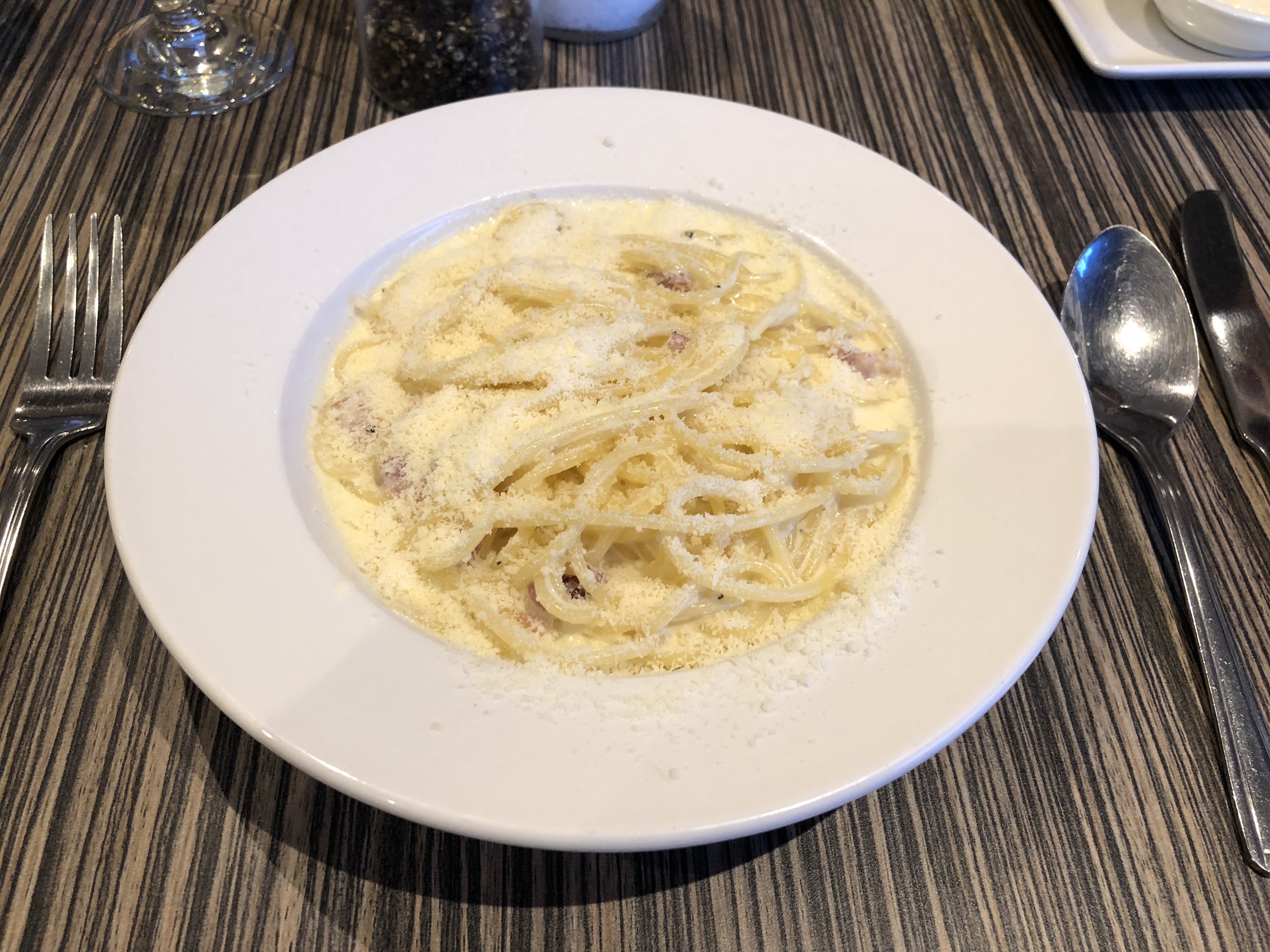
Take the spaghetti carbonara I had as my starter. A good carbonara should be golden, the sauce should hug the pasta, it should be resplendent with egg, it should be salty and sinful and fun. The pancetta (although ideally it might even be guanciale) should be almost crispy and add its own whack of salt to proceedings. It shouldn’t be like this.
It shouldn’t be a pasty albino of a thing, swimming in cream with scant evidence that it’s ever seen an egg. You shouldn’t be dredging through the lake of liquid once you’ve finished, picking out highlighter-pink cubes of bouncy bacon and wondering why you bothered. It shouldn’t be worse than eating at Carluccio’s, for goodness’ sake. It shouldn’t feel like a dish cooked by people who don’t especially care for food or know how it’s meant to taste.
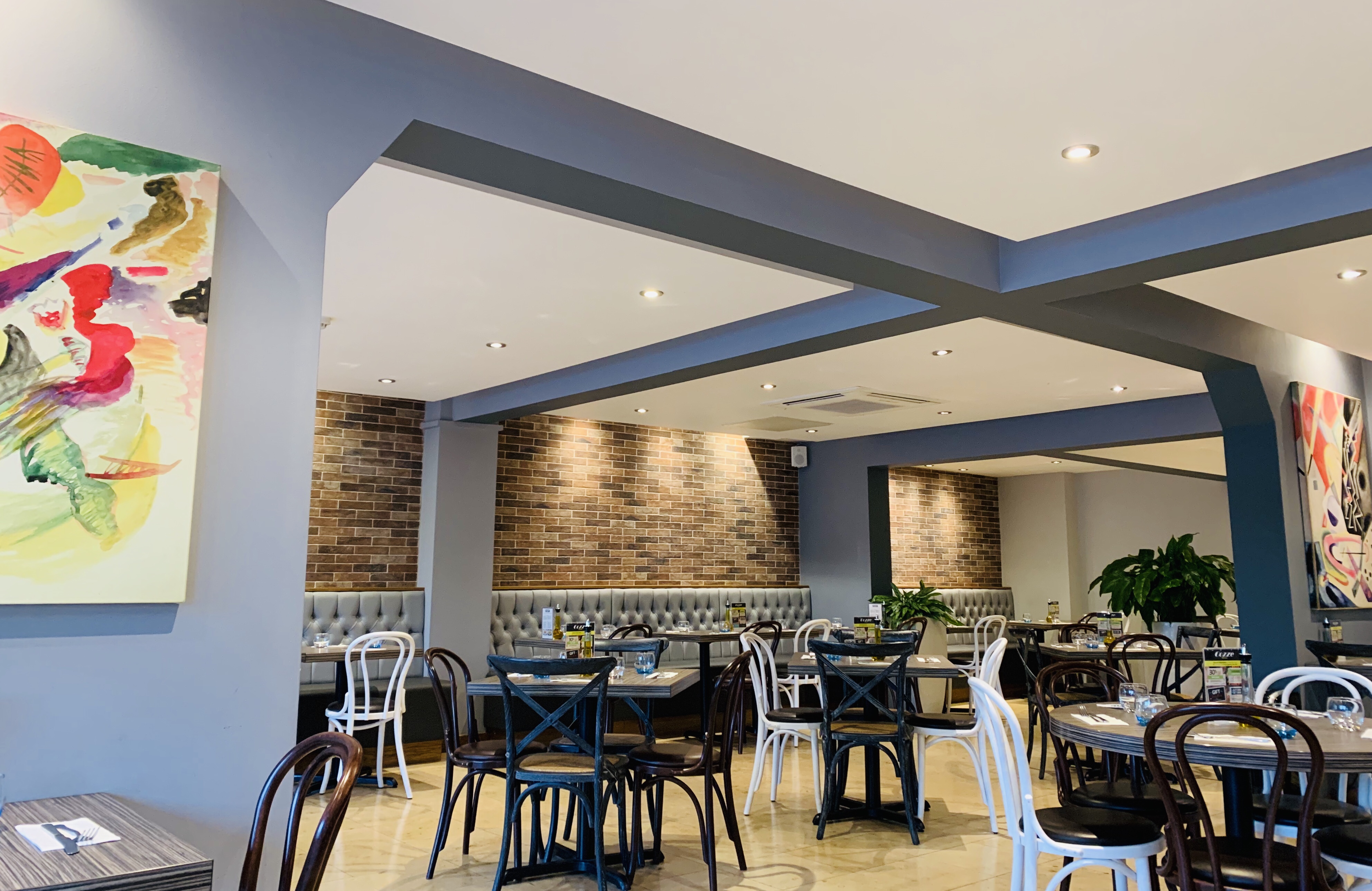
The sad thing is that the room itself is quite nice – a big airy space with nice furniture and vaguely Kandinsky-esque paintings on the wall. And the staff were lovely – really bright and friendly as they brought middling plate after middling plate to our table. We were the only people there when we arrived, although by the end three other tables were occupied. One big group appeared to be regulars, which makes me wonder if they’ve ever considered trying other restaurants. They might like them.
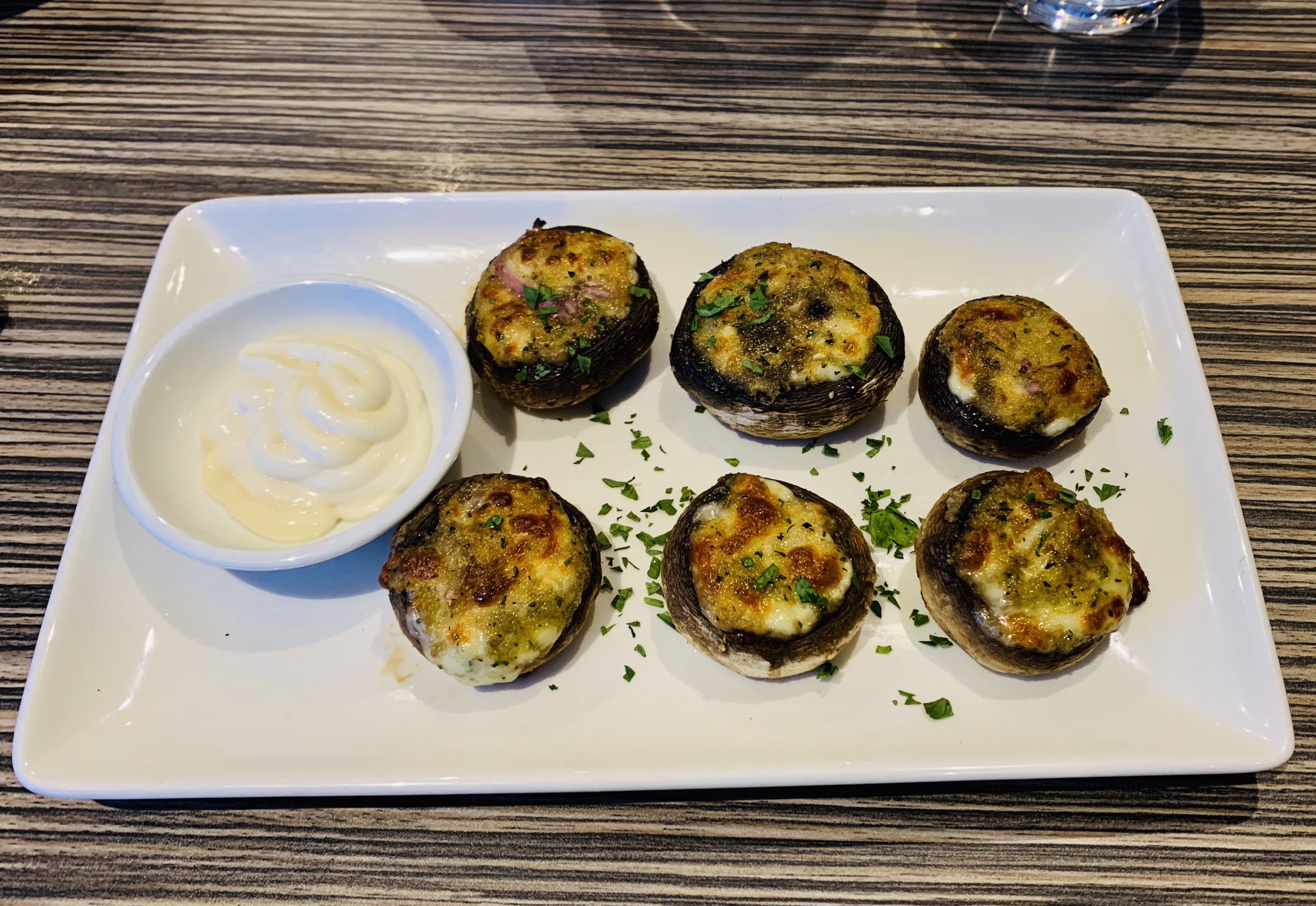
Zoë thinks I am being a little grumpy, and to be fair she ordered better than I did. But her stuffed mushrooms, laid out as if by a serial killer, might have been pleasant enough but I wasn’t sure they were elevated from anything you could pick up and do yourself in M&S. The ones at Papa Gee, in the heart of Caversham, at least have blue cheese in them to give some salt and tang and flavour: no such luck here. The dip seemed to be mayo. Who dips stuffed mushrooms in mayo? Why not just stick a bottle of salad cream on the table and have done with it?
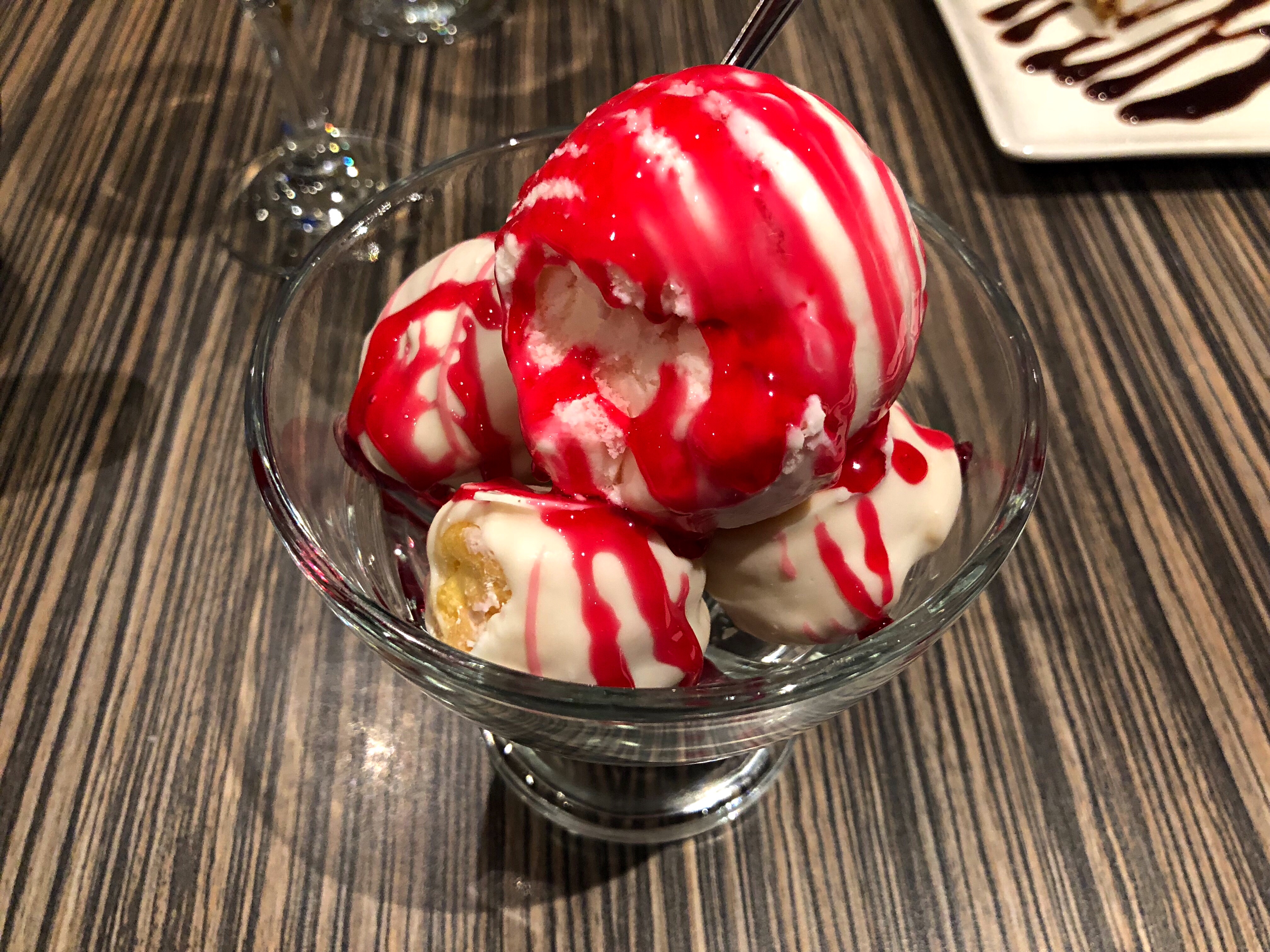
God, and the desserts. White chocolate covered profiteroles filled with Prosecco and raspberry ice cream sounded like they might at least be interesting, but turned out to be one of the ickiest things I’ve had in a long time. They were filled not with ice cream but with cream that tasted of nothing much. The white chocolate was sickly enough, but the Barbie-pink raspberry gloop on top, and the scoop of raspberry ripple ice cream in which almost no raspberry was evident, completed the spectacle. Again, Zoë’s dessert, a honeycomb cheesecake, was a little better but still every other ingredient was shouted down by sugar.
I’d had my doubts about Cozze before going, which mainly came down to looking at the menu several times over the years. Part of that came from my suspicion that they’d taken a kitchen sink approach – would an Italian restaurant really offer chicken wings, moules frites, baby back ribs and peri-peri chicken? Would they really do four different burgers, accompanied by the wording all our burgers some (sic) with fries and are fully cooked? I mean, I know what they were trying to say, but even so.
But more than that, my real problem with the menu was just how many things on it were also on the menu at Prezzo (ironically Cozze has seen Prezzo off in Woodley: that branch has now closed). If you’re a chain, why set yourself up to be a rival to a place like Prezzo? Should that be the place you set your sights on? Again, it says you’re interested in making money, but not particularly interested in food. But if anything, Prezzo’s menu reflects some recentish food trends – there’s burrata, there’s ‘nduja and so on. Cozze’s menu, with none of that to be seen, feels like an Italian chain menu from about ten years ago.
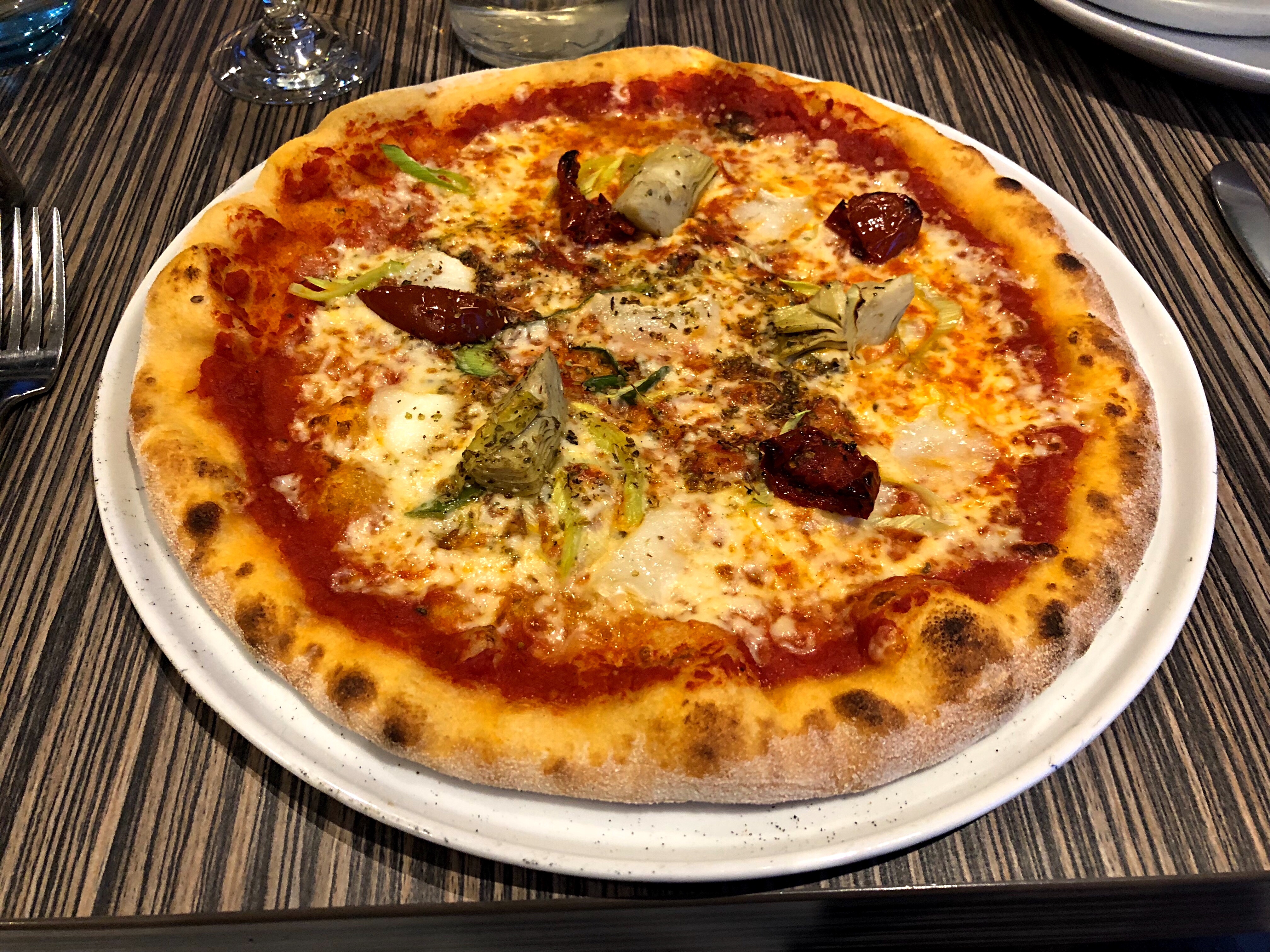
My main was better, although it still wasn’t anywhere near the best pizza in Reading. It had goats cheese (not enough), leeks, four bits of semi-dried tomatoes and three bits of artichoke. Like most of the other things at Cozze it wasn’t actively unpleasant, just objectionably unexceptional. I drizzled some chilli oil over it to try and make it taste of something. The chilli oil appeared to have very little chilli in it – crap as a condiment, perfect as an analogy.
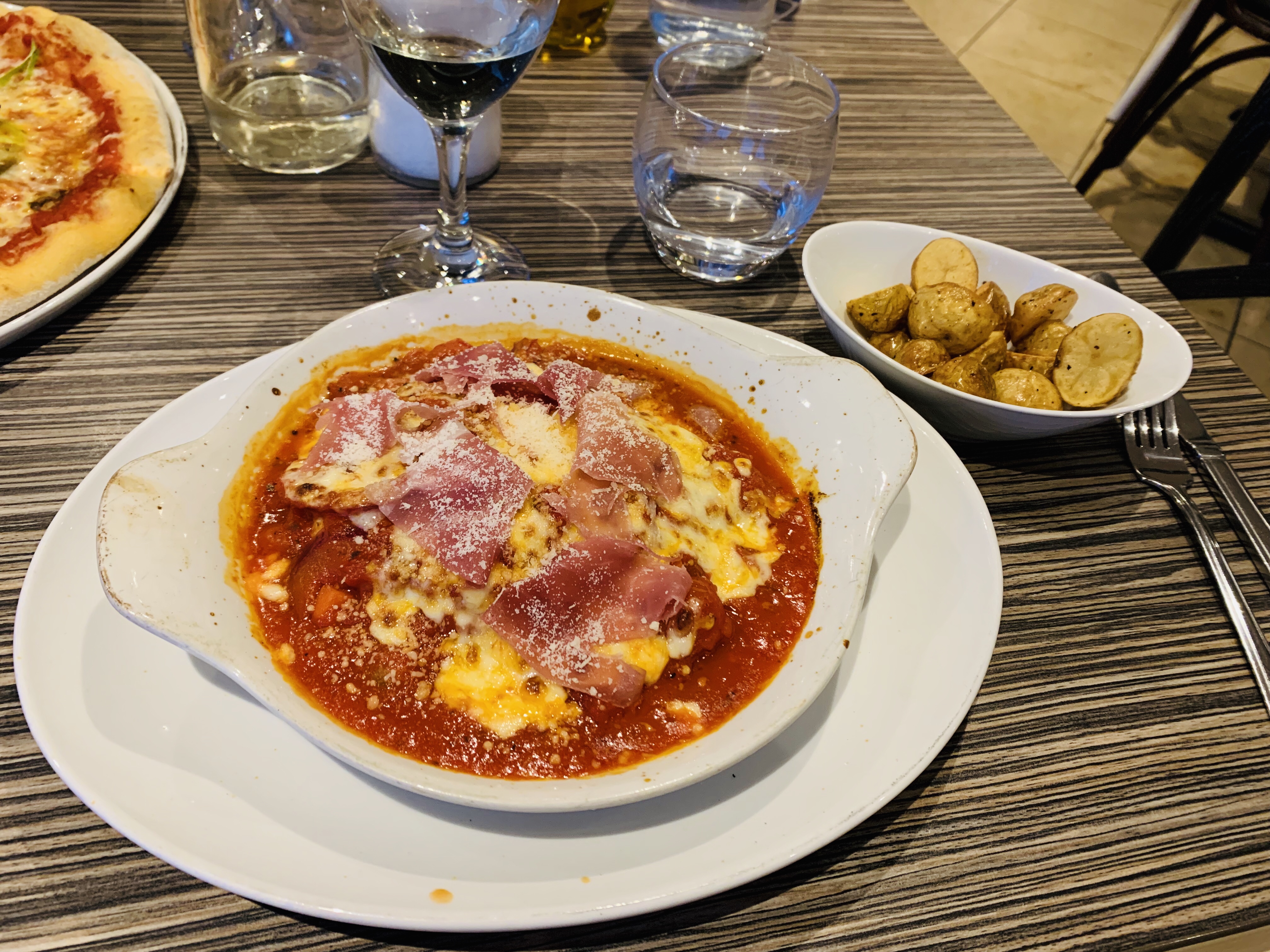
For completeness’ sake, before you or I drop off, I should also tell you about Zoë’s main course which was pollo prosciutto with pomodoro sauce and baby roast potatoes. Pepe Sale does a beautiful pollo prosciutto – a fillet wrapped in Parma ham and stuffed with cheese which you have with seasonal vegetables. It’s perfect: a few ingredients treated simply and with respect. For some reason, they choose not to drown it in chopped tomatoes and serve it in a bowl hotter than the sun like some kind of glorified ready meal. For some reason, Cozze does choose to do exactly that.
I had a mouthful and wasn’t clamouring for more. My advice, if you ever accidentally order this dish, is to eat it doing your very best to pretend you’re instead eating at Pepe Sale. But if your imagination is that good, you could probably enjoy eating pretty much anything. I used to have a brother in law with nasal polyps so bad he couldn’t taste anything: he’d probably quite like Cozze.
Don’t worry. We’re nearly there and our suffering is almost at an end. It just remains for me to tell you that we shared a five hundred millilitre carafe of Italian Sauvignon blanc which was slightly sweet and perfectly decent and that our meal came to fifty-six pounds, not including tip. That includes a discount because Cozze usually has offers through their website, so if you’re considering eating at Cozze you should definitely make use of them. Although if you’re considering eating at Cozze at this moment, I’ve probably failed as a restaurant reviewer.
You might feel that they caught me on a bad day. You might feel they’re unfortunate to be reviewed the week after I’ve written about eating in Bologna, having truly phenomenal pizza, pasta and gelato. And it’s not that Cozze is bad, to be fair. Nobody died, I wasn’t poisoned, nothing they do is inedible.
It’s just that if Cozze is that answer then “where can we go for dinner that nobody could possibly have any strong opinions about whatsoever?” is the question. The poverty of ambition is the thing I find a terrible shame. Although maybe that’s not fair either: Cozze aspires to mediocrity and, in that respect at least, it has to be considered a towering success. There are worse places to eat, of course. But there will always, easily, be somewhere far, far better.
Bologna is the city where I ran out of superlatives.
I’m used to picking city breaks on food and drink alone, doing plenty of research, booking restaurants and planning exactly where I’ll eat. I love traipsing round a cathedral, I like a gallery and I don’t mind a museum, but the food’s the thing I really make a pilgrimage for. And many of the cities still on my to do list are famous for their gastronomy – Lyon, for example, or San Sebastián. Bologna is in the same league, I think, and is a truly extraordinary place to eat and drink.
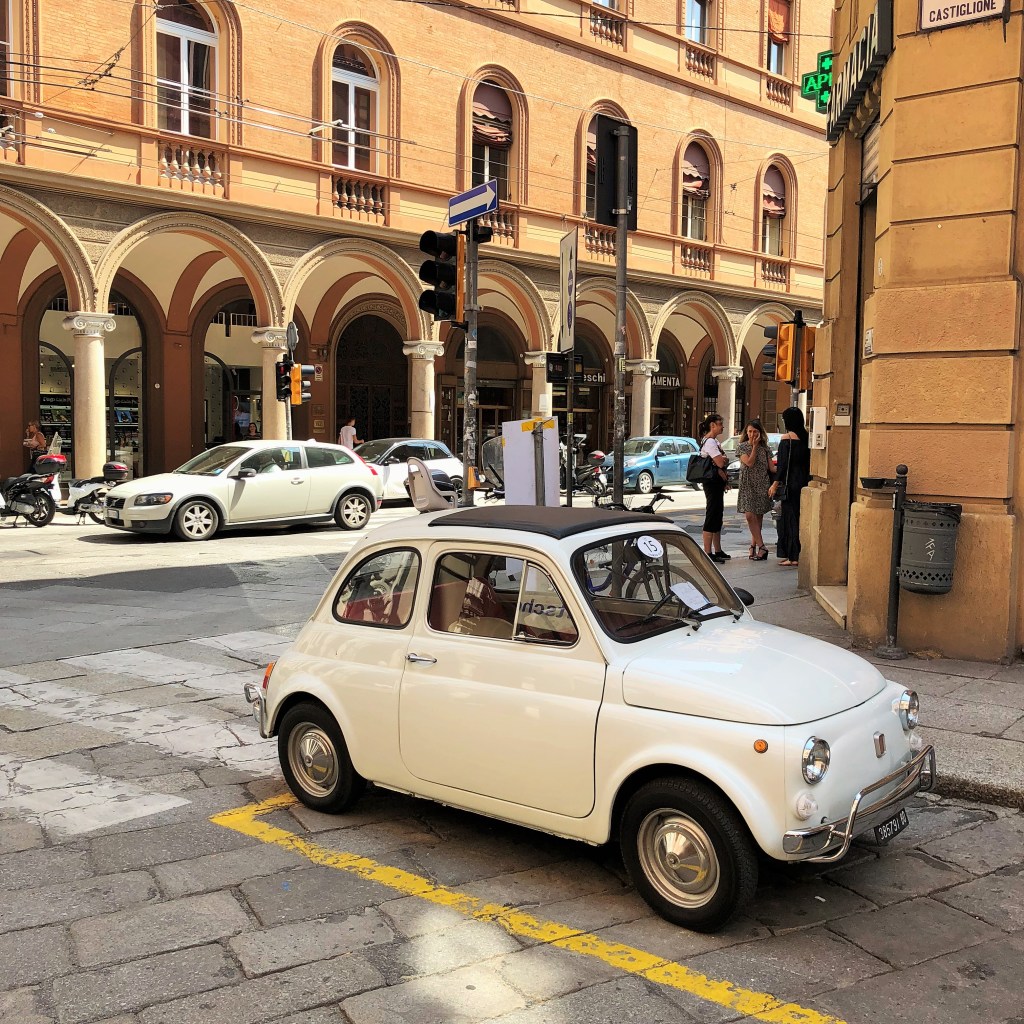
It’s beautiful, too. Miles of porticoes run throughout the city – some grand, some tatty but all offering shade when it’s sunny and shelter when it’s raining. The colour palette is like nowhere else I’ve visited – all reds, burnt oranges and dusky pinks. It’s a ridiculously photogenic place, but not picture-perfect and not remotely interested in being so pristine. It has far too much incredible life to it for that.
Bologna has many nicknames – la rossa, the red one, because of its red rooftops and communist history. La dotta, the learned one, because of its university, older even than Oxford. But more importantly, it’s called la grassa, the fat one, because it’s widely thought to be the gastronomic capital of Italy.
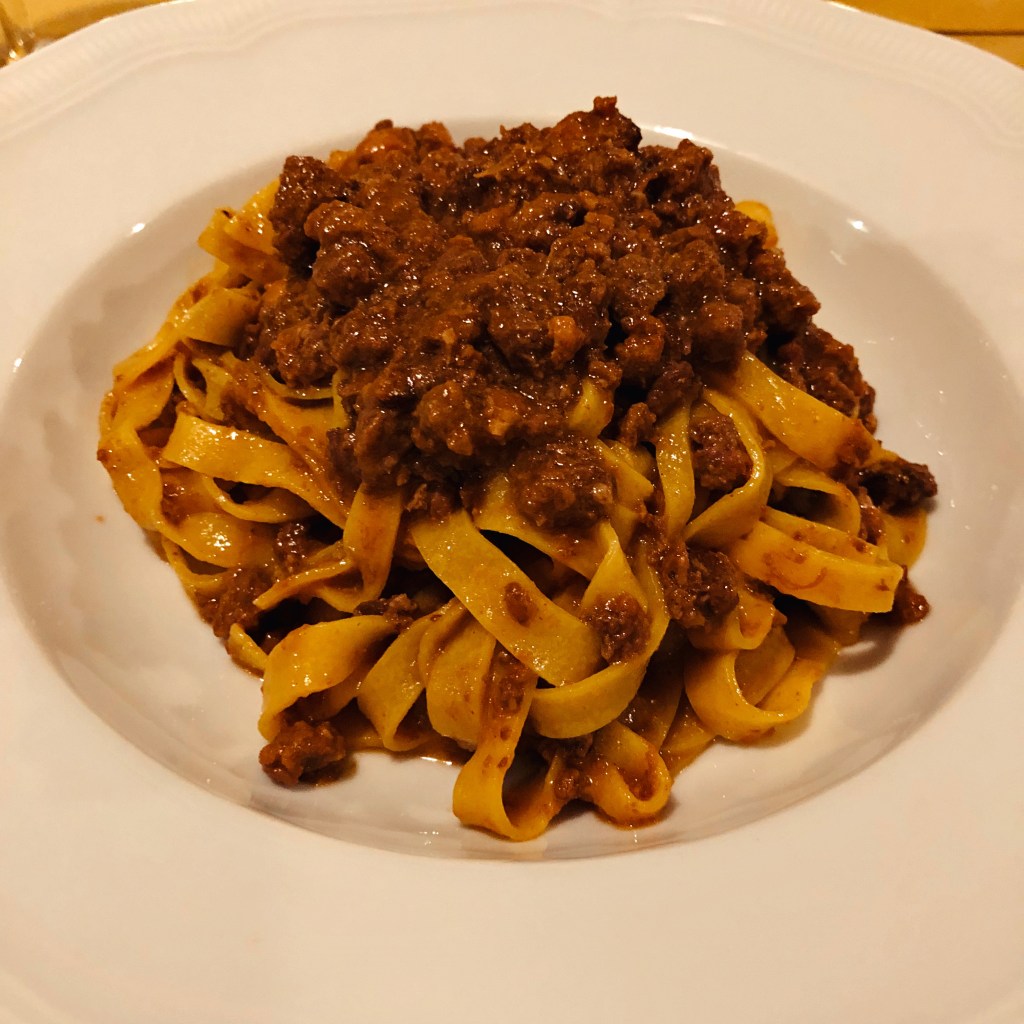
It’s in Emilia Romagna, the province of northern Italy responsible for Parma ham, Parmesan and balsamic vinegar. Bologna is also the place for pasta, whether that’s tagliatelle (never spaghetti) with rich ragu or tortellini in broth. And then there’s the local cheese, the mortadella, the wine, the growing craft beer scene; I’ve never been anywhere where food felt quite so front and centre in daily life, or anywhere where it was quite so easy to eat well.
It’s a real challenge to describe it without lurching into hyperbole, but what else can you do when you’ve eaten so many of your desert island dishes on one holiday? The best gelato, the best pasta, the best coffee… you come home feeling a little like you’ve gone from Technicolor to monochrome.
It’s not – at the moment, at least – a huge tourist destination: Rome, Florence and Venice are all far more fêted. But I loved it so much when I went last year that I went again this summer, and I loved it so much when I went this summer that I’m going again before the end of the year. If you’re considering a trip, I hope this list gives you some inspiration. Of course, once I come back from my next visit I might just have to add to it.
Where to eat and drink
1. Drogheria Della Rosa
I visited Drogheria Della Rosa on both my visits to Bologna and loved it both times although, on paper, it’s the kind of restaurant that could give buttoned-up Brits a panic attack. It’s a converted pharmacy, although generally you sit outside in the street enjoying the food, the buzz and the people-watching. The proprietor still stops at your table and asks what you want and – this is the bit which I found unnerving the first time – there’s no printed menu, wine list or prices anywhere to be seen.
Anyway, you soon get past that and everything I had there was terrific, from the ubiquitous tagliatelle al ragu to a veal dish my friend Al and I still rhapsodise over two years later (it wasn’t on offer on my second visit, to my eternal disappointment).
When you ask for a dessert wine they just bring over a bottle of Marsala and some glasses and leave you to it, another experience which is more fun the second time when you have a good idea how much the bill is going to be. But perhaps the best thing about Drogheria Della Rosa was the dessert – one of the simplest and cleanest I’ve ever eaten, a shallow bowl of pure, fresh mascarpone topped with top-quality grated chocolate. I daydream about that from time to time. I was having far too much fun to remember the size of the bill either time, but with a bottle of wine I don’t think it was far north of fifty Euros.
Drogheria Della Rosa, Via Cartoleria 10
2. Osteria Bottega
Osteria Bottega was probably the best of the many old-school restaurants I’ve tried in Bologna. I felt less likely to run into a group of Americans at an adjacent table (and they only had one person on the wait staff who spoke English) but if anything that made the whole thing more of a treat. It’s a nice, tasteful, reasonably basic room but the food is what stayed with me about my visit.
I picked this restaurant after a writeup on Andy Hayler’s blog. He’s an idiosyncratic reviewer – I always feel like he’s auditing rather than reviewing a restaurant – but he indisputably knows his onions and Osteria Bottega didn’t let me down. We started with a plate of aged culatello which could have matched any jamon iberico in Spain, served with slices of apple (a revelation) and plenty of Parmesan, because Parmesan is in plentiful supply in Bologna.
They just leave the bowl at your table, in fact – so unlike the stinginess here in Blighty – which enables you to finally work out the answer to the question how much Parmesan is too much Parmesan? (not that I ever reached a conclusive view on that).
It comes in especially handy with the tagliatelle al ragu, which was the best I had in Bologna – so intensely savoury, so rich, over so soon. Hayler says it’s a mixture of beef and pork leg that’s been cooked over an open fire, and he is the kind of man to check that sort of thing. Either way, I thought it was magnificent. The rest of the meal, for me, was marred by veal envy – my dining companion committed the unpardonable sin of ordering better than I did – but my rabbit porchetta was still a beautiful thing, even if it didn’t quite live up to the promise of the juxtaposition of those two words.
Osteria Bottega, Via Santa Caterina 51
3. La Verace
Another tip from Andy Hayler, La Verace is right on the edge of the city centre, not far from MAMbo, the modern art gallery. The gallery, like so many modern art galleries I’ve experienced on my trips to European cities, puts the f into art and isn’t necessarily worth visiting. La Verace, on the other hand, is well worth a detour.
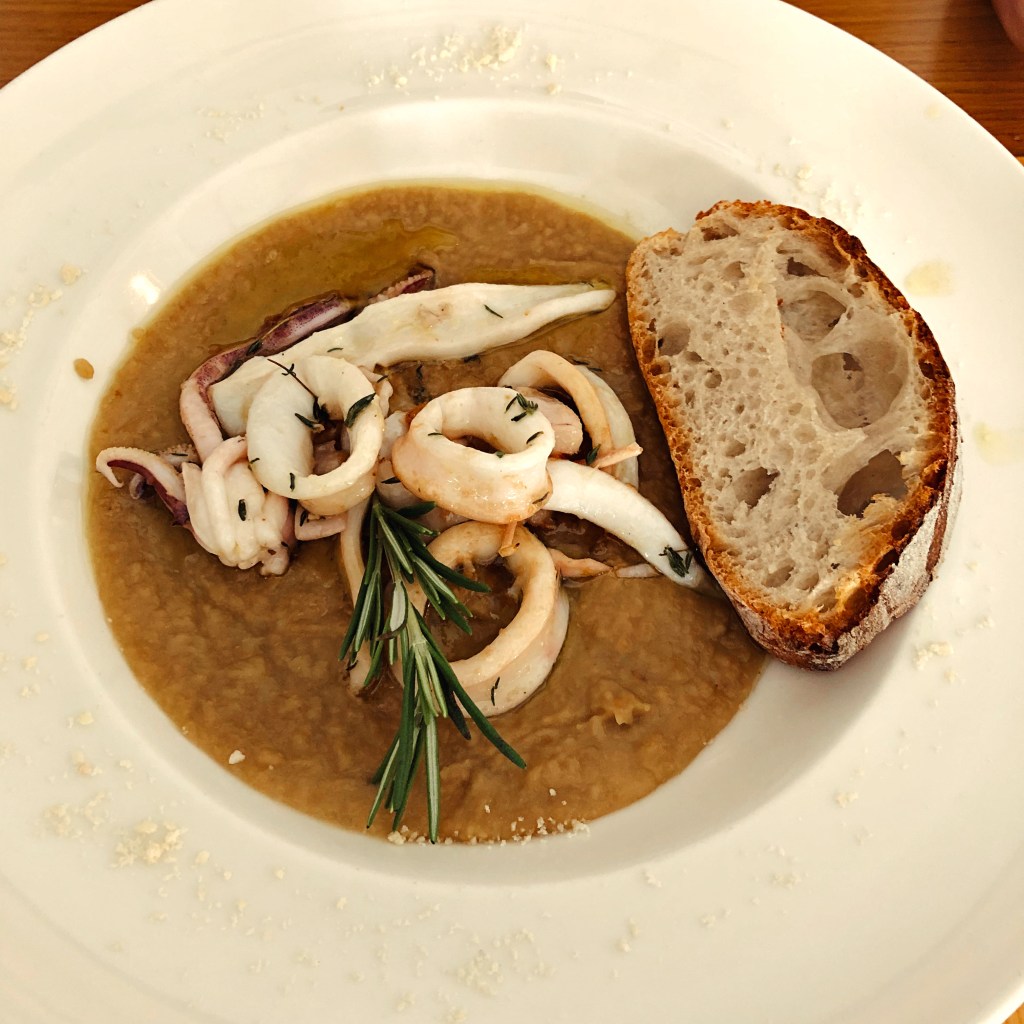
I came for the pizza and it truly was one of the finest I’ve had, with a perfect crust and a rich, almost fragrant tomato sauce. But actually, all the other dishes were even better – especially shedloads of tender squid served on a deep, earthy chickpea purée. I still occasionally go on – to anybody who will listen – about the oven roasted potatoes, salty and fatty with a slightly medicinal tinge of rosemary: one of the cheapest things I ate in Bologna and easily one of the most memorable.
Next time I’ll keep away from the pizzas and explore the rest of the menu: I suspect there are more works of art in it than you’ll find round the corner.
La Verace, Via Cairoli 10
4. Scacco Matto
It’s very difficult to have a bad meal in Bologna (I never managed it), and the majority of restaurants I ate in were brilliant and accomplished but resolutely unshowy. There’s an awful lot to be said for that, but if you do want to try something more cheffy and ambitious Scacco Matto is the place for you.
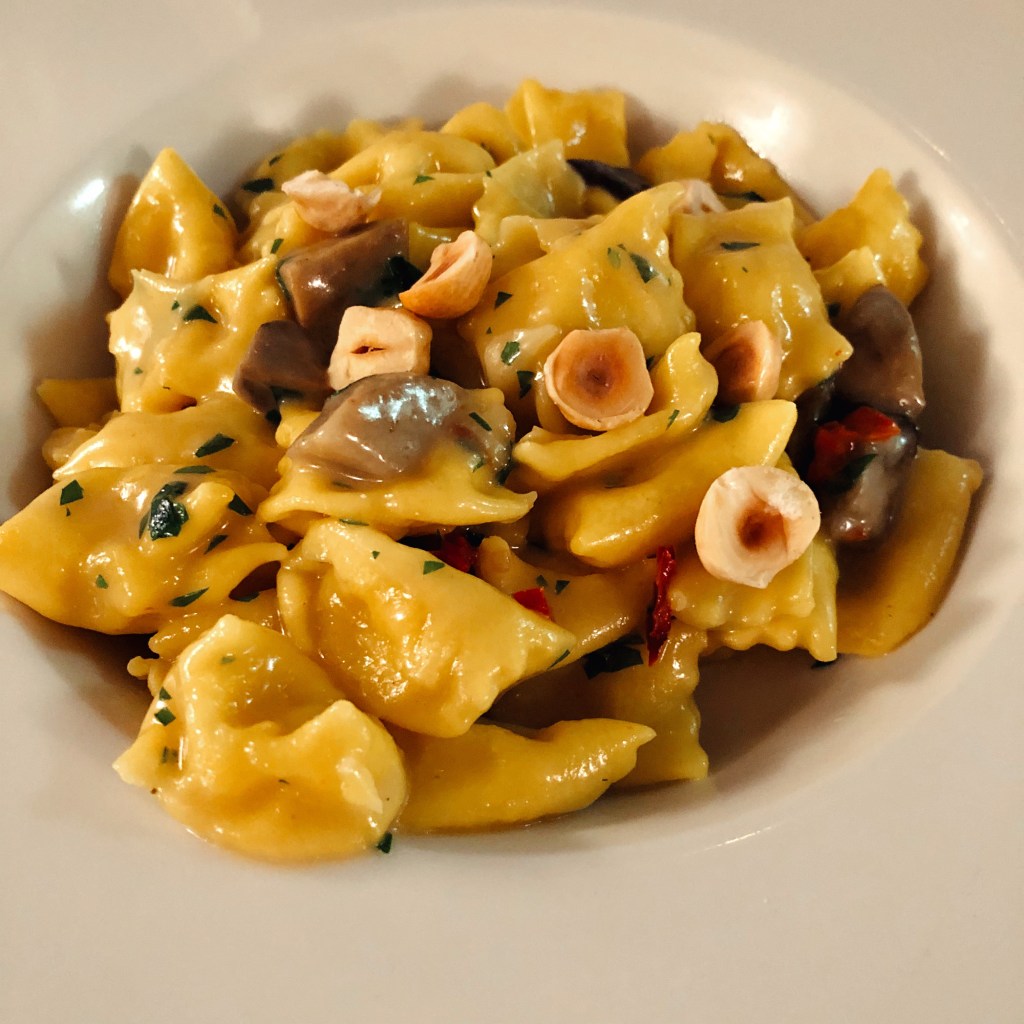
I went there after watching Rick Stein, on his Long Weekends programme, eating Scacco Matto’s plin, ravioli filled with sweet onion and Parmesan, glossy with butter and served with thick slices of wild mushroom and hazelnuts. I’ve ordered it on both my visits to Scacco Matto and it’s a death row dream of a dish, a dish with a half-life where you eventually keep eating half of what’s left, hoping you can somehow cheat the laws of the universe and make it last forever.
But other dishes are available, and they’re every bit as good. On my last visit I ate a single squid, scattered with peas and broad beans, resting on a thick slab of pork, in the same breathless rapture. I finished off with two beautifully rare tranches of tuna with ginger and mange tout, a dish with roots a long way from Emilia Romagna but somehow completely at home here.
When my friends and I all ordered the plin the waiter smiled and said “Rick Stein?” and I thought how nice it was to take someone else’s restaurant advice for a change. It’s hard to imagine a visit to Bologna where I didn’t eat at this restaurant – and if you want a pre or post-dinner drink Birra Cerqua, one of Bologna’s preeminent craft beer brewpubs, is two minutes down the road.
Scacco Matto, Via Brocaindosso 63
5. Sette Tavoli
I heard lots of recommendations for Sette Tavoli but, shamefully, the main reason I chose it was that it could be booked online (not all Bologna restaurants have embraced the Internet). It gets its name from only having seven tables inside, although on the day I ate there it was hot as balls (during the mini heatwave at the end of June) so we were out on the portico, trying to look unruffled, John Lewis portable fans whirring away like billy-o.
It has an attractive, short a la carte menu or you can pick one of two tasting menus centred around meat or fish. We went for the latter, accompanied with a very cold and crisp local white wine, and it was a properly lovely meal.
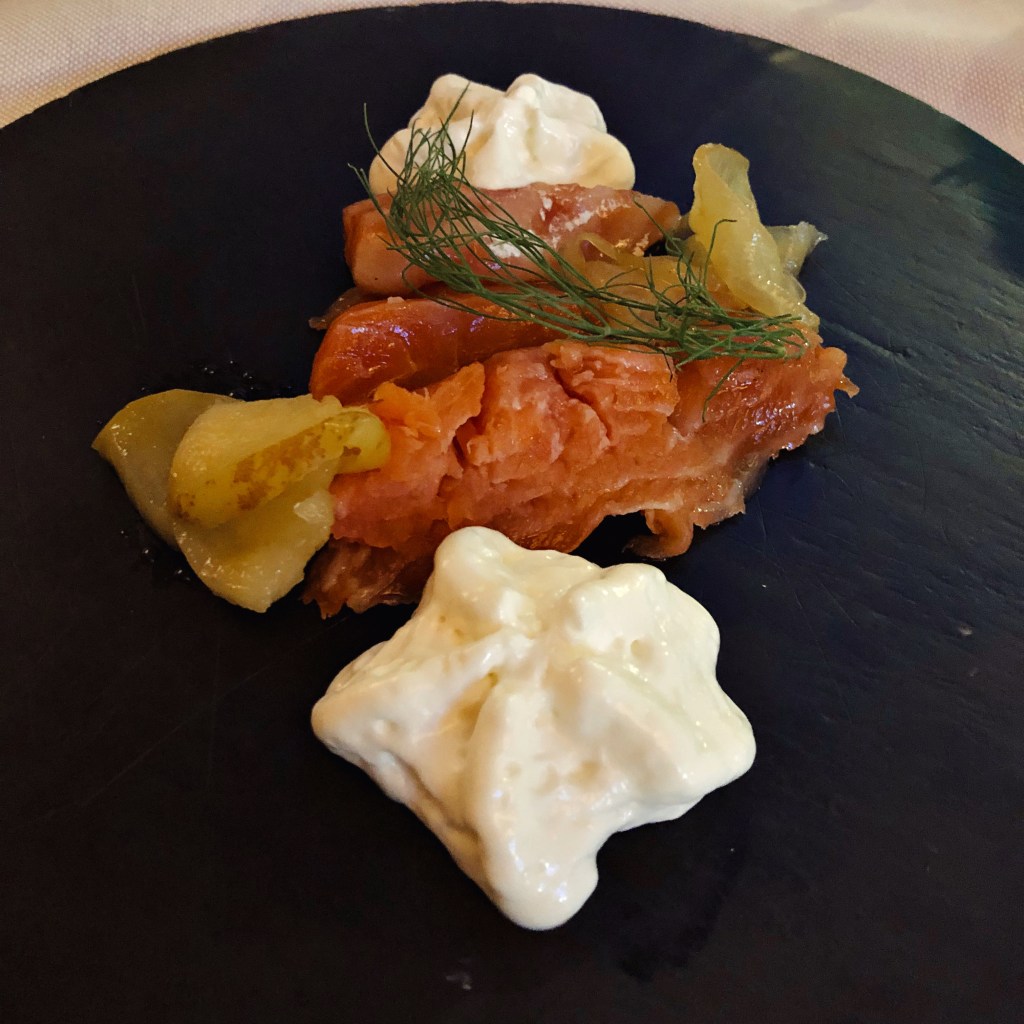
I enjoyed the fish encrusted in pistachio, served with a sweet and crunchy fennel salad, a clever bit of cooking on a dish delivered with minimum fuss or fannying about. But my absolute favourite was smoked salmon with ultra-caramelised onions and spuma di patate – the texture of creme fraiche but the distilled taste of spud at its most elemental. Nothing especially Italian about it, but who cares? It was nothing short of a magic trick, and yet another dish (Bologna is packed with them) that we talked about for days.
Sette Tavoli, Via Cartoleria 15/2
6. Simoni
One of the best things in Bologna is the Quadrilatero, the grid of streets just off Piazza Maggiore full of stalls selling pasta, cheese, meat, fish, fruit and vegetables. And, for me, one of the best things in the Quadrilatero is Simoni – if you get there early enough at lunchtime you can grab one of the tables outside, order a bottle of Lambrusco (the local wine which is red, chilled and therefore nothing like any Lambrusco you might have experienced at home) and make inroads into a menu full of cheese, charcuterie and bread. It truly is a happy place for me.
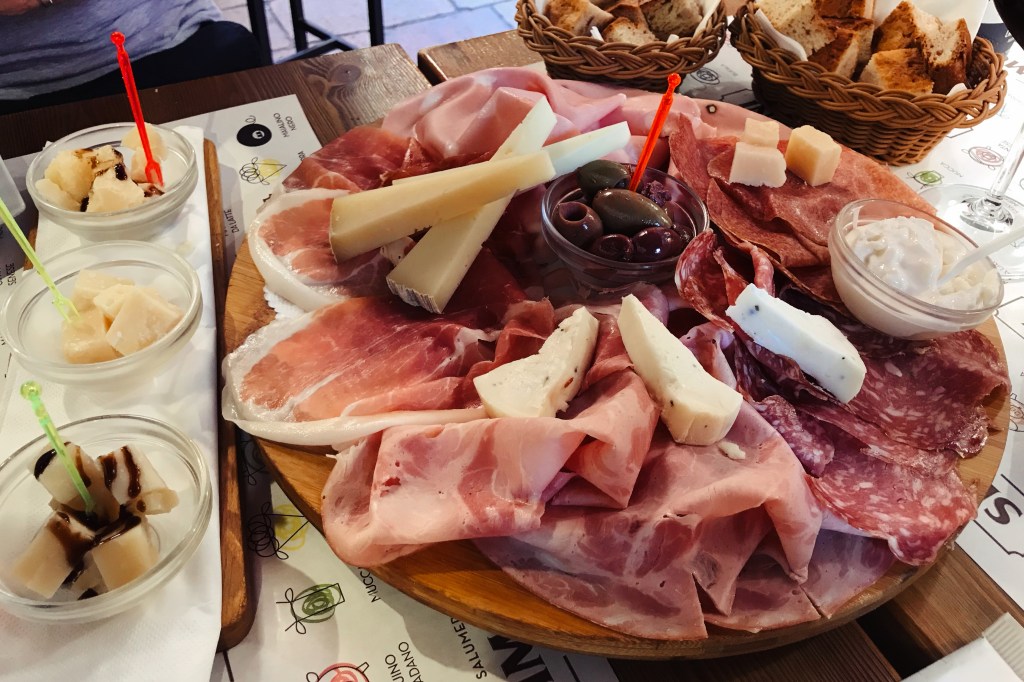
On a previous visit my friends and I demolished a selection of charcuterie and cheese – salami, Parma ham, a bunch of delicious cheeses whose names escape me and mortadella, the signature meat of Bologna which you have to try even if, like me, you have a vague suspicion of unreally-pink mystery meat. But on my most recent trip it was all about bread – first, squares of focaccia filled with beautiful scquacquerone, a gooey fresh local cheese a bit like the shapeless heart of burrata.
Even better was the porchetta panino, a beautiful thing stuffed with salty, fatty pork and studded with caperberries adding just enough acidity for contrast. Panini in the U.K. are just the way our awful coffee chains flog you a gooey, unremarkable toasted sandwich: having the real thing in Bologna was a true revelation. Either way, make sure you keep room for the tasting selection of Parmesan so you can try it aged for 18, 24 and 36 months: if nothing else, it will help you decide which kind to buy and cram into your suitcase on the way home.
Simoni, Via Pescherie Vecchie, 3/b
7. Cremeria Cavour
Pretty much any of the gelato you can eat in Bologna will ruin most U.K. ice cream for you for life (although I still have a soft spot for Jude’s salted caramel – available at Fidget & Bob and Nirvana Spa, fact fans). I made it a personal crusade to try as many places as I could: I loved Sorbetti Castiglione, just up the road from my Airbnb which did a fantastic gianduja gelato. I adored Il Gelatauro, where I managed to eat gelato and then follow it up with an affogato which was both enormous and itself 90% gelato – either a career best or a new low, depending on how you feel about gluttony.
But my favourite was the chi-chi Cremeria Cavour (which, confusingly, had changed its name since my first visit last year). Every single flavour I had was beautiful, from pistachio to fior di panna – pure cream, unadultered with vanilla or anything else. On my last visit I developed a serious addiction to their rum and chocolate gelato, one which can only be managed with further visits to Bologna. Sitting on a bench in Piazza Cavour eating gelato would, in most cities, be the standout gastronomic experience of a holiday but in Bologna, it has to settle for being first among equals.
Cremeria Cavour, Piazza Cavour 1D
8. Aroma
You’re not going to struggle for good coffee in Bologna, wherever you go. My weakness – which I was introduced to by my friend Al – is caffè al ginseng, which is hot, sweet, milky, comes out of a machine and would probably offend coffee purists everywhere.
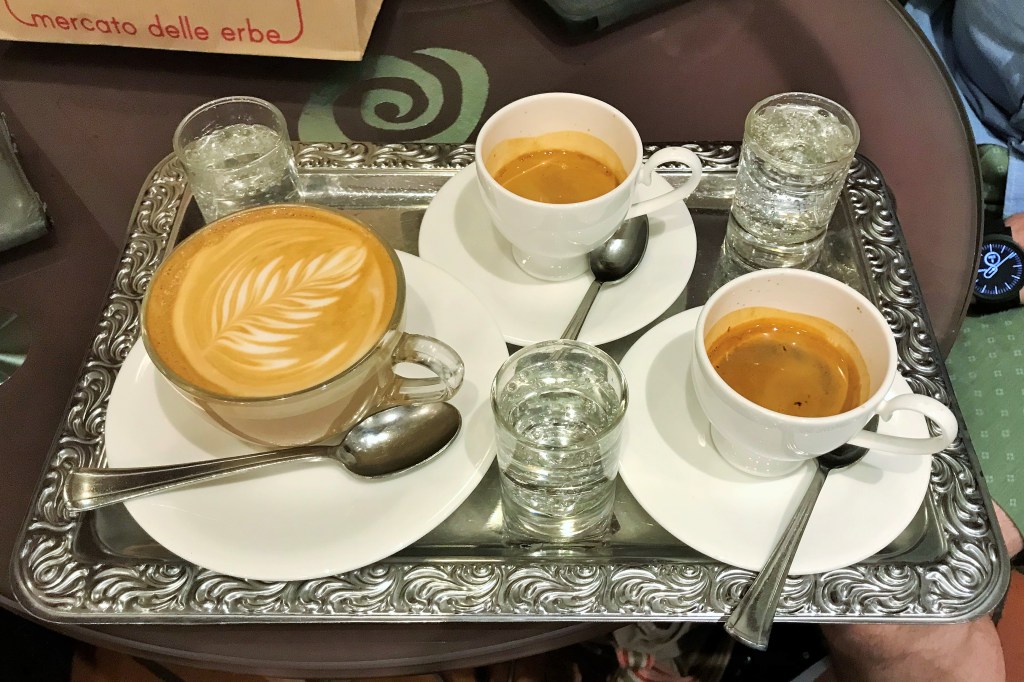
Personally I often think the most fun you can have with a purist comes from irritating them. But if you are in the mood to try a more rarified coffee, head to Aroma. The interior is dark and, dare I say it, a tad dated, but the staff are fantastic and friendly, speak brilliant English and serve possibly the best coffee I’ve ever tasted. My friend Al sipped his espresso, gave a sigh which was 50% whispered prayer and 50% happy finish, and immediately ordered a latte so he could check whether it was as good. It was.
Aroma, Via Porta Nova 12/b
9. Camera A Sud
Pubs are wonderful things, but there is something about a properly great bar that is truly transcendental. I’m always on the lookout for them on the continent and some of my favourites – Ghent’s Gitane, Granada’s Potemkin, Porto’s Café Candelabro – are, to my mind, reason enough to visit their parent cities.
A truly great bar is a little scruffy and bohemian but never dirty. It has a hangdog charm that you simply can’t manufacture or fake, and we aficionados can always sniff out a fake (we get lots of practice in Britain, which so rarely gets bars right). It feels like a place you could nurse a coffee in the morning, enjoy lunch, drink before dinner or booze late into the night.
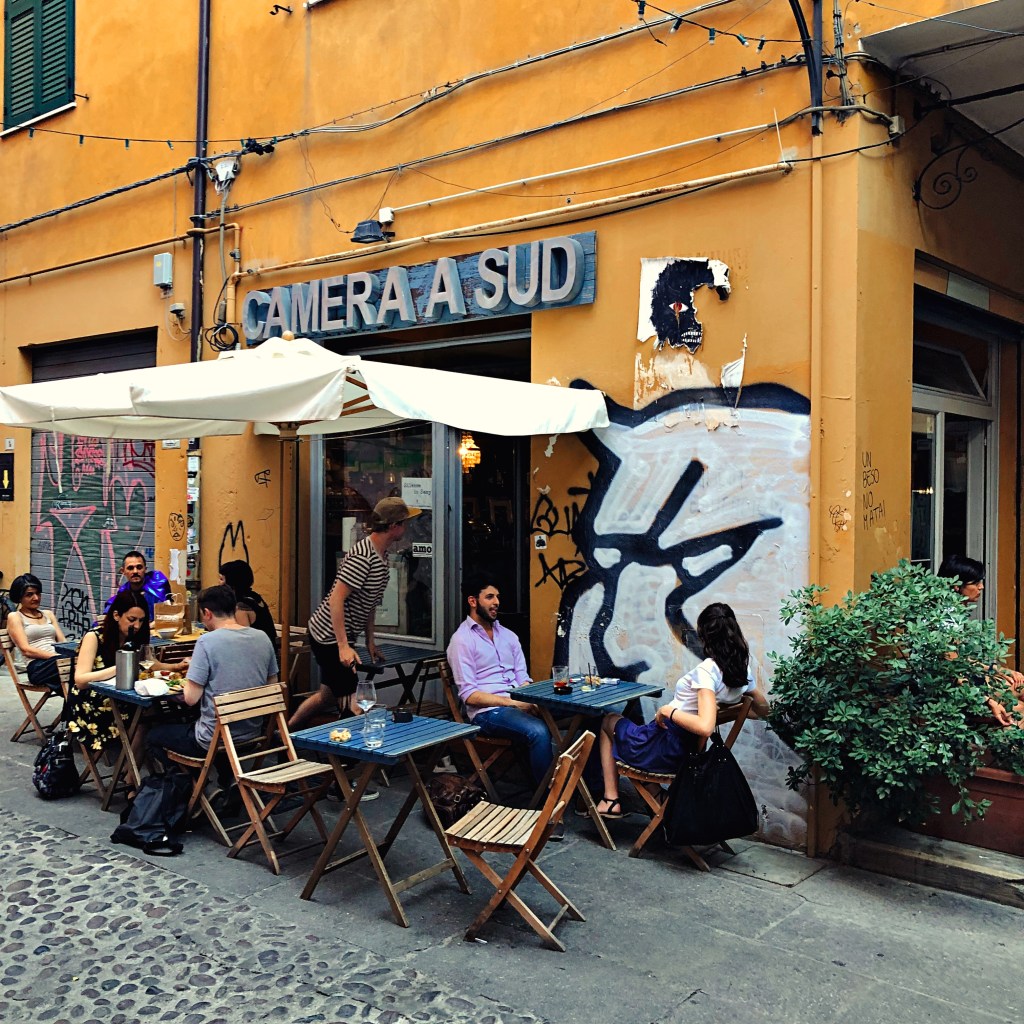
In Bologna, Camera A Sud was that bar. It was perfect for aperitivi, whether that was a perfectly cold beer, a glass of white or countless day-glo Aperol spritzes. The inside was scuzzy but uncalculated but sitting outside, as the shadows lengthened and people wandered past, was the perfect place to be.
Not only that, but the food was brilliant. Not a lot of cooking was involved, but the selection of salumi and mortadella wasn’t a million of miles from the quality at Simoni. The bruschetta – mozzarella and anchovy elevated by the genius addition of orange zest – was the kind of bar snack only a bar in Bologna would think of: I sent a picture to my friend Al and he recreated it at home the very next day.
The area around Camera A Sud is full of street art and intimidatingly fashionable, dishevelled people, beautifully boho and worth a wander, either with a camera or just with your eyes wide open. Just round the corner is another terrific-looking place called Caffè Rubik: I’ve made a note of it and I’ll try it next time, just in case it’s even closer to the Platonic ideal of the perfect bar.
Camera A Sud, Via Valdonica 5
10. Astral Beers
Both times I’ve visited Bologna I have been in the company of craft beer enthusiasts: Bologna is also at the centre of Italy’s burgeoning craft beer scene, and so there are plenty of places to try. More, in truth, than I have the stomach for, so I slightly lost interest in sitting on the pavement outside a place called Beer For Bunnies surrounded by the bearded and tattooed drinking something expensive and agricultural when I’d rather have been enjoying a really good glass of wine.
That said, some places were more my kind of thing. Birra Cerqua, which I mentioned earlier, was very nice indeed and Birra Baladin (which has a bar inside the Mercato Di Mezzo) makes some beautiful and unusual stuff. But my favourite was Astral Beers, not far from the famous towers, which felt a bit more grown up, a little less chin-strokingly post-rock and a lot more interested in being a bar where everybody could find something to enjoy.
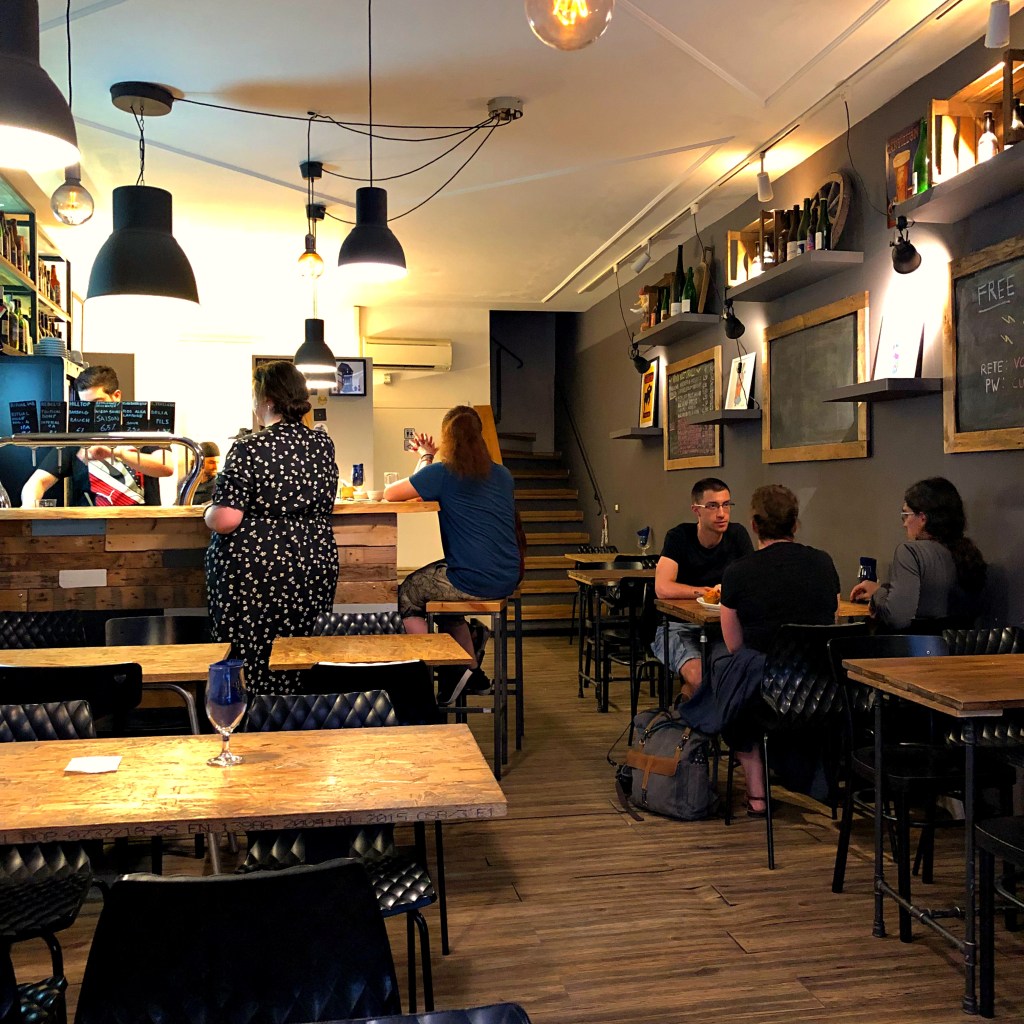
The staff at Astral Beers have more than enough enthusiasm for their stuff to bridge any language gap, and I really liked all of the Italian beers I had there, whether they were more conventional Pilsners or some very striking sours. It has some tables outside but the inside feels more grown up than many craft beer places I’ve been to – which, like craft coffee places, can sometimes feel like a temple to chipboard. They also did some lovely, affordable and in some cases biodynamic wines.
I never ate there, but the dishes I watched arriving at other tables looked good enough to give me pre-dinner food envy. Happily, it only ever lasted as long as my walk to the next restaurant.
Astral Beers, Via Castiglione 13/B
11. Osteria Del Sole
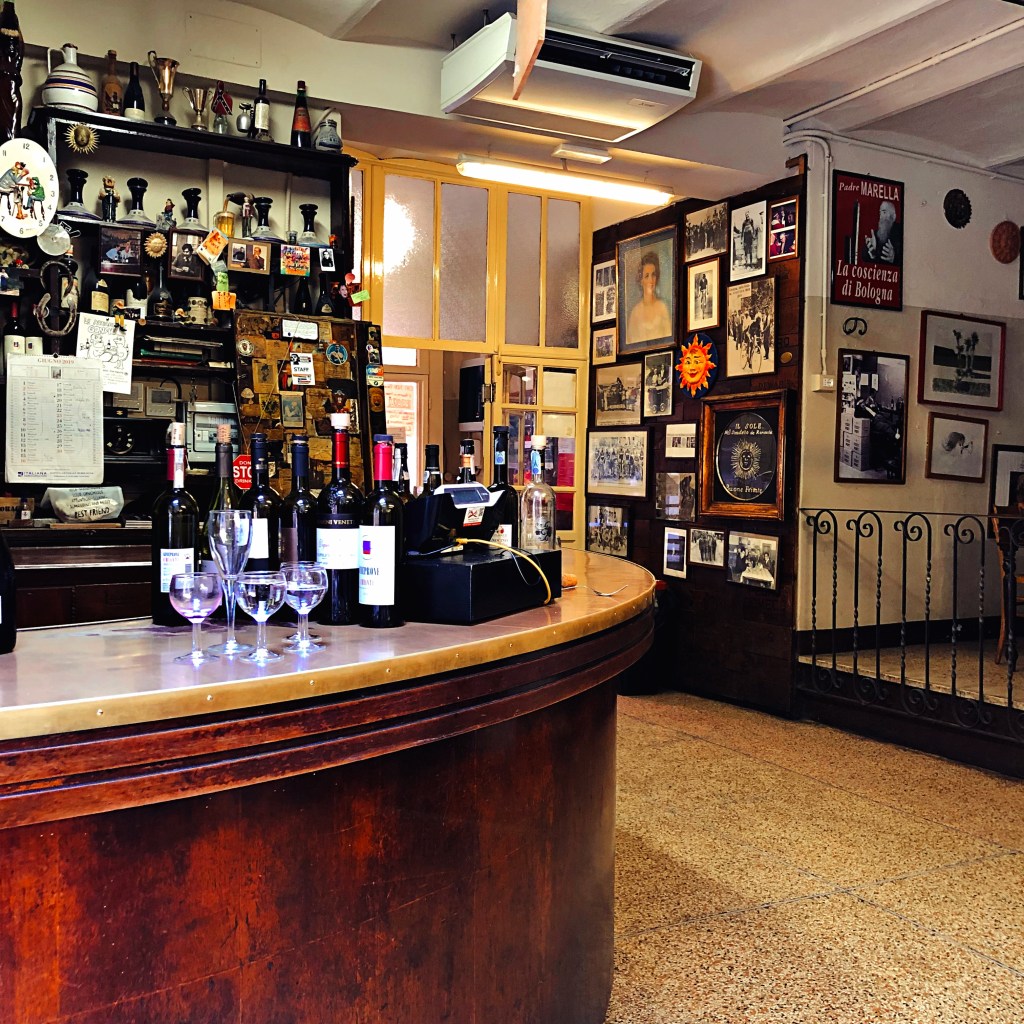
Confusingly, Osteria Del Sole isn’t really an osteria and doesn’t do any food. What it is, quite magnificently, is Bologna’s most venerable bar and dangerously close to an Italian take on an old man pub. The wine by the glass is perfectly pleasant – it’s a good place to try Pignoletto, the local sparkling white – and the Menebrea by the bottle is also serviceable, but really the atmosphere is the thing here. There’s also a little courtyard, although it lacks the battered grandeur of the interior.
Every time I’ve been, confusingly, many of the tables have been reserved (something which would never catch on in a British pub), but you can usually find some space. It has to be done, if just the once, and makes for a nice early afternoon pit stop before returning to the bustle, sights and sounds of the Quadrilatero.
Osteria Del Sole, Vicolo Ranocchi 1/D
12. Mercato di Mezzo and Mercato delle Erbe
A bit of a cheat lumping both these markets in the same entry, but both are absolutely worth a visit.
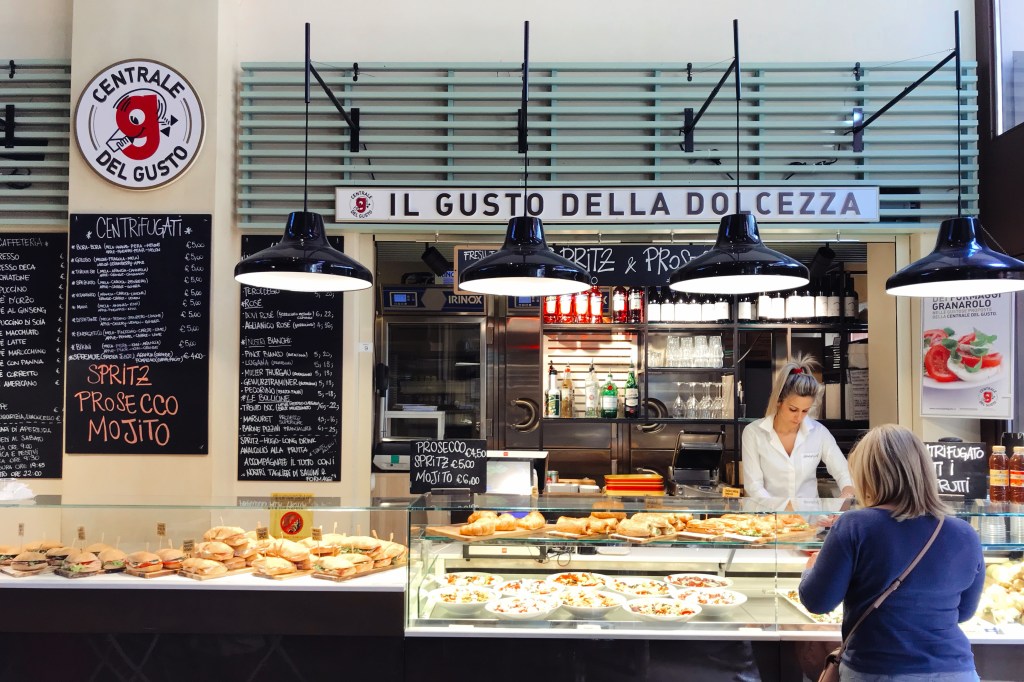
Mercato di Mezzo, in the Quadrilatero, is more like Market Halls Victoria (or what Reading’s own Market House desperately wishes it was), an indoor market with food vendors along both sides and communal tables in the middle. Everything I’ve eaten from there has been brilliant, whether it’s pasta accompanied with a local beer from Baladin, a slice of pizza grabbed on the run to munch on the way through the streets or a caffè al ginseng and a croissant packed with indulgent pistachio cream first thing in the morning. Visit, if only to see how far Reading has to go to even attempt to recapture the buzz of such a place done well.
By contrast, the Mercato delle Erbe – on the splendidly named Via Ugo Bassi – has a conventional market at its heart selling all sorts of wonderful fruit, vegetables fish and what have you (I picked up some fantastic truffle sauce on my first visit) and then, around the edges, there are lots of little restaurants with their own seating. I enjoyed a fantastic range of bruschetta on one visit, on another I went to Polpette E Crescentine, which does exactly what it says on the tin.
There are also some lovely bars where you can sit with a pre-dinner spritz, wondering whether snaffling a square of pizza would ruin your appetite and, just as importantly, whether it would be worth it (on balance, probably not, but you usually work that out the hard way).
Finally, it wouldn’t be a holiday without a souvenir. I always make sure I head to Formaggeria Barbieri in the Mercato delle Erbe, where they are wonderfully helpful and will vacuum-pack you massive pieces of Parmesan for your flight home. I managed to bring back two and a half kilos on my last trip (twenty-four month aged for everyday grating and forty month aged for best) and they even gave me a snazzy red tote bag which I prize far more than I probably should.
Mercato di Mezzo, Via Clavature 12 Mercato delle Erbe, Via Ugo Bassi 25
Since January 2025, Edible Reading is partly supported by subscribers – click here if you want to read more about that, or click below to subscribe. By doing so you enable me to carry on doing what I do, and you also get access to subscriber only content. Whether you’re a subscriber or not, thanks for reading.