Restaurant review: Django’s Smokehouse, Didcot

Right, let’s hear it: did any of you have Didcot in the sweepstake? Thought not, which means that the jackpot rolls over for another week. Same time next Friday?

So yes, a curveball. A review from Didcot today. And I know that the obvious response from many of you will be why Didcot? To which I would answer, Why not? After all, it’s a mere thirteen minutes from Reading on regular fast trains, making it as easily accessible as the likes of Wokingham, and Maidenhead – both of which have featured on this blog more than once – and far easier to get to than Henley or Oxford.

I know that many people have bought tickets to Didcot Parkway without ever alighting to the platform, because it’s nothing if not a sweet spot for split ticketing, but who among us has ever ended our journey there and had a look around? But it would be worth it if Didcot was harbouring a terrific restaurant that justified an expedition, so the real question isn’t Why Didcot? but Is Django’s Smokehouse such a restaurant?

Django’s Smokehouse has a curious origin story. The building was the home of a Chinese restaurant called Chopsticks for over 20 years, and when Chopsticks’ owner tried to hand the business over to her son, 26-year-old Andy Lai, he decided that he wanted to turn it into a smokehouse. The idea had marinated with him throughout lockdown, and in 2022 Django’s Smokehouse opened its doors.

You could say it was a risk, but Lai was convinced he was on to something. Didcot was on the up, he thought – “in five years’ time people won’t recognise Didcot”, he said – and his experience of food festivals made him think that American barbecue was just the thing to fuel the town’s ascent. And he might have had a point, because this summer Django’s won Best International Restaurant at the 2026 Ox In A Box Awards, beating a very accomplished field including Oxford heavyweights Spiced Roots and Antep Kitchen, both of which I’ve reviewed.

Now, those awards are voted for by the public, and I’ve always been a little sceptical of those – I’m thinking of the massive annual data gathering exercise conducted by Prosecco-gargling permagrifters Muddy Stilettos here – but the fact remains that these particular awards receive tens of thousands of votes, and for a relatively unsung spot in Didcot of all places, which hasn’t even been reviewed by the local media, to come out on top points to a devoted fan following. It was enough for me, so on a cold and muggy Tuesday night I hopped on a train to Didcot, my unsplit ticket in my Apple Wallet.

I had no idea what the centre of Didcot would be like, and having now visited I consider myself none the wiser. The stroll from the train station into town felt strangely disconnected from civilisation and then suddenly I found myself walking along the perimeter of the Orchard Centre, Didcot’s answer to the Lexicon or the Westgate. The Christmas illuminations were up but unlit on Orchard Street, the pubs were done up for Halloween: retail and hospitality, I find, are annoyingly good at making you realise the year is drawing to a close.

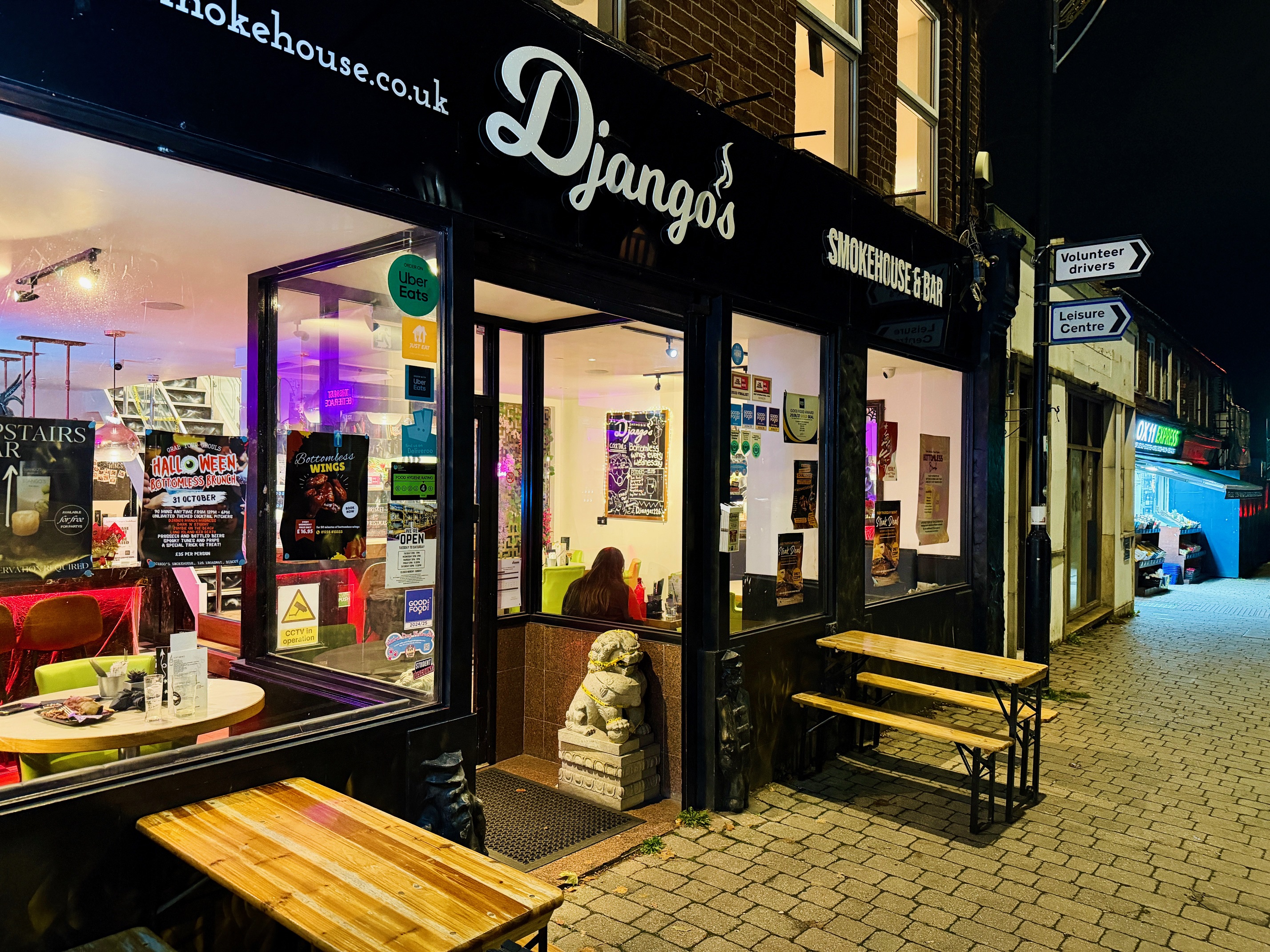
Everything I passed made for a strange hotchpotch: a massive Cineworld and the swanky arts centre on one side of the road (it closes at 8.30pm), the biggest branch of Boswell’s I’ve ever seen and a very upmarket-looking outpost of Crispy Dosa on the other with, just after it, a colossal Ladbroke’s. It seemed as if all the buildings were on shuffle, and rounding the corner to approach Django’s Smokehouse I had to walk past a sizeable branch of PureGym. That felt like trolling, every bit as much as watching people take their driving lessons on the street where I live.

The welcome inside was warm and immediate, and made me feel less ridiculous about my pre-reserved table for one. It’s a big restaurant, when it needs to be: 150 covers across two floors, with a big dining room out back and another upstairs. The wall of the back room displayed Polaroids of customers who’ve passed and failed the restaurant’s “Danger Wings” challenge: Django’s website has a similar gallery for another of its eating challenges, featuring people who have gamely agreed for the restaurant to capture their attempts to clear their plates – successfully or less so – for posterity.

But on a Tuesday night, that shrunk down to the homely. All the customers there during my visit were in the front room, which was a surprisingly agreeable place to be. I was seated in the window looking in, at a table bigger than I needed, but there was a cosy and likeable feel to it. The cobwebs were up for spooky season, their award was proudly on display and menus advertised a Halloween bottomless brunch and “brisket for Christmas”. I liked it there, although that cosiness dissipated somewhat when a Deliveroo driver came in and the door behind him took ages to close.
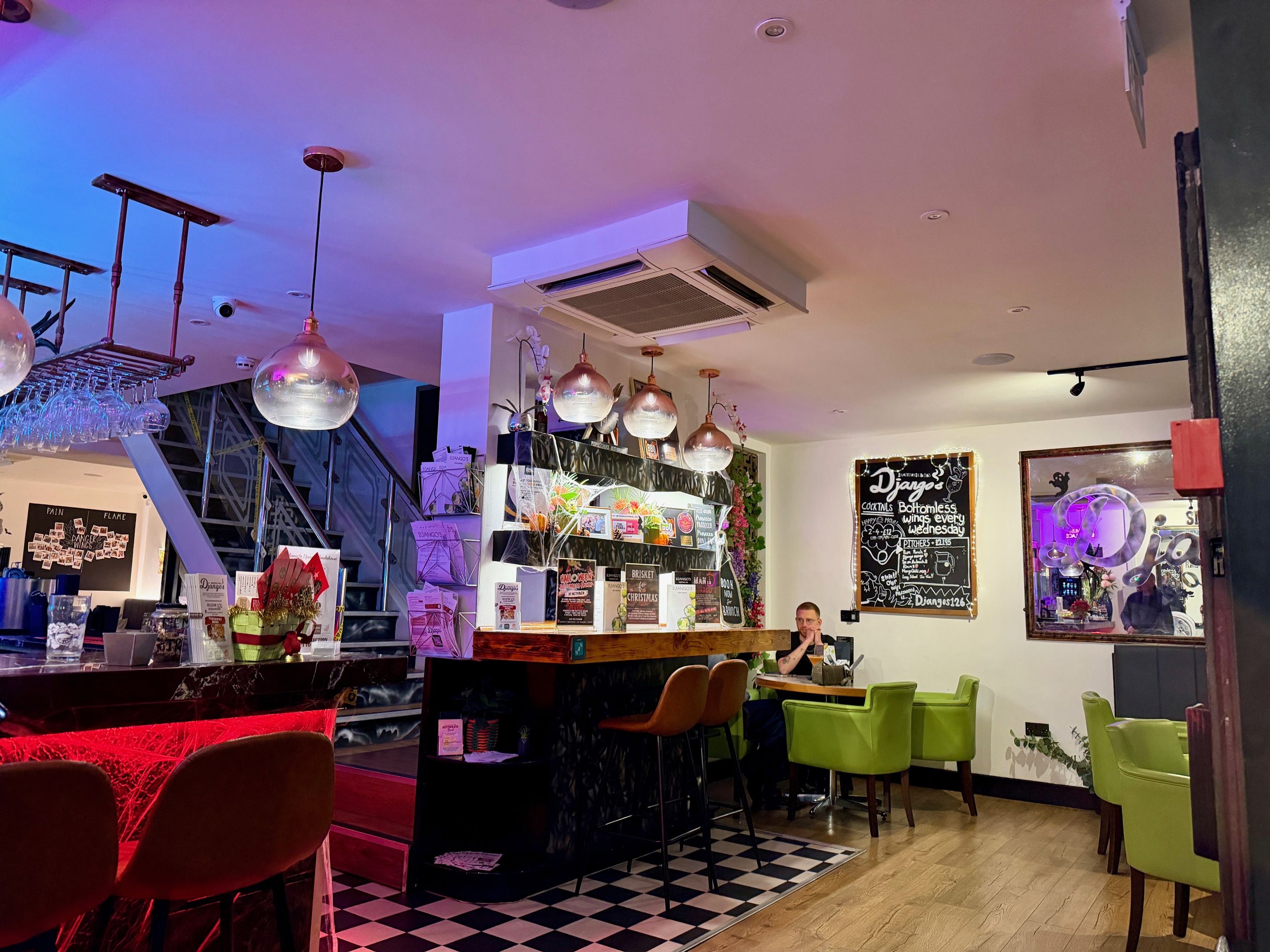
That evening my company was a couple of tables for two and another lone diner, also with a reservation. I wonder if she was writing a blog, too. And like I said, service was just pitch perfect from beginning to end: I have a soft spot for anybody who calls me “lovely” and refuses to judge an order which verges on conspicuous consumption. They didn’t win that award for nothing, that’s for sure.

Django’s menu had something for everyone who is not vegetarian or vegan: half a dozen well-chosen starters and then an onslaught of smoked meats – five different kinds, although if you’re in a group you can mix things up with a sharing platter. There were also loaded fries, as seen all over TikTok all the bloody time, and, on the other side of the menu, a small selection of burgers: I’m not sure why you’d have a burger at a smokehouse, but I guess it takes all sorts. Prices were decent, too. Starters mostly came in under a tenner and only two of the main courses – the wagyu beef brisket and the beef short rib – would set you back over £20.

There was also a small specials menu featuring, among the smoked pigs in blankets and truffled macaroni cheese, a queasiness-inducing quadruple smashed burger, which sounds like the kind of thing Shaggy and Scooby eat halfway through not contributing to solving the mystery, high as a kite. There were only a couple of meat-free options, and the server told me that after a run at the weekend the restaurant was out of smoked barbecued jackfruit: I won’t insult your intelligence by pretending I’d have ordered it, otherwise.

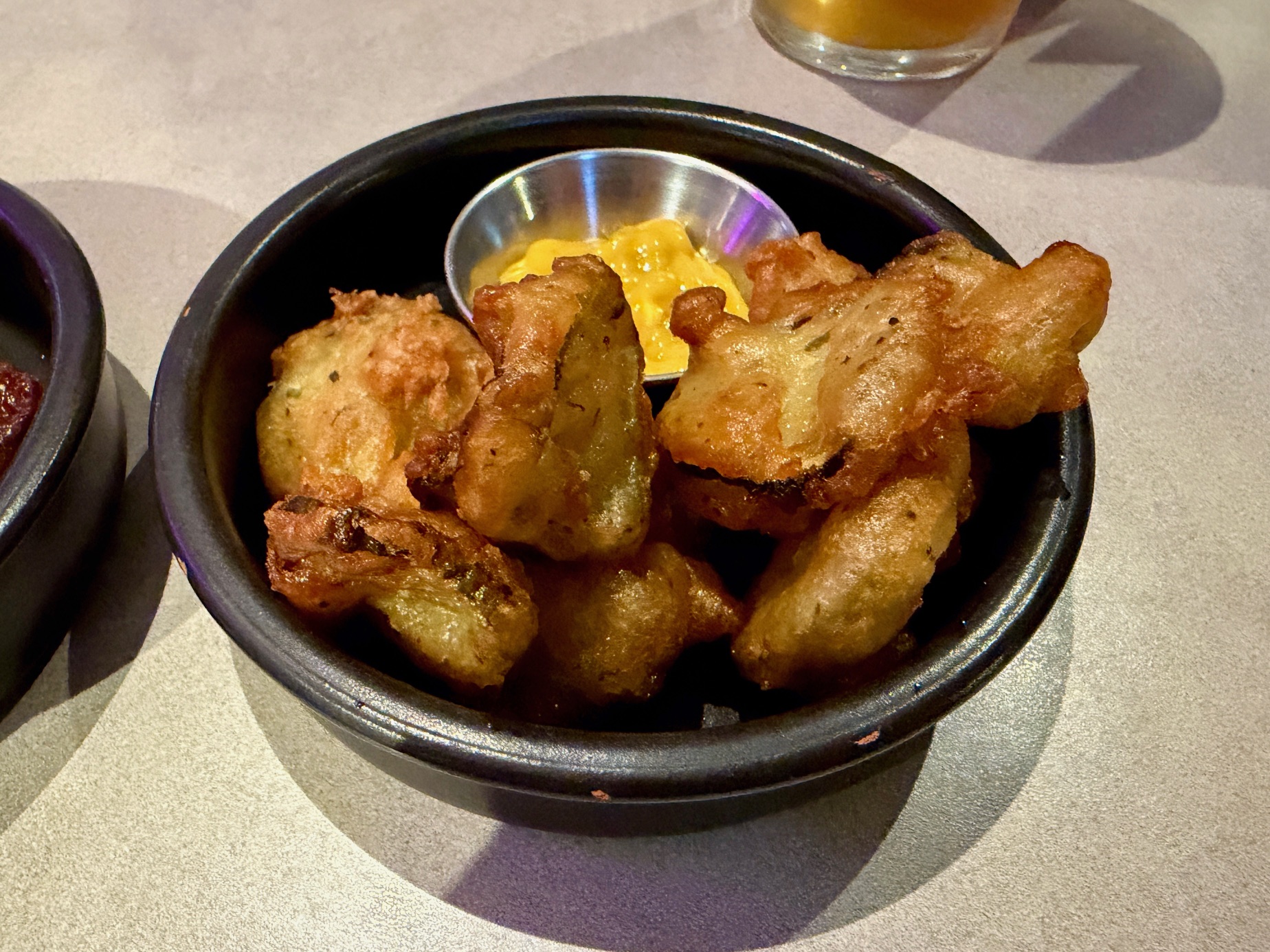
No power on earth would have stopped me, though, from kicking off with some frickles. I’ve had frickles in many places, and they often fail by being too big, too sparsely battered, too watery. Django’s were an absolute treat: little tart bombs, ticking away in a light and brittle batter, waiting to detonate. I liked the sweet mustard dip they came with, but to be honest I’d have been happy with them on their own. I’d have been happy with them on their own twice, for that matter.

They were easily their money at £7.50 if you like pickles, and fried food, and I am fortunate enough to love both. Django’s menu is a little amorphous in the sense that a lot of the starters would work as sides and vice versa, but these were probably a genre apart even from that – the ideal beer snack. I wish something like this was available in pubs across Reading, or even just one pub, actually. I’d make it worth their while.
On that note it’s worth saying that Django’s serves wine and some good-looking cocktails but its beers on tap, classic Americana, are Budweiser and a sessionable IPA from Goose Island. Context is everything: if I’d ordered that IPA in a pub I’d have found it thin and middling, but when you need something to zhuzh up a palate being continually coated with glorious fat, over and over again, its lemony effervescence was, by accident or design, a super choice.

The pork belly burnt ends were less successful. Huge hunks of meat, striated like sandstone, they looked like they’d turn out to be a highlight of my month. But sometimes appearances can be deceiving, and I wanted these to be more fun to eat than they were. The meat lacked give, required the punctuation of those thick layers of fat to make a satisfactory whole. But what they really needed was to be glossy with sauce, something to offset and augment, and instead they had a thin drizzle.

Not only that, but a thin drizzle of something subtle, when this is not a cuisine that calls for or rewards subtlety. The menu says that it comes with gochujang aioli, and leaving aside for one moment the fact that gochujang aioli isn’t a thing that needs to exist, what little sauce there was managed not to taste of either. The menu calls these sticky, which is the last thing they were, and it’s a shame. I’d have loved them to just be smothered in gochujang, come to think of it, and authenticity be damned.
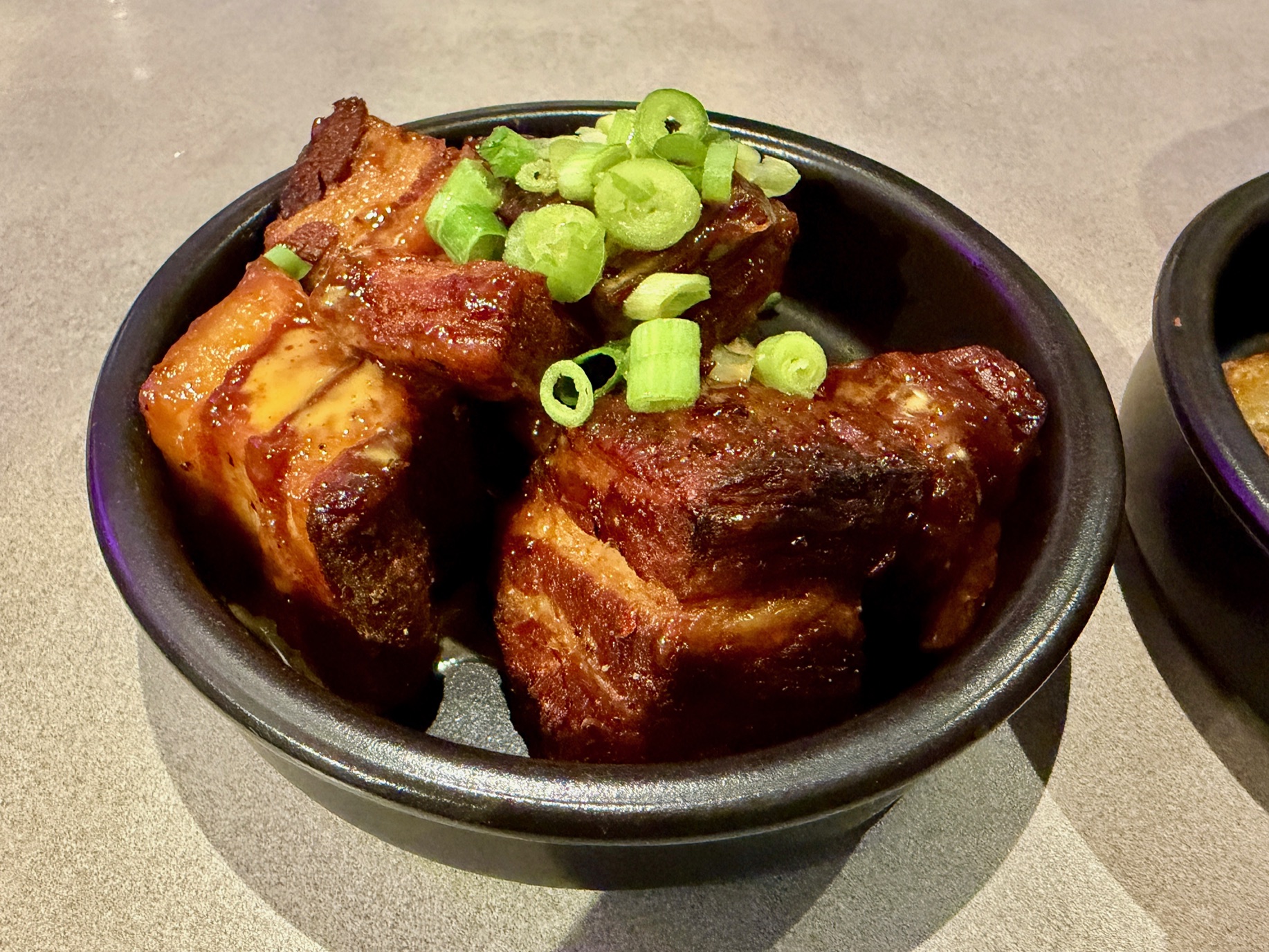
I seem to have ordered pork belly bites, or something like it, a few times this year on duty, but never has the gulf between potential and achievement been so difficult to bridge. You can also have the burnt ends as a main – see what I mean about that amorphous menu? – but if you go to Django’s, I’d advise against it.

But I was not unhappy. My seat was comfy, my beer was cold, my people-watching was up to scratch. A couple of regulars came in who had clearly reached the point of befriending the staff, and a little genuine warmth in a restaurant goes a long way. I was on to another half of that IPA, and whoever was in charge of the music was trying to appeal to has-beens like me: Everybody (Backstreet’s Back); Zombie; it was like Gen X FM had taken over the turntable, or I was back in the Bull and Chequers in Woodley as a callow 23-year-old, at the mercy of whoever had stuck a few quid in the jukebox.

The server had done that winning thing where I’d asked her for recommendations and she’d suggested the thing I was tempted to order, the flipside of the phenomenon where you pick something and they say “oh, good choice”. So the slow-smoked 7 hour beef short rib was her idea and mine: the menu even has an asterisk next to that dish, denoting one of the restaurant’s favourite dishes. If I didn’t like it, perhaps it would reflect on all of us.

And it was so huge, and so almost good, and so very huge. I quite liked it, possibly because God loves a trier and it nearly worked. It was a colossal piece of meat and yes, it did sort of slide off the bone. It had a black pepper rub, and a George Hamilton tan, and it didn’t take much for a fork to shred it nicely. I could see why people would love this, because I came close to loving it myself.
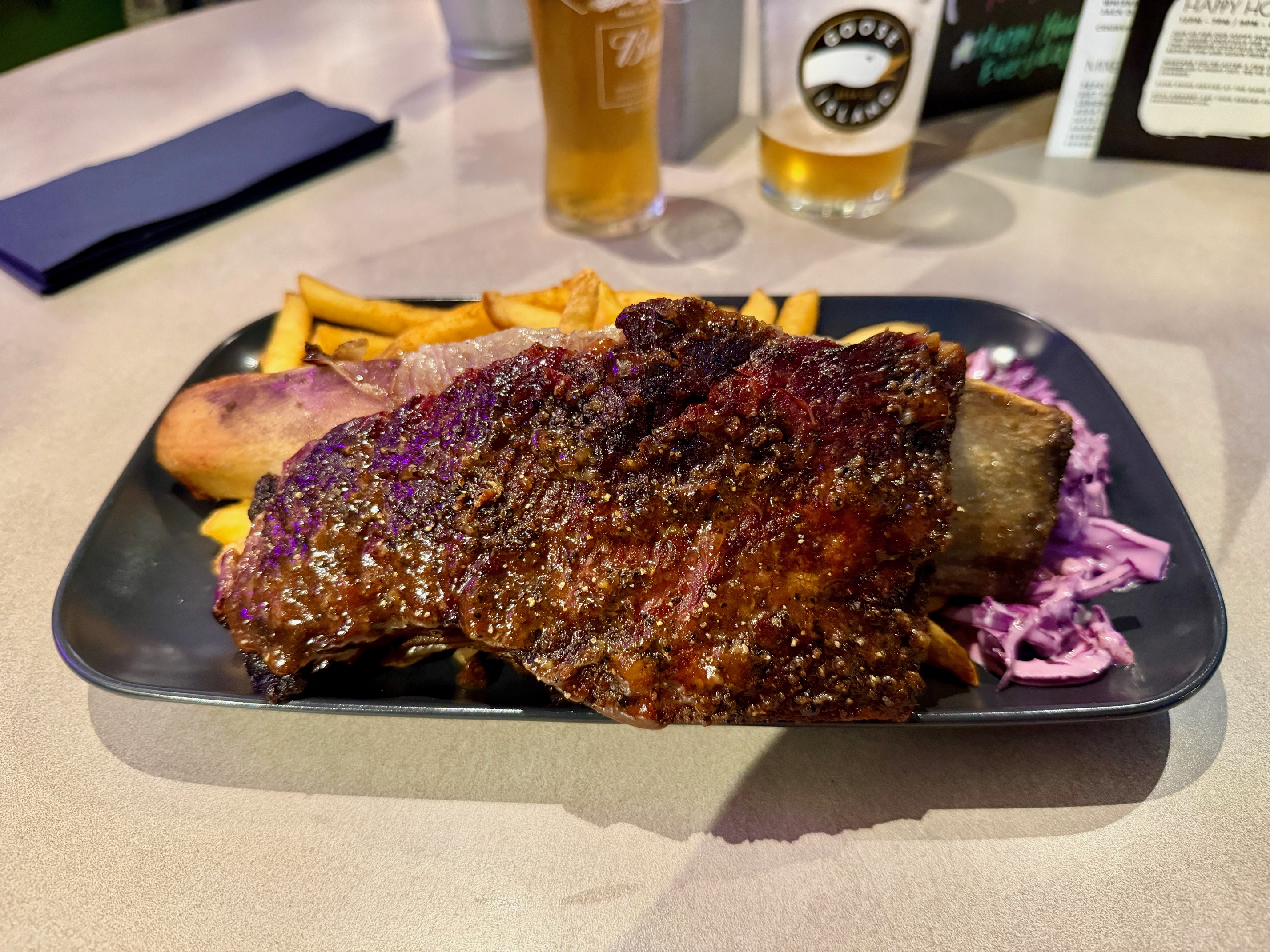
But the beef managed not to entirely be to my taste, in a few ways that may have been particular to me. The bits that were dry were a little too dry, not sauced enough, an issue I’d also encountered with the burnt ends. The server nicely brought me some of the restaurant’s own barbecue sauce, and it was very good, but the beef needed it I thought. And then there was the fat, which for me wasn’t rendered enough. It reminded me of the times I’ve eaten an undercooked beef cheek, and there in its core, not melted down, I’ve found a gooey blob of fat like the end product of a messy sneeze.

I know some people love beef fat, almost certainly love it more than I do, and this mightn’t be a deal breaker for many of you, but it slightly deterred me. I know that the comparison might be superficial at best, but I thought of the short rib curry that the Moderation serves, or the short rib dish on the menu at Clay’s, and I wanted this dish to live up to that potential. Not comparing apples with apples, or even beef with beef: different cooking methods, different ethoses, all that jazz, but it didn’t quite hit the spot for me. It wouldn’t put me off trying other things at Django’s, but at £28 I wanted this to be a knockout.

Still, the fries were excellent – especially after my hideous experience last week – and Django’s coleslaw, with plenty of red cabbage and a dressing that tasted more like a vinaigrette, was very enjoyable. I would have liked some pickles on the side to lend acidity but I can eat pickles pretty much any time, so I would say that.

I would have ordered some sides, but I figured I’d asked for quite enough food as it was. Besides, a lot of the sides looked as if they might be bought in: my server confirmed that the popcorn chicken was, and stuff like the mozzarella sticks sounded more Iceland than Kansas City.

The friendly chatter between the servers and their regulars meant it felt like it took a while to get my bill, but I didn’t mind. It was nice, on a cold and inhospitable night, to sip my beer a little longer and postpone the drab walk back to the station: I couldn’t find anywhere in Didcot to have a good pre-train pint anyway, as the Town That Untappd Forgot.

Eventually, during a break in their conversation, I asked if I could settle up. “I was just about to come check on you” my server said, and I honestly believed her. My food and drink – and make no mistake, I left that restaurant full – came to just over £62, including a 12.5% service charge.

While I was sitting there, in no particular hurry, I wondered whether the owner was right that Didcot would be unrecognisable in five years. He only had another year for that prophecy to come true, after all, and I guess when he said that he probably had no idea just how challenging those five years would be for all of us. People who open restaurants are dreamers, but if it wasn’t for their reckless, sometimes poorly-researched dreams, towns and cities across the U.K. would be infinitely poorer.

That was definitely true of Reading, but I reckoned it was true of Didcot too: I mean, I’d now spent about two hours there and I unilaterally decided that qualified me as an expert.

So is Didcot worth going to, just to eat at Django’s Smokehouse? You’ll have your own view on that from what you’ve read but if you want to hear mine, the answer is: kind of. I wanted to like Django’s very much indeed, and parts of it I really did. The menu is admirable and interesting, the service is a shining credit to them.

I wish I could have unconditionally adored the food. I wish I’d been able to say “this took me back to when Blue’s Smokehouse opened in Bracknell”, or “if you miss Bluegrass BBQ this is the place for you” or even “close your eyes and you could almost be in Copenhagen, at Warpigs”. I can’t quite say any of those things, but that doesn’t mean that I wasn’t charmed in a quieter, less performative manner.

So yes, if you like barbecue, or you’re in the area, or you have a split ticket and feel like living dangerously, Django’s is ten minutes and a world away from the station. Is it the best restaurant in Didcot? I’m not sure about that. I have always revered Zigana Turkish Kitchen, slightly further out, a spot where you smell the charcoal a block before you reach the front door, where the Efe is cold and eating the lamb chops for the first time verges on an epiphany. And yet, for some reason, I’ve never reviewed it. So that’s settled, then: next time I’m in Didcot I will go there. Maybe you’ll win the sweepstake, that week.

Django’s Smokehouse – 7.3
126 Broadway, Didcot, OX11 8AB
01235 813333

https://djangossmokehouse.co.uk

Since January 2025, Edible Reading is partly supported by subscribers – click here if you want to read more about that, or click below to subscribe. By doing so you enable me to carry on doing what I do, and you also get access to subscriber only content. Whether you’re a subscriber or not, thanks for reading.
Pub review: The Punter, Oxford

I took a slightly roundabout route to deciding where to review this week. It was always going to be somewhere in Oxford, but the initial plan was to visit the Old Bookbinders, a gorgeous backstreet pub in Jericho that has served up affordable French food for fifteen years, with my old friend Dave. But then at the beginning of the week I got the dreaded WhatsApp from him: struck down with a bug, only just back at work, he’d be in no fit state for eating or boozing at the weekend.

I briefly contemplated going there solo, but then I recalibrated: I could try out Permit Room, the Dishoom offshoot in the centre of Oxford, instead. Unlike most people I’ve met, I’ve never eaten in a Dishoom: I save no reservations dining for holidays. But everything I read suggested that, although Dishoom might not be what it once was, Permit Room was another kettle of fish entirely.

There were only five branches, and Oxford was graced with one: the kind of chain that Reading would so dearly love to attract but never does. I was sold. I made a reservation for lunch, did my research, pored over the menu. But I didn’t wind up eating at Permit Room.

So what happened? Well, my manager happened. I was in the office last Friday and on a break between poring over spreadsheets and crafting impeccably disappointed emails we got to chatting, as we often do, about Oxford, a place where I suspect we both frequently daydream about living. That usually involves shooting the breeze about where to get good coffee, or eat good food and he happened to mention The Punter to me. Had I heard about the changes there, he asked?

The Punter has an interesting history. There’s been a pub there for 150 years, but it reopened under that name a mere 15 years ago. Then, in the height of the pandemic, it decided to remake itself as an exclusively vegan and vegetarian gastropub. The following year it appointed chef Anthony Skeats, who previously cooked at a Michelin-starred pub in Oxfordshire, and plaudits followed. It made the Good Food Guide and even featured in the Sunday Times when it was reviewed by Charlotte Ivers, the paper’s then restaurant critic.

Ivers was very much the Liz Truss of broadsheet restaurant criticism – a massive Tory who didn’t do the job for long and whose reign now feels like an aberration. And her review of The Punter was a little on the lukewarm side, but it was still a rare appearance by an Oxford establishment in the national press.

But the reason my manager asked if I’d considered The Punter, he told me, was that it was serving meat and fish dishes again. A little research confirmed that the pub had rowed back from its bold new direction. Skeats left a couple of years ago, and in February the pub launched a new menu – still 60% vegetarian, they said, but now with fish dishes. Why the volte-face, you might ask? Was it because the market just wasn’t there for an entirely meat free venue, or was it something else?

Well, according to owner Tom Rainey it was partly due to government policy but mainly down to the closure of the Botley Road, a major thoroughfare which was pretty key to being able to reach the pub at all. Rainey said that this reduced footfall to the pub by 75%, if not more.

The Botley Road was closed so Network Rail could rebuild the nearby railway bridge and add an extra platform to the station. Which doesn’t sound an unreasonable thing to do, but what was unreasonable was the sheer duration of the closure: excellent local website the Oxford Clarion described it as having reopened “after 1,258 days and £237m”. Rainey, speaking to the local media, was more to the point: he called it “three and a half years of hell”.

It’s always tricky providing background like this because my Oxford readers already know all this and everybody else might not be that interested, but to put it in some kind of context for my Reading readers: you know how the Fisherman’s Cottage went through a phase of complaining to the Chronicle about the council cutting off access to the pub? Imagine that to the power of ten, being virtually inaccessible for over three years.

Anyway, I’d like to say that I cancelled my plans to go to Permit Room because I’m a sucker for the underdog. But the truth is that after my manager told me the news about the Punter I looked it up online, and I really fancied the menu. It looked clean and tempting, and I thought a little outing to the Punter might be a lovely way to spend a Saturday. The sample menu still had vegetarian stuff on it, but half of the dishes involved meat or fish. It was as if its time as a vegetarian pub was an embarrassing episode in its past it was trying, gradually, to forget. We’ve all been there, though. I booked a table.

If the rhetorical route to the Punter was circuitous the physical one couldn’t be much more direct, now that pesky bridge has been sorted. You leave the train station and rather than striking out towards Park End Street and the Westgate, you instead turn right and within five minutes you’ve crossed a pretty little bridge and find yourself on Osney Island, right by the river, walking down East Street, a beautiful run of terraced Victorian houses. It reminded me of the Village in Reading, an enclave so close to everything, yet magically removed. You are right by the station and yet you’re utterly in the middle of elsewhere, dreaming about living in one of those houses (I looked them up: we probably can’t afford to).

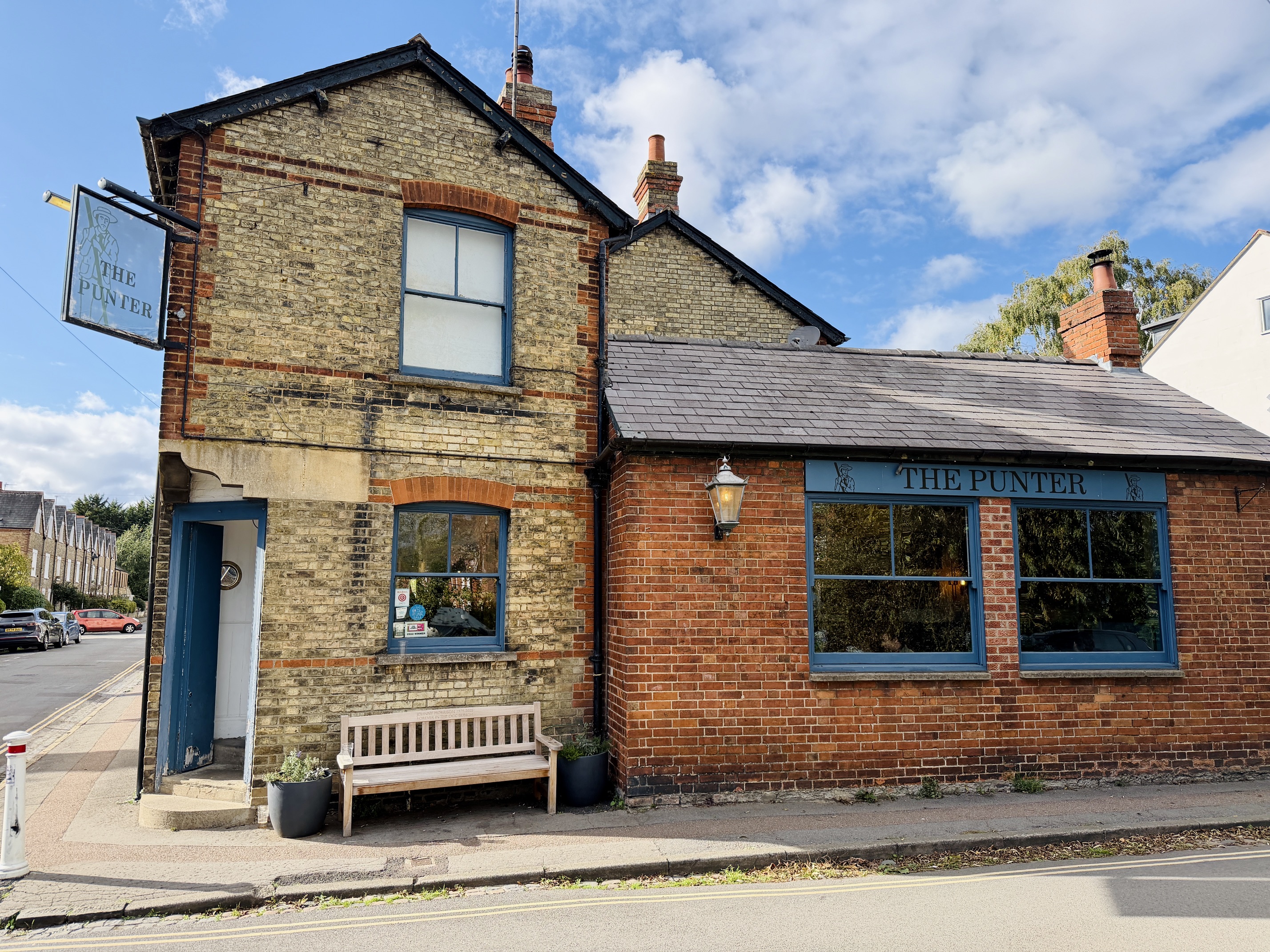
And there, on the corner with South Street, is the Punter, a ridiculously attractive redbrick pub with a decent looking outdoor space. I imagine Victorian side streets used to be awash with these: places like the Punter, and the Retreat in Reading, make a good case for the survival of the fittest. Boats went past on the Thames and a gaggle of men in Lycra, all repping the Oxford Cycling Club, were gathered outside in the sun, drinking pints of cask beer. It was awfully bucolic for somewhere so near the city centre: I realised I’d never been to Osney Island before in thirty-five years of coming to Oxford, and I felt I’d missed out.

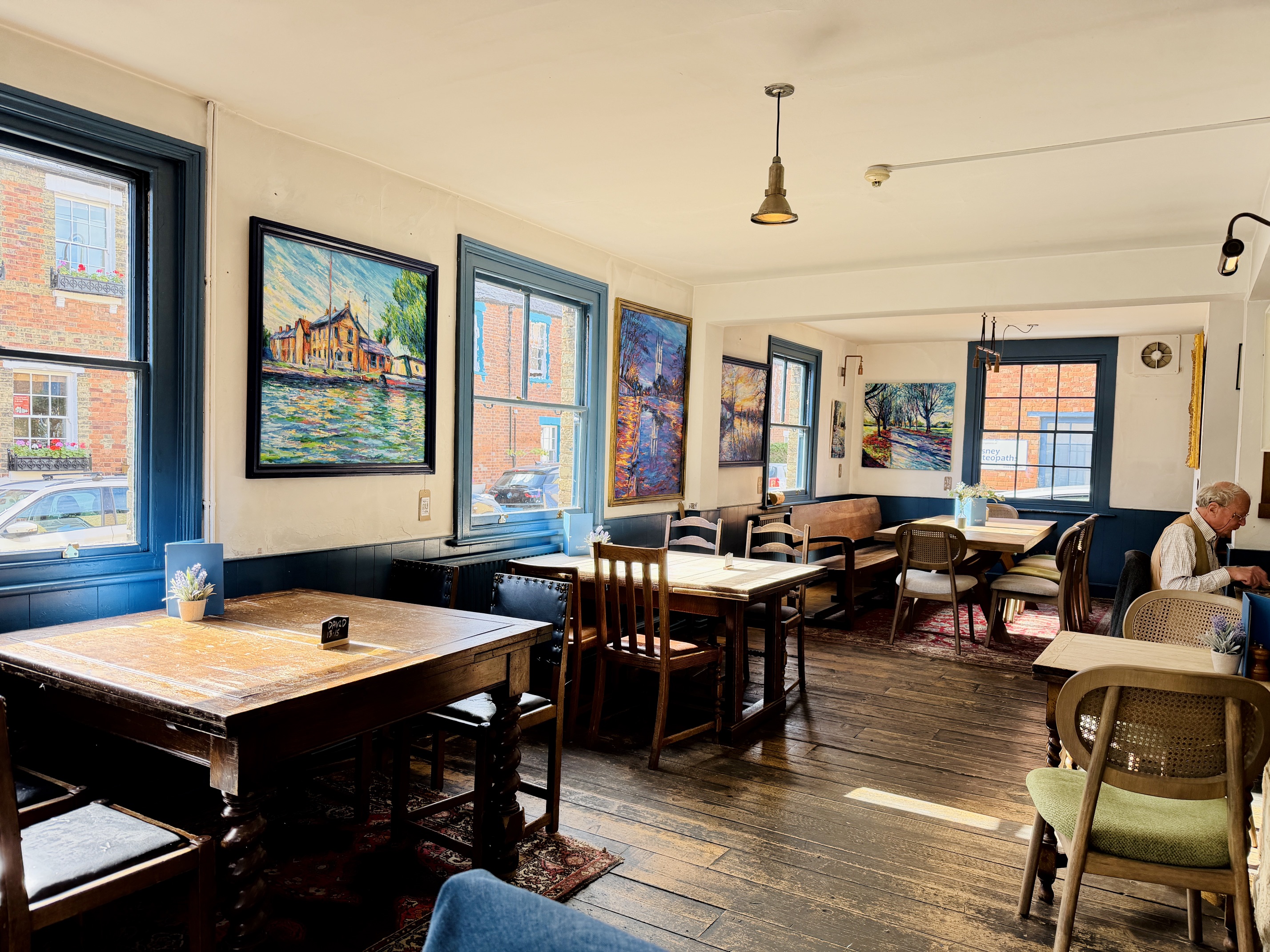
The Punter is absolutely beautiful inside. It’s a corner plot with two rooms and I was in the bigger, even more gorgeous one. Window is a noun that’s yet to transform, horrifically, into a verb, but if it ever does you could do some terrific windowing here: the bright blue frames look out on the redbrick terraces and the water, the whole thing almost more glass than wall. Vibrant, likeable art hung between each window, and the overall effect was oddly magical.

The staff had originally kindly plonked me at the one table that looked out on the river, but I asked nicely if I could move so I could see the whole room, experience all that life and light. The Punter’s well-curated Instagram feed boasts that customers come for the river and end up looking at the walls. They’re not far from the truth.

The menu was different to the one I’d seen online, which was something of a curveball, but the overall balance of it was the same: roughly half the dishes involved meat and fish, and most of the rest were vegetarian rather than vegan. Starters mostly maxed out at a tenner, mains clustered in the low twenties. Although the staff who looked after me were charming, friendly and a credit to the place, one of them owned up that the menu had changed recently and that he couldn’t advise me on some of the dilemmas it gave me. Perhaps if it had been a little more bedded in I might have chosen better.

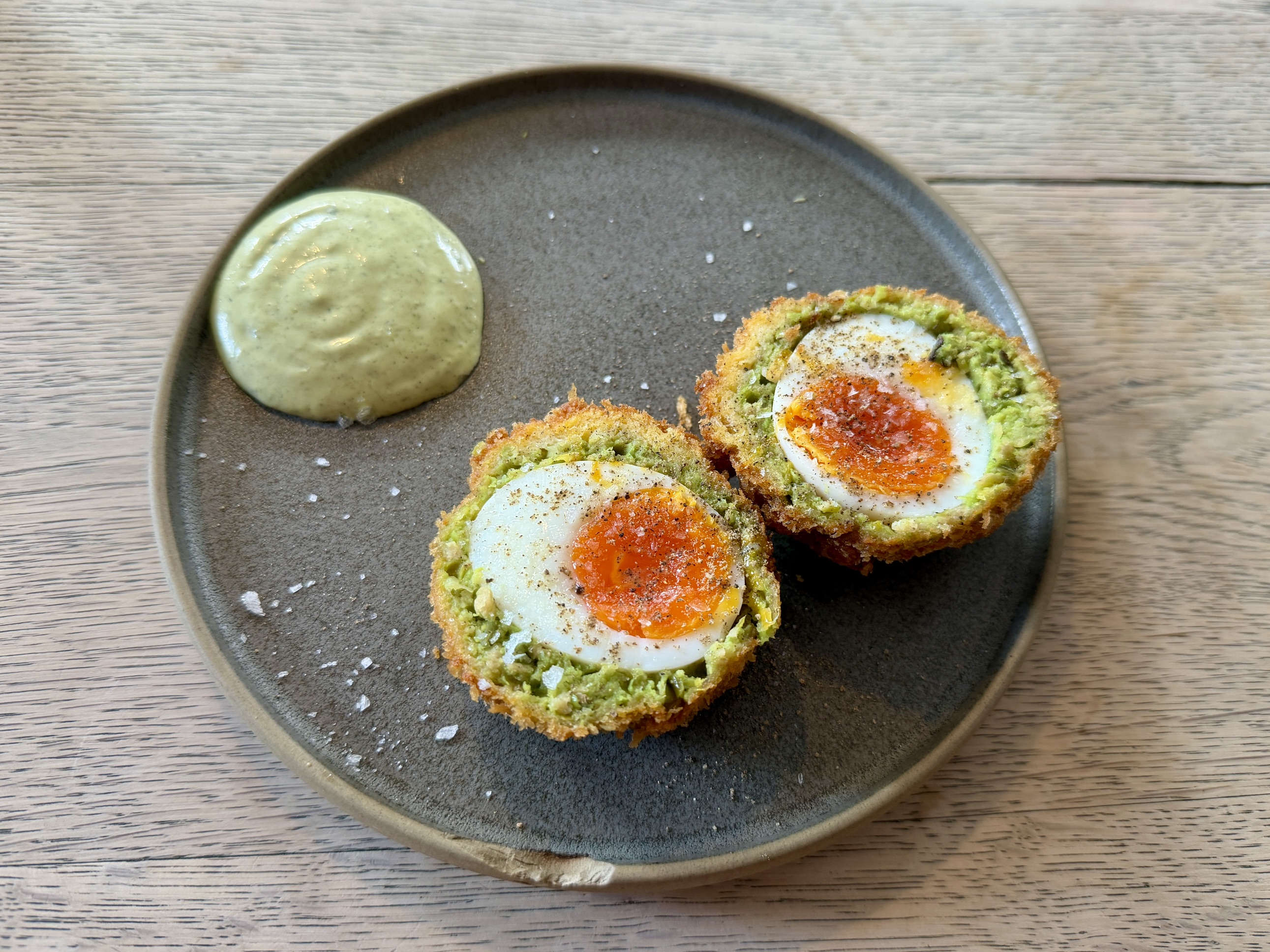
My lunch started superbly, though. A Scotch egg from the bar snacks menu was exemplary and – to my surprise – completely vegetarian. Pea and leek took the place of sausagemeat, and a stellar job they did of it. The flavour was interesting and complex, although the advertised truffle had taken the day off, the yolk was perfectly fudgy, the crumb faultlessly light and crisp. An excellent herb mayo completed a really joyous dish that felt its money at £8.

So often vegetarian or vegan food involves ultra processed ingredients, bad karaoke renditions of meat. This was far better and infinitely more interesting. It felt like it was invented not by a vegetarian but by a meat eater who cared for vegetarians, wanted them to know the pleasure of a really good Scotch egg without betraying their ideals. I wondered whether every dish had been like this during the pub’s all vegetarian era: if so, I rather wished they hadn’t changed.

Another thing to really like about the Punter was its wine list. They did have a good cask selection, and just the one interesting pale ale from Buckinghamshire’s XT Brewing, but a well-curated selection of wine – four whites, five reds – was on offer with all but one available by the glass and smaller 125ml glasses priced fairly. I can think of an awful lot of restaurants that could learn from the Punter and I loved my French pinot noir so much that I clocked up another glass. Sitting there in that room, feeling a blend of relaxation and anticipation, I decided that good things were in my future.

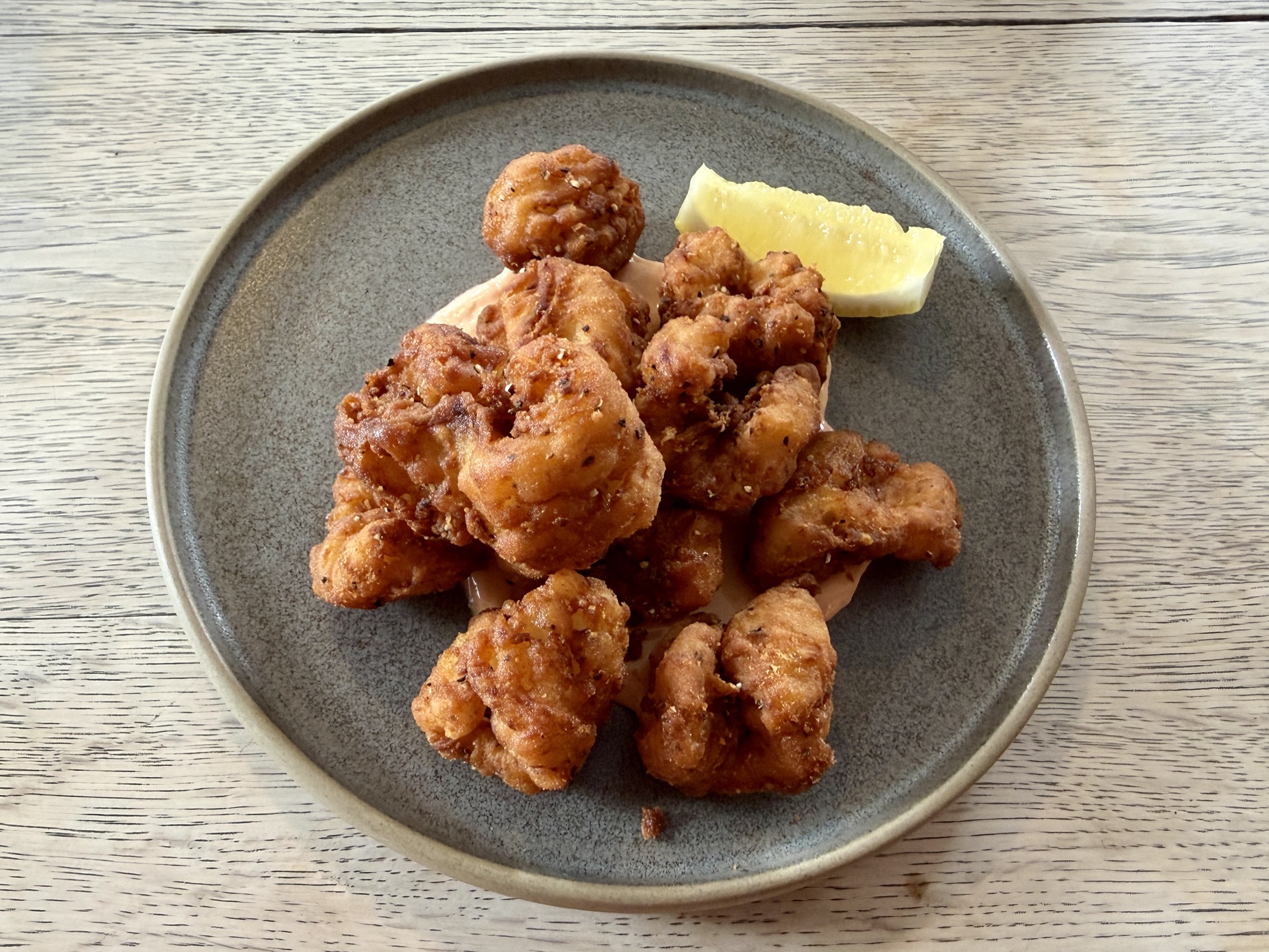
For my starter I was torn between the truffled rarebit and the salt and pepper squid, and my server steered me towards the latter. It was pleasant, but not quite there: bronzed, clenched fists of squid promised good texture, but under that coating they lacked the softness of the truly fresh – not bad, or even uniformly bouncy, but close enough to good that you knew they could have been better.

I liked the coating, but I don’t think it was salt and pepper. It felt like there might have been a bit of nigella seed in there, and it just about went with the mayo – which was described as sriracha aioli but I suspect was just sriracha mayo. As I write that up, describe that attempted fusion of China, Thailand and Spain, I’m aware that it sounds busy in theory. In practice it wasn’t, but it also wasn’t entirely successful.

Here’s a terrible secret, though: at this point I really didn’t care. Because the pub was so lovely, and the surroundings were so enchanting, and I was far too busy wishing I lived just round the corner to raise classic restaurant reviewer niggles like squid freshness. The cyclists kept wandering in to top up on pints of ale, the pub was slowly attracting more dog walkers.

A table of four women, all a few years younger than me, came in for their 1.30pm booking and were pure joy and camaraderie, enjoying an afternoon together and intending to make the most of it. Wine was ordered – not a bottle, the implication being that such excess would follow in due course – and they started catching up. There was something about that group that had the nicest energy: no willy-waving, no oxygen thievery, just good friends sharing stories, comparing notes, feeding off each other.

It was clear that eating at the Punter was a break from their well-trodden routine (“they know us at the usual place”, one of them conspiratorially admitted to the others) and benevolently looking on I found myself feeling sort of happy and kind of lonely. It made me want to round up all my brilliant male friends – the likes of Jerry, and Graeme, and Dave – and make them go to the pub with me, to try and build something a bit like what they had. But it was a good sort of lonely, if there’s such a thing, because I knew that I at least did have friends like that, even if they weren’t there right now.

Besides, what did I have to complain about? I was having a solo lunch in a gorgeous dining room, flooded with autumn sunshine. I could see the river from my table, and the pinot noir was delicious. And the people watching was superb: I got a little glow from seeing those four good friends set the world to rights, in a conversation that aced the Bechdel test.

I have had a difficult 12 months, with my accident and my surgery, losing my poor dad – who would have loved The Punter, like he loved everywhere – and my wife’s operation. And yet here I was, on the other side of some of that, in this little pocket of tranquil reflection. It truly is a good life, if you don’t weaken.

Then the fish and chips arrived and ruined all that.

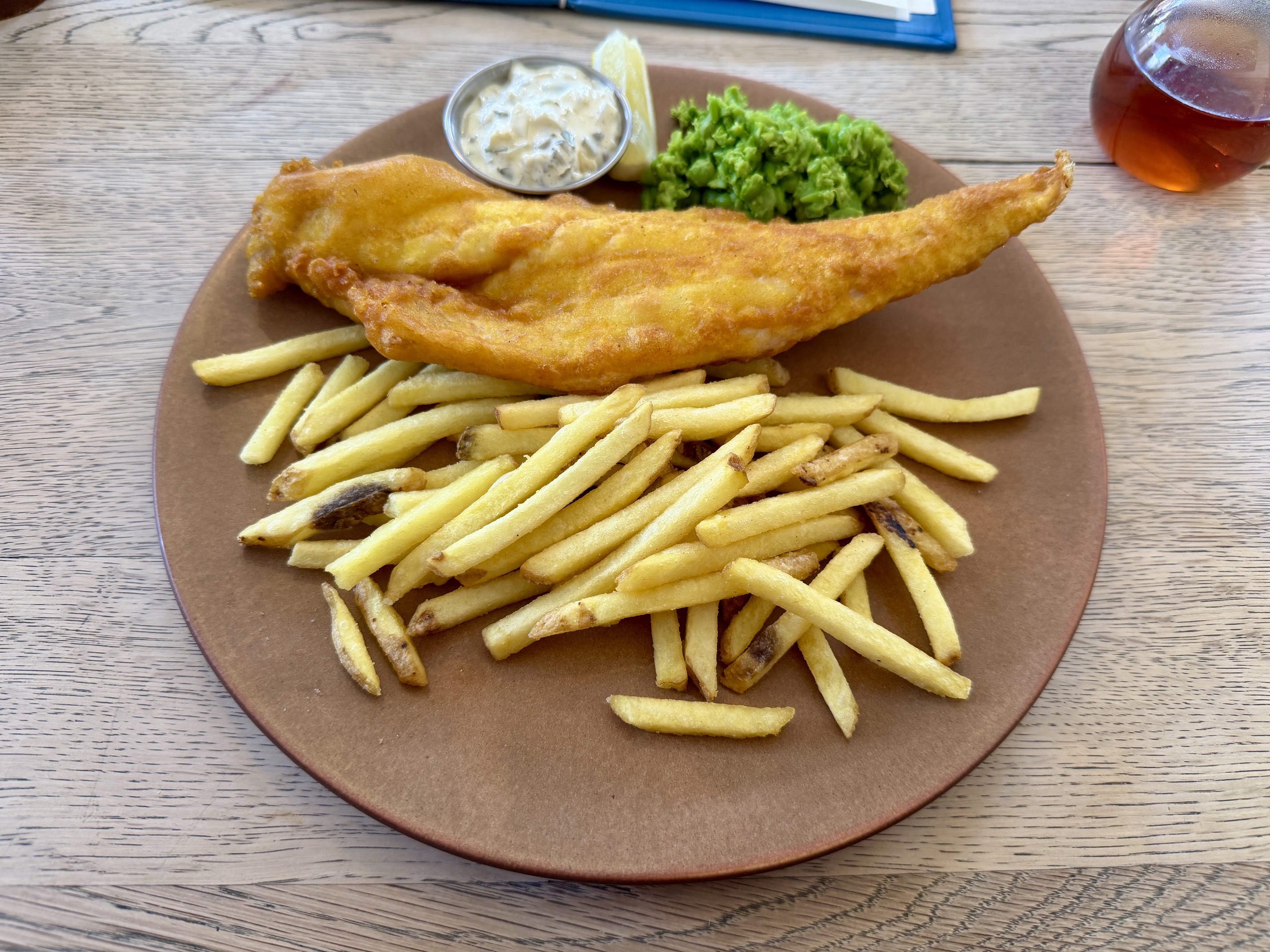
Really, it wasn’t good. Can you tell from the photo? I nearly had the monkfish and bream stew, but my server couldn’t tell me anything about it. I almost ordered the ham hock and cheddar “open pie”, but he told me that it was a sort of casserole with a pastry lid and a layer of mashed potato on the bottom, which I thought sounded downright weird. So I picked fish and chips, a great benchmark of pub food and generally a safe bet even in the iffiest of pubs.

Yet every element of this had something wrong with it. The fish was not unpleasant – haddock, falling neatly into flakes, and the coating was suitably light. But it was a small, anaemic piece lacking the crinkles and crunch of really good batter: the squid had been better, in that respect. The crushed peas tasted of lemon, which crushed peas really shouldn’t do. The tartare sauce was just mayonnaise that had gone on an unsuccessful speed date with some chopped gherkin. I like tartare sauce, I think, to be cheap and nasty, to be napalm for the roof of your mouth the way good salt and vinegar crisps are.

And then there were the chips: my god, the chips. I am a little bit finicky about chips, and I won’t generally eat them if they don’t pass a short visual audit. You can make a case for skin-on chips, or skin-off, but for my money you can’t make a case for “suspicious black patches on”. These were just manky, and there were enough scuzzy ones – which I encountered early enough in proceedings – that it rather put me off the rest. If they were bought in, which I assume they were, the pub needs to buy better. If they weren’t, there are even fewer excuses.

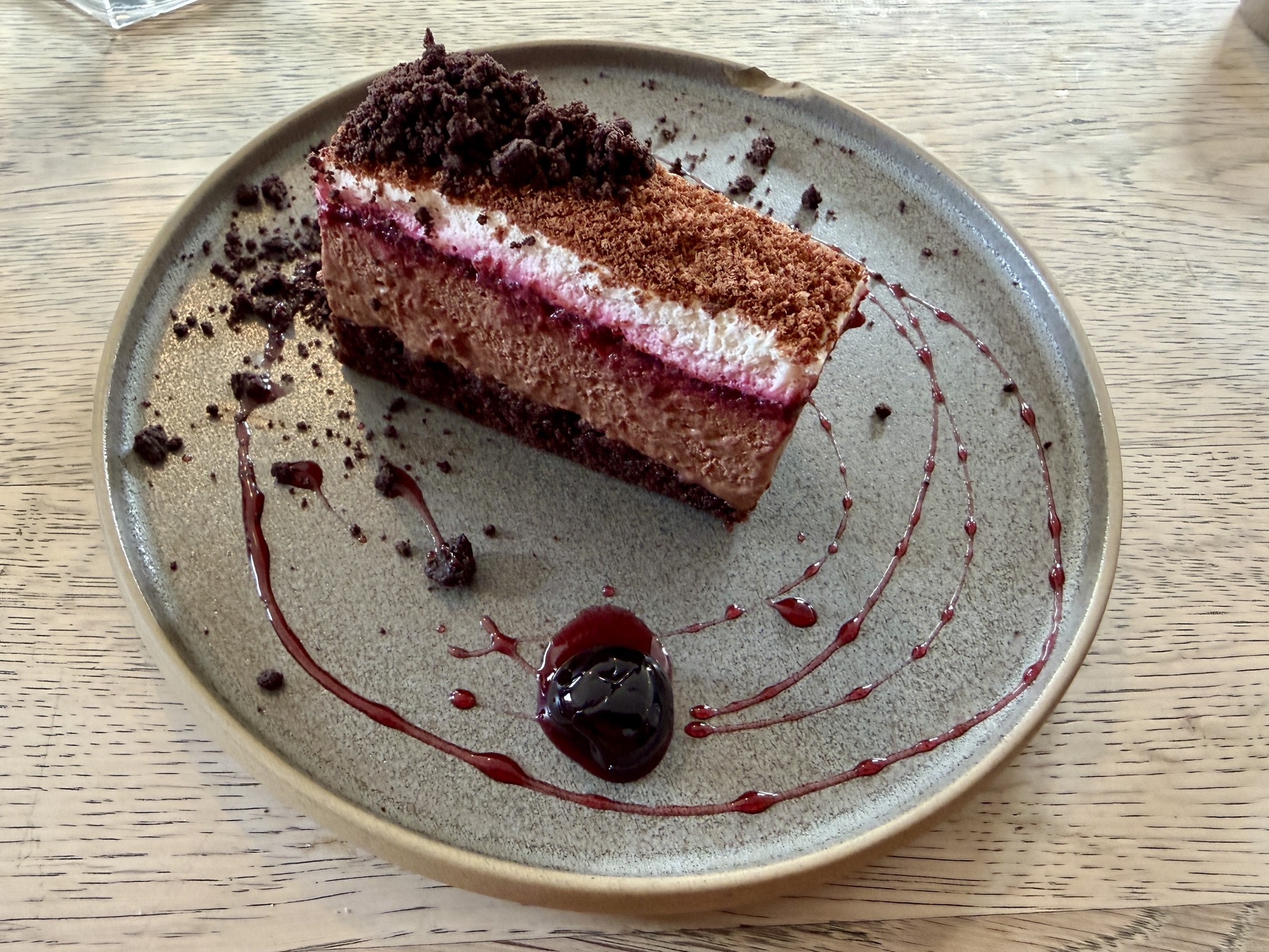
Could dessert recover from that? Well, actually, yes. I’m so used to ordering chocolate mousse and it being a dollop of something loose and airy, usually drizzled with extra virgin olive oil and scattered with salt, that I’d forgotten the simple pleasures of the more orthodox rendition. This was a lozenge of denser, less bubbled mousse – you could wonder if they’d used something like gelatin, if the pub wasn’t still a little vegetarian – on a slab of chocolate sponge, a rubble of chocolate crumb on top, cherry sauce Spirographed around.

I loved it, and I was grateful to the pub for doing its best to stop me leaving full of sadness and resentment. It’s worth also adding that the pub gets its coffee from local Jericho Coffee Traders, and my latte was as good as any coffee I’ve had in a restaurant or pub for as long as I can remember. My bill came to £65, not including tip, and I told my server that I’d had a marvellous time. Which wasn’t a lie, even if those chips should have been taken across the road and drowned in the Thames.

I used to work with a chap called Phil, nearly 20 years ago, who looked like Sonic The Hedgehog and entertained me very much. He was also obsessed with shaving his scrotum and telling everybody about it, which is a story for another kind of blog entirely, and he’s now high up in project management somewhere, so thank goodness he doesn’t read this. But I was reminded of Phil, when I reflected on my meal at The Punter.

Here’s why: we all went out after work one evening for his birthday, and he decided he wanted to eat at Prezzo. I went, because I wasn’t always the gastronomically hyper-evolved being who is writing to you now. Phil looked at the menu and railed, entertainingly and at length, about the fact that it included a burger. What kind of Italian restaurant offers a burger, he ranted? And what kind of chump orders it?

You can probably guess what’s coming: the server came round, Phil ordered the burger and naturally he hated it. At the time I thought it was emblematic of Phil himself, to do something he knew he would dislike and then enjoy his chagrin more than he could ever have enjoyed his meal. But I did a Phil at The Punter, because if you look at the dishes I enjoyed – the Scotch egg, and that chocolate mousse – they were vegetarian. It was only when I wandered off track, ate the fish, that disappointment came looking for me.

I told you I saw the truffled rarebit go to another table, and it looked good. The braised Hispi cabbage with miso chimichurri that also went to that table? That looked good too. I bet the black garlic rigatoni and the celeriac steak, the porcini and pearl barley burger – all of them on the mains – were good too.

So don’t read as much as usual into the mark at the bottom of this page, because it arguably reflects as much on me as it does on The Punter. That afternoon, taken in by the menu and the cyclists and the pinot and the sunshine, I emulated Phil. I reckon vegetarians, and people who are prepared to put their prejudice to one side, will eat even better at the Punter than I did. Except for the fries: those fries were an affront.

It is one of the greatest contradictions of restaurants and pubs that you can have a wonderful time without having a wonderful meal, a brilliant afternoon or evening eating middling dishes. The Punter is great evidence of that. I really hope it recovers from its three and a half years of hell, and I have more than half a mind to go back. And bit of me hopes that they reverse their position on the whole vegetarian thing. It’s always better to do what you love, and if you stick at it I remain hopeful that you find the love you deserve in return.

The Punter – 7.2
7 South St, Oxford, OX2 0BE
01865 248832

https://www.thepunteroxford.co.uk

Since January 2025, Edible Reading is partly supported by subscribers – click here if you want to read more about that, or click below to subscribe. By doing so you enable me to carry on doing what I do, and you also get access to subscriber only content. Whether you’re a subscriber or not, thanks for reading.
Café review: Donnington Deli

I don’t ordinarily review somewhere until it’s been open at least a month. That’s definitely the case here: Donnington Deli, the second offshoot of East Reading institution Café Yolk after 2025’s Baby Yolk, opened at the end of January, so you can’t say, eight months later, that I haven’t given it time to settle in.

That’s not the whole story, though, because I was in fact standing outside the door of Donnington Deli the very lunchtime it opened, genuinely excited to have a look round. I remember it was a bright Friday in January, and I was still in the early stages of recovering from my broken arm. I planned to do some shopping, have a coffee and maybe try a sandwich for lunch, but it wasn’t to be: I was disappointed that it was in fact just a sandwich shop, not a deli at all. I might have been even more miffed that they didn’t serve coffee.

I wandered up the road to Monty’s instead, and had a very agreeable brunch there. And I had a good old whinge about it all on social media, because I never learn to reserve judgment. It’s something I must work on next year: I know it drives my wife crackers at times. Anyway, I now see with the benefit of distance that being unimpressed that Donnington Deli wasn’t a deli was like being unhappy, all those years ago, when Bakery House turned out not to be a bakery. It misses the point somewhat, judging a book by its cover in that way.

I returned to Donnington Deli a couple of times the following month, tried two of their sandwiches and wasn’t entirely convinced. Their much-vaunted focaccia was dense, like a brick, and I thought the sandwiches were too big, not special enough. You got a free drink – not a coffee, because they still didn’t serve it – but it was something like cola or ginger beer through a siphon; I would rather have had a smaller, less expensive sandwich and paid extra for a drink I actually wanted, like a latte.

That was over six months ago, and I decided Donnington Deli needed a little more time – or, perhaps more accurately, that I did – before I visited on duty. I would leave it to find its feet, and prioritise other places instead. In the intervening months, Donnington Deli kept doing its thing. It was lauded by the usual suspects on Instagram with gormless, childlike wonder, but change was so incremental as to be unnoticeable. With one exception: coffee was introduced in April. See, I told you that was a mistake.

So why did I go back? It was a confluence of events: I had a Monday off, and the sun was out. Zoë’s convalescence from her operation was going well but I think she’d reached the stage, after a week of my fussing and cosplaying Laurence Nightingale, where “needing a rest” also included “needing a rest from me”. I thought a nice walk in the sunshine and a spot of lunch, a couple of hours out of the house, was just the ticket. So I meandered my way down the hill, ready to give Donnington Deli a look through fresh eyes.

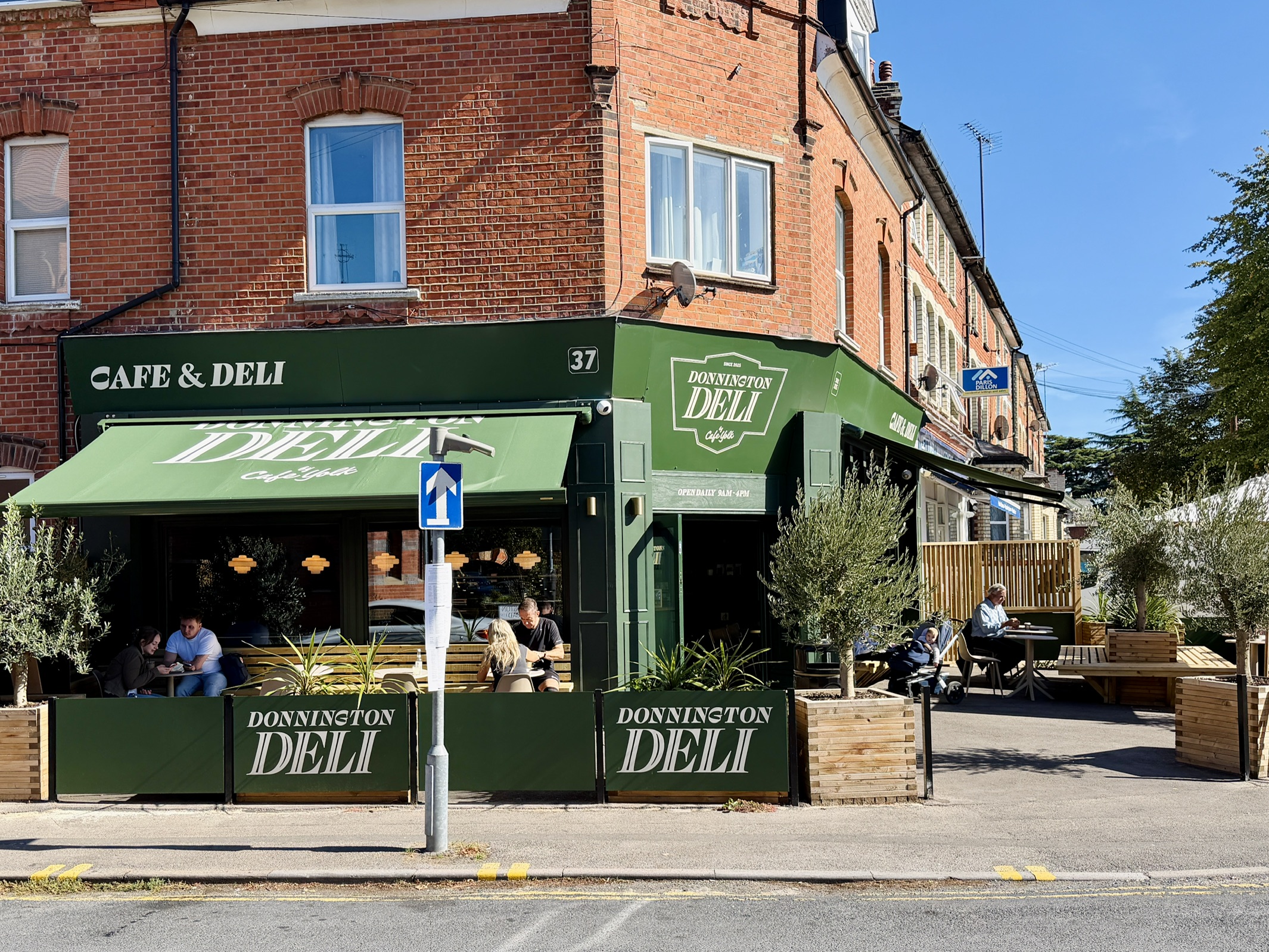
It is a lovely space inside and out, and it’s come into its own in the summer months. The look and design, as with all of owner Alexandra Langlais’ spaces, is superbly done and it fills its street corner in a very striking fashion: racing green, perhaps in a subliminal hint to the building’s former purpose as a car dealership. The inside is plain and unfussy: a pale wood parquet floor with banquettes along its perimeter, that classy shade of green carried through to the counter and the menu boards suspended over it.

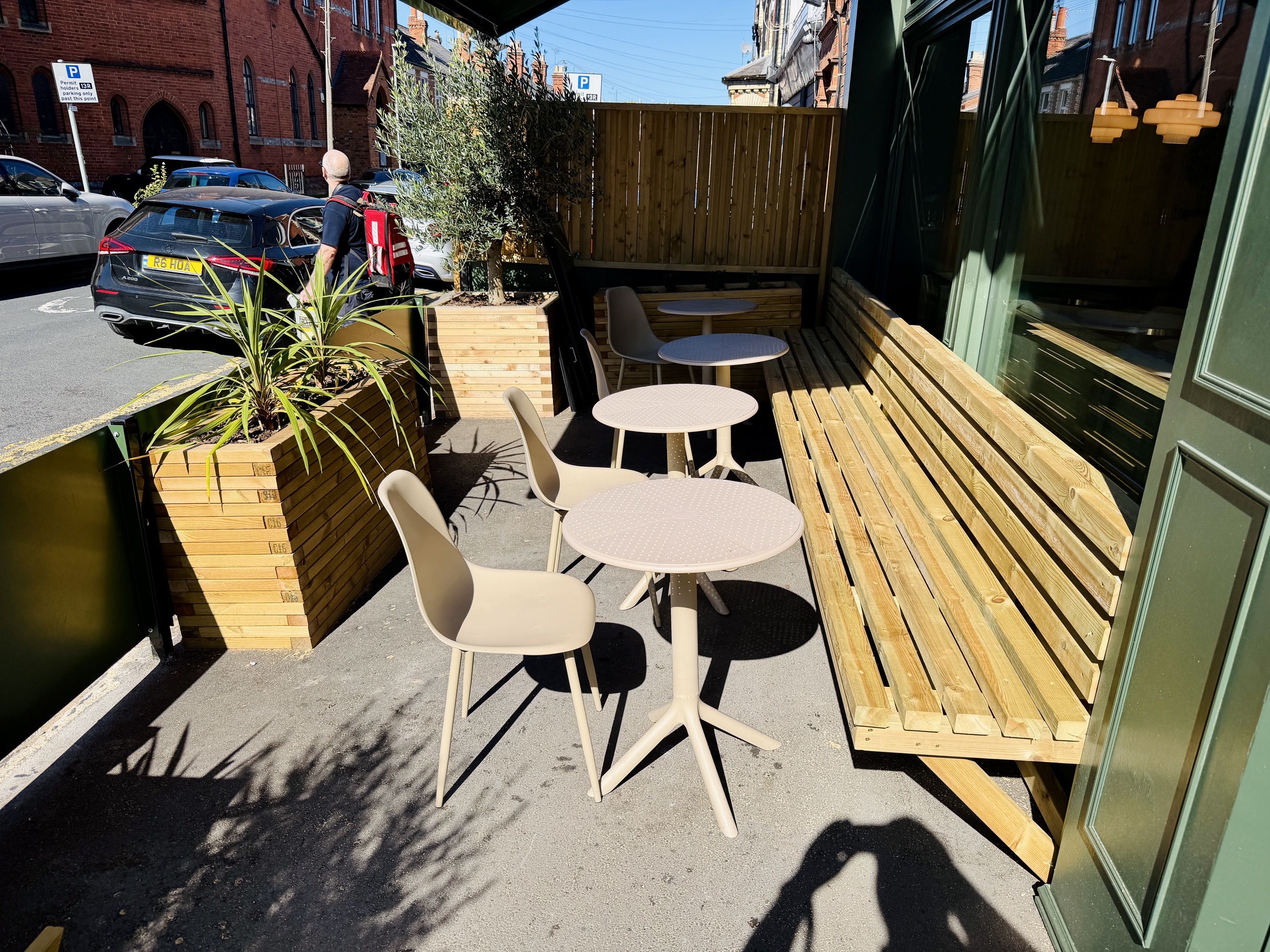
But the outside, which has come together in the months since opening, is also fetching and it’s where I sat on this visit. This was where you got your real people-watching opportunities seeing all the bustle of the Erleigh Road under way, all those lives momentarily intersecting with mine. Term hadn’t started yet, but the area still hummed with life – and this is, to some extent, Langlais’ achievement, because Café Yolk opposite has been drawing footfall to this part of town for well over a decade. It was a good mix of chairs and benches, sun and shade, and a really nicely done terrace.

Donnington Deli’s menu hasn’t changed significantly since it opened, with the exception that you can now get any of your sandwich fillings as a chopped salad instead. A total of ten sandwiches are on offer, all made fresh to order. Donnington Deli may be trying to emulate trendsetters like Sandwich Sandwich, producing overstuffed sarnies optimised for social media, but this isn’t quite as trailblazing as all that: that’s how sandwiches are made at Shed, or Pierre’s, and has been for many many years.

This might be me, but I was surprised by how little the selection offered by Donnington Deli appealed to me. It was like my experience at Mignonette a few weeks back – where every dish on the menu had some twist or feature that made it clamour to be chosen – only in reverse. Two of the ten sandwiches led with turkey, literally nobody’s favourite meat. Another couple featured balsamic glaze, which felt like a decidedly retro choice.

I also, in the interests of giving Donnington Deli the best possible chance, swerved all their sandwiches I’d already tried. That meant avoiding their pastrami sandwich, which had been crammed with pastrami to the point where it almost became a chore, with a wodge of sauerkraut which was lacking in acidity. Their chicken Caesar, too, with its strangely vinegary dressing and catering-pack bouncy bits of pink bacon rather than salty rashers.

It also meant avoiding the steak and cheese sandwich, which comes with a side of gravy. Zoë had ordered this on a previous visit and I thought it had a false advertising problem, being packed with something cold that you could describe as pastrami-adjacent. Here’s a hill I’ll die on: I think you should only be allowed to call it a steak sandwich you’re actually serving a steak – hot, off a grill or a griddle. Otherwise it’s a beef sandwich making promises it can’t possibly keep.

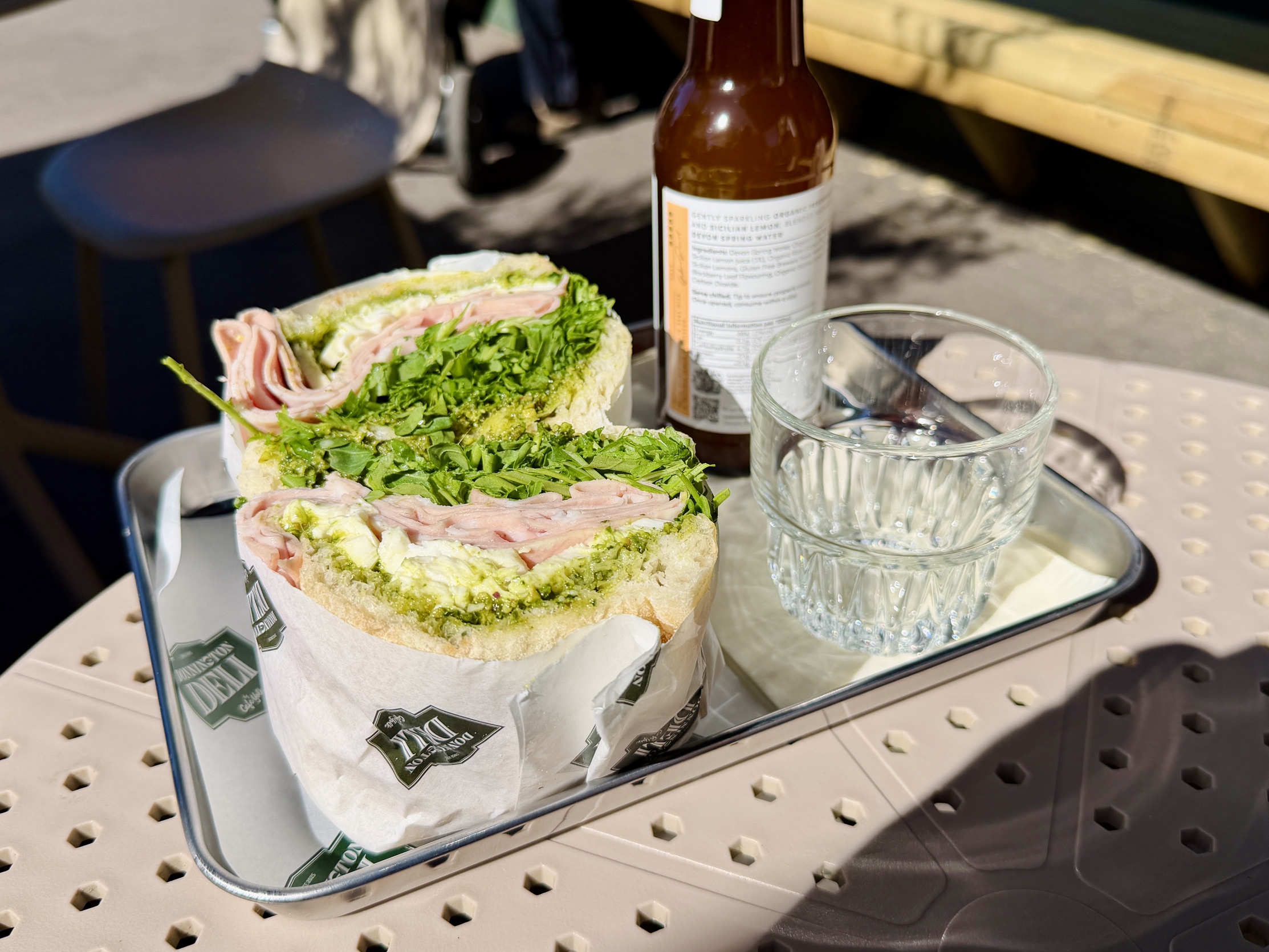
Anyway, this happily meant that I probably ordered Donnington Deli’s best – and easily their most distinctive – sandwich, the mortadella. They brought it out to me with my bottle of ginger beer: Donnington Deli has stopped including a cheap soft drink with your order, which I think is a good thing. But in the majority of cases it hasn’t affected the price, which means you’re effectively paying more for less.

Anyway, my mortadella sandwich was £10.50, and you can see that this is very much aimed at visual eaters: it comes on the lined, branded tray, cut open to give you a good look the cross-section. It’s all about the cross-section these days: not that I’d know, sticking to my outdated early twenty-first century web-logging in a world increasingly awash with one minute videos and silly little microphones.

Let’s do the positives first, because there were a fair few. As a combination of flavours, it worked superbly: on that level, at least, it wasn’t overkill. The mortadella was enjoyably silky – I’ve never been a lover of the stuff but this did a solid job of converting me. I am however a huge fan of mozzarella, and I loved it here, seemingly torn and adding that cool creaminess. And best of all was Donnington Deli’s pistachio pesto, which balanced this out precisely and tasted delicious. A huge sheaf of rocket rounded out a sort of pastel tricolore thing going on.

There was just enough happening here, and I appreciated the idea. And yet there were problems with the execution. I still struggled with the bread: they’ve moved from focaccia to ciabatta and although it wasn’t the huge dense block of previous visits it still felt like heavy going.

Not only that, but it wasn’t up to the job of holding its contents – the first half of my sandwich I just about managed to eat, but by time I got to the second leg it was soggy, not holding together. Toasting the bread might have helped, but there’s little evidence that any of Donnington Deli’s food is exposed to a primary heat source: I guess that’s why they sell a beef sandwich, not a steak one.

I would have liked this to be less comically huge, better balanced and more focused on being feasible, let alone fun, to eat. I would want it smaller, and ideally less expensive, and perhaps that just means this kind of thing is not for me. I couldn’t help but be left with my initial suspicion that this is food to be looked at and photographed, but not so much to be consumed.

It reminded me of what it’s like to buy shoes as a man with size 12 feet: you cast your eye over a pair of shoes in a shop and they look really snazzy, but when they bring the size 12 version up from the basement your stylish footwear has mysteriously morphed into clown shoes. This sandwich, I’m afraid, was clown shoes.

I realise that I should have said something good, then something constructive, then finished on something good. But this is feedback about a sandwich, not a feedback sandwich: I’ve never been terribly proficient at the feedback sandwich.

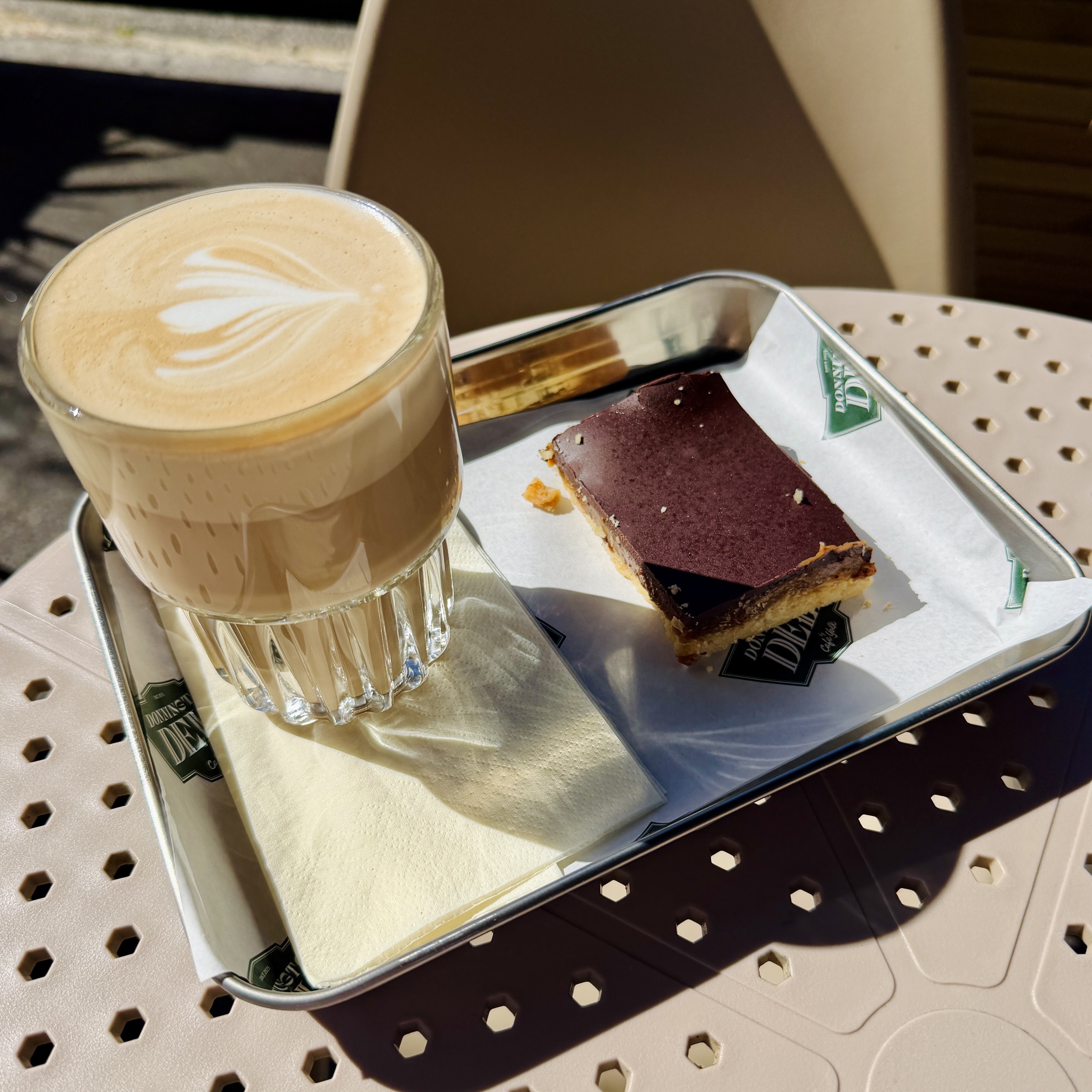
To try the full gamut of Donnington Deli’s offerings I ordered a coffee and a cake and moved to a sunnier table to polish them off. I had initial misgivings about the latte – it started bitter, but as I worked my way through it either it tasted better and better or I came to terms with it. I’m still not sure which. I’d say it wasn’t as good as the coffee was at Café Yolk back when they bought beans from Anonymous Coffee, but better than the coffee I had at Yolk after they jogged Anonymous on.

They used to use Kingdom, they now sell their own beans: it’s anybody’s guess who roasts them for Yolk and Donnington Deli. I liked it, though – it might just be worth making a stop in east Reading for, although that’s also because that part of town is starved of good coffee. The millionaire shortbread, however, was unspecial: the chocolate a tad waxy, the caramel too molten. Perhaps there was just no pleasing me that day: the whole thing came to just over £20.

The reason for leaving it a month before I review somewhere new is, of course, to give them a chance to iron out their teething troubles. I reckon 99% of hospitality businesses, especially independents, open before they’re really ready and keep tinkering and fixing the snagging while they come to terms with beginning to trade.

The benefit of leaving it longer, as I did here, is that it gives a hospitality business proper space and time – not to iron out day one niggles, but to work out what it is and who it wants to be. And often, I’m sure, that is the case. But sometimes a business is authentically itself from day one, it knows what it aims to achieve and is set on doing exactly that.

In some ways, I suppose, it’s to Donnington Deli’s credit that I believe that’s precisely what has happened with them. Because the review I have written, eight months in, is remarkably similar to the one I might have produced if I’d visited it on duty in February. I think the range of sandwiches isn’t interesting enough, the execution feels unbalanced and, for my money, it is maximalist in a way that even I, a greedy sod, can’t buy into. I left a fair amount of my sandwich, which isn’t like me at all.

I admire their single-mindedness of purpose, it’s just not a purpose I can rally behind. For this kind of thing, Mac’s Deli in Theale remains the place to beat: Donnington Deli feels more to me like a slick rebrand of somewhere like Pierre’s in Reading: the style is something else, but the substance needs to catch up. The fact that Yolk still has queues while Donnington Deli wasn’t the busiest on my visit might bear that out.

But I would sound a note of caution, because I was unmoved by Yolk when I first visited back in 2013 and it, still thriving and expanding, has clearly had the last laugh. I’m just one person, and you have to weigh my opinion carefully. What do I know, anyway? After all, there’s plenty of evidence that owner Alexandra Langlais might have a far better idea what kind of food the folks of East Reading are looking for than I do.

Donnington Deli – 6.6
37 Erleigh Road, Reading, RG1 5NB
0118 3131129

https://www.instagram.com/donningtondeli

Since January 2025, Edible Reading is partly supported by subscribers – click here if you want to read more about that, or click below to subscribe. By doing so you enable me to carry on doing what I do, and you also get access to subscriber only content. Whether you’re a subscriber or not, thanks for reading.
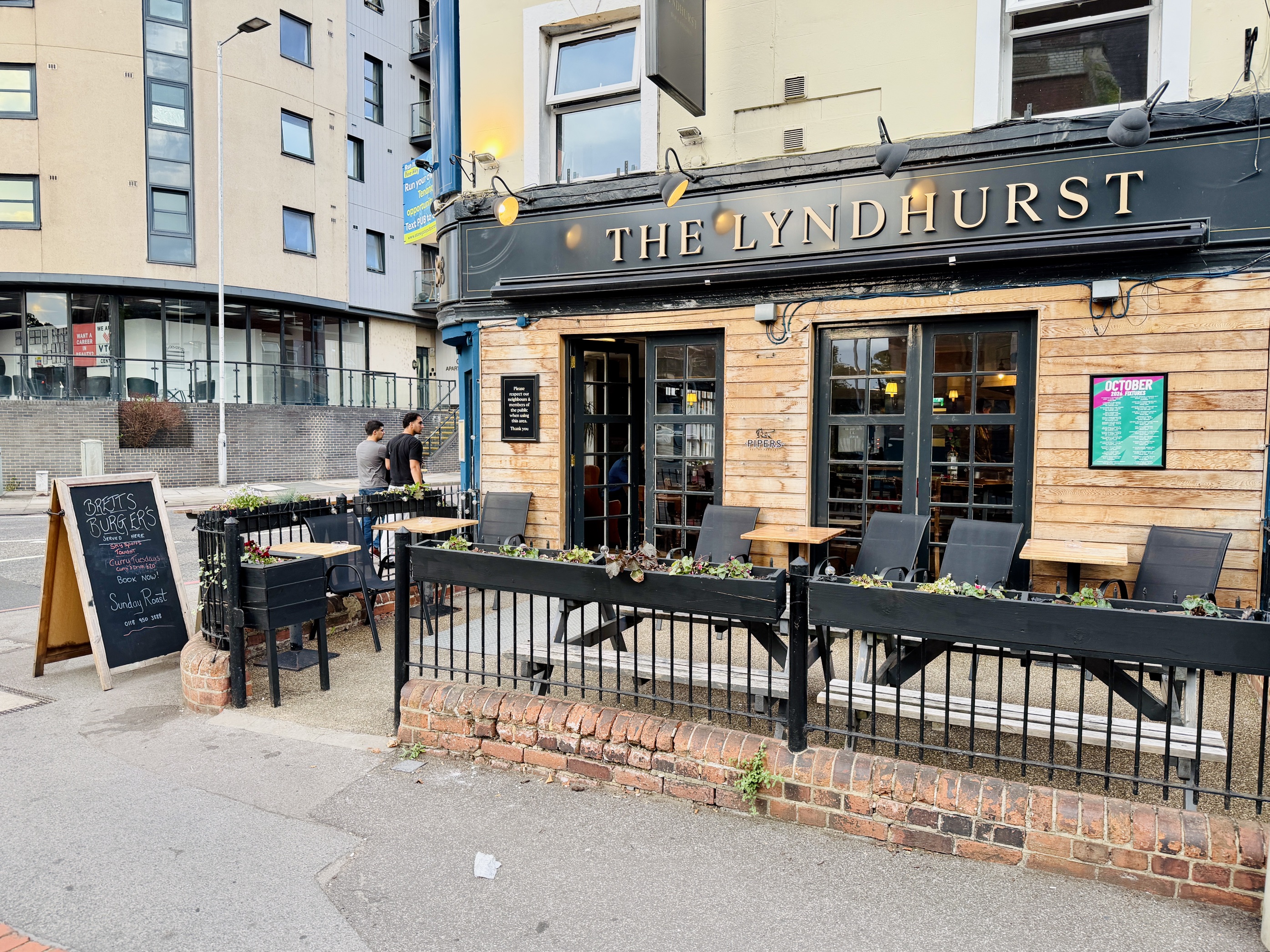
Pub review: Brett’s Burgers at The Lyndhurst

From late 2019 until the spring of 2024 The Lyndhurst boasted some of the best food Reading has ever seen: varied, exceptional quality, ludicrous value. Since then, the pub has become a perfect encapsulation of many of the problems facing hospitality in general and pubs in particular.

I’m not known for my concision, but make yourself comfortable and I’ll try to run through the potted history of the pub since landlords Sheldon Fernandes and Dishon Vas moved on in May 2024. Here goes: first of all the pub was taken over by Becky Blissett, about a week after it had closed its doors. Blissett had a turbulent reign which mostly seemed to involve her complaining to the local papers about a perceived whispering campaign that the pub wasn’t as good as it used to be.

She was particularly rattled by what she said were false claims that she intended to turn the pub into a sports bar. Let’s take her word for it about that, but the main thing I remember from that time was the pub’s weird AI-generated posters on Facebook showing an anthropomorphised lion wearing a football shirt sinking a pint in a generic pub which looked nothing like the Lyndhurst, designed to get punters in to watch the Euros. But, you know, not a sports bar.

The pub was also known during that time for closing regularly at short notice – sometimes announced on social media, to be fair – and for a video someone added to a Google review showing some of the pub’s new regulars verbally abusing a couple of passers-by for the crime of walking their dog. As my wife liked to put it, the landlords went from caretakers to undertakers.

Five months later it was over and the pub was under new management again: rumour has it that Blissett received her marching orders on holiday. Because, make no mistake, the true villain of this story is the pubco, just like usual. They are the ones who hiked the rent, which forced out an enormously successful team doing exactly what pub landlords are supposed to do. The chaos that has followed since clearly demonstrates that they never, ever had a Plan B.

Let’s walk through the rest of the chaos. In November 2024 new landlord Jim Kelly stepped in. We’ll call him Landlord No. 2. Kelly was sort of a pubco-appointed firefighter who joined failing pubs to stabilise them, but speaking to the Chronicle it sounded like he was after a more long-term gig this time. “We have done so many, so now it’s time for us to stay and reap the benefits,” he said. So naturally he left the following January: what else did you expect?

Landlord No. 3 came on board at the start of 2025 and looking at the Lyndhurst’s social media from that point onwards, you can see them desperately trying everything to get people to drink in the pub. Gigs, DJ nights, sport, the veritable kitchen sink. For a long time, to the untrained eye, it looked like they’d given everything a whirl except offering really good food. Not that they didn’t serve food, because they did, but there was more chopping and changing on the menu than in the kitchen.

None of it seemed to take, because the food options became increasingly desperate. They launched a new menu in January 2025, and then some kind of tapas-style menu the following month. Later in the year they seemed to do a daily special under the title “Wots (sic) In The Pot”, including such delights as “sausage casserole” and “savoury mince & potatoe (sic)”. What other kind of mince is there?

Each of these things was announced with a new AI poster, because if there’s one thing that unites everybody who’s tried to make a go of the Lyndhurst since Fernandes and Vas left it’s a weakness for shitty AI art. Yes, I know pubs can’t make any money and they can’t afford to hire graphic designers. They can, however, afford to spell check the word ‘potato’. And they can afford to check whether what they put out makes sense, which for example their AI slogan We Put The Mmm In Our Curry manifestly didn’t.

The AI posters weren’t confined to food though: one celebrated Armed Forces Day, another particularly risible one marked VE Day by mocking up a picture of the Lyndhurst where it had mysteriously acquired an additional storey and moved somewhere completely different – a generic street in Belgravia, by the looks of it. They were flying about six Union flags, for that matter. I’m not sure when the Lyndhurst got so jingoistic: it felt like Landlord 3 was running the pub they were used to running in a new area, without checking first whether it fitted in at all.

For some reason the one pot classics didn’t do the job, so there were more culinary convulsions for the remainder of Landlord No. 3’s time at the helm. They set up a café on the terrace, to try and catch the morning trade. They decided to offer jacket spuds, that epitome of the high life, under the name “Loaded Kitchen”, and then they tried Yorkshire pudding wraps. And finally, at the start of this year, they had one last throw of the dice doing the one thing they had previously avoided: offering food people might actually want to eat.

So in January they gave their kitchen to a South African team, Smoked Oak, who had also popped up at the Nag’s Head. Smoked Oak offered Braai boards, boerewors rolls and, by all accounts, a killer potato salad. It looked decent: it was getting to the point, in fact, where I thought it was time to pay them a visit and check it out. So inevitably – you can see what’s coming, can’t you? – Landlord No. 3 left the pub in June. Of course they did. It was in danger of becoming some kind of success.

I sat out all those comings and goings, so why did last Friday find me strolling down Watlington Street to visit the Lyndhurst for the first time since Fernandes’ and Vas’ farewell bash, almost two and a half years ago? The answer is that when the Lyndhurst opened again last month, with Landlord No. 4, Stephen Williams, in charge, it announced a development that had people in Reading talking: the food in this latest incarnation would be by Brett’s Burgers.

Subscribe to continue reading

Become a paid subscriber to get access to the rest of this post and other exclusive content.

Restaurant review: Mignonette, Richmond

A couple of Fridays ago I was sitting outside a very pleasant café called Butter Beans, a minute away from Richmond’s beautifully refurbished Art Deco train station, experiencing what could safely be described as mixed emotions. I was happy, because I was about to have French food for lunch. But I was also sad, because I was not in France doing it.

I was supposed to be. It was the week of my annual big holiday and our plans, made right at the start of the year, were to return to Montpellier, arguably my favourite city in the world. We had booked the bed and breakfast we always stayed in, and the room we always stayed in, for that matter, and I had been daydreaming about a glass of wine or a cold beer out on the roof terrace before dinner. The city had decided – jolly decent of them, if you ask me – to organise a week-long craft beer festival to coincide exactly with my time there.

In a parallel universe you wouldn’t be reading this review, and I’d be sitting on a terrace somewhere (an hour ahead, you see) with a bottle of Languedoc white and a menu in front of me, no doubt being insufferable – well, even more so – on social media. But many of my holidays have come a cropper in the last twelve months, and this one was no exception: Zoë needed an operation on her back, and it was scheduled for the day after we’d come back from France. But in the run-up to the procedure she was in too much pain to catch a train to the airport, sit on a flight for three hours, sleep in an unfamiliar bed, the list goes on.

As the date of the holiday inexorably approached I knew that we would have to have The Conversation, so I mentally prepared myself. I stopped thinking about what restaurants to book, unfollowed various places on Instagram so I wouldn’t have to look at all the dishes I wouldn’t eat and all the fetching dining rooms I wouldn’t eat them in. I unfollowed the beer festival too, said nah nah nah I’m not listening to all the tap takeovers and events.

It was fine, I told myself. After all, when I broke my arm we cancelled a couple of trips away and Zoë, who is of course a far finer human being than I am, never made me feel guilty. There will be other times she said, and I know she meant it. She had given me the script nine months ago, and when we had The Conversation I faithfully followed it. And I meant every word, because that’s what marriage is about, but I have a feeling Zoë would have done a better job of hiding her devastation. Or perhaps she wouldn’t have been devastated, because she’s not unworthy like me.

I kept the week off though, convincing myself that a staycation might be nice. And I decided to treat myself on the Friday with a little solo excursion, lunch with a paperback, a day out on the train. Maybe it was the new series of Ted Lasso, perhaps it was something else, but I found myself eyeing up Richmond as an option. It was a leisurely direct train, taking almost exactly an hour, and there was a very appealing French restaurant a short walk away from the station: technically in Kew not Richmond, I suppose, but not worth splitting hairs over.

Mignonette has just celebrated its second birthday, and it’s safe to say that it’s had a decent couple of years. It won a Bib Gourmand from Michelin after it had been open barely six months, and although it hasn’t so far come to the attention of the broadsheet critics, it did receive a very positive writeup from restaurant guru Andy Hayler – who has featured on the blog before – when he paid it two visits in the first couple of months. “Already shaping up very nicely indeed” was his verdict.

It is owned by chef John McClements, who previously held a Michelin star at a restaurant in nearby Twickenham, and most of the coverage it garnered in the first few months focused on its value for money. Mignonette, you see, offers an extremely affordable prix fixe at lunchtime (“even less than Noble Rot’s” was one comment) and McClements, speaking to the Standard, made much of his attempts to keep costs down, running a lean ship in the kitchen and cutting out the middle man when sourcing ingredients.

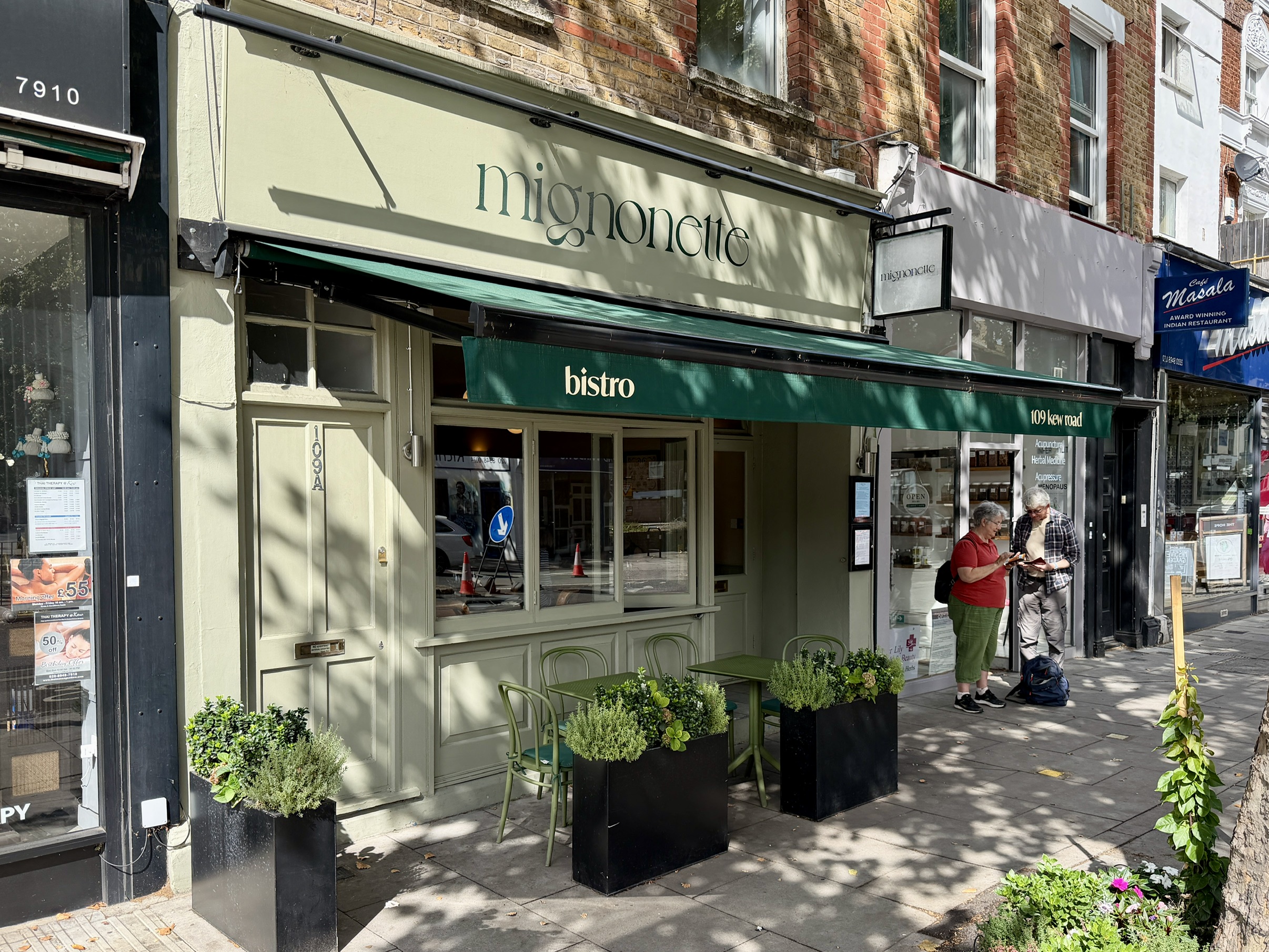
“Reasonably priced” felt like a difficult concept to square with “just around the corner from Richmond station”, so I decided it merited a visit for that reason alone, if no other. Fortified by excellent caffeination, I made the short stroll in the sunshine. You couldn’t miss the place, with its tasteful sage frontage, racing green awning and micro-terrace with a couple of tables outside. It reminded me somehow of Chelsea’s Medlar, as if a distant relation, and that shared language made me strangely confident that a promising lunch was in the offing.

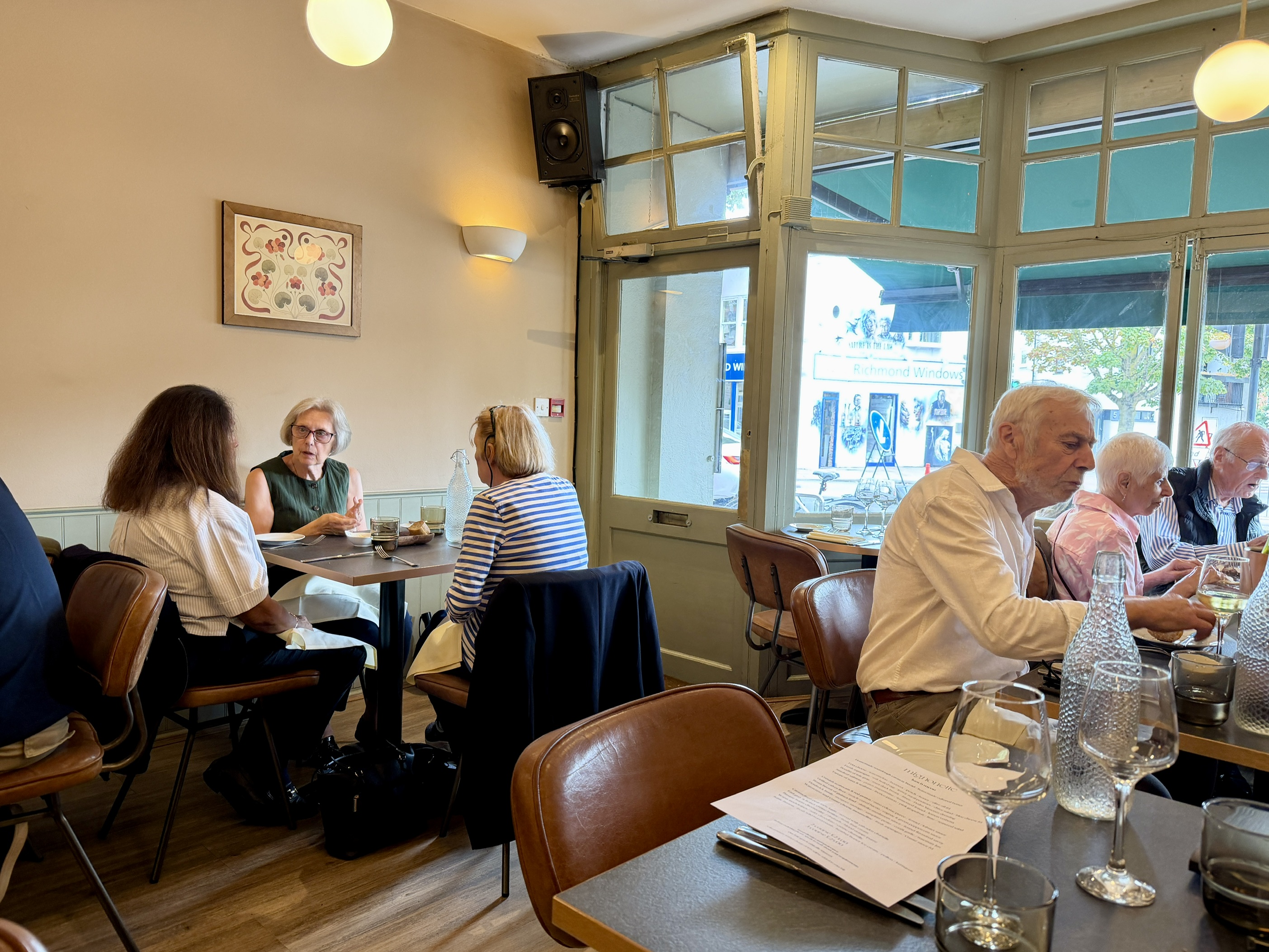
The one review I’ve found online of Mignonette was sniffy about the interior (“no expense has been incurred”, it sneered) but I thought it was absolutely fine. It’s a compact room with about thirty covers, although I think they have more space on another floor, and while it’s pretty plain and unadorned, I think I’d pick that over ersatz.

I do think a couple of the smaller tables are ones you wouldn’t want, especially the table for two crowbarred into the bay window, but I had no complaints. I had a great table with my back to the wall, plenty of space and an unimpeded view of the comings and goings of both the diners and the small, friendly and extremely efficient brigade of serving staff.

I don’t know what this says about the demographic of the area, but I was one of the youngest people in that dining room and I think we all know by now that I’m no spring chicken. Bloody boomers, eh? They were there taking advantage of the prix fixe when, generationally speaking, they’re the bastards most capable of paying for the à la carte. I guess being retired comes in really handy when you’re having your main meal at lunchtime.

Just how much of a bargain Mignonette’s set menu is came as a surprise to me, even though everything I’d read said as much. Initially I was disappointed that it was the only menu available: the à la carte comes out to play in the evening. But then I read it and any disappointment evaporated. It is – you may need to read this a couple of times and I promise it’s not a typo – £23 for 2 courses or £25 for 3. Normally that is done by using cheaper ingredients, or by just giving you two choices per course – one meat and one vegetarian, say, with an additional fish option if the restaurant is in a giving mood.

None of that was the case here. Five starters, five mains and five desserts to choose from, with foie gras, smoked salmon, jamon iberico, guinea fowl and lamb all making an appearance. And there were flashes of interest almost everywhere you looked: fermented fennel with one starter, seaweed salad with another, treacle-cured bacon or Merguez sausage cropping up with the mains, heather honey ice cream, pollen and kumquat paired with one of the desserts. I would have only found a prix fixe as attractive as this in a couple of my Montpellier haunts, and they would both have been more expensive.

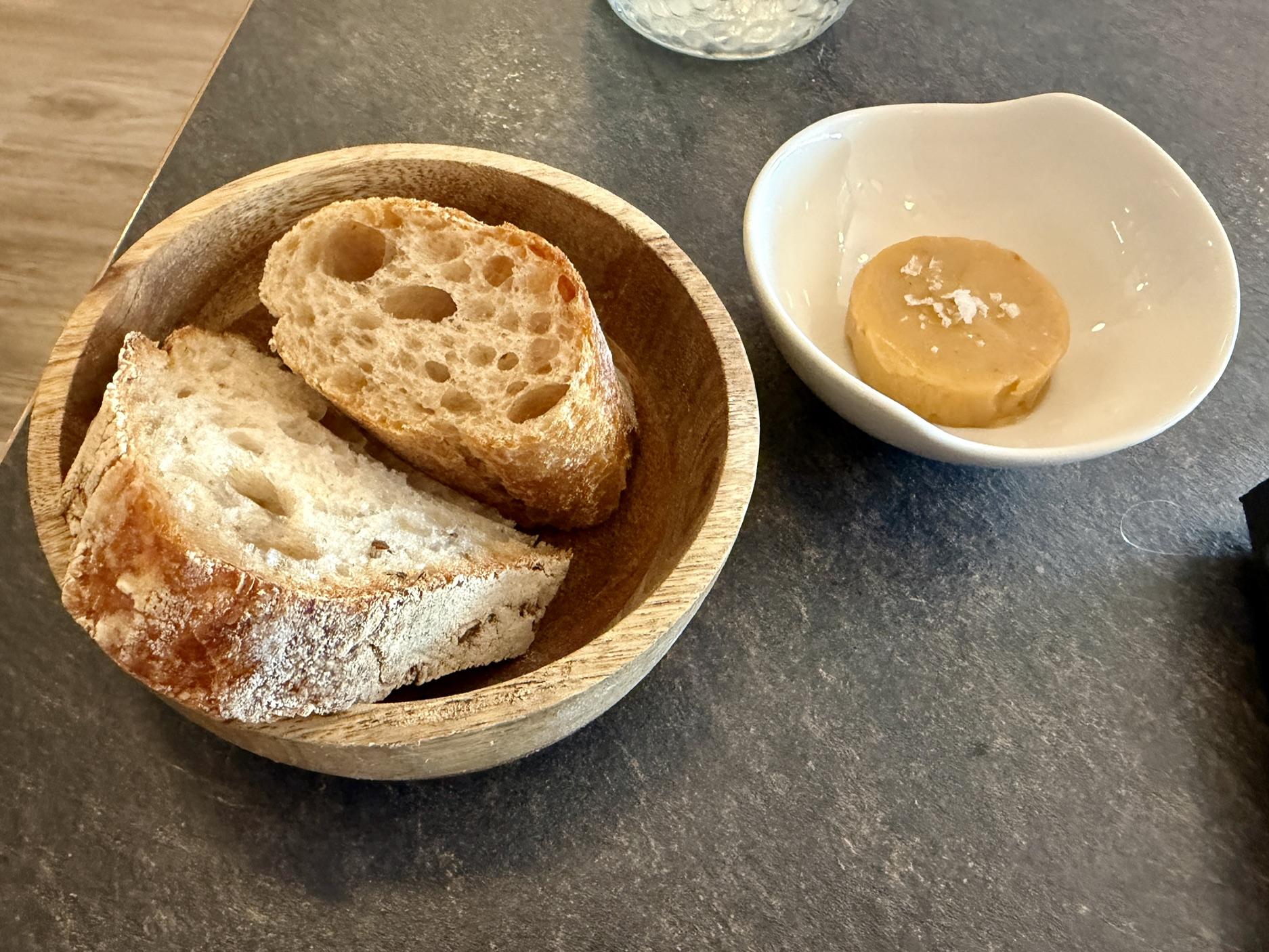
Whichever permutation of dishes you eventually choose your meal begins, as mine did, with bread and butter. Two types of bread – one a lightly seeded loaf and the other a slice of baguette with an impeccable airy springiness. They came with Mignonette’s Marmite butter, which was the colour of a fudgy caramel and had a relatively subtle but unmistakeable umami depth. It might even convert people who think they hate Marmite, not that I’m among that tribe. A review I read was dubious about this being the default rather than a bog standard salted butter: some folk are just ingrates, if you ask me.

Both bread and butter were replenished when I tore through them, which I found extremely winning. By this point I had a respectable £28 half bottle of Fleurie in front of me, along with my paperback (An Absence Of Cousins by Lore Segal: don’t bother, I feel like I’ve been reading it all year) and the sunny afternoon stretching out ahead. Everything was going very swimmingly indeed.

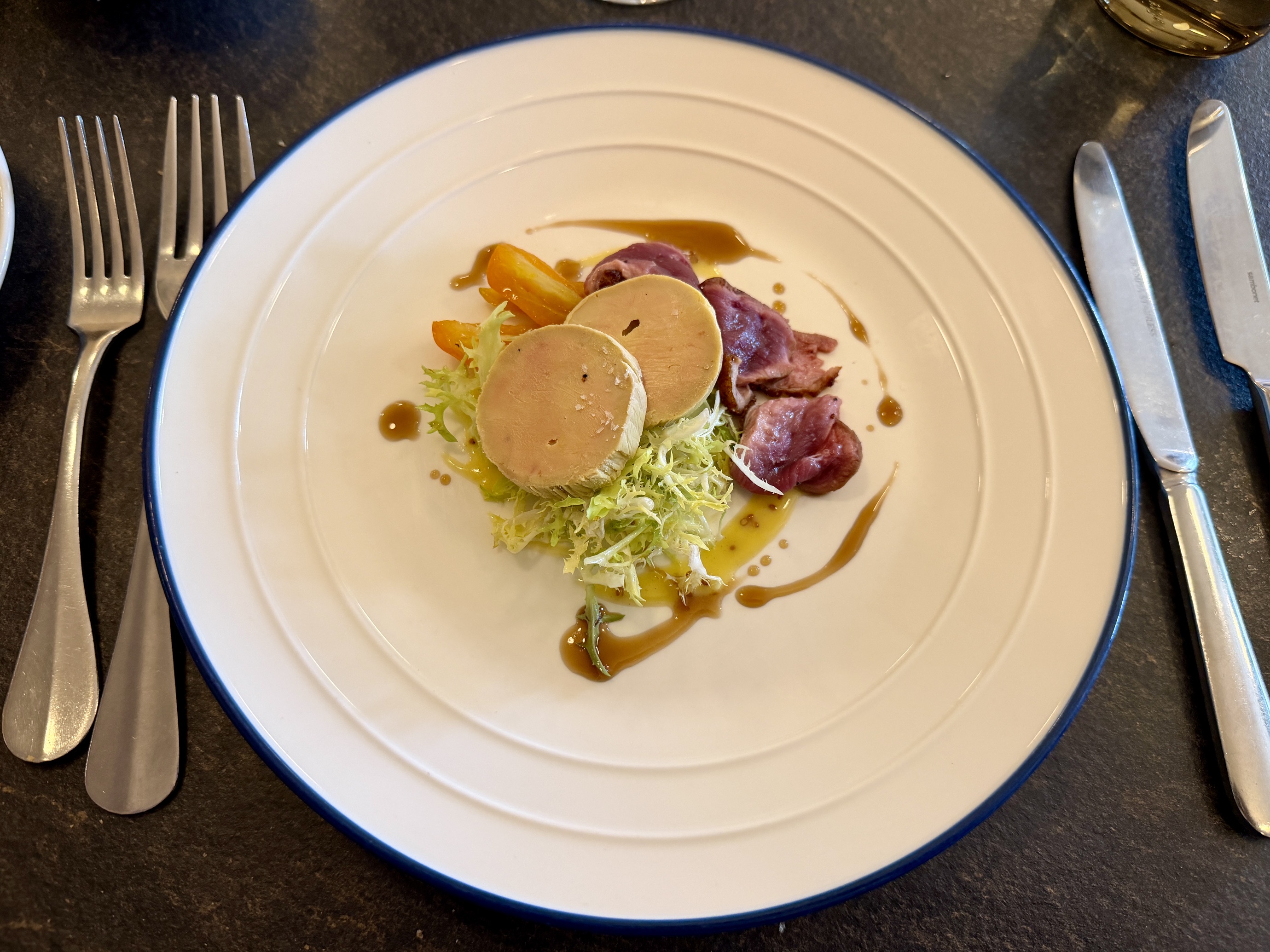
That trajectory was not remotely altered by a very fine starter. What was billed as a boudin of foie gras – ethical foie gras, the menu takes care to point out – was two glossy discs of the stuff, with a little sprinkle of salt, served with thick ribbons of duck. The latter was allegedly roasted, but I’m not sure exactly how roasted anything can be when its centre is quite so ruddy: that didn’t matter though, as it proved a marvellous counterpoint.

Hidden underneath were two little nuggets of sunshine which at first I took to be sundried tomatoes, but had a note of citrus that made me think they were possibly something like kumquat. And frisée, which is a leaf I generally cross the road to avoid. And a gorgeous dressing with a flourish of Pedro Ximenez that made me think that everybody who had tried to serve me frisée in the past had just been doing it wrong. This is the genius of French cuisine at its best, to me, if it can make frisée a treat.

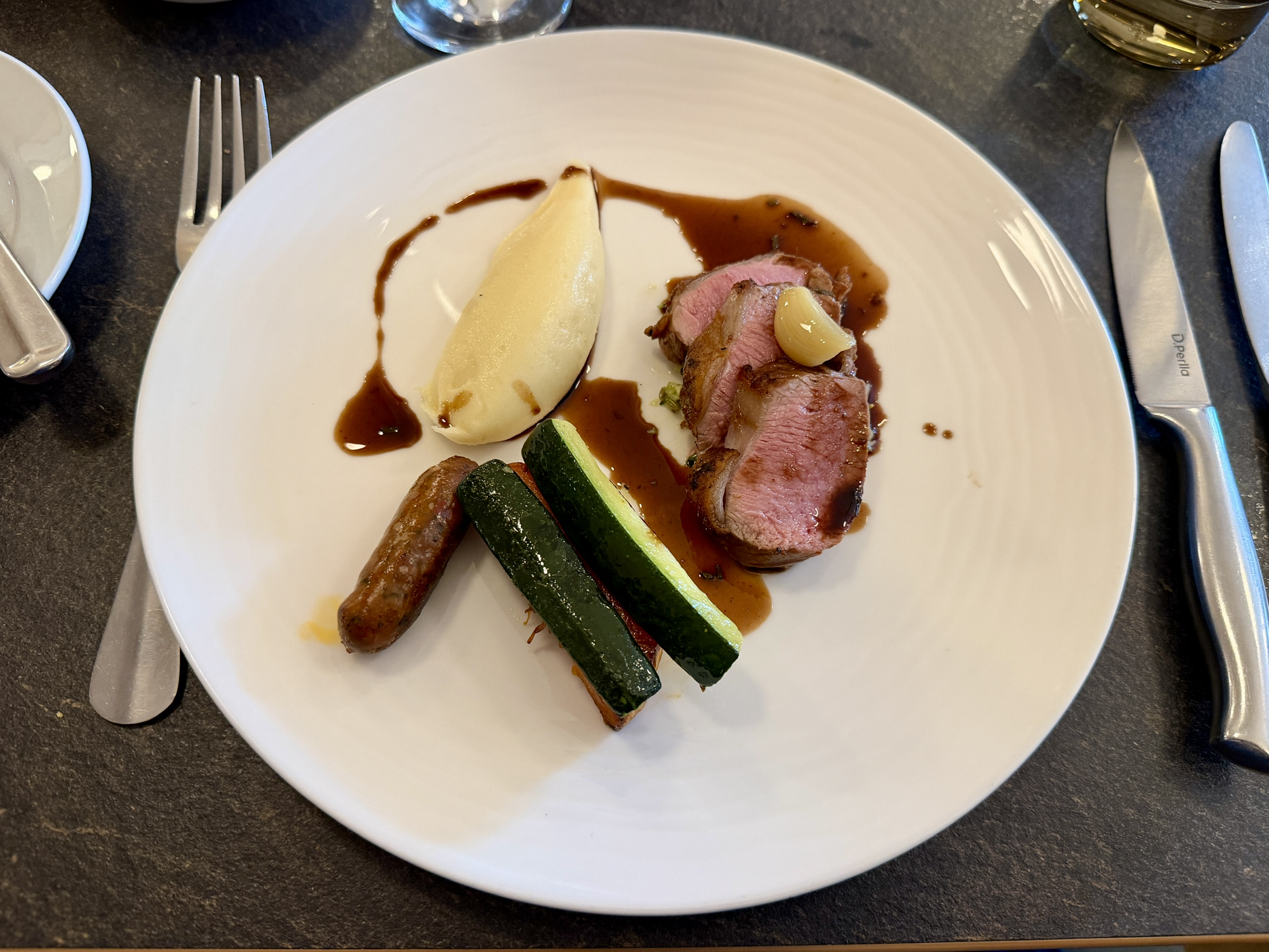
If the starter was strong, the main was better. Knockout, in fact. Three thick slabs of Herdwick lamb, cooked impeccably, with an embarrassment of riches in support. A soft golden clove of garlic on top. To the side, a quenelle of dreamy pommes purée and two batons of delicious, just-firm-enough courgette. A semicircle of what could have been squash, or pumpkin, again cooked bang on, so soft it could have been confited.

Under the lamb, a phenomenal samphire pesto – a new one on me, but a superb advert for not just eating samphire with fish. And then one final treat: a nubbly little Merguez sausage, from the other side of the tracks to that blushing loin but providing exactly the heat, poke and contrast that catapulted this from a very polished plate of food to one of my dishes of the year.

A couple of months ago, in Cheltenham, I had an exceptional lamb dish as part of Le Champignon Sauvage’s à la carte menu. That menu was £92 for 3 courses. This dish was its equal in accomplishment and quality, on a menu where 3 courses sets you back £25. It is simply unbelievable that Mignonette can offer this range and quality at this price – I’m not sure how they can do that, or how sustainable it is, but I can tell you how wonderful it feels to be a beneficiary of that.

What I would also say about Mignonette’s lamb, before we move on, is that I can’t remember ever eating a dish quite so mindfully. Not just in the glass half empty sense of being aware of it coming to an end – although yes, that too – but in the sense that every forkful was considered, every permutation of components was tried and tasted. Just as you can order from a menu countless ways, it felt like you could eat this dish countless ways too. I loved it. I tore a little crust off my bread to mop up the final whispers of rosemary jus, before loading every last molecule of Marmite butter on to the remaining piece.

I felt a responsibility, as a table for one, to try and spend enough that the restaurant didn’t lose too much money by accommodating a lone diner. That’s my excuse for the alcohol on my final bill setting me back more than the food did. It’s my excuse for laying waste to a half bottle of red, and it’s the reason I ordered a glass of Pineau des Charantes to go with my dessert. It was a glorious pour of potent nectar, and I adored it. You need to at £18 a glass, and I know that on paper that’s ridiculous: in my defence, when the food is reasonably priced to the point of irrationality, it makes you do crazy things.

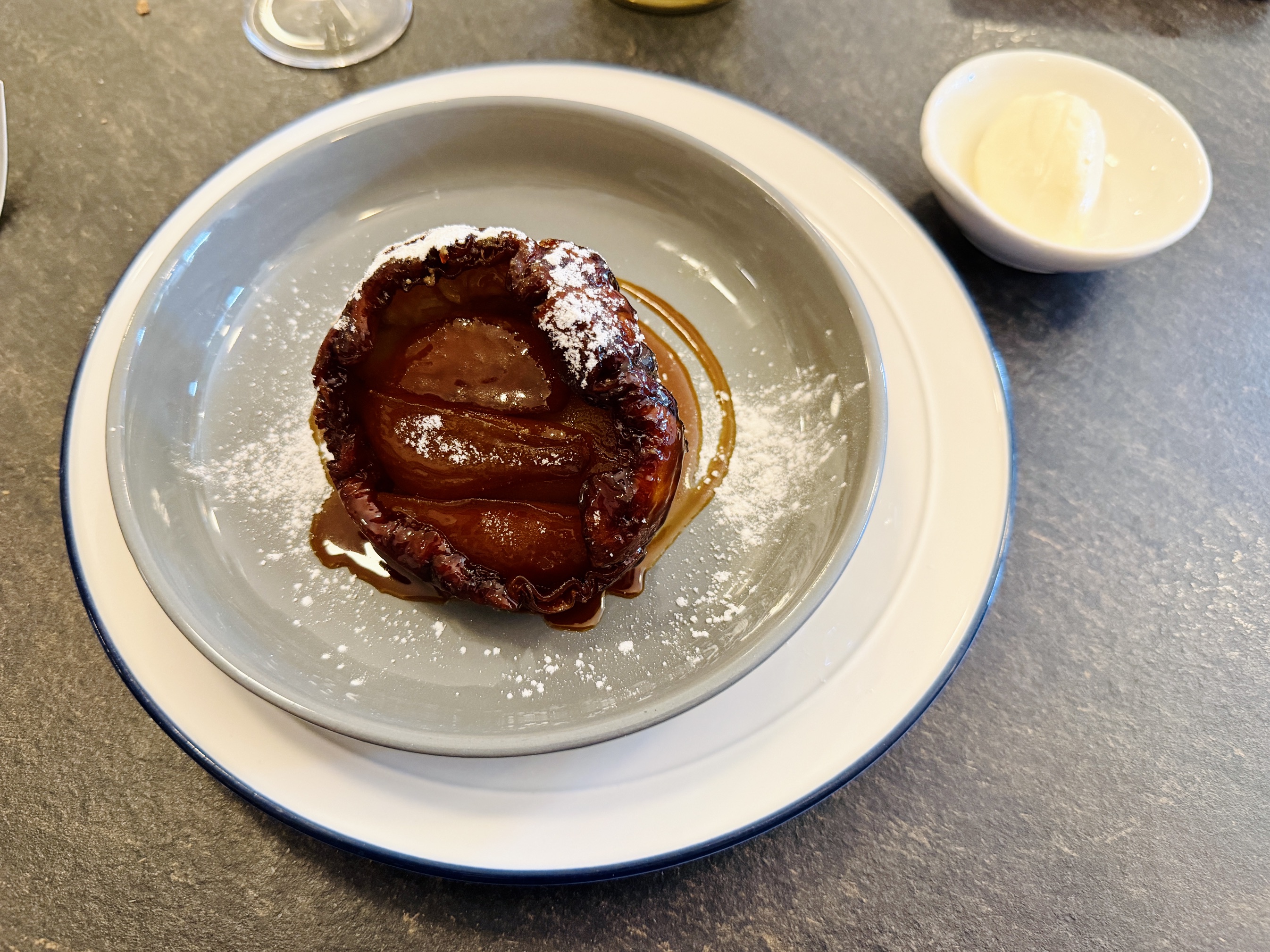
My dessert with that was a caramelised pear tarte tatin, and if it was the weakest thing I ate it was still miles from an ordeal. It was an individual tarte rather than a section of a larger whole, and something about it didn’t entirely work. The apples were scorching hot, the pastry not quite so: it felt as if they’d met late in proceedings, even though I knew that couldn’t be the case.

But these are not serious problems, not against the backdrop of such a brilliant meal. The sticky caramel sauce encircling the tarte was a thing of beauty, and the crème Chantilly, shot through with Calvados, was arrestingly good. I perhaps might have enjoyed the Earl Grey and honey crème brûlée better, or the Basque cheesecake with rhubarb, but there may be other times to weigh those up. I didn’t see any of them waft past to other tables, which gave me less to envy. Besides, technically this dessert cost £2.

The whole affair was brisk, which I might object to in other circumstances, but for a prix fixe – and a ludicrously priced one at that – I had no problem with it. I was asking for my bill just over an hour after I took my table, and the whole thing came to £78, including an optional 10% service charge. I occasionally say “but you could spend less”, sometimes less convincingly than others, but it’s definitely true here.

So yes, Mignonette is quite extraordinary. To put that set lunch in context, at home and away, it is considerably cheaper than London Street Brasserie, and miles better. Or if you want to compare apples with apples and talk about French restaurants, it’s also less expensive than Oxford’s Pierre Victoire – and much as I love that place it doesn’t come close to Mignonette in terms of quality.

A placid hour on the train, a ten minute walk and food so good that it’s verging on a giveaway, including dishes that hold their own against far pricier ones at acclaimed Michelin starred restaurants. Can you tell I quite liked the place? It is a destination restaurant in a neighbourhood restaurant’s clothing, and I really want to go back to try their à la carte one evening. This is my first review from Richmond, and much as I loved ambling round it I wouldn’t hold out for a sequel any time soon: if I’m in that part of the world, I’ll probably be eating at Mignonette.

The rest of my afternoon was quite lovely, since you asked. With the happy afterglow that a brilliant lunch and a little booze can give, I headed to Kiss The Hippo and had a fantastic latte before buying some beans to take home. I mooched around town window-shopping and remembering times, a lifetime ago, when I was a far more frequent visitor to Richmond.

I sat on a bench by the green and watched all the happy tourists pass by in their Richmond FC shirts, and I was far too replete with the milk of human kindness to judge them at all. And I stopped in a hugely likeable fragrance shop called Parfum Le Dance, because that’s the kind of thing I do, and sprayed countless bottles on strips of paper before taking my three favourites for a little walk, drying down on my wrists and hands. And then I went back to buy a bottle of something indulgent to remember the day by. Why not? I was on holiday after all.

It was, I reflected on the train home, a day out for the ages. Good French food, excellent coffee, people watching and fragrance shopping: I hadn’t missed Montpellier in the slightest.

Mignonette – 9.1
109 Kew Road, London, TW9 2PN
020 82401215

https://www.mignonettebistro.com

Since January 2025, Edible Reading is partly supported by subscribers – click here if you want to read more about that, or click below to subscribe. By doing so you enable me to carry on doing what I do, and you also get access to subscriber only content. Whether you’re a subscriber or not, thanks for reading.