Restaurant review: Mono Pizza, Basingstoke

There’s an exhibition on at the Willis Museum in Basingstoke called I Grew Up 90s, and speaking as someone who tried and failed to grow up back then I felt I had to go and experience it, even if it was tantamount to enthusiastically massaging salt into the gaping wound of my middle age.

I never thought I would see the day when the Nineties came back into fashion, in much the same way no doubt that my parents rolled their eyes when kids decided to revive the Sixties. It had an air of ‘kill me now’ about it, as far as I was concerned. I can’t believe you like all that crap from back then people like me could reasonably say, although I now realise – with the perspective of thirty years’ distance – that what we really mean is Jesus, I am so old.

The Willis Museum is housed in the former town hall, an attractive building at the top of a gentle hill in the older part of Basingstoke, past the purgatory of Festival Place. On the way there a strip of street food stalls was doing a brisk trade – a sizeable queue outside the Thai stall suggested, as did the aromas, that it was decent – and in the market place outside voluble traders were flogging veg from trestle tables. The graceful early Victorian architecture was impressively incongruous, I thought, as I passed between the pillars of the entrance, ready to do some time travel.

Inside, the placard on the wall made an interesting case for the decade, depicting it as a strange bubble of time that history had forgotten. And I think there’s truth in that. It was a strangely innocent time, after the fall of the Berlin Wall, the Gulf War and the release of Nelson Mandela but before 9/11 and the credit crunch. In the Eighties we were scared of the bomb, or AIDS, but in the Nineties we weren’t scared of anything. We were lucky, but of course we didn’t know that.

The exhibition aimed to remind visitors of the Nineties through over 200 objects and artworks. It was the decade of Girl Power and Cool Britannia, the introductory blurb said. On the Internet we asked Jeeves, and on the streets we paged each other (incidentally, my favourite Easter egg of the time was that if you asked Jeeves “are you gay?” he always produced the result “I prefer the word jovial“: and to think people reckon they’re so original nowadays asking Siri to tell them a joke).

There were no smartphones, social media or reality TV to distract us, but we might occasionally have returned a tape late to Blockbusters, concluded the introduction. And wandering round it, feeling simultaneously old, young, comforted and sad I noticed they did have a huge Blockbuster logo on one wall, and a cabinet full of VHS tapes: Notting Hill; Ace Ventura; True Lies; Basic Instinct.

An HMV carrier bag was framed on another wall. “God, the number of those I must have handled” said Zoë, who worked there when the Nineties were already almost a decade in the rear view mirror, the shop still flogging CDs ahead of the death rattle caused by iPods, iPhones and streaming. I wondered how many times I’d come home from the Oracle on New Release Monday with one of those.

Other cabinets were full of reminders of other aspects of that forgotten age, trying hard to present it as halcyon. The Cadbury’s Spira bar – which I still miss, I don’t mind telling you – and a tub of Gino Ginelli ice cream. A giant foam finger from the original series of Gladiators. Cartman, Beavis and Butt-Head, arguably the most puerile firm of solicitors there never was. Purple Ronnie and the very first Nokias and Motorolas, a loaf of Mighty White and a recipe book for Chicken Tonight. The posters for Four Weddings, Reservoir Dogs and Trainspotting. A can of Tab Clear (“trial offer 23p”), a bottle of Two Dogs and a Hooch branded glass.

You could even buy a Tamagotchi from the gift shop, which reminded me that once in the Nineties, when my brother went to some insurance conference in Manchester overnight, he asked me to take care of his Tamagotchi which, of course, promptly died. I’m not sure what the electronic equivalent of getting another almost identical one from the pet shop was, but I remember fessing up to him in the Flier & Firkin – which is what the Oakford is now – and him taking it much more personally than I expected.

Standing there in the gift shop, seeing the packaging for ‘the original virtual reality pet’ I took a photo and sent it to him, knowing that even on the other side of the world in New South Wales, his Saturday night drawing to an end, he was one of the only people I knew who would understand what I was experiencing. Sorry again that I killed your Tamagotchi my message said. You’re forgiven came the response, hours later when I was fast asleep.

All that nostalgia left me badly needing to eat my feelings, and Zoë and I had plans for a late lunch at Mono Pizza, the Basingstoke restaurant highest on my radar. Now, at this point I need to apologise if you’re a reader living in Basingstoke, but my research on where to eat there resulted in fairly slim pickings. There’s taco spot El Bigote, which looks like it’s al fresco only, there’s Nigerian restaurant Afrizi, which I hear is rather good, and there’s Mono.

Beyond that, I didn’t find evidence of a burgeoning food culture in Basingstoke. I suspect Festival Place’s best days may be behind it, and the imminent closure of its Apple Store would suggest as much, but the presence of the likes of ASK Italian, Pizza Hut and Wimpy suggests that even Reading has it good compared to some places. By all means correct me if I’m wrong, because I really do love an underdog.

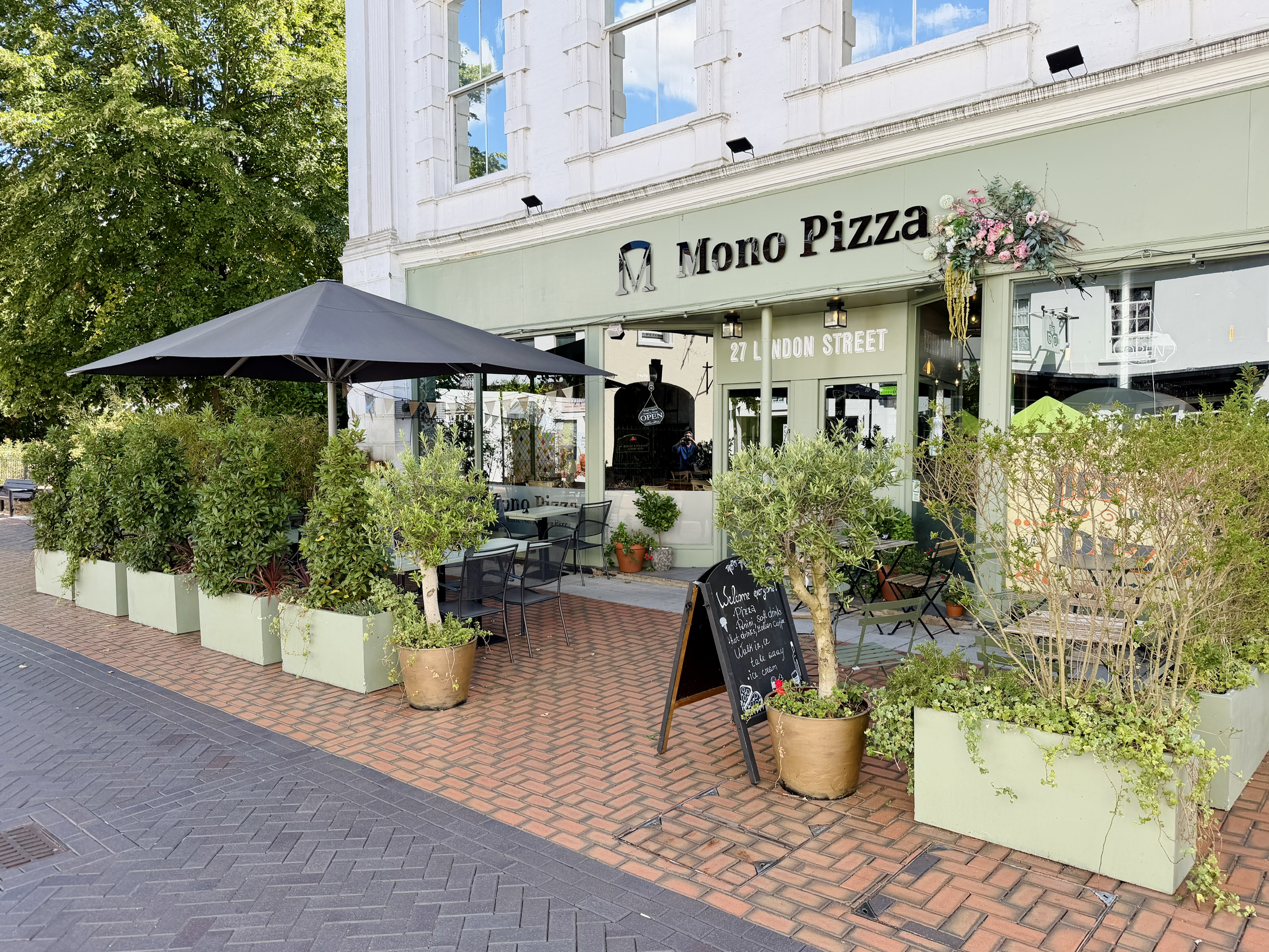
Anyway, Mono was the spot that jumped out at me. Run by married couple Timofei and Veronica Dragan, Mono took the tried and tested route to where it is now: starting out as a pizza van in late 2023, then parking up at a permanent pitch at Festival Place the following spring. And then, almost exactly two years later at the beginning of March, Mono moved to a permanent site just round the corner from the Willis Museum, taking over the ground floor of a handsome building in a spot that used to be a bar.

Plaudits followed when Mono – still a van at this stage – won Best Pizzeria last summer at something called Slice-o-Mania. Now, you can be sniffy about an event of that kind and say that it’s largely attended by people who think pizza is a separate food group, and you might have some justification for thinking that. But the fact remains that a huge amount of big names in the U.K. were there, and for an unsung food van from Hampshire, after trading for less than two years, to win big in that company is a truly impressive result.

And all of my research suggested that Mono was an interesting proposition: that Dragan was from Naples, that he sourced all of his ingredients obsessively from Italy, all the things you’d really want to hear about this kind of establishment. I like a pizza as much as the next normal person, and the bottom has rather fallen out of Reading’s pizza scene since Sarv’s Slice left, Amò closed and reopened and Dough Bros changed hands, so as I approached Mono’s tasteful, sage green edifice I found myself rather hoping for the best.

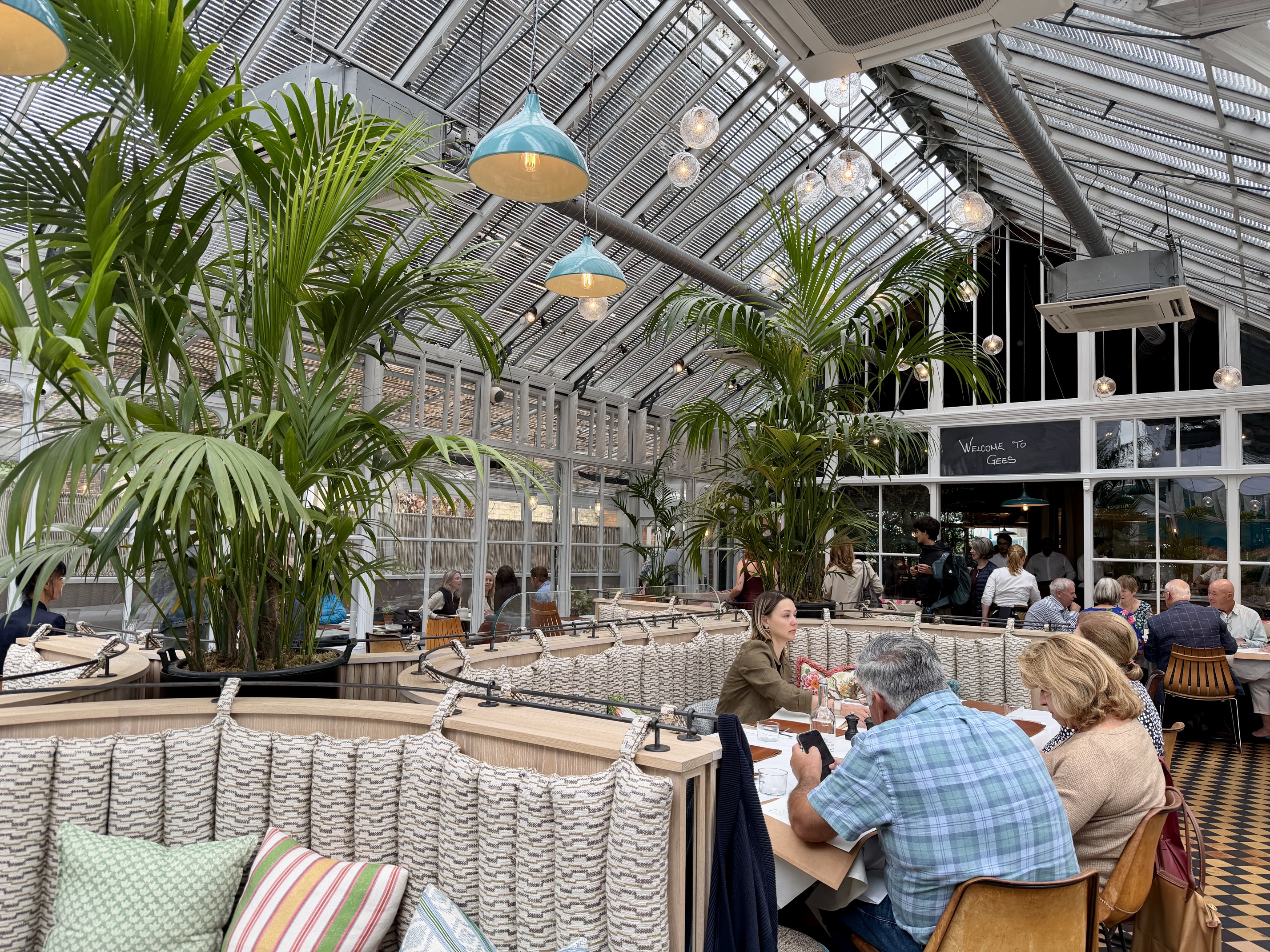
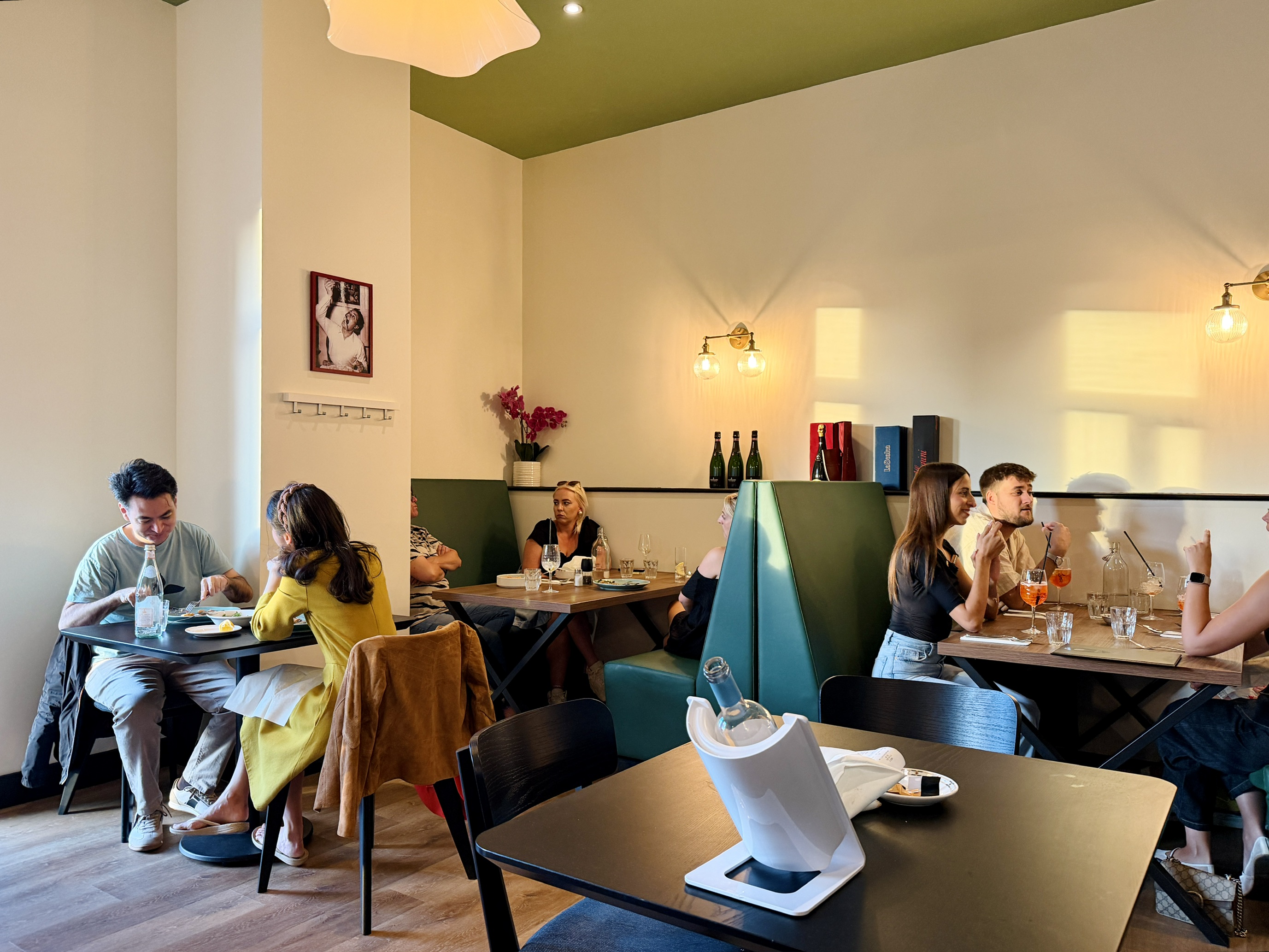
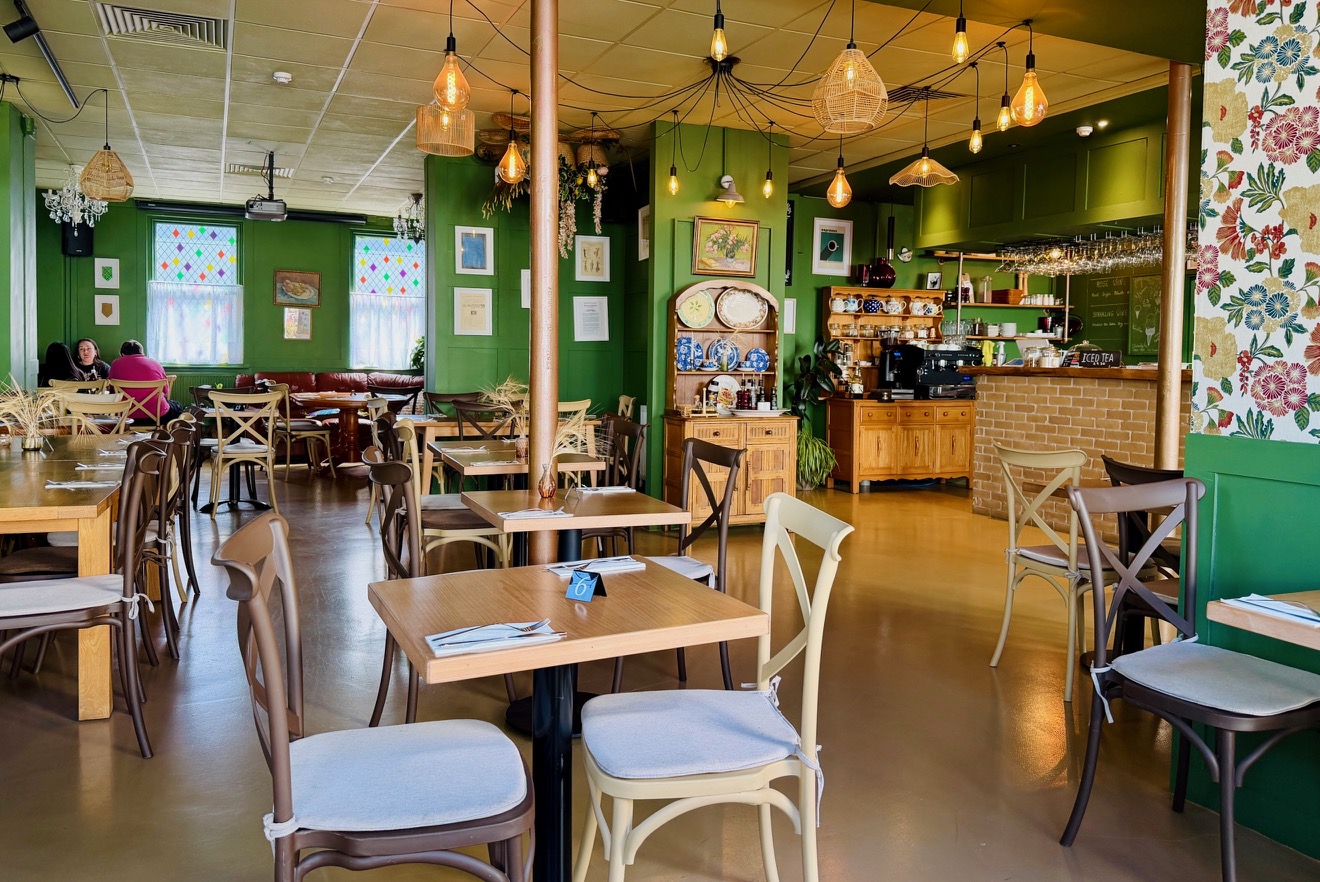
The interior was really rather nice. Big, in a they-might-have-bitten-off-more-than-they-can-chew sort of a way, but nice nonetheless. It was all green walls and well-proportioned tables, with one panel of fake greenery and a few slightly random Welsh dressers dotted around the place. It worried me slightly how quiet it was, though: we were there admittedly after the lunchtime rush had passed, but apart from one table outside and a few occupied within it was almost empty. Maybe everyone was in the queue for Thai street food, or lost in the time machine just down the street.

Over an Aperol Spritz – not bad, perhaps slightly watery – we had a good squizz at the menu. It is, and this is a good thing, very stripped down, not like some pizza menus that go overboard on filler. One antipasti option, three panini, ten pizzas and nothing else: if you don’t fancy that, go elsewhere. And the pizza options were also very restrained – no wacky combinations and not even the anchovy, caper and olive combo that’s inevitably my first choice. There was a simplicity to it: pizza by a purist, for purists.

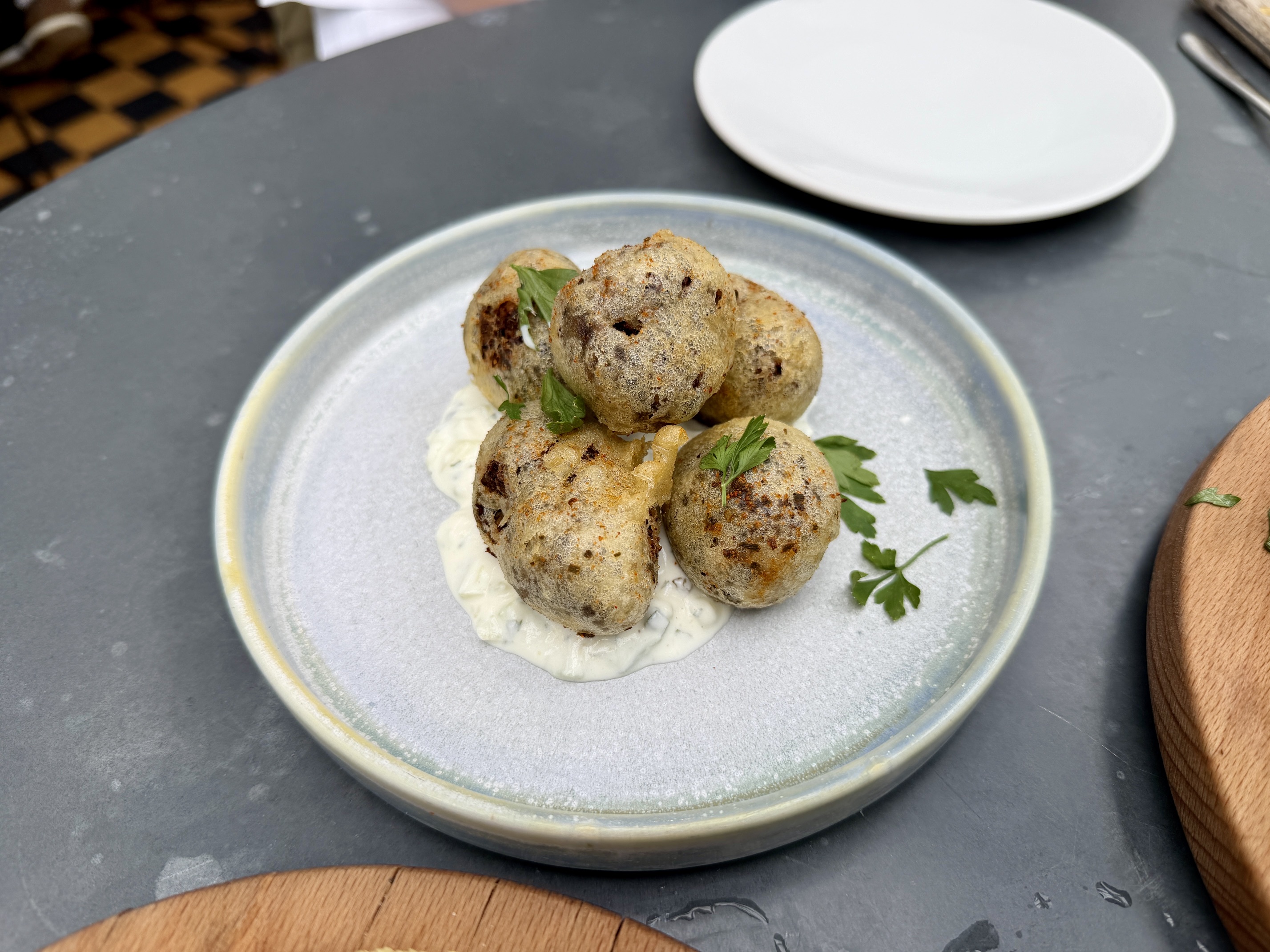
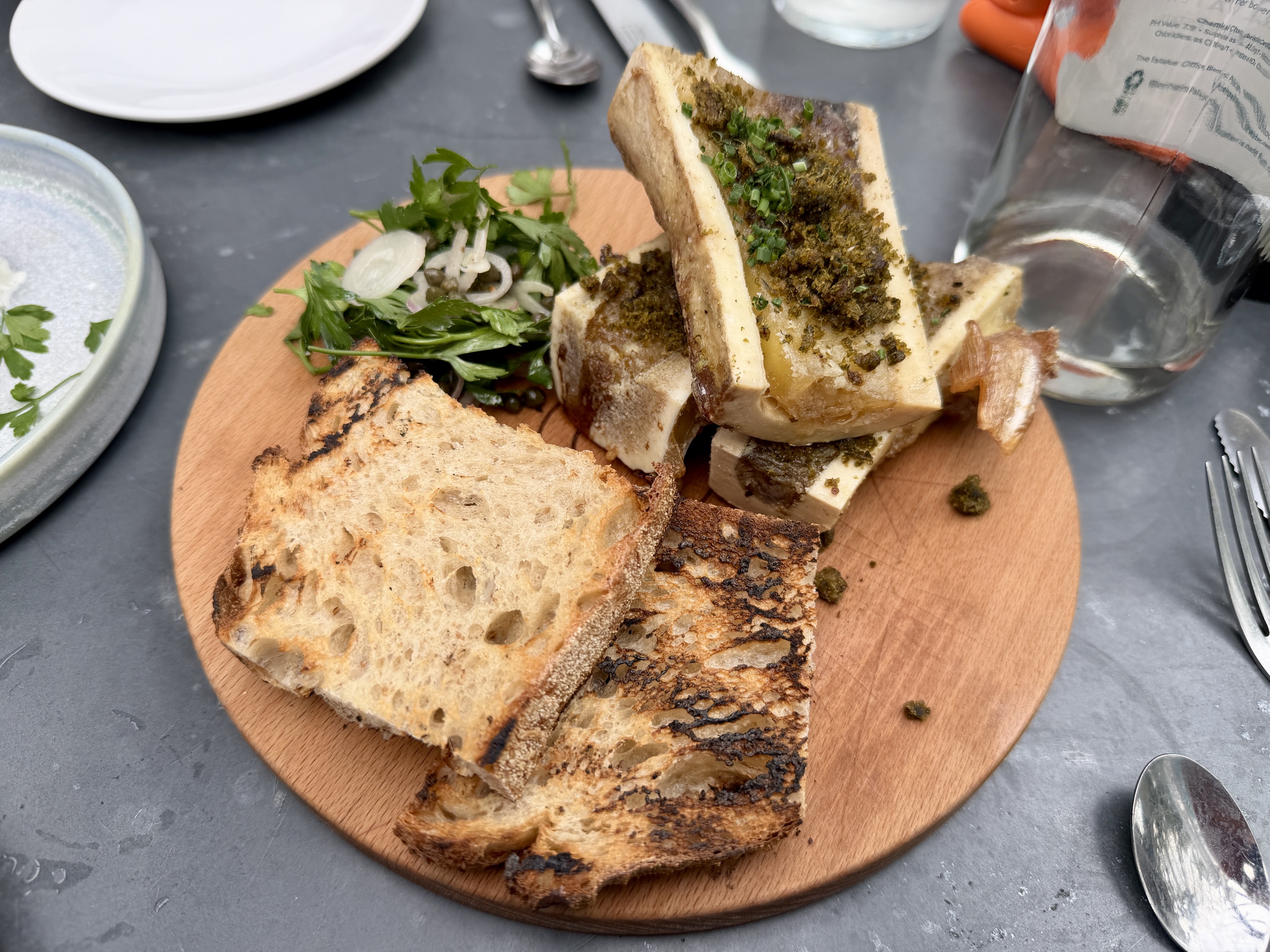
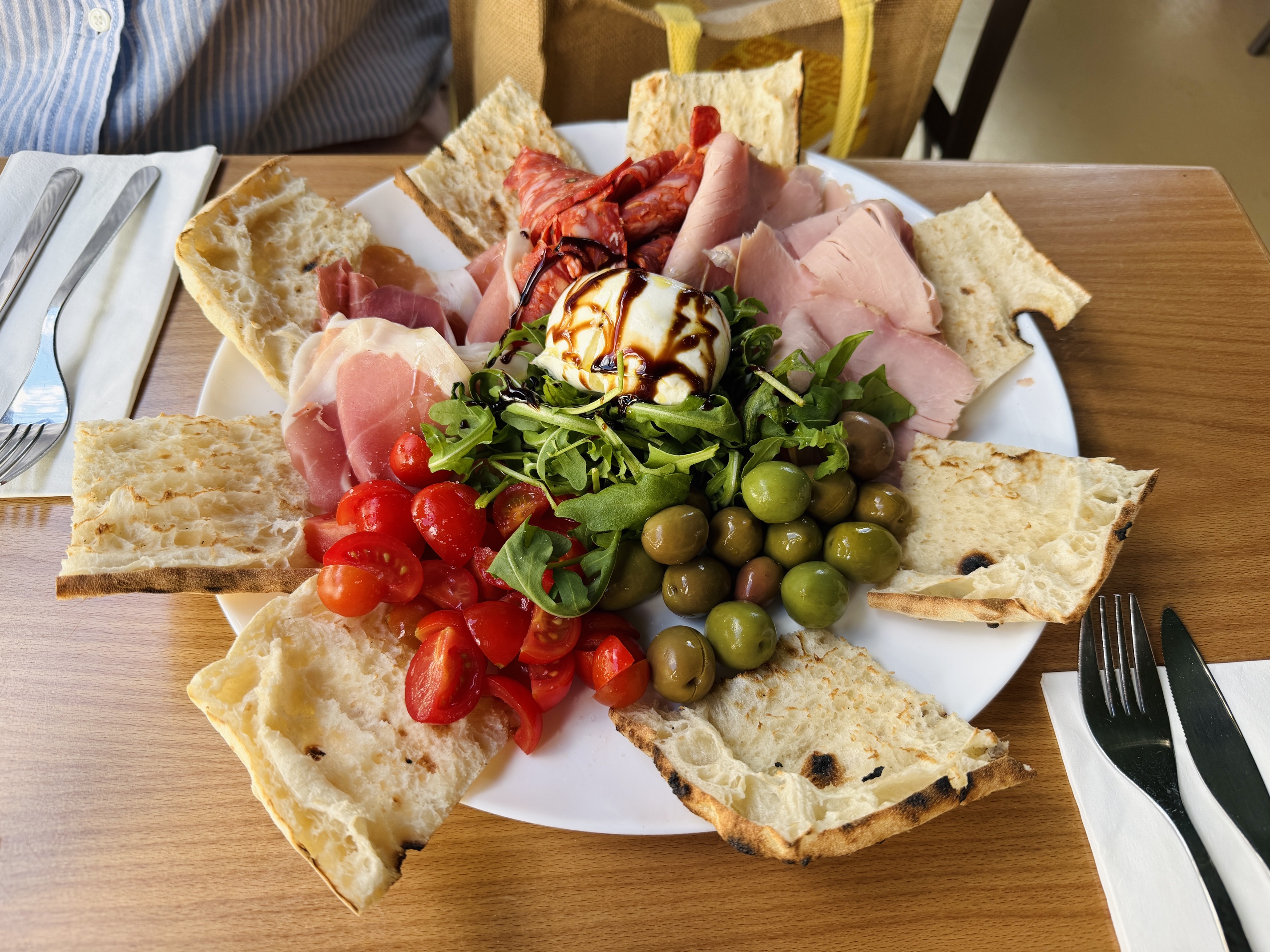
We began with the only starter on offer, the selection of antipasti to share. In a way, this is just a deconstruction of all the things you might see chucked on a base and scorched in the oven. But it’s a good fishing expedition if you want to get a picture of what a pizzeria’s raw materials are like: it proved to be very illuminating as far as Mono was concerned.

When you consider that this was £15.50 for two, it was ridiculously generous and enormously likeable. The Parma ham, with that slight sheen of the incarcerated in plastic, was pleasant but unmemorable. But everything else was better than it looked, better than I expected. A very good prosciutto cotto was miles better, really good quality and very tasty indeed. And the spicy salami, about which I had my reservations, was knockout stuff: coarse, not at all suspect and with an enormous chilli kick. Quite marvellous.

That’s before we get to the olives, which were good but not great, or the cherry tomatoes, sweet and bursting with contrast. Or the mozzarella. Hats off to Mono for not just wheeling out the ubiquitous burrata. I think I’ve always preferred mozzarella to burrata and I’m prepared to wait as long as it takes – it could be longer than a decade, the way things are going – for public opinion to catch up with me. But in many ways, the real bellwether was the bread – little squares of the stuff, like scraps of panino. They were light, airy, salty, just the ticket with any combination of the rest of the dish. In short, they boded well.

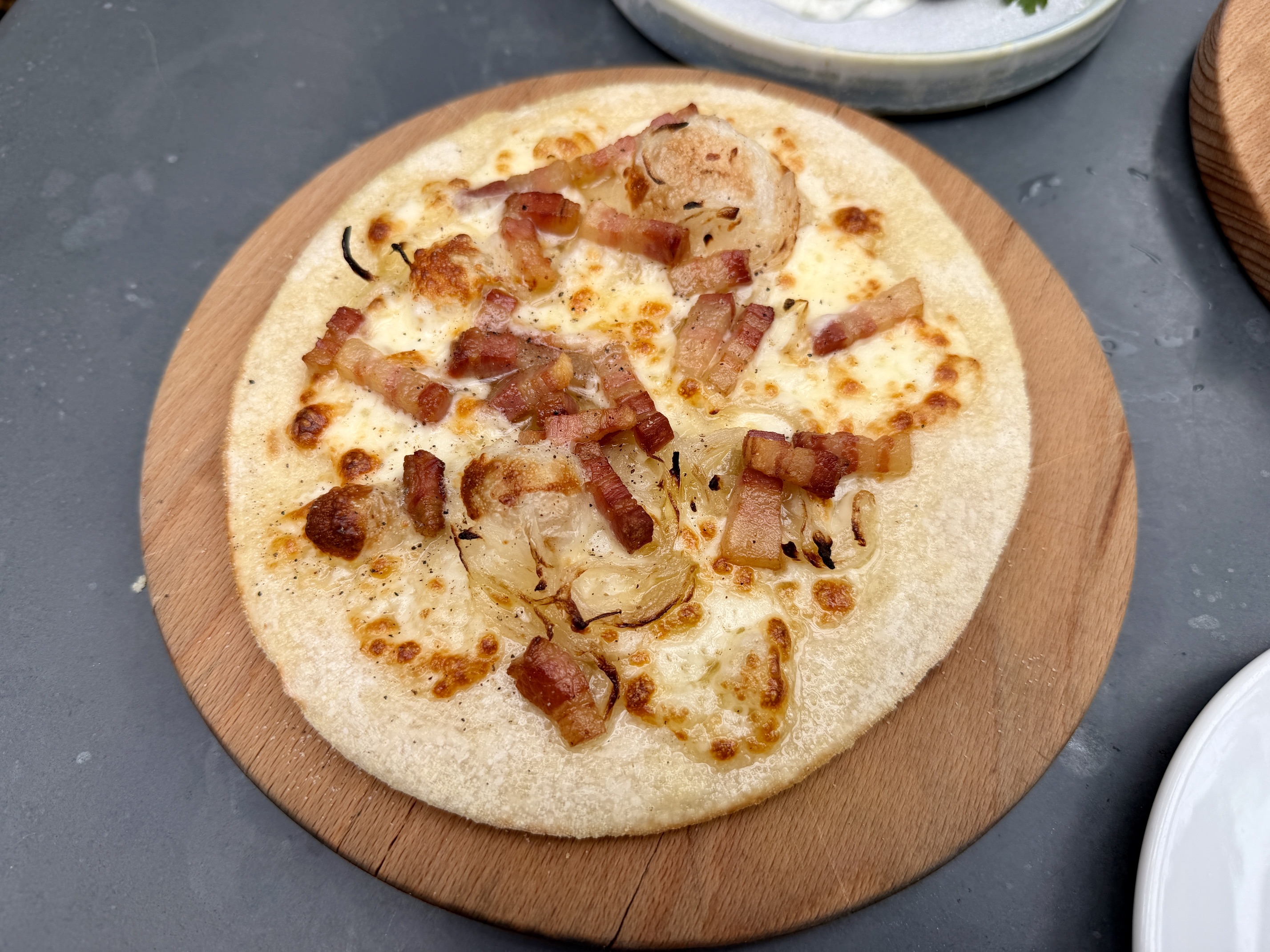
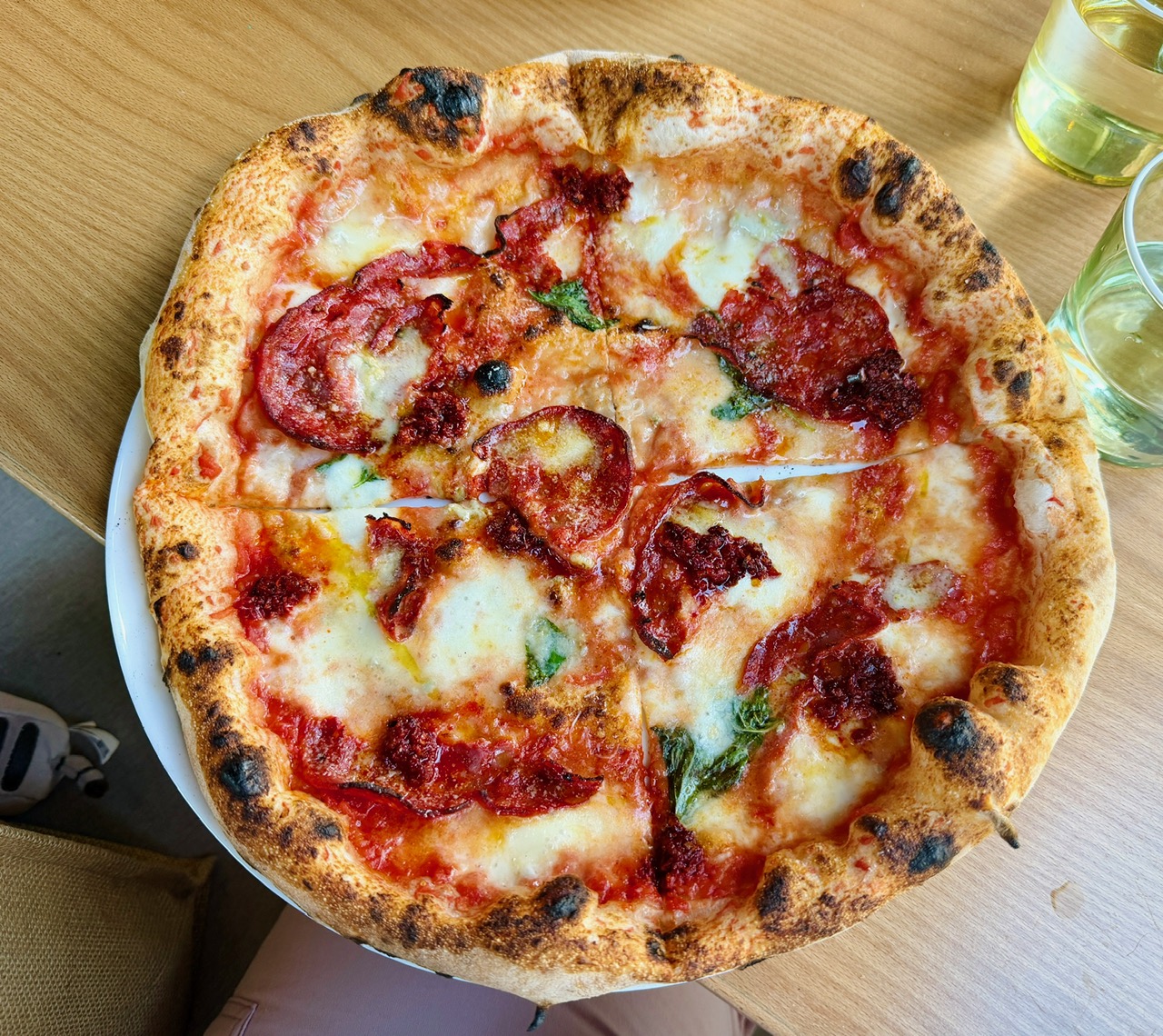
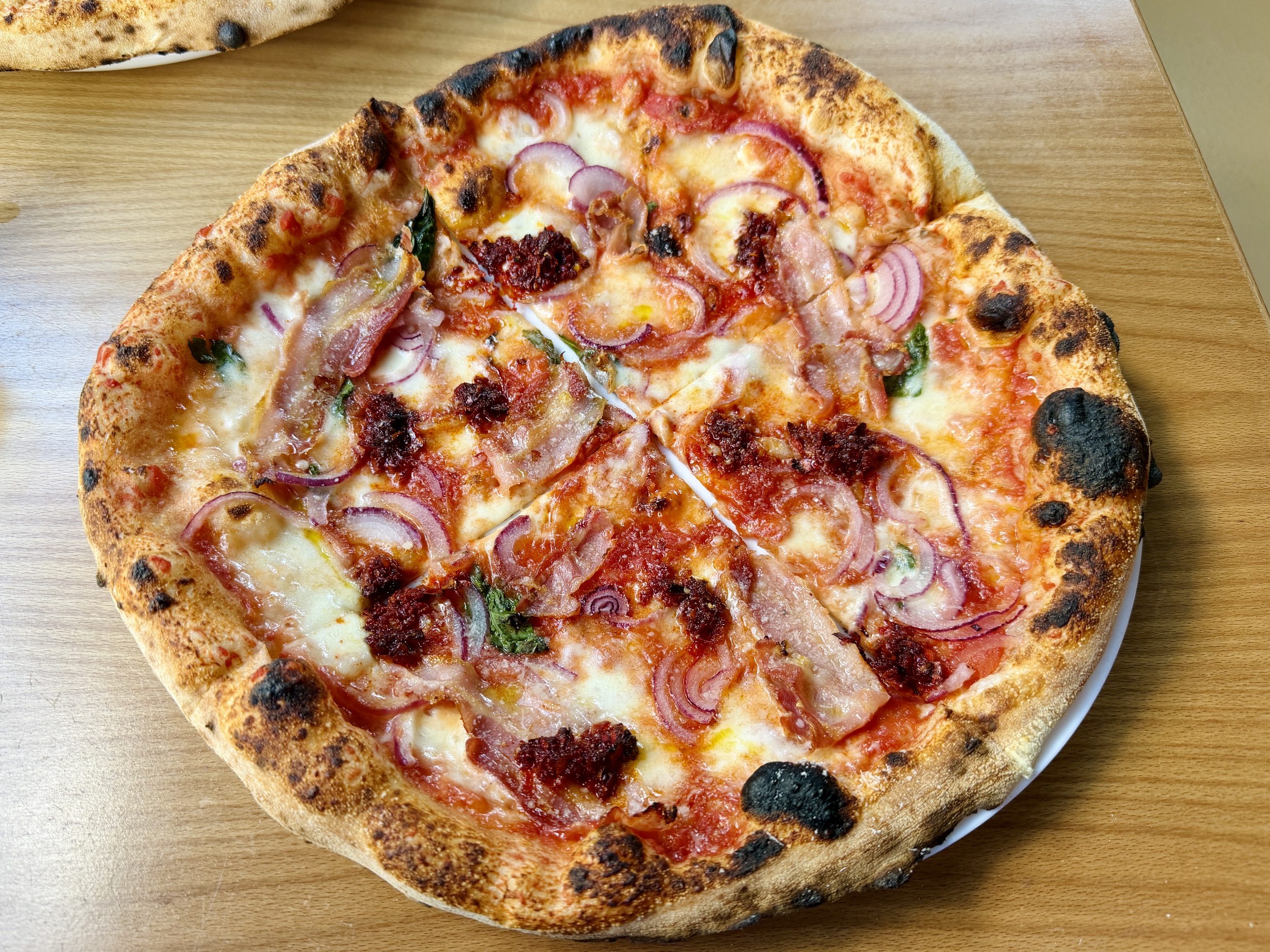
When my pizza, the ‘Pizza Rebby’, came out twenty minutes later it built on the potential of all that had gone before and synthesised it into a magical whole. That base was the final boss of dough, its evolutionary pinnacle, so light and well-done, so judiciously bubbled and blackened. I have got quite tired of the prevalence on social media of New York pizza, or New Haven pizza, or whatever “tavern style pizza” is, or London pizza. I’ve got tired of seeing mockneys on Instagram jabbering about how great it is. This. This is what good pizza looks like.

And the other cleverness of Mono is not just to have a small menu but not to do too much with any of those pizzas. This was not overloaded: potent clusters of punchy ‘nduja, translucent strips of pancetta gleaming away, ambrosial slivers of red onion, a surprisingly effective smattering of torn basil.

Zoë had chosen another classic, the Diavola, a variation on that theme with the spicy salami from earlier on taking the place of my pancetta. And, because it’s Zoë and she likes to tinker, she had asked to have gorgonzola added to it (“it’s the ‘Diavola plus'” she said to me, clearly pleased with her ingenuity). I would like to say that she was wrong, that she had offended the simplicity of Mono’s menu. But, because it’s Zoë, it elevated what was already an excellent pizza into a world-beater. The fire of both types of meat would have been enough – and again, you have to love Mono for refusing to touch hot honey with a twelve foot pole – but if it did need anything it was the pungent whack of salt from that blue cheese.

“I could come here every week” said Zoë, and I couldn’t agree more. I wasn’t sure, without that exhibition, that I had any other reason to visit Basingstoke: there’s nothing in the way of independent retail, one indie coffee shop, no craft beer. But you would travel for this.

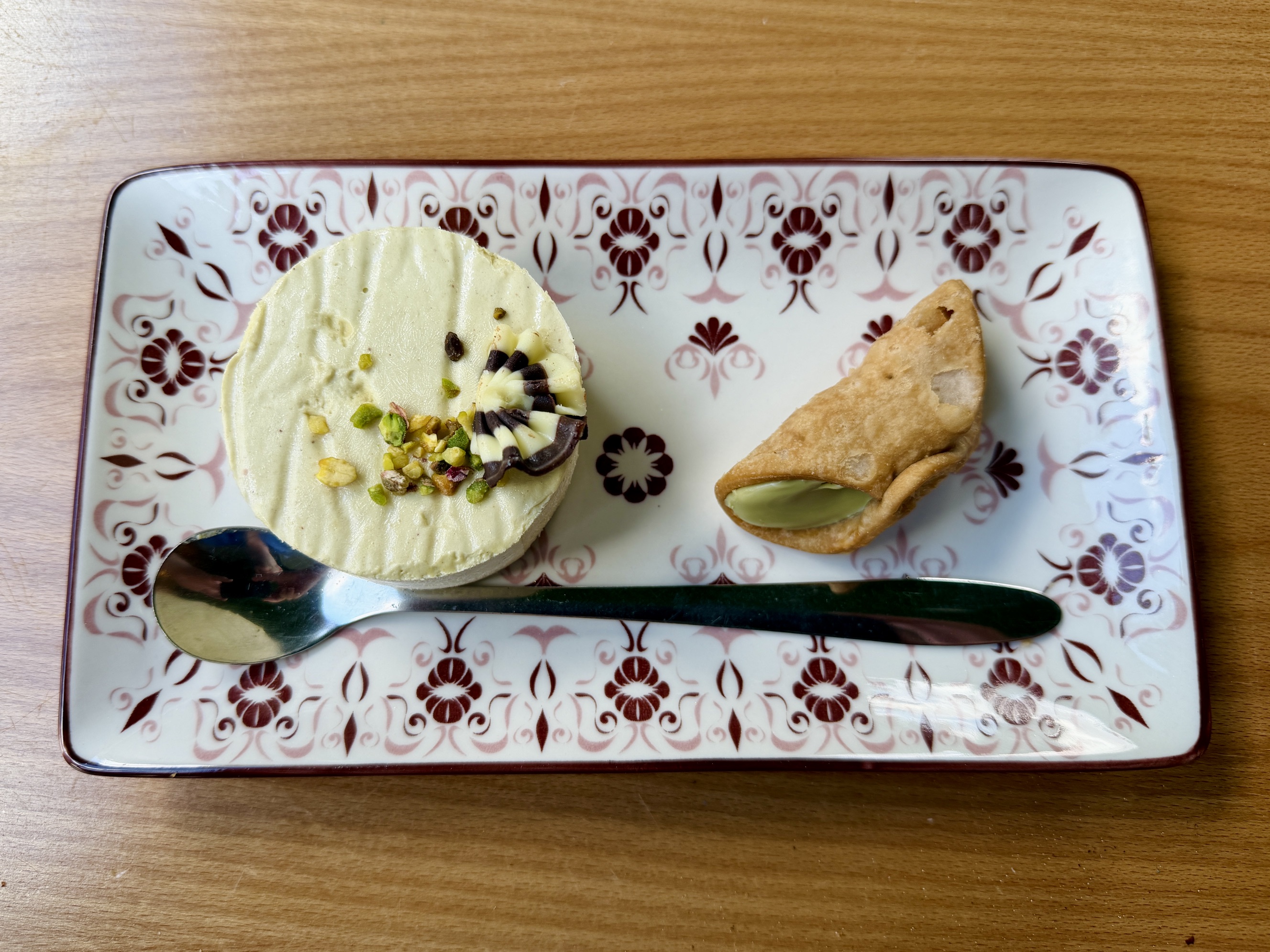
We had to have dessert, and Mono’s menu is so concise that between us we ate everything on it. I’d asked what the “Mono pistachio” was and was told it was like a cross between an ice cream and a mousse. That doesn’t do it justice, and nor does the blurb on the menu that reads like a list of ingredients: pistachio cream with milk, pistachio paste, egg, cream, white chocolate and biscuit notes. So if you go, throw all that in the metaphorical bin and order it anyway.

What it actually is is something closer to a pistachio and white chocolate parfait, with a biscuit base, somehow at the middle of a Venn diagram of ice cream, cheesecake and doubtless many other treats. I adored it: it was delicious at first, rock hard and challenging to eat with the long, slender teaspoon. But as it softened, everything just came together. I had it with a pistachio cannolo which was maybe the least impressive thing I ate that day: the shell a little heavy but the filling miles more complex than my dessert. It was still more than decent. £7 for these two, would you believe.

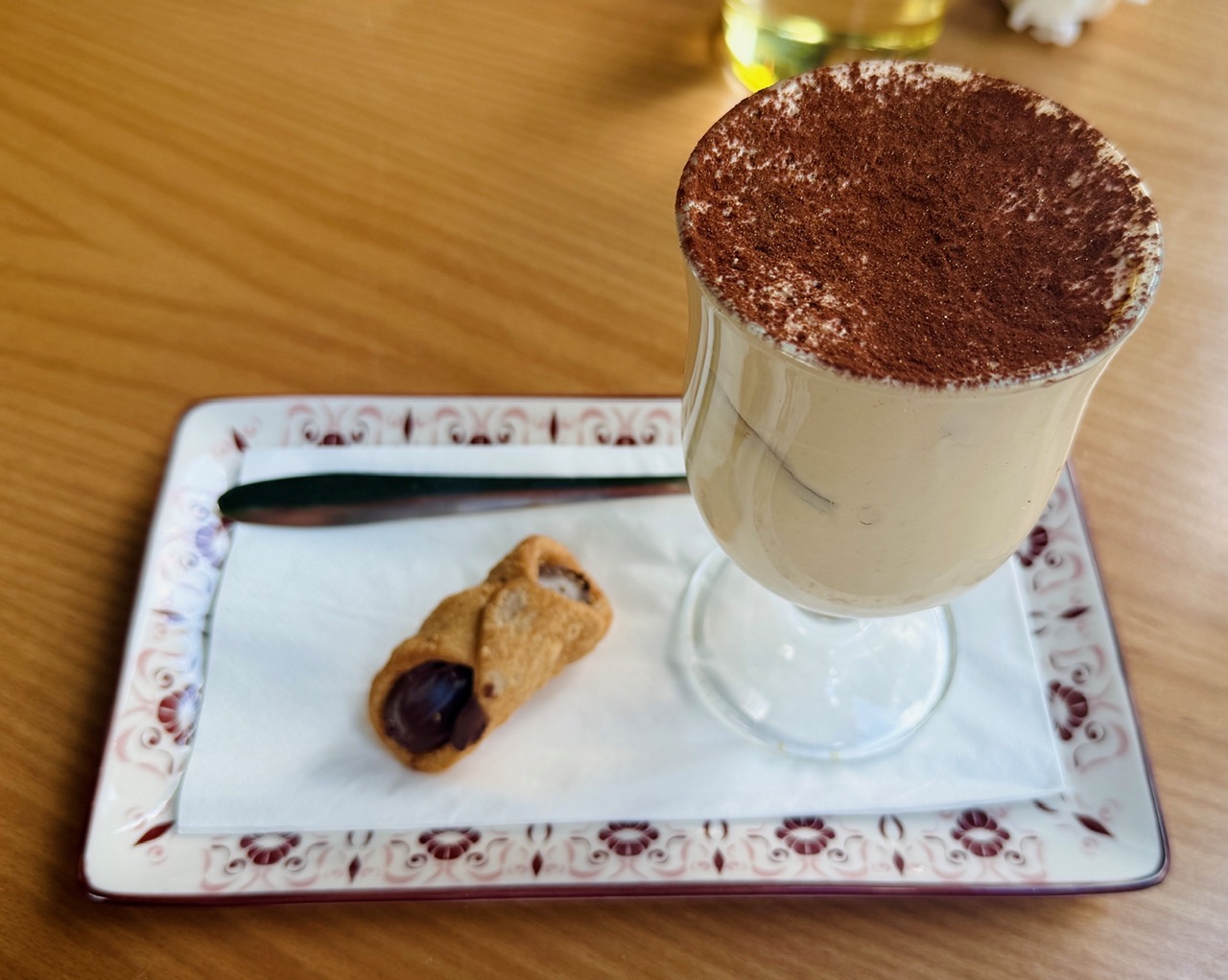
Zoë loved her tiramisu, served grandly in a little chalice. It was relatively delicate, airy and boozy and she made quick work of it. It didn’t quite reach the dizzying heights of the very best – Paesino’s, say, or Ragù’s – but it was very, very close. “Besides, once you’ve had a heavy pizza you want something this light” she added. I’m told the hazelnut cannolo was also thoroughly agreeable.

Although there were few diners when we started our meal, I was reassured to see a regular trickle of people coming in to eat. The couple who had been eating outside when we arrived came in to specifically tell Dragan how much they’d enjoyed their meal, that it was their second visit so far but it wouldn’t be their last.

Our bill came to something like £86 for three courses and a drink apiece, not including service. There might be cheaper options: Mono’s pizzas generally cost between £15 and £20 but believe me, you get what you pay for. And service, from a trio of servers including Dragan, was bright, friendly and really winning. At one point the phone rang and I heard them take a reservation for a large table, and I remember thinking that those people were in for a really terrific evening.

The Internet is full of people who will tell you that every pizza they eat is the Best. Pizza. Ever, or every burger the Best. Burger. Ever. It gets a bit much, it jades you and the biggest cardinal sin of all: it’s so boring. If everything is special then nothing is. So I don’t say this all the time, but here goes: Mono’s pizza is the best I can remember having in this country. Better than Papa Gee, Knead, Paesino, or Amò at its peak. Better than wonderful pizzas I’ve had in Bristol, or at Blue Collar, or from Sarv. It’s really that good.

That’s the funny thing about my visit to Basingstoke, a journey that simultaneously showed me life thirty years ago and gave me a glimpse of my future. Because in the Nineties, my idea of a great pizza was a San Marco from Misselbrook & Weston, the little supermarket nearest to my suburban Woodley home. They were kept in the freezer section, and I could pick one up for something ridiculous like £3, bung it in the oven and think I was eating like a king. If Future Me appeared in a vision to Nineties Me and offered him a single slice of Mono’s Pizza Rebby, I think Nineties Me’s brain might melt.

That’s the thing about the past: it can be a lovely place, but you can’t live there. Besides, the food is way better here in the present.

Mono Pizza – 8.7
27 London St, Basingstoke, RG21 7PG
01256 280093

https://monopizzabasingstoke.co.uk

Since January 2025, Edible Reading is partly supported by subscribers – click here if you want to read more about that, or click below to subscribe. By doing so you enable me to carry on doing what I do, and you also get access to subscriber only content. Whether you’re a subscriber or not, thanks for reading.

Restaurant review: Angelo’s

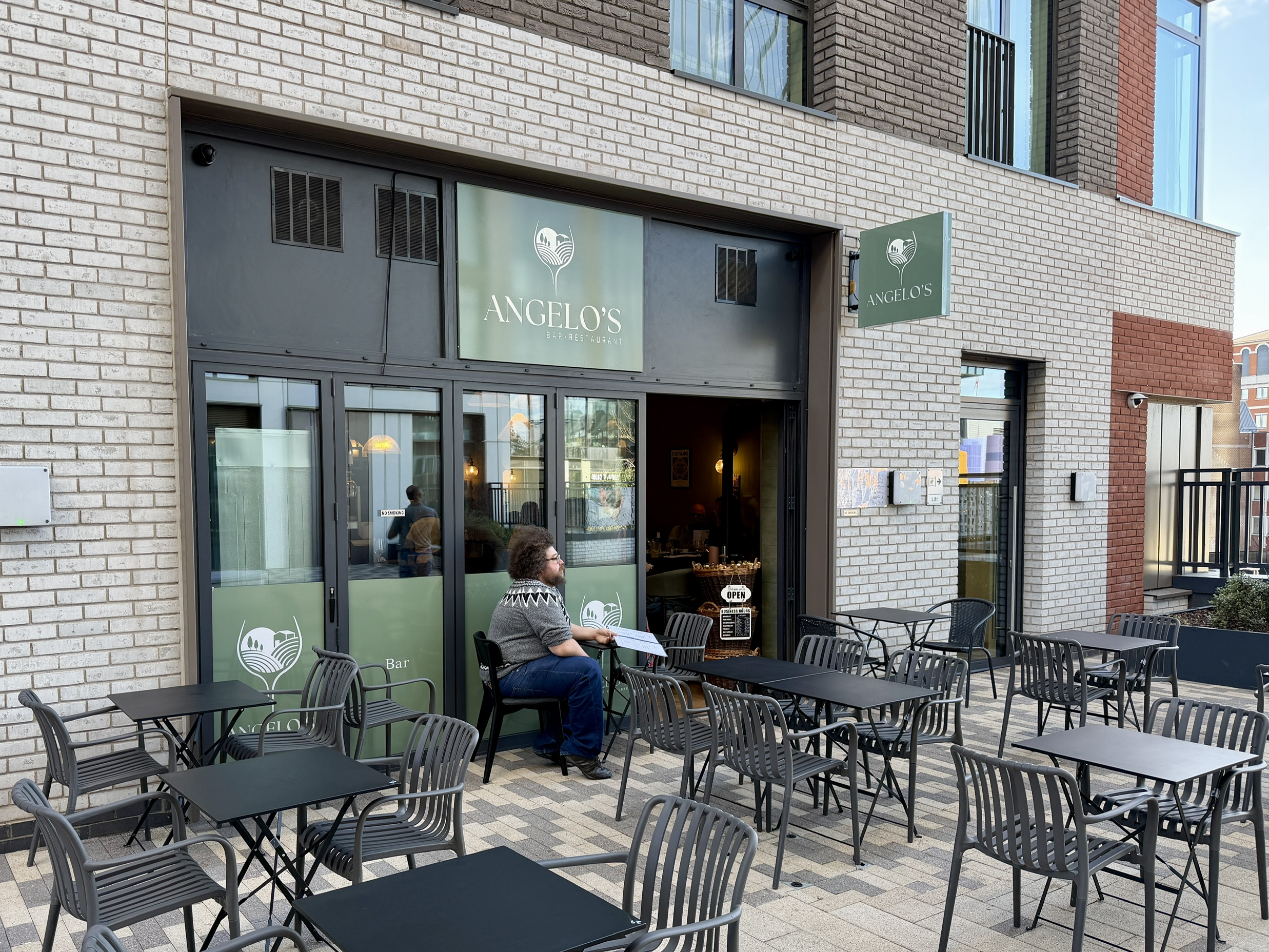
Have you been to Angelo’s, the new Italian restaurant in the town centre, yet?

And have you been asked whether you’ve been there yet?

The thing is, people keep asking me if I’ve eaten there, to the point where it seems like Angelo’s is the only Reading restaurant anybody is interested in. I had a readers’ lunch at the Moderation a couple of Saturdays ago and I was asked so many times I lost count – although it was a pretty boozy afternoon, so that just means “more than three times”.

Not only that, but many of the folks asking me already had an opinion: pretty ordinary, said one person that afternoon, unmoved by the wild boar ragu. Really rather good was another verdict, also delivered at the readers’ lunch. And don’t think you have to have been in order to pitch in: I saw some pictures earlier and thought ‘I can do better than that at home‘, one of my readers told me on Instagram. 

That felt like a bit of a slap across Angelo’s figurative face: I mean, I can do better than Cozze at home, but that says more about Cozze than my talents in the kitchen.

It’s easy to understand, though, why Angelo’s is such a big event. In 2024 the biggest openings of the year were the Rising Sun and Siren RG1, a chain trying to look like an independent and an independent with all the polish of a chain. Both were underwhelming at best. Last year, the headlines were grabbed by Rosa’s Thai and Cosy Club, desperately middling middle of the road fare for Reading’s middle classes, with Nua and Pho 86 quietly flying the flag for new indies in the town centre.

But this year? Unless you’re very excited about Shake Shack – in which case I’m afraid you’ve come to the wrong place – Angelo’s is not only the most interesting thing to open in the town centre but, in truth, the only interesting thing to open here. It’s shiny and new, it’s very central on the Station Hill development and it’s independent: the owner is also behind Ruchetta in Wokingham, which has also now been rebranded as Angelo’s. Although he’s doubtless sunk a lot of money into this high risk endeavour, there appears to be no venture capital involved.

That would be enough to make it worth checking out, but it’s also the kind of restaurant many people think Reading is sorely missing: an Italian restaurant. Not a specialist pizza restaurant like Zia Lucia, not a place that only does pasta like London’s trendsetters Padella and Bancone, or Maidenhead’s pale imitation Sauce and Flour. And not an entry level defroster like Prezzo, Zizzi or Bella Italia, either: a proper Italian restaurant. The kind we haven’t had since we lost San Sicario, the kind we were blessed with for decades when Pepe Sale was at the height of its powers.

It helps that Angelo’s kept us waiting. They signed a lease last April, and everybody expected them to open before the New Year. But due to unspecified delays an opening date never materialised; the infrequent updates on the restaurant’s Instagram page gave more of a sinking feeling than a growing sense of excitement. Finally, they opened at the end of June and the early signs were not encouraging. A very minimalist website was one thing, but a menu strewn with more typos than AI slop – who knew there were so many ways to misspell ‘mozzarella’? – was another altogether.

Fortunately both have now been amended, but Angelo’s still feels slightly like it’s fixing things as it goes along: at the time of writing it’s walk-ins only for tables of fewer than six people, and the phone number has only just been added to their Google listing. All of that, though, can add up to creating a feeling of demand – it’s good to make people work for it, sometimes – and when Zoë and I sauntered up just after six on a Thursday evening all but a couple of tables inside were already occupied.

The space is neat and compact. There’s a front section with high tables and a bar that maybe sits ten or so people, and then a dining room out back which can accommodate twenty. It was tasteful, if maybe a little lacking in character, although I liked the little booths and teal banquettes.

But the restaurant had the best accessory of all: customers. On one side of me a pair of happy friends were catching up, on the other a group of three was having an absolute ball, all loud and infectious laughter. From my seat I could see out the window across Garrard Street, to a part of town that used to look so very different. I liked this space, fashioned out of nowhere. It reminded me a little bit of Me Kong.

Angelo’s menu bore little resemblance to the typo-strewn mess that first appeared online, in more ways than one. First, it was cleaner, professional, read very well. Secondly, and this is a little strange, the points of difference were more than mere spelling errors – perhaps ten dishes have survived from that original menu, just over a month ago, and the remainder have been replaced. Was the initial menu a beta test that should never have seen the light of day, or had the restaurant already figured out that some of its dishes didn’t work? 

The other big alteration was the deletion of pizza: Angelo’s original menu offered eight, this one had removed them entirely. I think I read somewhere that this was the consequence of necessity, but I rather hope they have the courage of their convictions and stick to it: Reading has plenty of places to get pizza, but next to nowhere to get good pasta or antipasti. The menu I ordered from that night filled a yawning gap in the market – pizza, however well done, might dilute that.

Even truncated, it represented a good and interesting range, of both options and price points. The ten starters ranged from £7 to £15, and the dozen or so pasta dishes were almost uniformly between £16 and £18, unless you were itching for the black fettucine with seafood. A relatively modest six secondi were pricier, starting just below the £20 mark and marching north from there, but even so nothing seemed extortionate or unreasonable. I had loved Ruchetta when I went there on duty in 2014 but, even then, its dishes there were about as expensive as those on Angelo’s menu twelve years later.

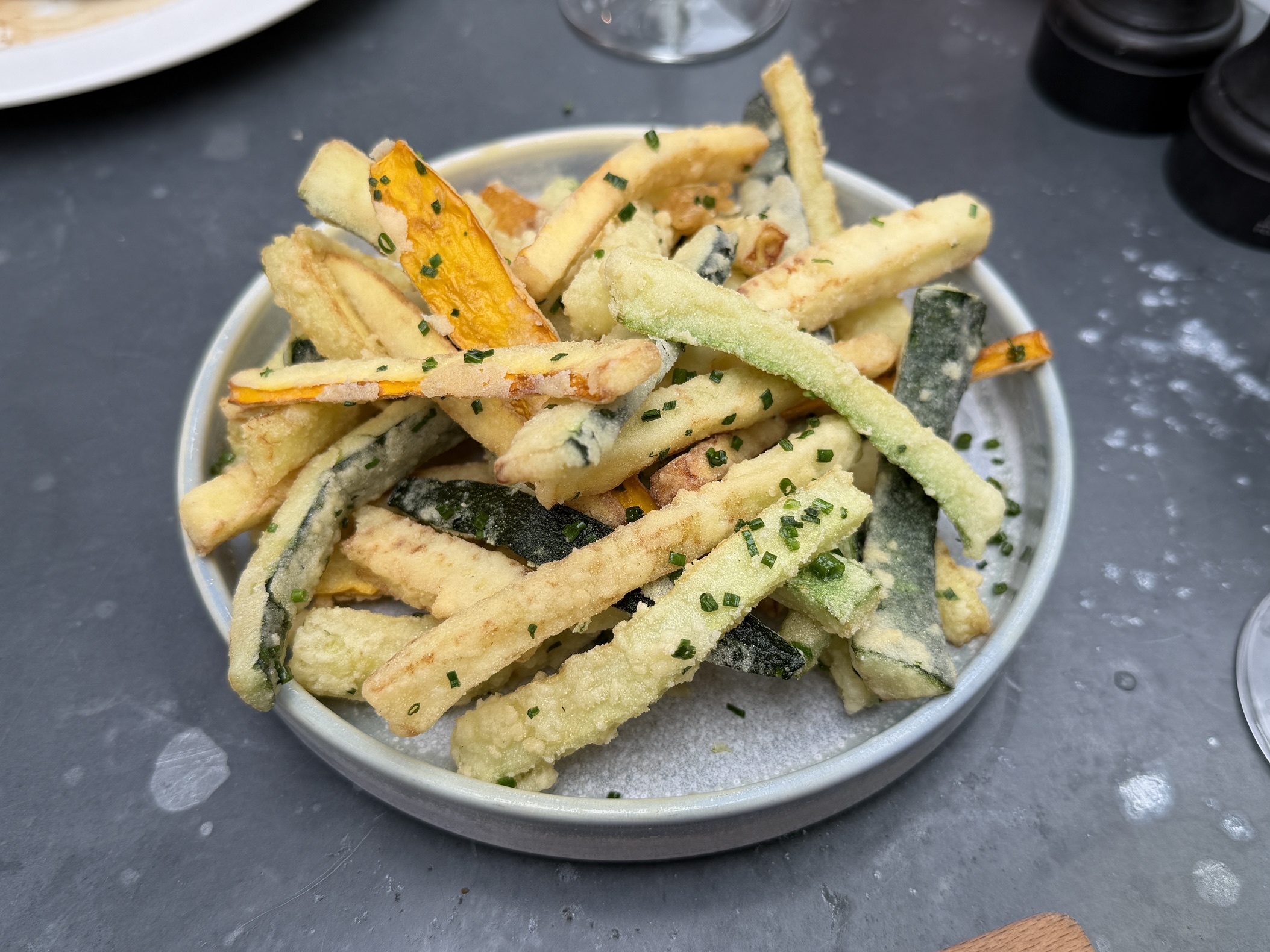
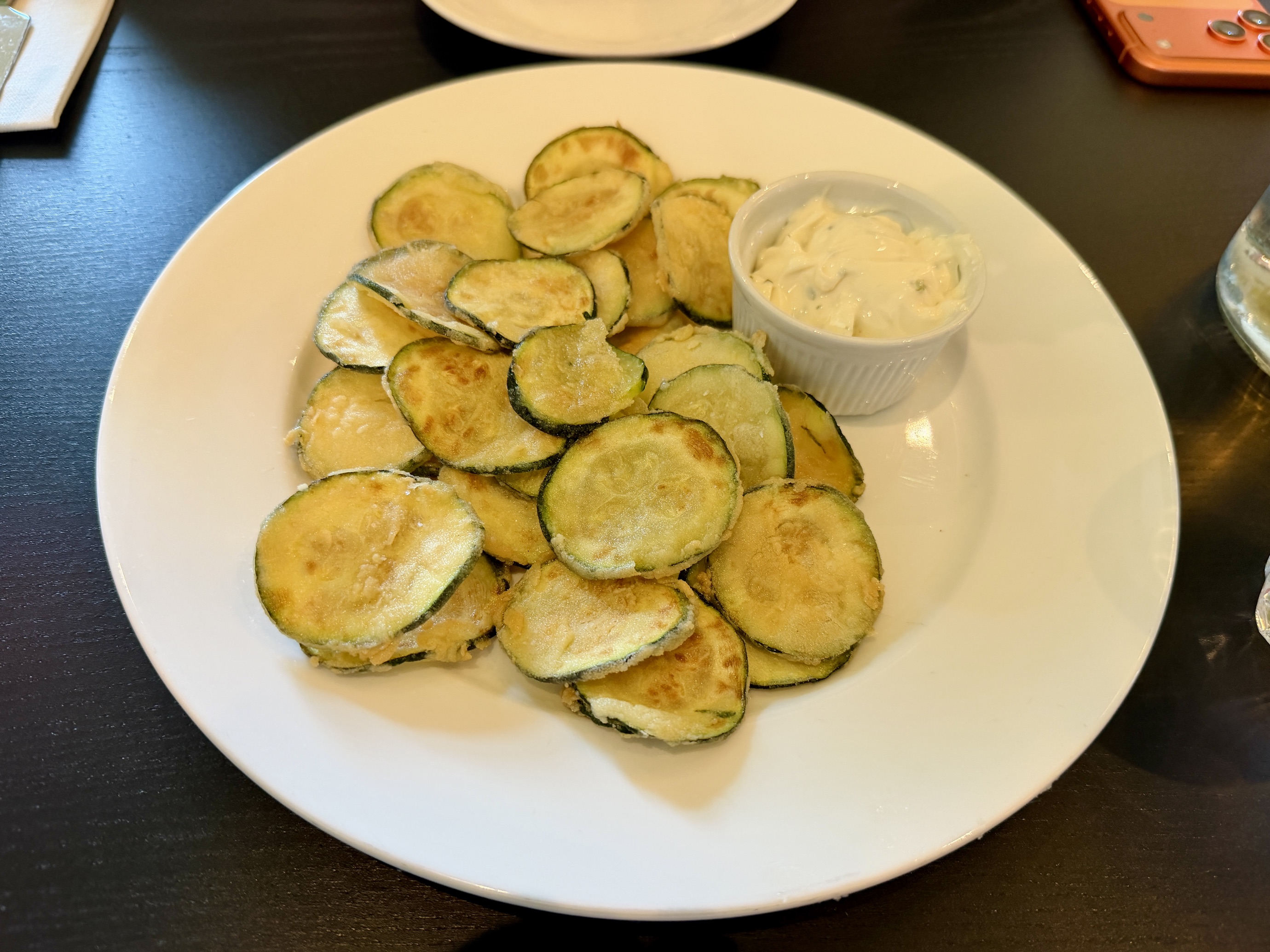
We started with a pair of cracking Aperol spritzes, because it was summer, and the one thing on the antipasti menu that felt like a great shareable start to the meal. Zucchini fritti had survived the great menu cull, and I’d seen from other writeups that Angelo’s served these as thin, round slices rather than batons, almost creating the sensation of exceptionally upmarket chips and dip.

Did that work? Well, it did, but it could have worked a lot better. The advantage of strips is all that surface area to crisp up: these, by contrast, were limp enough that they were droopy when you picked them up. They weren’t much cop when it came to dipping them into what really was an exemplary lemon aioli. 

So there is scope to perfect them, yes, but I was surprised by how enjoyable they were, even short of perfect. The seasoning on them was excellent, brilliantly judged, and if it meant you had to use a fork and load that aioli on with cutlery – far too evolved, for food of this kind – it didn’t stop them being a particular kind of wonderful.

We made short work of them, we made short work of our spritzes and slowly the sun went about the business of setting outside. “I really want this to be good” said Zoë, out of nowhere.

I totally understood what she meant. After a couple of years of disappointing big names opening in the town centre, Reading could badly do with a win. I looked round this fresh, new room and these fresh, new customers, took in the bright and chatty service happening all around me. No pressure, I thought to myself.

But all those were good signs, weren’t they? And the wine list was a good sign, too: sizeable, fascinating, covering price points from entry level – including 425ml carafes, if you wanted to be moderate and affordable – all the way up to eye-watering. Moreover, it was 100% Italian, covering so many different regions you just don’t see on wine lists in Reading: Umbria; Calabria; Piedmont; Sardinia.

Looking at it made me realise, again, how much I missed Pepe Sale – and how glad I was not to have to visit Vino Vita ever again. We ordered a bottle of pinot noir from Pesaro, a place of which I’d never heard, and I really loved it – silky, fruity and balanced enough to make a fist of going with everything we ate. It was £56, and what I could find online suggests you could buy it retail for just under half that: if every markup on Angelo’s wine list is in that ballpark, wine buffs are going to have some fantastic evenings there.

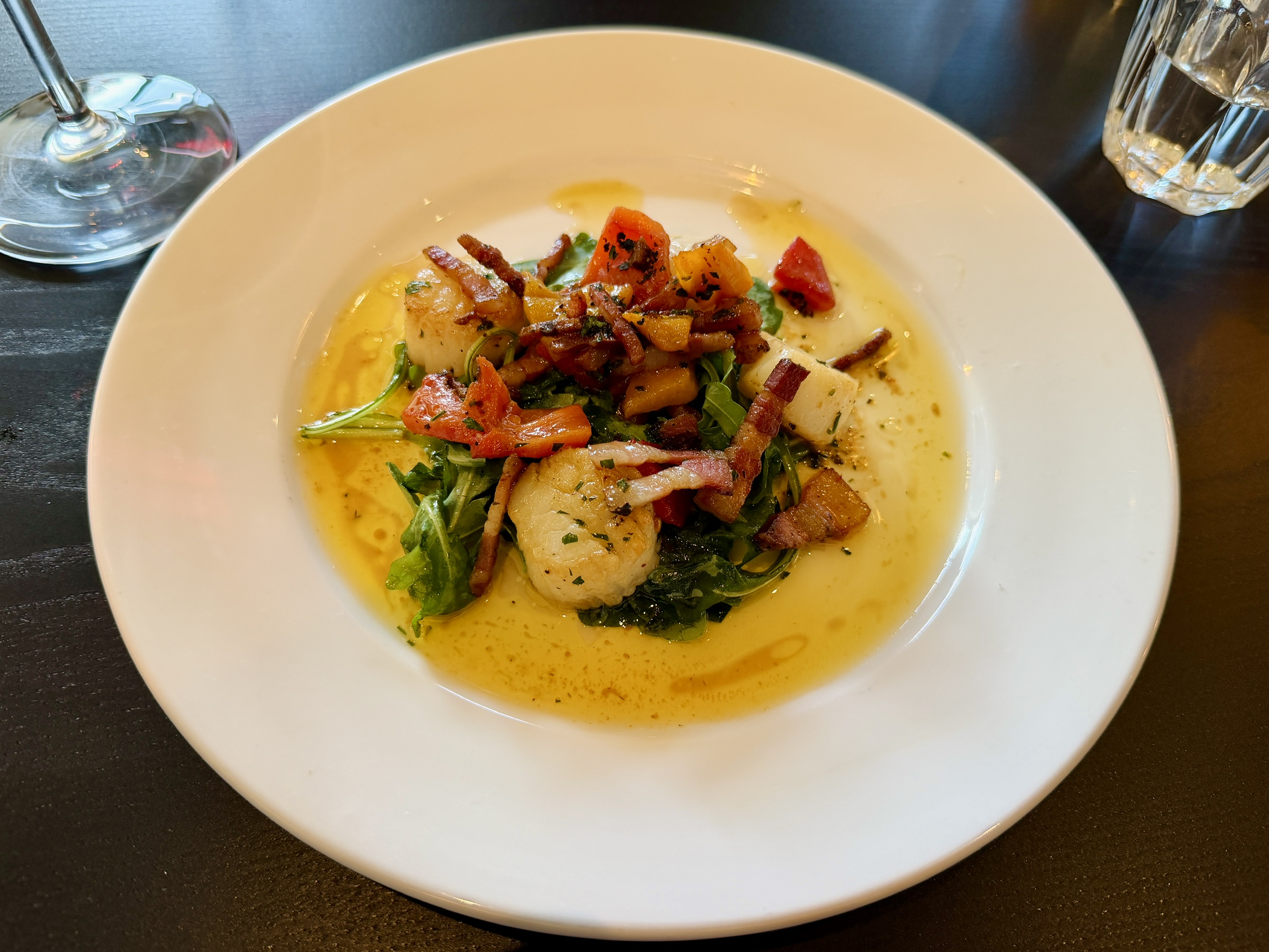
My starter was sheer joy. Four handsome scallops, cooked to just the right side of jellied, could have been enough of an attraction on their own. But tumbled with sweet roasted peppers and crispy matchsticks of pancetta, they were forkful after forkful of fun. I wasn’t prepared for how much I would enjoy this dish, or how simple, how superbly done it was.

The transformative element, though, was the salmoriglio, the bright Calabrian sauce of olive oil and lemon juice that perked up a dish which was plenty perky already. The whole thing was daytime TV presenter cheerful, without the artificiality that comes priced in with that. I could eat it again and again, although it also made me look forward to the day when Angelo’s has swordfish on its menu.

This starter was £15, and yet when I compared it to the masterpiece of eking out that was, say, No. 1 Ship Street’s more expensive scallop starter, I felt as if I was robbing Angelo’s blind, not the other way round.

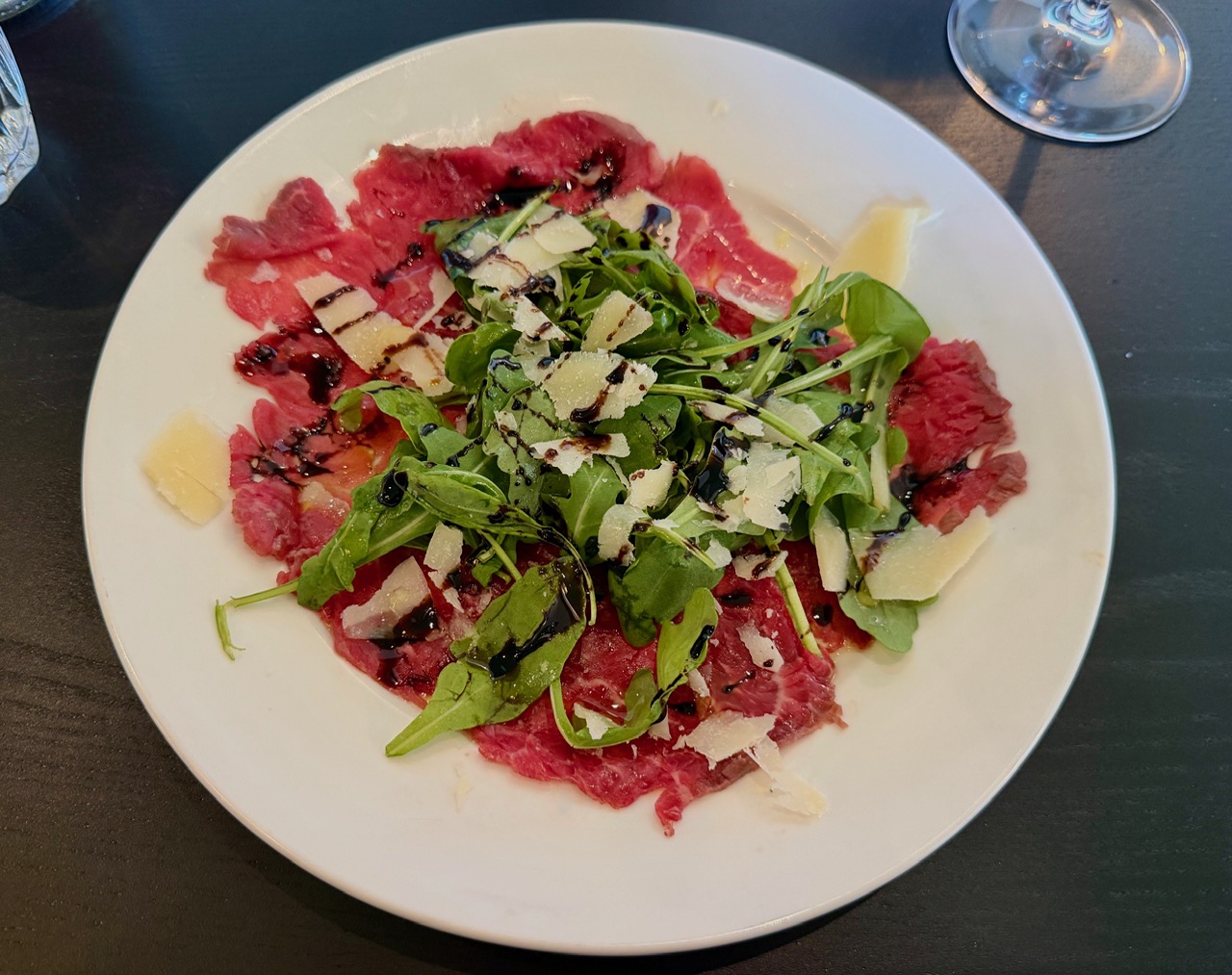
Zoë was equally happy with her choice, another salutary lesson in the virtues of buying good stuff and leaving it as unfucked with as possible. A generous mosaic of pink and marbled beef carpaccio, sliced almost to translucence, was laid out and scattered with rocket and Parmesan. So little to it, but so much to enjoy.

“I could have gobbled three plates of it”, she told me later. “You can quote me on that.”

Also, and I know this is an aside, but how nice it was to eat in a genuine Italian restaurant that uses balsamic vinegar, not some gloopy, sugary glaze, and only uses it sparingly when appropriate, rather than festooning everything with thick ribbons of it to make something that would otherwise taste of nothing taste of something worse. I had almost forgotten how much I liked eating in an Italian restaurant in Reading that treated its customers like adults.

Pacing was faultless – there’s a sentence you haven’t seen me write much this year – and something like twenty-five minutes later, when I was still basking in the afterglow of my starter and enjoying the warm fuzzy feeling that comes with a great bottle of red, our main courses came out. We’d ordered from the deep and the shallow ends of the menu here, more by accident than design, but I think it speaks volumes about what Angelo’s has to offer that both were equally superb in different ways.

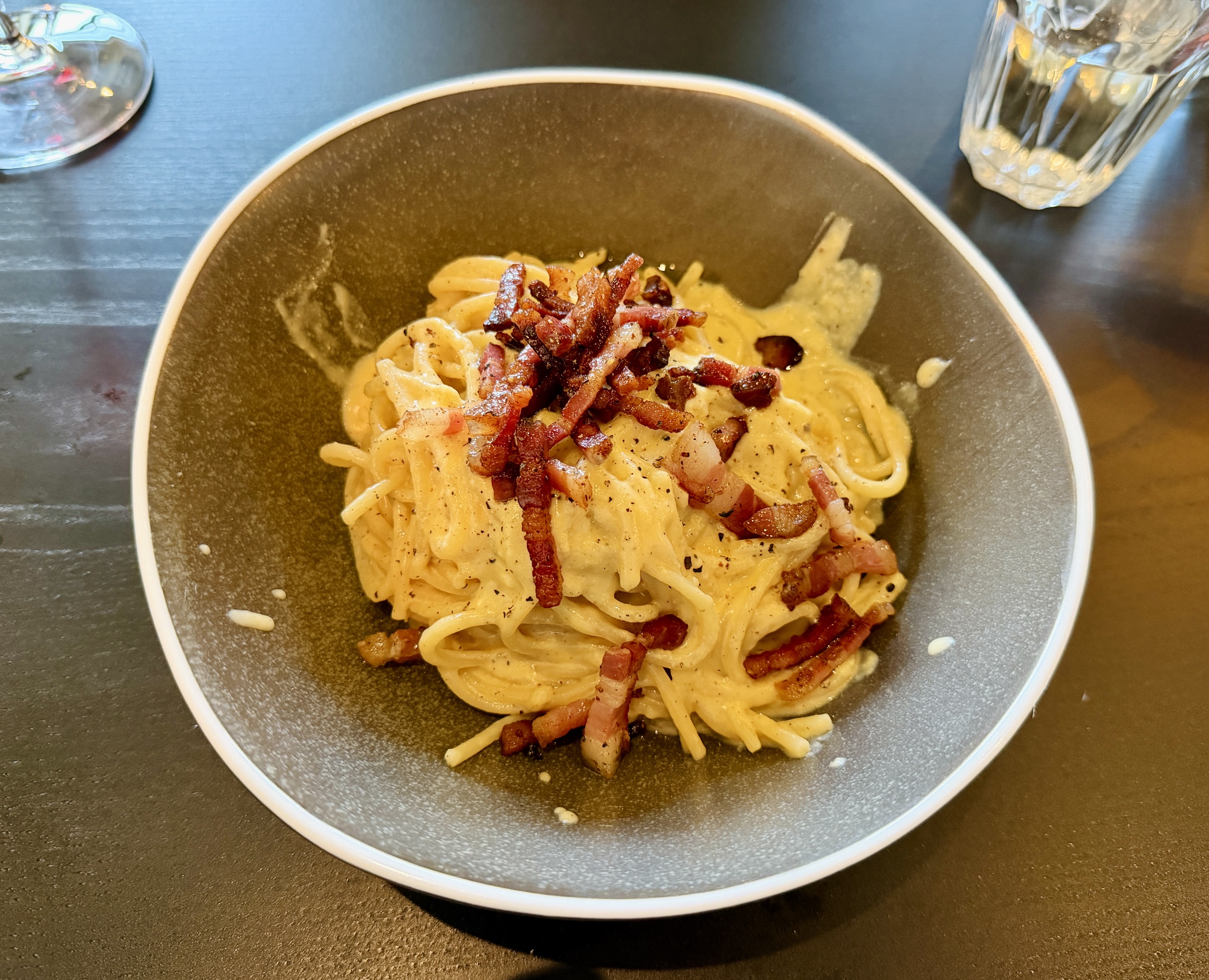
I loved my main course so much I can’t even tell you, and I loved the fact that it was a mere pound more expensive than my starter. Carbonara is a good test of an Italian restaurant, but I doubt many pass it with flying colours the way Angelo’s did. The golden colour of a Brazil shirt, pasta impeccably al dente, the sauce clinging to every strand, full of depth and saline complexity. This was a textbook carbonara: egg yolk, pecorino, no cream, no adulteration of any kind. Purists might object that it was pancetta not guanciale, but those purists need to get out more. Besides, that thatch of bronzed strips was heaven.

By the end of it I wasn’t only planning when I could go back to Angelo’s, I was planning when I could go back to specifically eat this again. Surely I had a free evening next week to slink off for a bowl of it? If I had my way, the people behind Cozze would be sentenced to come to Angelo’s, try this once and then have to eat their subpar albino version every evening for a month. That would teach them, or at least it would if they liked food better than margins.

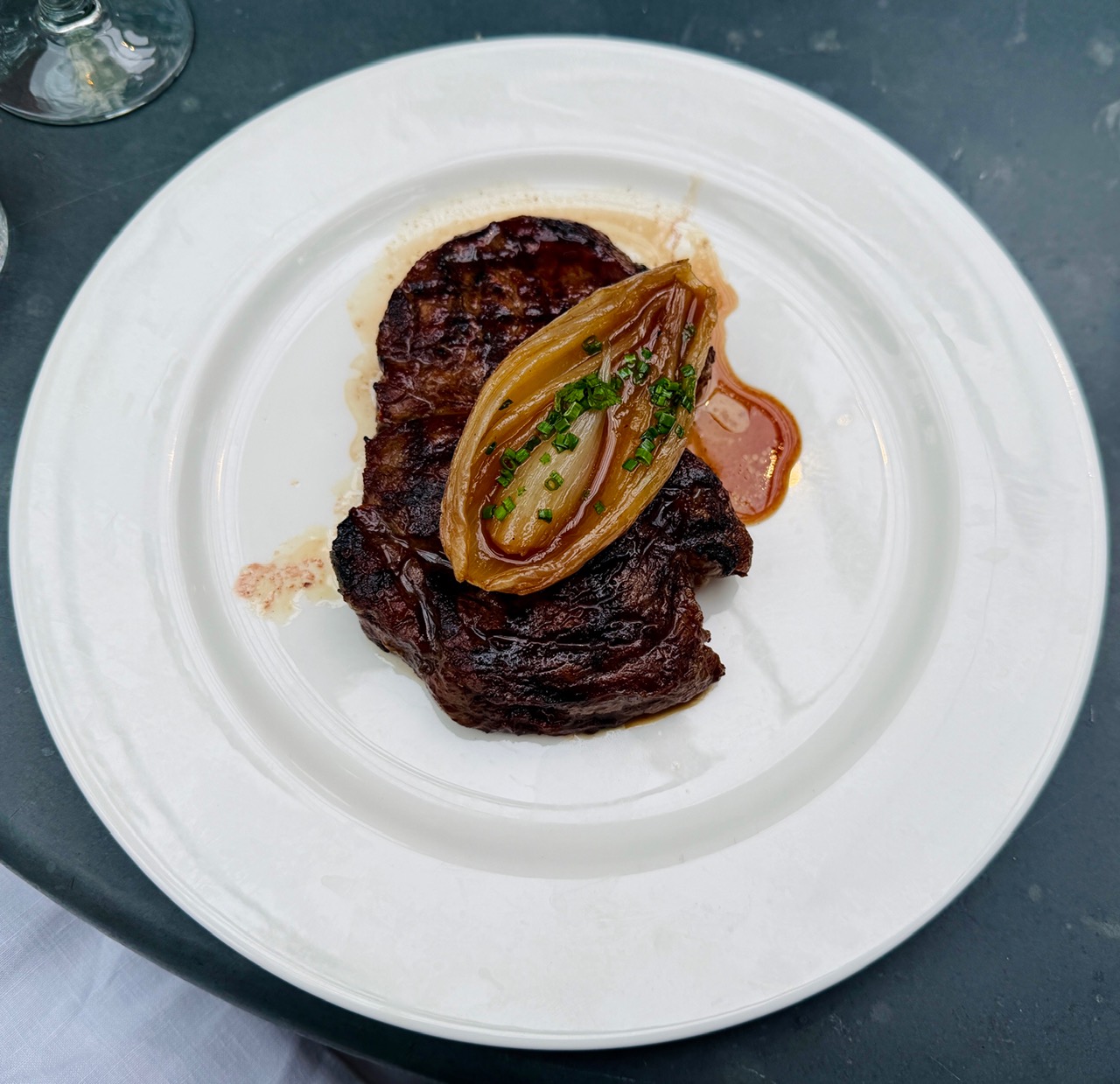
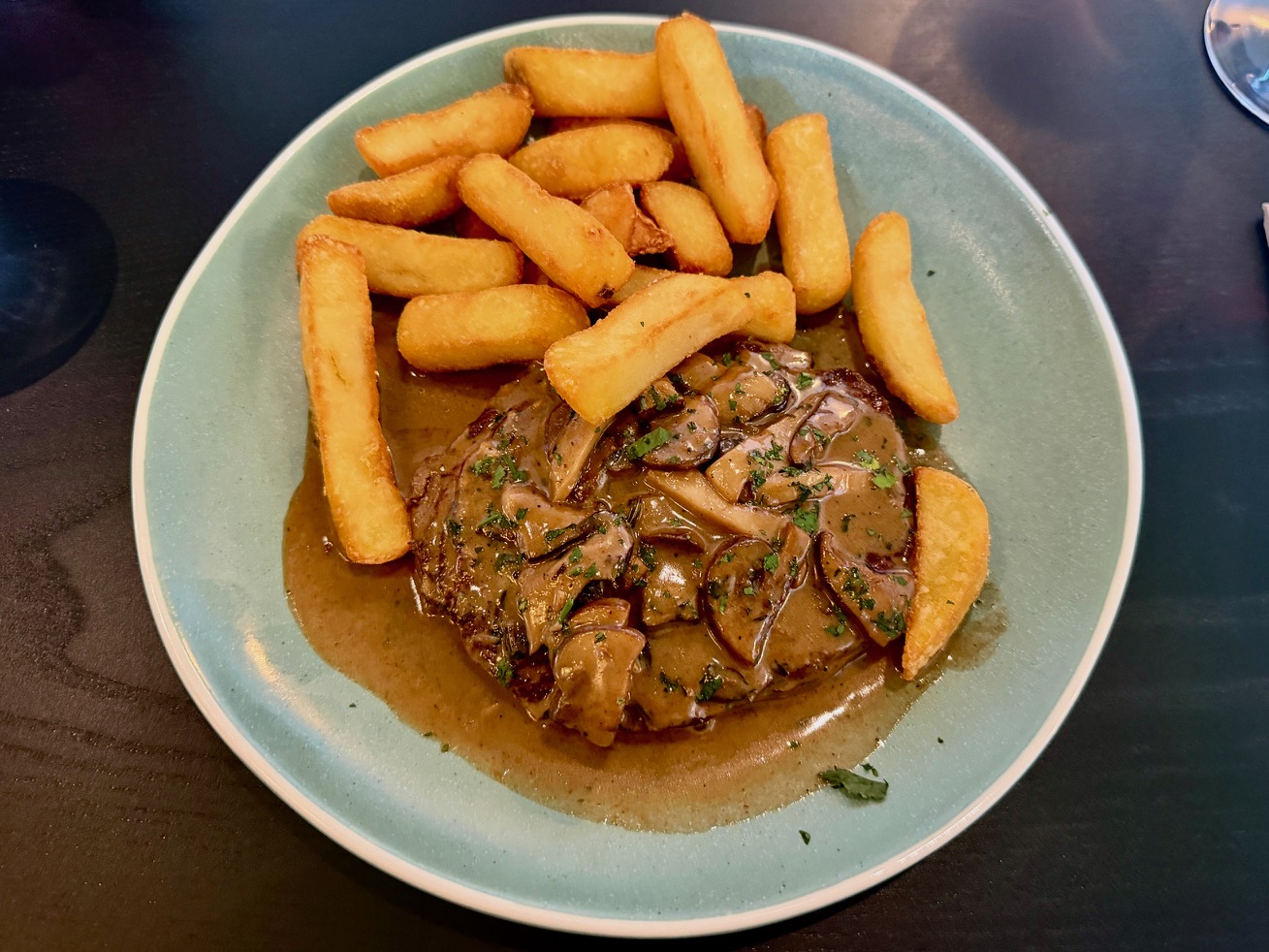
Zoë, as regular readers will know, has an annoying habit of ordering better than me. But I thought she’d erred ordering the most expensive and pedestrian-looking dish on the menu. Ribeye, mushroom, cream and brandy sauce and chunky chips. Sounds a bit blah, I told myself, and at £33 it would have to be really, really good: everything in peak condition, everything in balance, everything coming together.

So of course, to my mixed delight and irritation, it was precisely that. Steak cooked perfectly medium as requested (I’d have had it pinker, but I don’t judge) a sauce of dreams – and more than enough of it, too – and some knockout, golden, crisp-edged and nicely irregular chips. I was happy for her, even if this dish felt about as Italian as I am, but I was just as happy, if not more so, for Angelo’s. Because this was high stakes, and they had not missed. Even her side dish, spot-on tenderstem broccoli positively infused with garlic and chilli, was a winner, not an afterthought.

I had to have dessert after two magical courses like that; I wanted to give Angelo’s the chance of the kind of clean sweep that propels that rating at the bottom into the upper echelons. It was a flab-free dessert menu with limited options but, again, they were the choices you would want to see: a tiramisu, a panna cotta, an affogato, a rum baba which turned up at the table next to me and looked positively immense, in every sense of the word.

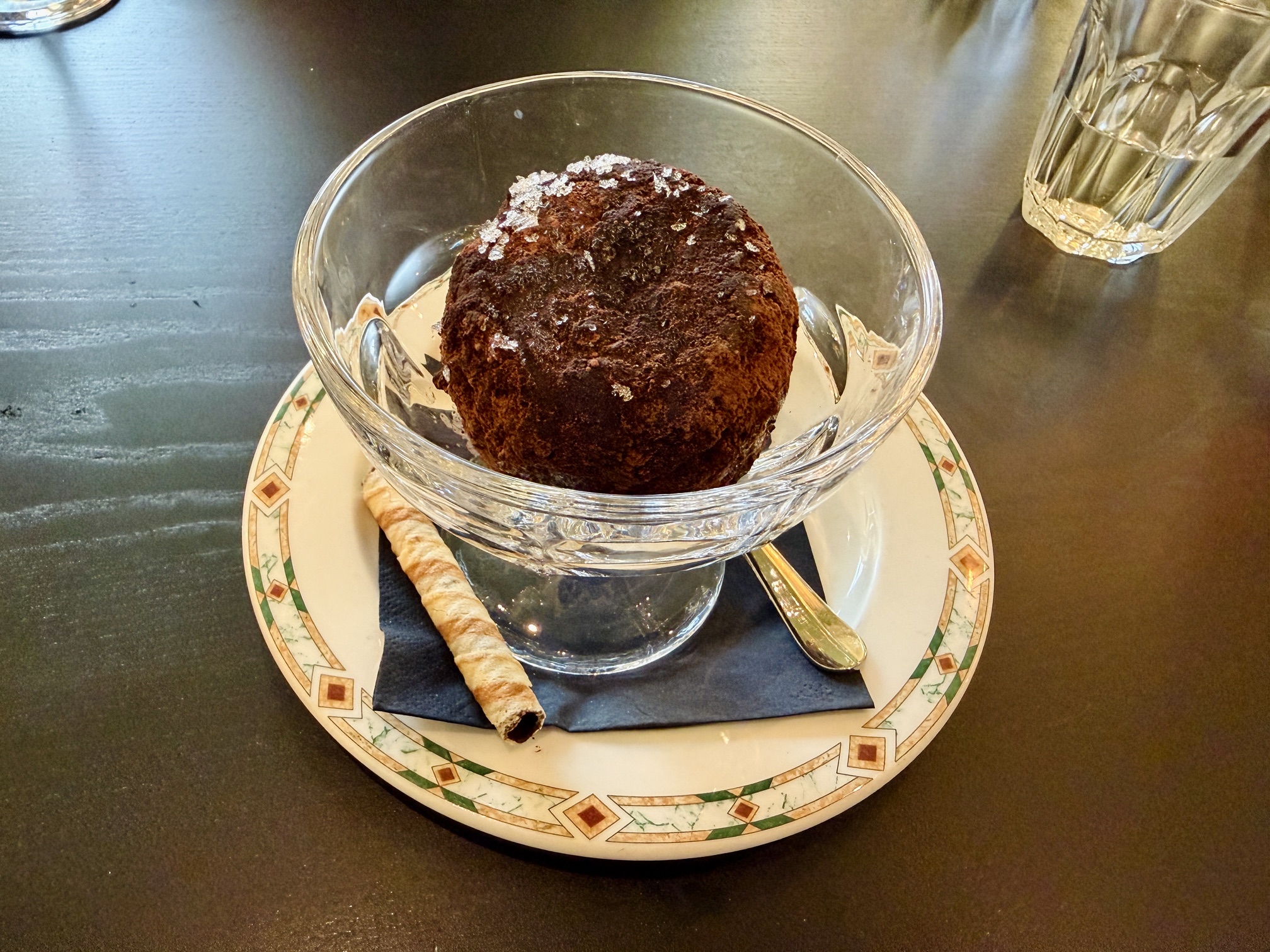
But we both, in the end, went for the tartufo cioccolato and, yet again, Angelo’s pulled something out of the top drawer. I have had these before where they’ve felt a little anonymous, like a freezer ready fancy-schmancy choc ice, something to finish your meal with when you lack the imagination for a proper dessert. I’ve had them at Pepe Sale, and even as I’ve enjoyed them, I’ve known I was slightly short changing myself. But nobody ordering this at Angelo’s is doing anything other than treating themselves in a big way.

It was a huge, cocoa-powder dusted puck of a thing, crowned with ice crystals, and we waited for our dessert wine to turn up before we made inroads. But when we did, it was just glorious. Have you heard how Wall’s ruined the iconic Feast ice cream earlier this year by swapping its chocolate ice cream for vanilla while leaving that disconcertingly nostalgic core of plasticky chocolate intact? Angelo’s has performed that trick in reverse, so at the centre of its tartufo is a core of zabaglione. It is, and I don’t use these words lightly, life-alteringly good.

So, by the way, was the dessert wine. Angelo’s offers five by the 50ml glass, and none of them are cheap. But in for a penny in for a pounding, as my wife is wont to say, so we tried the priciest, the muffato from Umbria. It was the same gold I associate with all of the meal: the gold of the summer sunshine outside, the gold of the salmoriglio, the gold of my carbonara, of that zabaglione. Maybe everything Angelo’s touches turns to gold – in truth, it was beginning to feel that way.

It was, as I said, it was a costly way to end the meal – £13.50 a glass – but I quite liked Angelo’s pricing. It felt democratic rather than random, that you could have a main course that cost the same as your starter, or a glass of dessert wine that cost almost twice as much as the dessert accompanying it. I think you could come here and eat very well indeed, yet spend more or less than we did. I’m absolutely certain that the oenophiles among you could badly bruise your debit cards at Angelo’s. But it would all happen so nicely, and you’d come away so happy, that you wouldn’t mind one bit.

Our meal for two – and bear in mind we had nibbles, and aperitivi, and dessert wines and a metric fuckton of good times – came to £200 on the nail. Personally I don’t begrudge a penny of it, and it’s worth mentioning that they leave the question of service entirely up to you. I hope they get the tips they deserve, because service was delightful from beginning to end.

I don’t want to patronise Angelo’s by saying I was not only ecstatic but relieved that eating there was such a stellar experience. But it doesn’t pay to be dishonest, so I should admit that I was relieved. I didn’t want to put the boot into yet another big money signing for the town centre, especially an independent. Even if it is underneath Ebb & Flow, a collection of performative if well-appointed shoebox apartments whose main purpose seems to be to make wealthy buy-to-let landlords wealthier still.

I wanted something to buck the trend of unremitting meh that seems to afflict the RG1 postcode. I really, really did. But if I wanted Angelo’s to be decent, it was beyond my hopes that it would turn out to be quite this good. It is the best thing to happen to central Reading for ages, and the best thing to happen to a reviewer of central Reading restaurants, arguably, for even longer. So, has my enthusiasm been infectious? Does it make you want to go?

It’s worth it, believe me. I may be the latest person to ask you if you’ve eaten there yet, but I have a feeling I won’t be the last.

Angelo’s – 8.8
9 Friar’s Walk, Station Hill Square, Reading, RG1 1HP
0118 3042885

https://www.angelosdine.com

Since January 2025, Edible Reading is partly supported by subscribers – click here if you want to read more about that, or click below to subscribe. By doing so you enable me to carry on doing what I do, and you also get access to subscriber only content. Whether you’re a subscriber or not, thanks for reading.
Restaurant review: Gooi Nara

There’s no such thing as Spotify Wrapped or Apple Music Replay for restaurants, as far as I know. But if there was, the restaurant whose food I ate most last year is almost certainly Gooi Nara, the Korean restaurant on Whitley Street that has been there for something like ten years, if not more. And yet returning to it a couple of Saturdays ago for dinner with Zoë was the first time I’d set foot inside since I reviewed it in 2018.

The thing is, as regular readers will remember, I moved to Katesgrove a couple of years ago, which means that, along with Kungfu Kitchen, Gooi Nara is probably the closest restaurant to where I live. And what that means is that on the nights when neither of us can face cooking we know that a delivery driver won’t get lost, won’t drop other orders off en route to our house and can be trusted to turn up pronto with piping hot food from just round the corner. Over the last two years, between us, we’ve developed quite a Gooi Nara habit.

It’s no coincidence that they won my “takeaway of the year” award in 2024 – but my love of a Gooi Nara delivery has continued ever since. It is refined and perfected now to the point where Zoë and I order exactly the same thing almost every time: dakgangjeong, or Korean fried chicken, for her and tang su juk, chicken in sweet and sour sauce for me. The latter comes ready to assemble, one plastic container of gorgeous fried chicken and a tub of sweet, sharp sauce with orange and pineapple bobbing in it (I was skeptical too, but don’t knock it until you’ve tried it). It has made me happy many, many times.

Sometimes we push the boat out and get some mandu, fried chicken dumplings, as well but otherwise those two and a couple of portions of rice are everything we need for a contented chomp in front of the telly after a hard day. I especially grew to love Gooi Nara when I was discharged from hospital and could only eat with one hand: I remember the first time I had their sweet and sour chicken after my accident I could only eat half, the rest popped in a LockNLock in the fridge. It was even better cold the next day: it remains the only occasion when I’ve had any leftovers at all.

That’s all well and good but I love their food so much, and always hear so many positive comments about it online, that it felt like we were doing them a disservice by only ever ordering the same two takeaway dishes. And my review was over eight years old, after all, so it felt like high time to go back. Early one Saturday evening Zoé and I took a short amble there, tracing the path of so many delivery riders in reverse, to check it out.

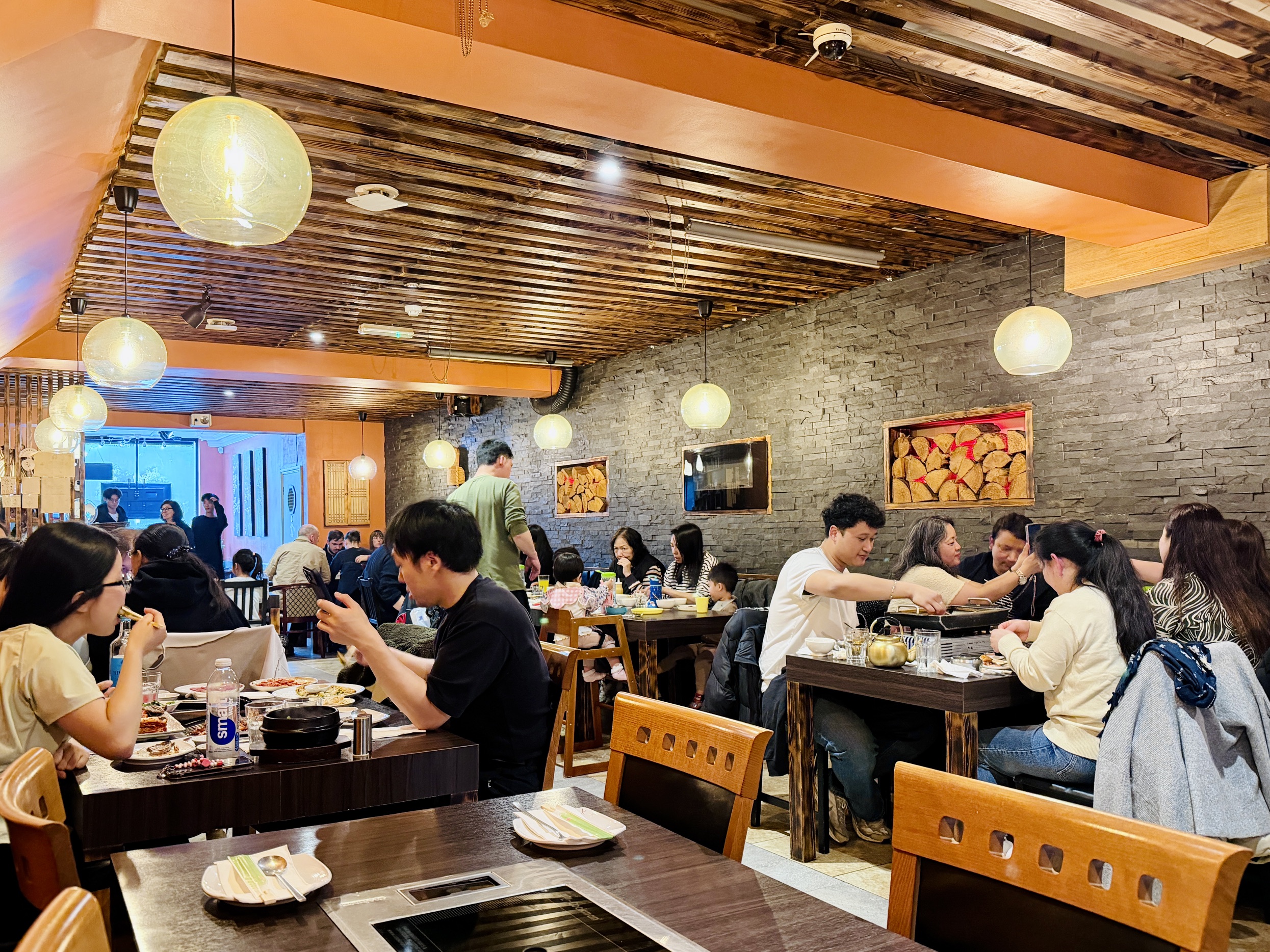
First things first: it was absolutely packed at 6.30pm on a Saturday evening. So much so that they could only just find room for us, tucked away at the very back with a great view of what was clearly a very successful restaurant. The decor didn’t feel like it had changed much in the intervening eight years: it still had a welcoming, homely feel, all wooden beams and faux slate walls.

The main difference, I would say, is just how well Gooi Nara appeared to be doing. It also started out very warm, and on a punishing day as the hot plate in the middle of our table got switched on it became even more sweltering.

In terms of the mix of customers, I would say that with the exception of the table next to ours later in the evening we were the only one exclusively made up of pasty Anglo-Saxons: I did envy my fellow WASPs at the other table who no doubt were getting an excellent introduction to the full gamut of the menu from people who knew exactly what to order.

It did appear, too, that Gooi Nara had a good reputation: I overheard a conversation at one of the big tables nearby to the effect that its occupants had converged at the restaurant from many places, some miles away. Maybe Gooi Nara filled that role for Southerners who couldn’t easily make it to New Malden, the Little Korea of the UK.

Gooi Nara’s menu has changed, I think, from when I visited it last. Back then I’m pretty sure it hedged its bets, with both a Korean and Japanese section, but now it’s all kind of thrown in together: edamame; takoyaki; agedashi tofu and pumpkin korokke feature, along with yaki soba and udon.

But the Korean elements of the menu are far more extensive, and the menu can be quite overwhelming with sections seemingly for everything: soup; rice; bibimbap; jeongol (or hotpot); noodles and of course Korean barbecue. The sides, to add to the confusion, appear at the very beginning, before everything they could conceivably be on the side of.

It made me wish I had my own food sherpa – is that cultural appropriation? – to guide me through the highlights of the menu, a feeling that only intensified as I saw some gorgeous dishes waft past to other tables. Was the delicious-looking tofu (I’m not even joking) that went to the table opposite the agedashi tofu, or the Korean doo-bu jeon? I decided on reflection it was the latter. And how good did the platter of various types of kimchi look when it arrived at the table next to me, a couple having one of the most Guardian conversations I’ve eavesdropped on in a very long time?

I came away from it all feeling silly and parochial, realising that really I only knew a handful of dishes on the menu and the various bits and bobs I’d ordered the best part of a decade ago. I was well aware that on this visit I would stay in my comfort zone, even if I’d insisted to Zoë that we couldn’t order any of the things we would invariably put in our takeaway order. So we ordered a couple of starters, a couple of mains and two items for the barbecue, and even then I’d say we played it extremely safe. We might have been outside it, but our comfort zone was only a short walk away.

Everything came if not all at once then really in a very short space of time. One minute we were necking our cold bottles of Cass, a perfectly decent lager I would struggle to tell apart from Asahi, Ha Noi or Singha in a blind taste test, let alone its Korean alternative Hite, and the next our grill was switched on and pretty much everything we’d ordered was cramming in on our table.

And the table looked big, but since the centre of it was given over to said grill you ended up playing the equivalent of those sliding tile puzzles trying to work out what could go where. Try to combine that with the timings of actually cooking some of your food and the whole experience became a little like patting your head and rubbing your belly at the same time, impressive training in multi-tasking. Forget my doing those six pointless LinkedIn games every morning: this would be much better at keeping me mentally sharp.

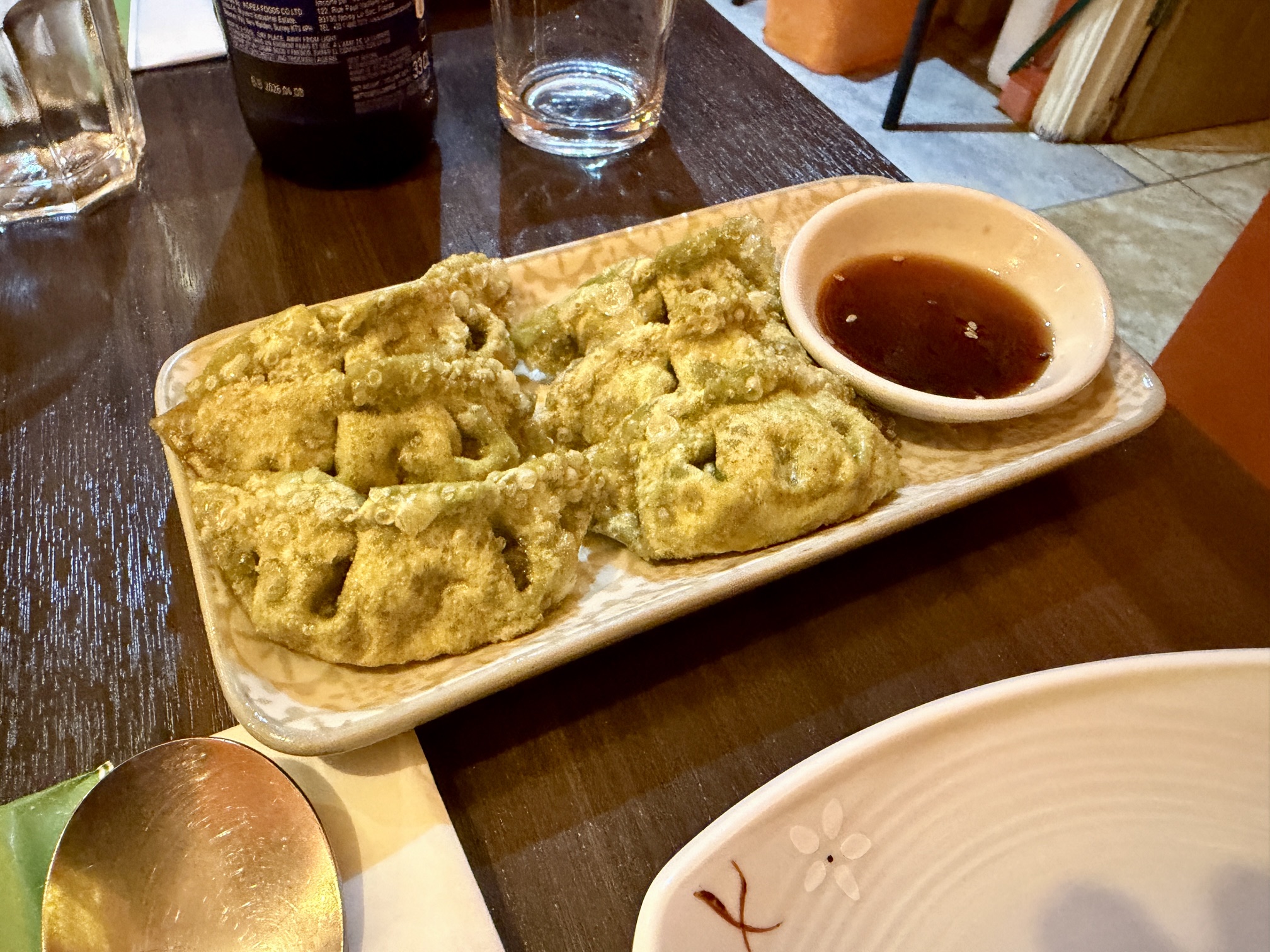
Vegetable mandu were, if anything, even more enjoyable than the chicken ones which had been dropped off by a friendly rider so many times in the last two years. A bit more crinkly and expansive than their chicken equivalents, they had a pleasingly light, grease-free texture and a filling I could almost convince myself was virtuous. Gooi Nara’s dip of soy, sesame oil, sesame seeds and quite possibly something else beginning with S had a gladdening sharpness that complemented them very nicely indeed.

A quirk of Gooi Nara’s menu is that, if it is to be believed, you get 5 chicken dumplings or 5 prawn dumplings but a strangely non-committal “5-6” vegetable dumplings. Fortunately on this occasion we got a shareable, even number, but I’m pretty sure whenever I’ve ordered the chicken mandu I’ve been given 6 of those too. Go figure, pun not intended.

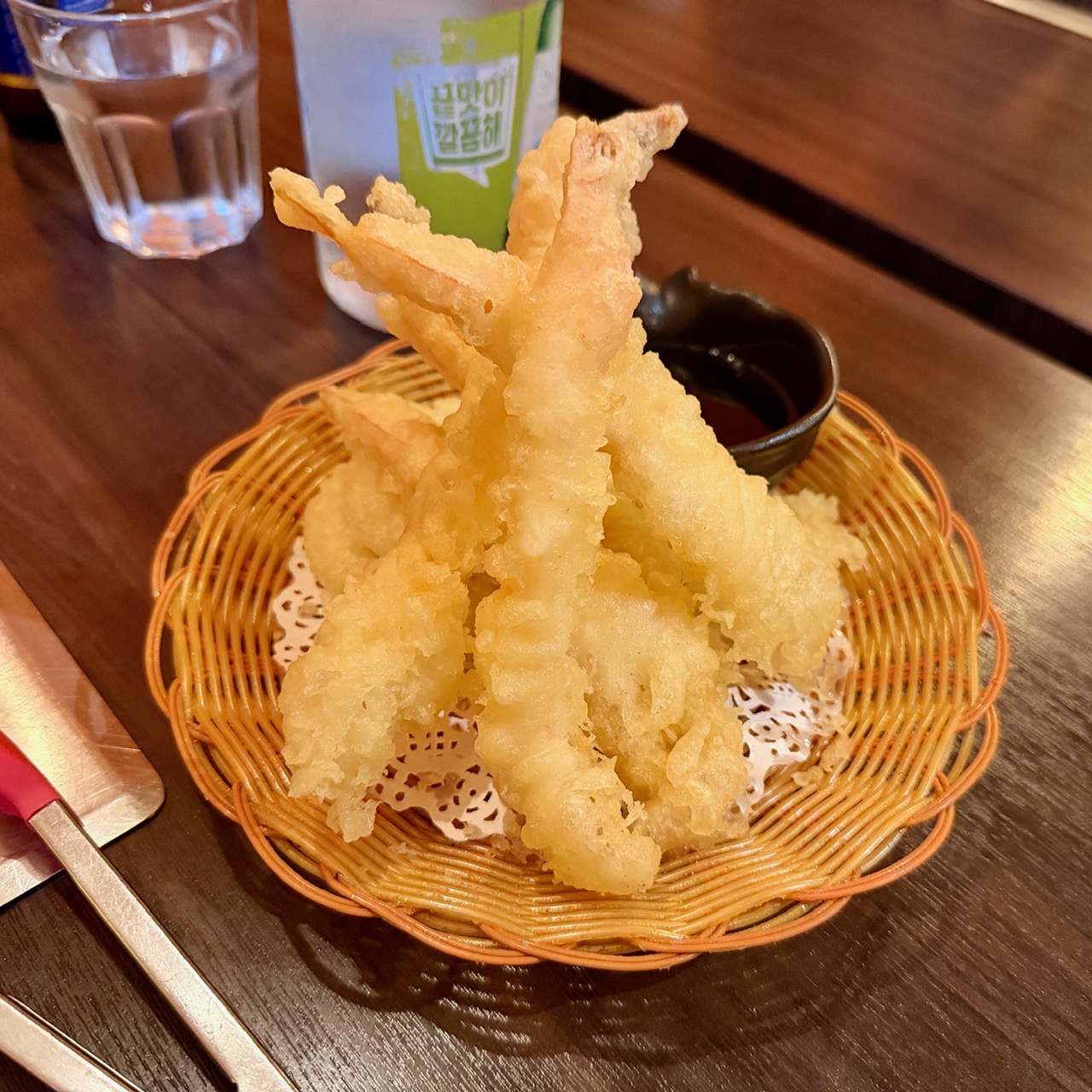
Also decent were the prawn tempura, which I would say were better than they looked. In the picture below they come across as a little wan, a tad too blond, but they had a real deft lightness and, again, next to no grease. The dip they came with, almost exactly the same as the one that accompanied the mandu, was still good but the dimensions of the vessel and the size and length of those prawns made it, practically speaking, a faff: it was a bit like trying to get a pool cue in a beer glass. £12.30 for these, so as much as both of the main courses we’d chosen.

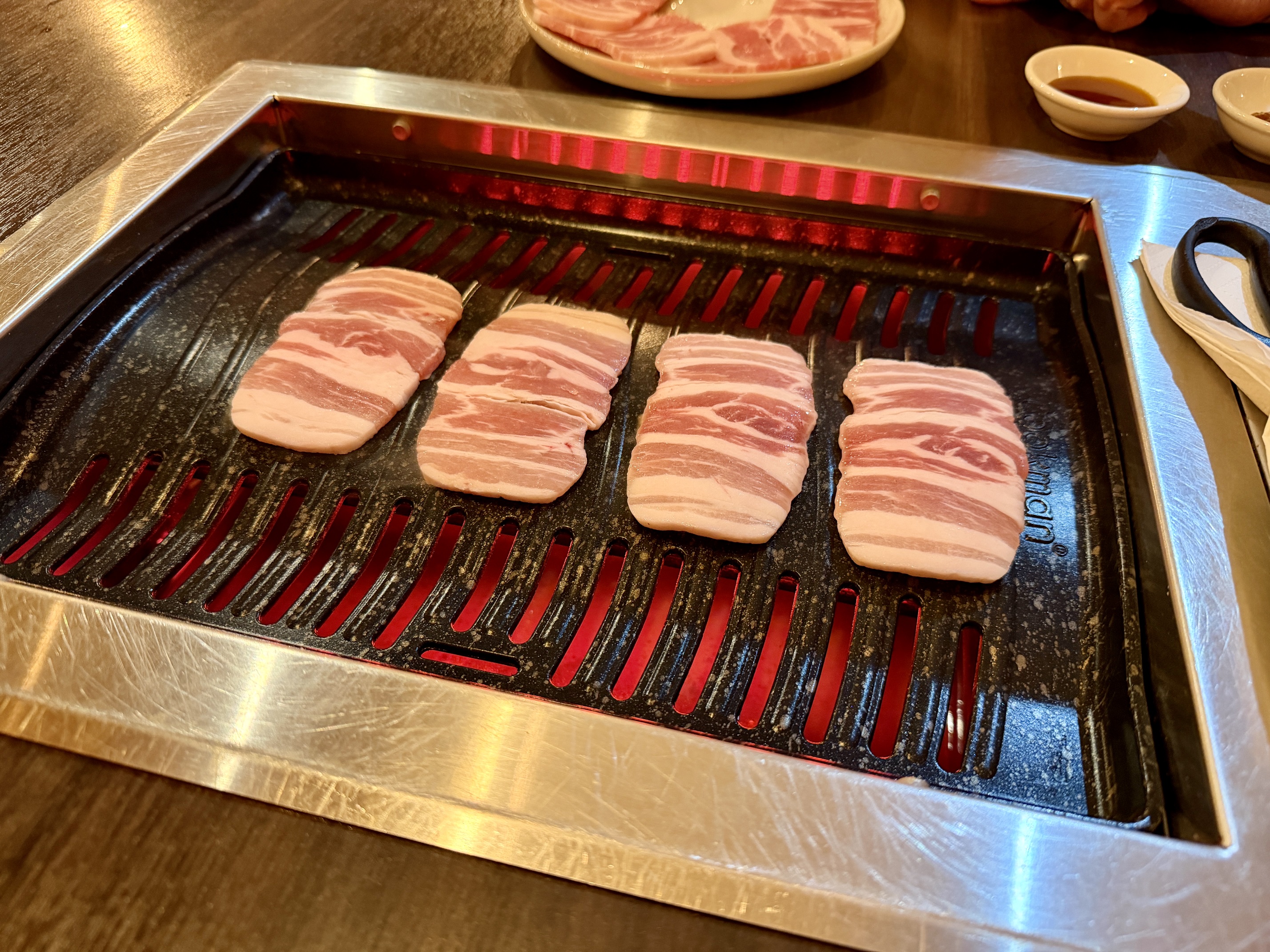
By this point we’d also started to avail ourselves of the barbecue. Sam gyap sal, unadorned sliced pork belly, turned up looking a bit like those cheap bacon-flavoured corn snacks you can get in supermarkets, and I did wonder whether we should have gone for the spicy version, but it crisped up beautifully on the barbecue, that fat rendering and permeating just enough.

We chose the pork to cook first precisely because it wasn’t marinated the way our other barbecued meat was, to try and avoid cross-contamination. We had a couple of dishes of condiments to dip them in, and I failed to make a note of either, but one was definitely soy and the other was definitely not: I think it might have been ssamjang, the traditional sauce used with Korean barbecue containing gochujang and soy beans.

It was only later that I realised we should have ordered some lettuce to wrap the pork in: it’s hidden away, chronologically speaking, in the list of side dishes at the beginning of the menu.

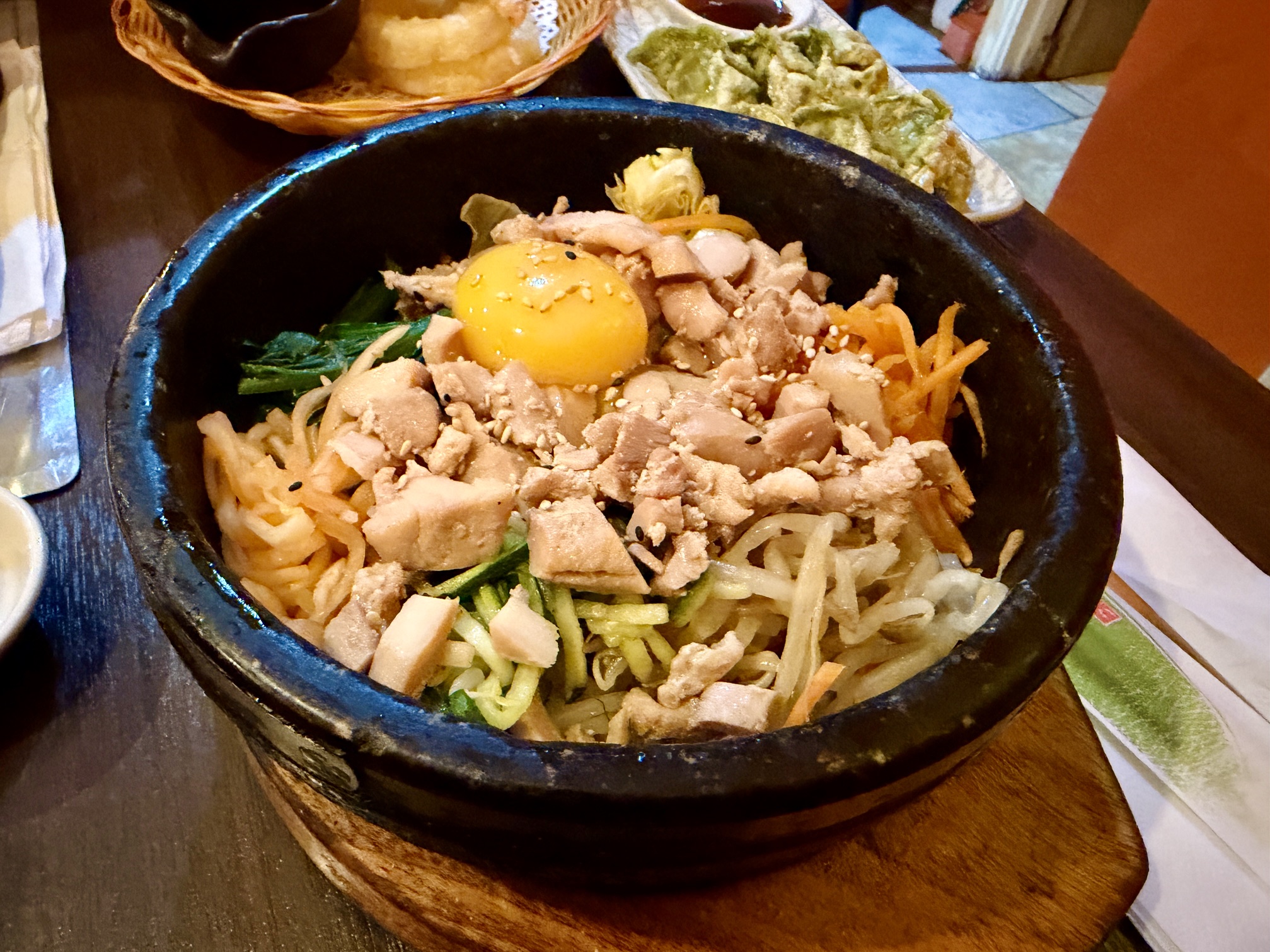
My main – although the concept of a main slightly falls away when it all comes at once – was the chicken dolsot bibimbap, a dish I haven’t eaten in a long time. For the uninitiated, this is rice, chicken, veg and an egg yolk brought to the table in a hot stone bowl, so it keeps cooking and sizzling as you work your way through it. I broke up and dispersed the egg and made my way through it, and by the end some of the rice had reached the crispy state known in Korean as nurungji (I suppose the closest European equivalent is the delectable socarrat at the bottom of a paella).

I would have described this dish as a little nondescript, a tiny bit bland, if it weren’t for the squeezy plastic bottle of gochujang which came with it. The more of this I added, the more I enjoyed it, and the more I enjoyed it the more I added it: I do wonder how much you’re meant to use, and how much was left in that bottle when I was done, but it turned what could have been a trudge into a frolic.

The other thing that whole experience taught me was patience. Ordinarily I would have a moan – god knows you’ve probably read enough of them – about everything arriving at the same time and forcing me to choose what to eat first.

Eating in Gooi Nara that evening, among all that good-natured, deceptively well controlled bedlam, I realised that it was probably a very English mindset: that your food is at its best the moment it arrives at your table and it’s downhill from there, that it’s a scramble to eat it before it goes cold and that too many dishes at once guarantees disappointment.

But it didn’t feel that way here. Those prawns and dumplings sat there, keeping their freshly fried heat. The pork sizzled on the barbecue, with more on the plate waiting to take their place. Our second barbecued meat hadn’t even made it to the front of the queue. And my bibimbap was still hot, gradually perfecting its texture. What was the rush? Everything would be eaten in its own good time, in the right order, with no need for conniptions.

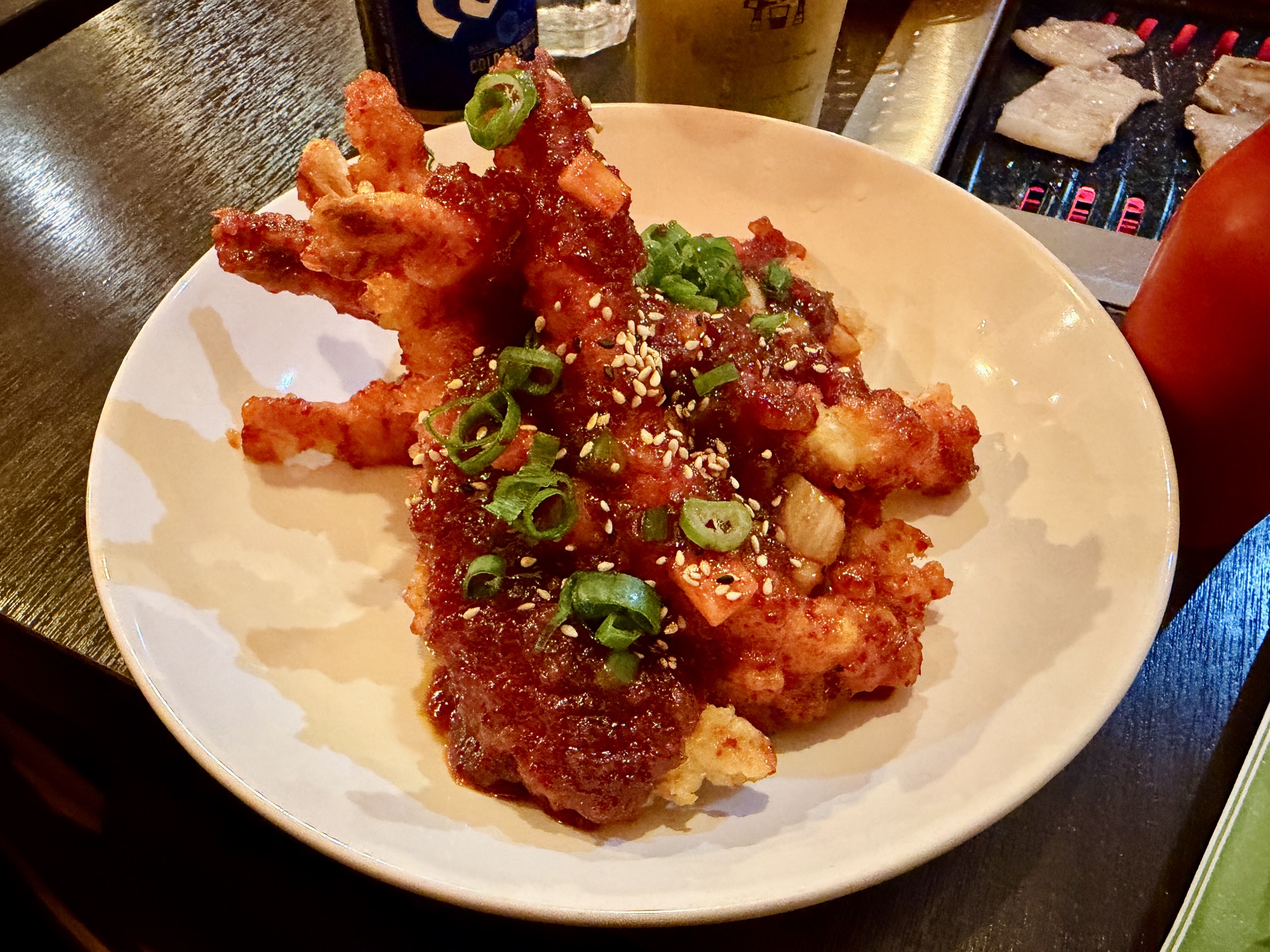
Zoë loved her main, I don’t think I would have done. I managed to persuade her not to have her regular takeaway order, her chicken gam-poong gi, but she ordered it with prawns instead. I was expecting this to be prawns curled up, little inverted commas in a crisp coating, tossed in the gorgeous spicy sauce that makes this dish such a crowd pleaser in my house.

Instead they were fully extended like an accusatory index finger, the tempura prawns from earlier on making a reappearance with some sauce thrown in. So deeply impractical in many of the same ways as that starter, and downright impossible to eat with rice. I didn’t order them, and I certainly wasn’t allowed to try them, so it doesn’t really matter. Zoë really enjoyed it, and maybe in the free-for-all of our meal overall it didn’t really matter that they weren’t quite what I thought they would be.

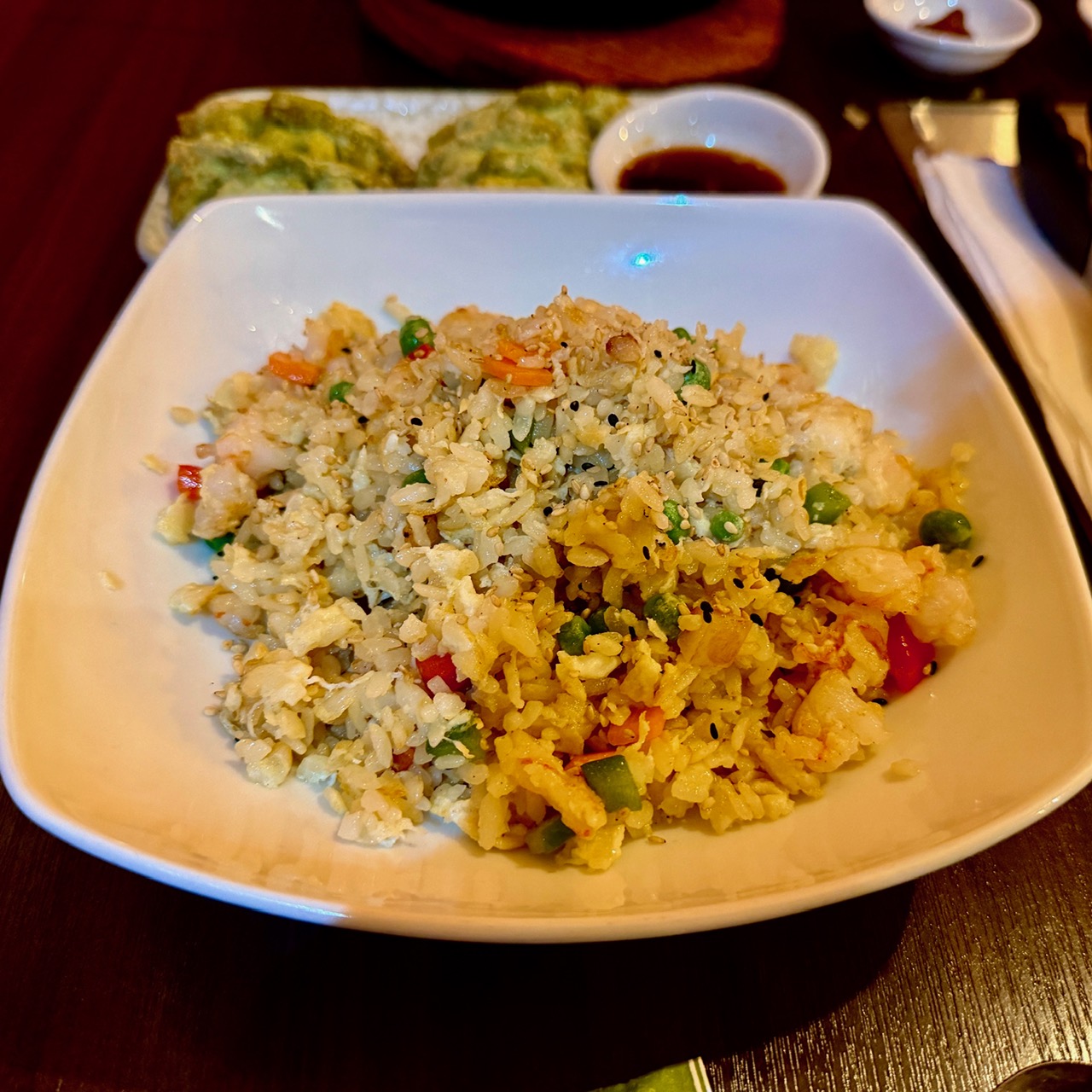
The dish they didn’t go with, or at least I thought they didn’t, was Gooi Nara’s special egg fried rice with vegetables and shrimp. Zoë, again, seemed to enjoy it but I thought it was a bit steep at £11, especially considering that you could get a bibimbap for roughly 50p more. Plus I got a bit squeezy bottle of gochunjang, let’s not forget, and this looked like it badly needed that or something like it.

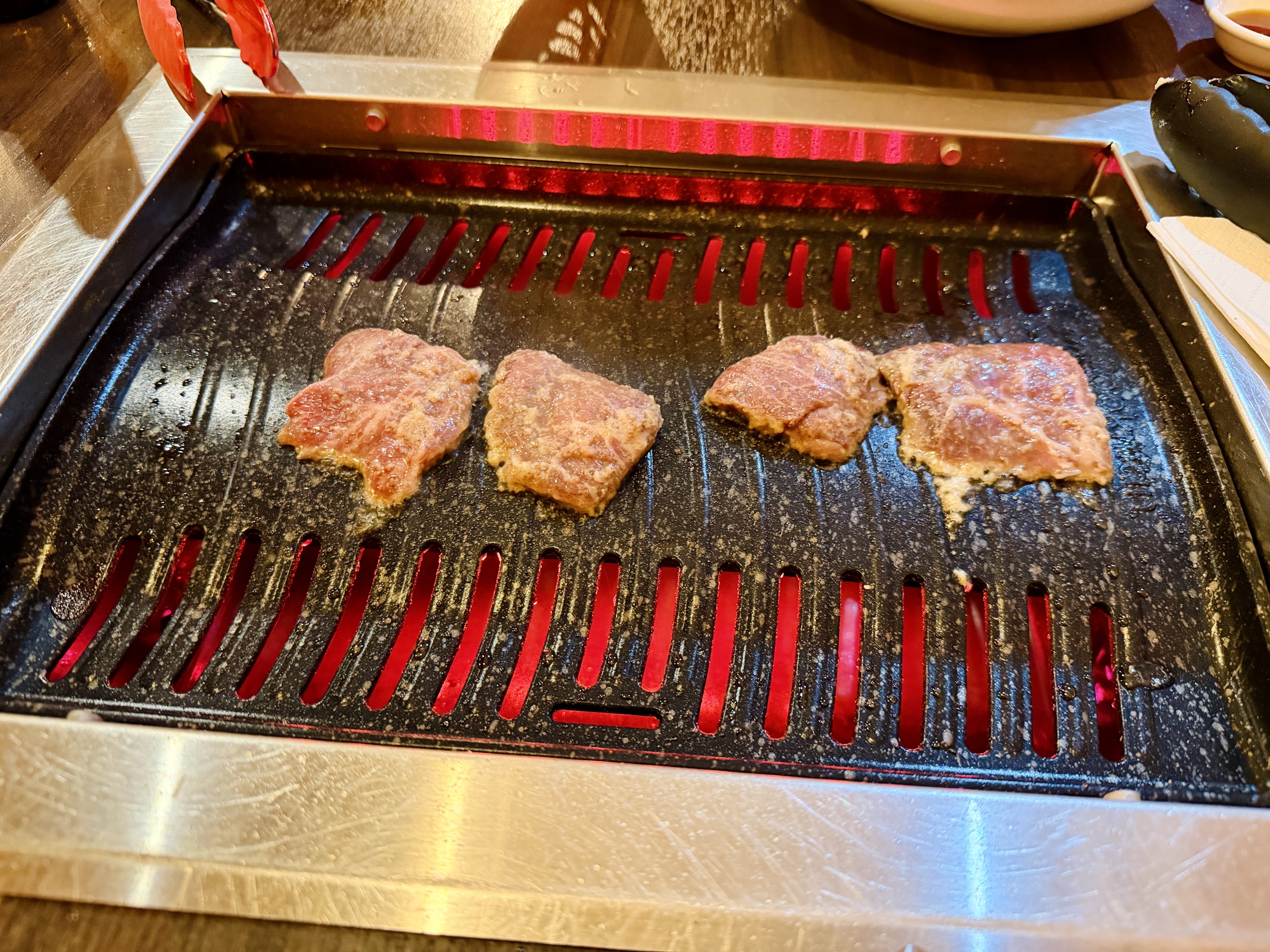
Finally, as we flagged in the heat, a little John Lewis portable fans valiantly whirring away to almost no avail, we barbecued the last dish in our order. By sheer coincidence I’d actually ended up ordering something from my 2018 visit to Gooi Nara – the ju-mul luk, beef with garlic and sesame oil. It was smothered in marinade there on the plate, slices much thinner and better cut than I remembered from my last encounter, and it smelled pretty amazing before it was ever even exposed to heat. As it cooked, the aroma got more and more gorgeous: perhaps we’d saved the best til last.

Tasting it at the end of the process, I rather thought we could have done. Every single piece was buttery-soft, that marination doing its work with no notes, and although it might have been nice to enclose each piece in a lettuce leaf and enjoy that contrast, I rather wonder if the lettuce might have wilted as badly as I did towards the end of an hour in that hot, noisy, oddly glorious room. By some tragedy, Zoë found herself full halfway through my final spell as the commis chef of our table. I buckled up and finished the rest: it had to be done.

Gooi Nara’s menu only has two desserts, both of which are Japanese, but we were too hot and too full to attempt either of them. Our bill for all that food and a couple of beers came to £95, not including service, and of course we were more than happy to tip: even just watching the constant parade of staff back and forward to tables, carrying a huge array of fascinating dishes without ever breaking rhythm, juggling orders for customers and brown bags out to delivery drivers, filled me with admiration.

It made me think of all the Saturday nights when we’d fired up a delivery app and our food – perfect, beautifully packed, prompt and piping hot – had arrived in what seemed like no time. Every evening that happened, the restaurant might well have been as busy as it was that evening. We emerged into the sunlight on Whitley Street feeling like we’d spent just over an hour somewhere totally not-Katesgrove, but also arguably in Katesgrove’s very best restaurant. We also resolved that, delicious and convenient though a Gooi Nara takeaway always was, we needed to visit again far, far sooner.

Rating Gooi Nara this time has been quite difficult. I definitely enjoyed it more than the previous time I went, but I have a feeling that the limitations on the rating it receives on this occasion have more to do with me than with them. So whatever mark Gooi Nara gets as a restaurant, I think this might be a review where I, as a reviewer, might struggle to scrape a 7. I have a feeling that if I’d been bolder, gone further to the perimeter of the menu, I could have enjoyed it even more and it would have done even better.

In that sense it would have been nice if Gooi Nara had, in the way that great communicators like Kungfu Kitchen, Clay’s, Kamal’s Kitchen and the Moderation do, tried more to tell the story of their food and bring newcomers in. But really, that’s not mandatory, especially when a restaurant has been going for about 10 years and is doing very nicely without having to do any of that. So much as I might have enjoyed having a bit more guidance on how to attack the menu, that was definitely a me problem, not a Gooi Nara problem.

I will be back, and when I do I will try some more esoteric dishes: if you have any recommendations drop them in the comments. In the meantime, I suspect another paper bag with my regular takeaway order lurks in my not too distant future. Eat-in, delivery: get yourself a restaurant that can do it all.

Gooi Nara – 8.1
39 Whitley Street, Reading, RG2 0EG
0118 9757889

https://gooinara.com/

Since January 2025, Edible Reading is partly supported by subscribers – click here if you want to read more about that, or click below to subscribe. By doing so you enable me to carry on doing what I do, and you also get access to subscriber only content. Whether you’re a subscriber or not, thanks for reading.
Pub review: The Jolly Cricketers, Seer Green

There are many restaurants I would love to visit but know, realistically, that I never will. You only have so many hours in the day, weeks of annual leave and pounds in your current account. I may never eat in San Francisco, or New York. I might never get back to Montreal, a city I loved nearly twenty-five years ago, to eat my way round it.

Zoë and I try to do at least one trip every year to a place we’ve never been together: in 2024 that was Lisbon, last year Oviedo. This year – next month, in fact – it’s Glasgow: if you have any Glasgow recommendations, put them in the comments. But that’s slow progress, and the list of places I would like to go will see me out, even if I were to devote myself to that and nothing else.

In this country, right at the top of that list sits the Parkers Arms, a pub in Lancashire’s Forest of Bowland, a beautiful part of the country by all accounts. I would defy you to look at the Parkers Arms’ Instagram or read any of the many breathless reviews of the place online and not want to eat everything proprietor Stosie Madi cooks up, from pies to langoustine, from pasta to partridge. Clay’s owners Nandana and Sharat are enormous fans, and when people who cook that well admire somebody’s work you do rather sit up and pay attention.

But I am not a driver, and if you live in this part of the country getting to Newton-In-Bowland is a challenge to put it lightly. By the looks of it, if I caught the bus from outside my house at just past 1 o’clock and absolutely everything went my way, I could be there just in time for dinner. I’d be absolutely broke, have nowhere to stay and no way to get home, but I guess I could just about do it.

Plus of course if I ate there once – me being me – I would be devastated at all the things on the menu I’d missed out on, and then I’d wonder how I could manage to do it again. Sadly the likes of Bruges and Málaga are quicker, easier and cheaper to get to than bits of our own country: that’s public transport for you.

But as it happens, Madi is indirectly responsible, via a strange chain of events, for this week’s review. For the last couple of years she’s been incredibly supportive of my writing, which I think she discovered through my slightly crabby review of Planque, Vittles‘ favourite London restaurant, and occasionally she’s recommended reviews of mine through her own social media. That led to me being followed on Instagram by the Jolly Cricketers, a pub in the Chilterns that I’ve always known of by reputation.

Then, one day last month, the Jolly Cricketers contacted me and asked if I’d ever consider reviewing them. Owner Amanda told me that she had run the pub, at the heart of its village, for coming up to eighteen years and said that any friend of the Parkers Arms was a friend of theirs. I said I would see what I could do, but that it wasn’t the easiest place to get to by public transport, and they said they completely understood. “Maybe one Friday you’ll find I’ve eaten at yours, when the review goes up”, I told them. “Maybe one day”, they said.

That did make me think. After all, the Jolly Cricketers was a darned sight easier to get to than the Parkers Arms, so perhaps I owed it to both pubs – and myself, of course – to make the bloody effort to get to the one I could reach. It was less than an hour in the car, or I could take a couple of trains. It took two hours, but what else was I going to do on a Saturday?

And then life took one of those unexpected turns. My dad died, and the venue we picked for his celebration of life – we didn’t, as a matter of policy, use the F word – was a lovely venue halfway between Beaconsfield and Gerrard’s Cross, deep in the Chilterns. When I looked it up on Google Maps, I couldn’t help but notice, because in the midst of death we are in life, a couple of minutes’ drive north of the venue… was that the village the Jolly Cricketers was in? It was, and so I booked a table for the day after my old man’s sendoff. I told myself it’s what he would have wanted.

By the time the day came, it was exactly what I needed. And that’s not to say that his sendoff the day before, the day he would have turned 80, hadn’t been lovely, because it was. The music, picked with expert assistance from Zoë, was spot on (a bit of Dylan, James Taylor, Scottish folk singer Archie Fisher and Fantasia On A Theme By Thomas Tallis). The pictures of my dad captured him just right: there he was looking suspiciously down the lens at me in one; holding one of his extensive collection of fountain pens in another; behind the wheel of his beloved Mustang in a third.

My brother Matthew, back from Australia, made a beautiful speech, and I read a poem my dad had written in anticipation of the day he left us, feeling like a pale imitation. And there were people from every stage of his life: his family, all the way back from his childhood in Bristol; friends from his badminton era; his tango era; his performance poetry era; neighbours; my mum and my stepfather, paying their respects.

It was as good an event as those events can possibly be, and when we had drinks afterwards in the nearby hotel it became clear that everybody had learned at least something new about my father, a complicated cryptic crossword of a man at the best of times. “I never knew about the poetry” said my cousin Wayne, sipping his cider from the bottle. “I didn’t know him that well” said a neighbour of his, “and after today, hearing all that, I wish I’d known him better.”

You and me both, I almost said, but I was glad that the celebration of his life had made people realise it was a life worth celebrating. Afterwards, when everyone had taken their leave Matthew, my stepmother Tricia, Zoë and I had a late meal in the hotel restaurant and agreed that we had done a good job of honouring his memory. The question of what next? hung there unspoken: that was for the future.

But when I woke up the following morning, wrestling with an unfamiliar shower in the hotel bathroom, it hit me: he was gone. He’d been gone already, of course, but now he was gone gone. And I felt that flatness everybody told me I would inevitably feel at some point. I congratulated past me on booking somewhere nice for lunch for this new phase, this unfamiliar landscape. Even if it hadn’t been what my dad would have wanted, it was what I needed.

But first my brother, Zoë and I did something rather magical. A short walk from the centre of Beaconsfield is Bekonscot, the oldest model village in the world. It’s close to celebrating its centenary, and I found it enormously touching that it had survived all this time, a little time capsule of Merrie England in the Thirties which managed to be wholesome and beautiful rather than some kind of billboard for the bullshit Britain Brexiteers want us to return to. My dad wasn’t even born when it welcomed its first visitors, and wouldn’t be for over sixteen years.

I’ve spent much of the winter and spring watching Gilmore Girls and Zoë would quite like to live in Stars Hollow rather than Reading (although I’d run out of places to review very quickly). But Bekonscot might give it a run for its money: at the risk of channelling my inner Bill Bryson, it is an utterly magnificent place and I rather feel everybody should go there and experience the sense of wonder at least once.

Everywhere I looked the attention to detail was incredible – there was a railway with multiple stations, a cable car, a harbour, a pier, a gorgeous deco Tube station. A football match played out by the riverbank, the picture house advertised a motion picture starring Oscar Winna and Carrie Zmatik, folks danced round the maypole outside a handsome church, the little train chuffed from one stop to the next, adults and kids towered over every diorama, peering, fascinated, taking photos.

And there I was with my brother, on the first day of this new phase, going round a model village together, somehow a lot more adult than we had been a couple of days before, or the month before that. That makes it all sound sad, which it wasn’t completely, but it was poignant all the same. Would my dad have enjoyed Bekonscot? He was an engineer, he would have appreciated the precision. But the answer is that I didn’t know, and now I had no way of finding out: now that, that is sad.

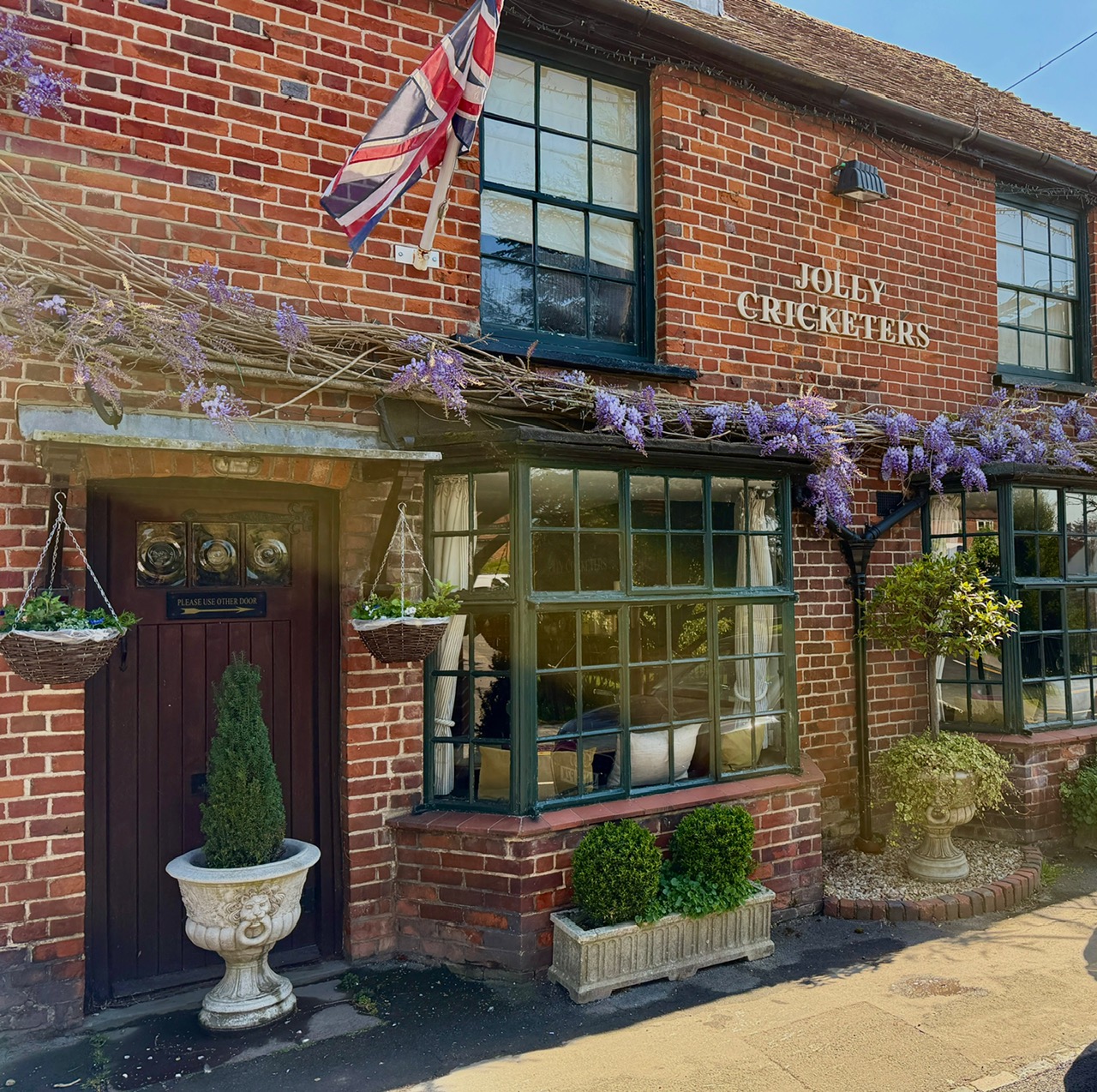
It’s just over a five minute drive from Bekonscot to Seer Green, proudly proclaimed on the signs as “The Cherry Pie Village”. It really is a gorgeous place, and the Jolly Cricketers is in a beautiful spot one side of the churchyard. Even the church, in the sunshine, was delightful: tables and chairs out in case you wanted to stop and rest, a cafe inside with its own Instagram account. And the pub was a picture postcard perfect spot, wisteria running along the top of the racing green window frames. It could easily have belonged in Bekonscot too, if only it had been a lot smaller.

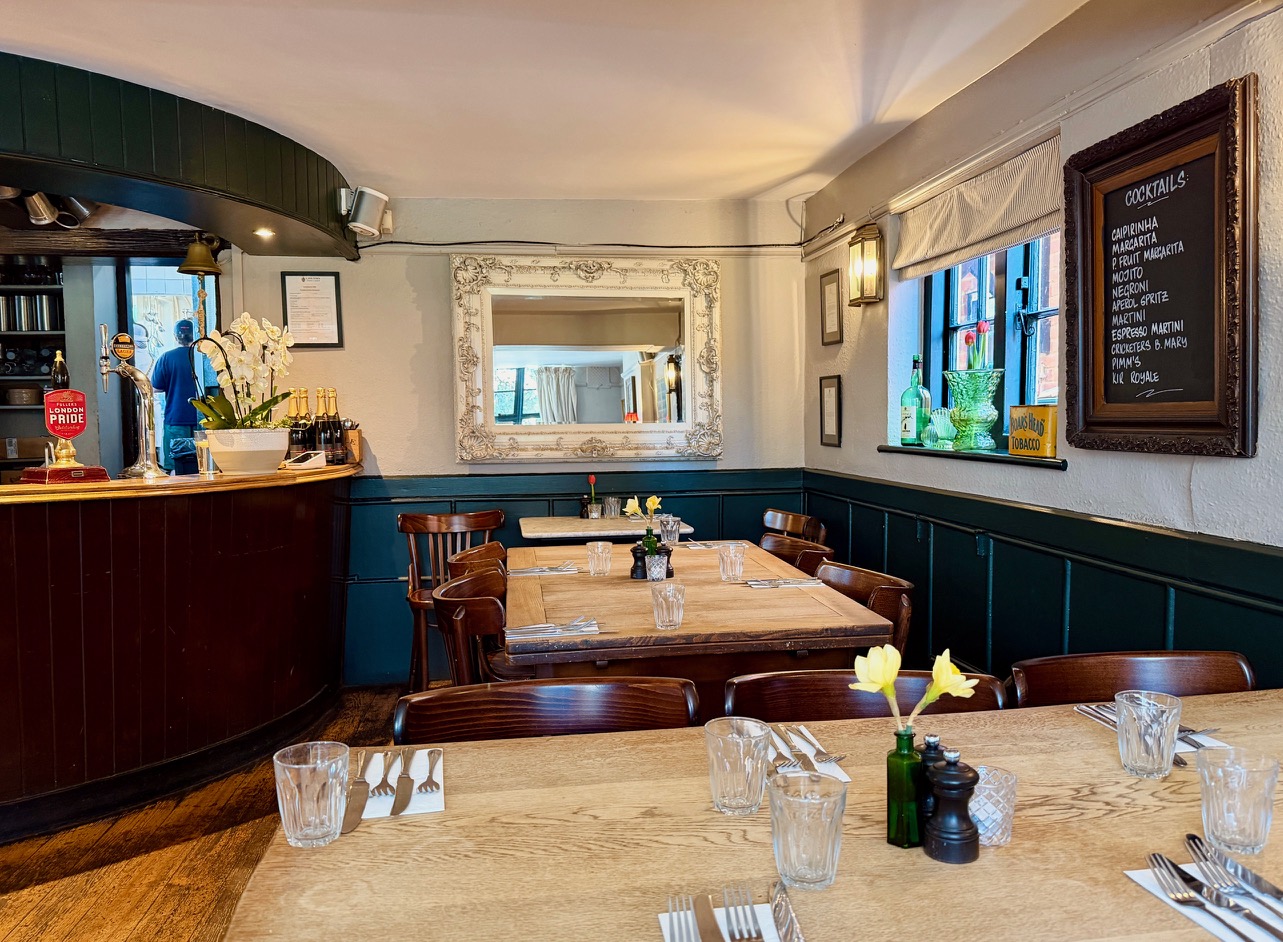
It was made up of two rooms, a larger bar and a smaller dining room, although I imagine you can eat in either. The staff told us it was a quiet lunchtime so we could sit anywhere, and they very kindly let us expand into a table that would ordinarily seat six, my brother, my stepmother, Zoë and me. Sun poured through the windows, and the cricketing theme was worn lightly: a ball on the mantelpiece, the menu broken into sections saying Warm Ups, Openers, Main Play. It was an extraordinarily handsome space, somehow a very classic dining room transplanted into a gorgeous old pub without remotely jarring.

One of the nice things about going to a place like the Jolly Cricketers in a large group is being freed of the tyranny of having to choose something different to everybody else. And – I can’t imagine why – all four of us were in the mood to eat our feelings that day, so we attacked every section of the menu and gave ourselves permission to order without fear of hesitation or repetition.

My brother had an alcohol free beer, Zoë and my stepmother tried the alcohol free gin and tonic and I, the sole drinker, regretted not being able to order a bottle from the wine list, especially because the pub stocked fascinating-looking natural wines from Woodfine, a winery in the village. I consoled myself during the meal with a Spanish Chardonnay which was extremely good and a Rioja which was even better. Even so I suspected that the real treats were further down the wine list – especially a Saperavi and a Xinomavro, both around the £50 mark.

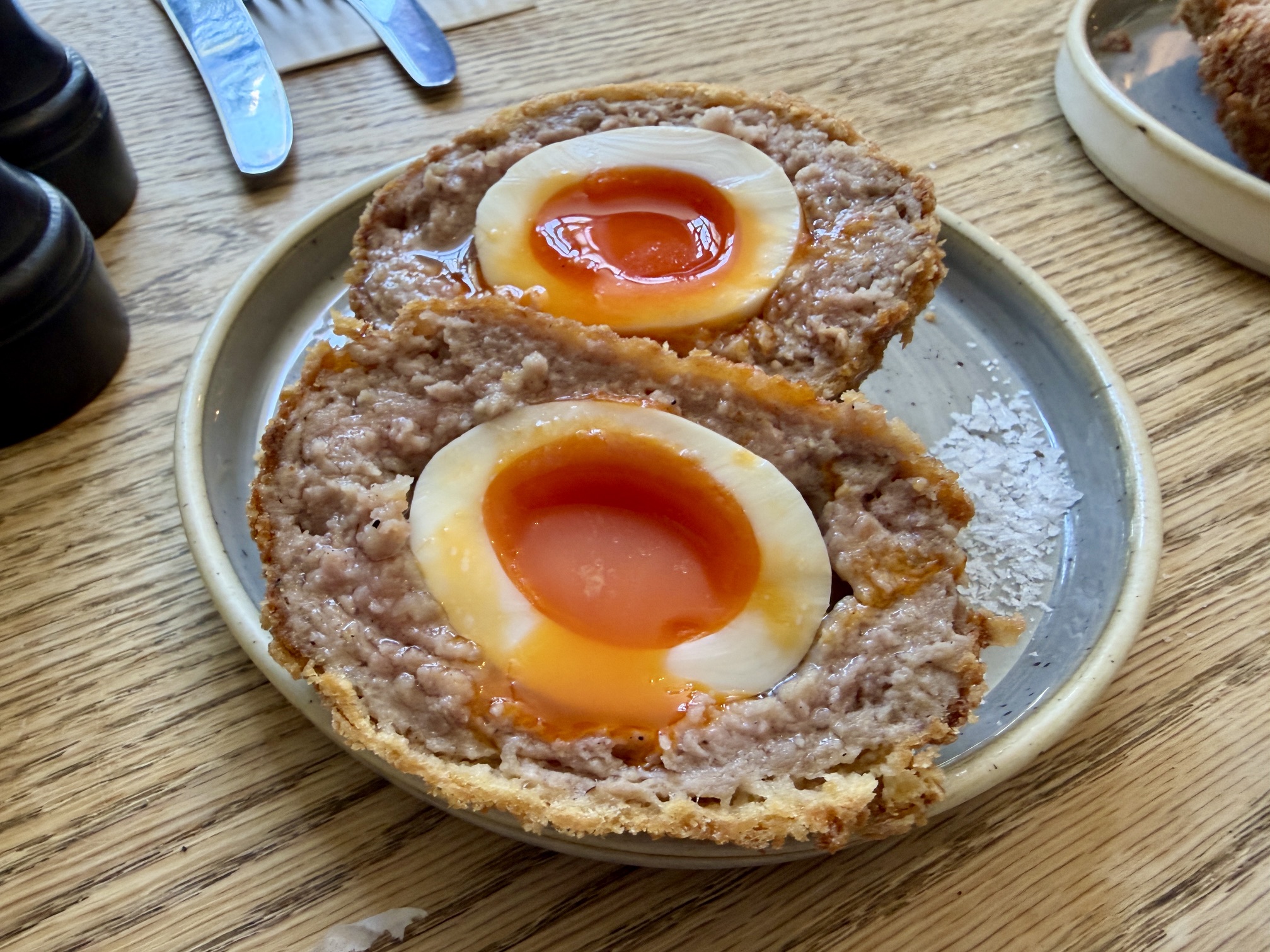
Now, on to the food – and before you judge, I’d just like to say again that it was a very particular set of circumstances. First, the Scotch egg. We had two of these between the four of us and I absolutely adored it, the pork coarse and judiciously seasoned, the Burford Browns spilling golden secrets, a smattering of salt flakes to sprinkle on top. It took me back to the glory days of the Lyndhurst, and made me wish I had a pub doing food like this within walking distance. The yolk was a little runny for my stepmother’s personal taste, the lack of brown sauce or any other condiments won Zoë’s seal of approval: on balance, a palpable hit.

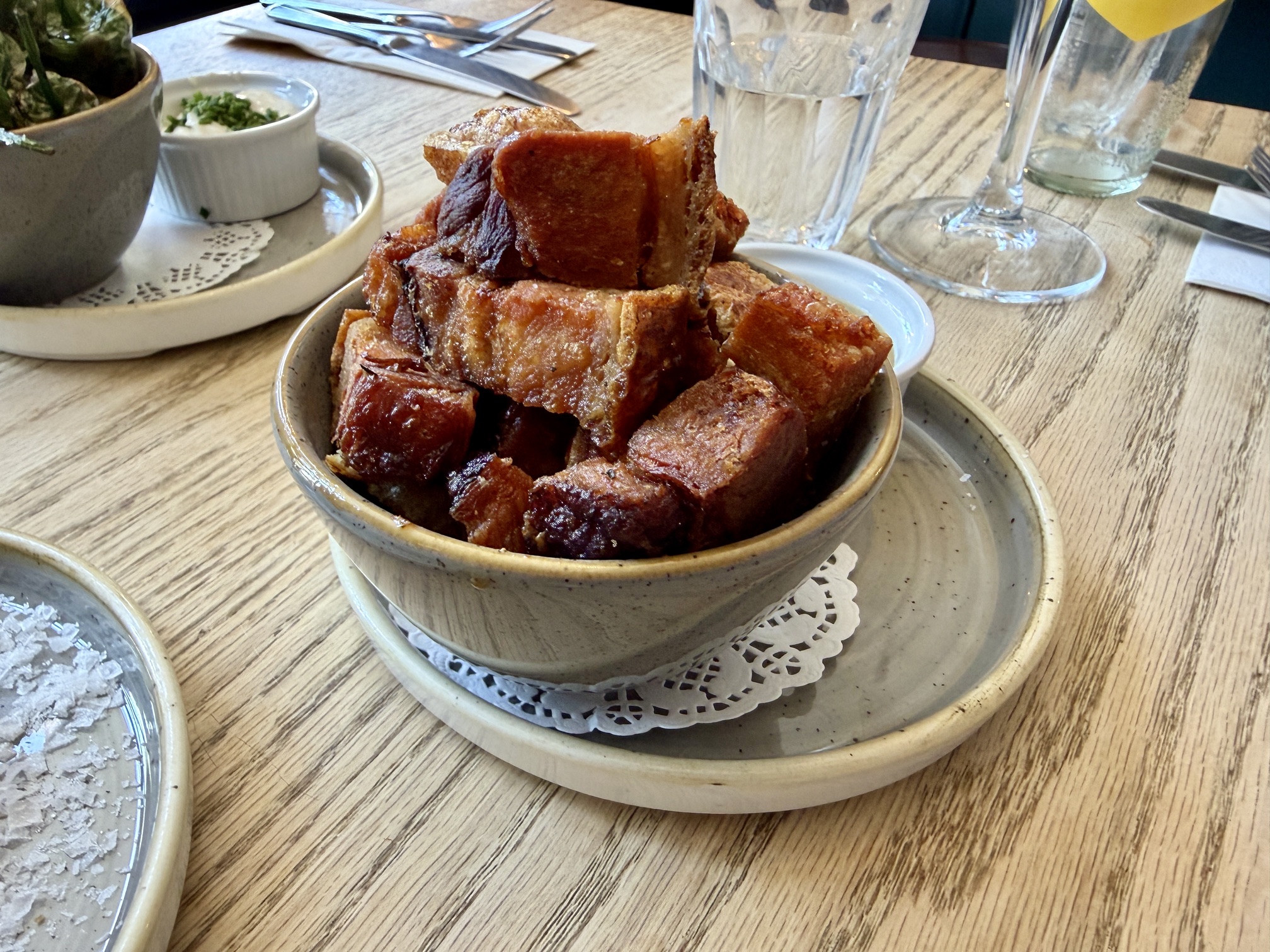
Even better were the cubes of crispy Chiltern pork in a cairn with a little bowl of apple sauce for dipping. These were simple, bronzed and moreish beyond measure, and if I ever sweep to power every licensed establishment will have to offer this dish or something like it. I doubt many would make it seem as easy as the Jolly Cricketers did, though: such simplicity, just pork, salt and apple.

I regret the fact that we only ordered one portion of these, and I stand by that despite the sheer quantity of what we got through, but it was indisputably excellent value at £8.50.

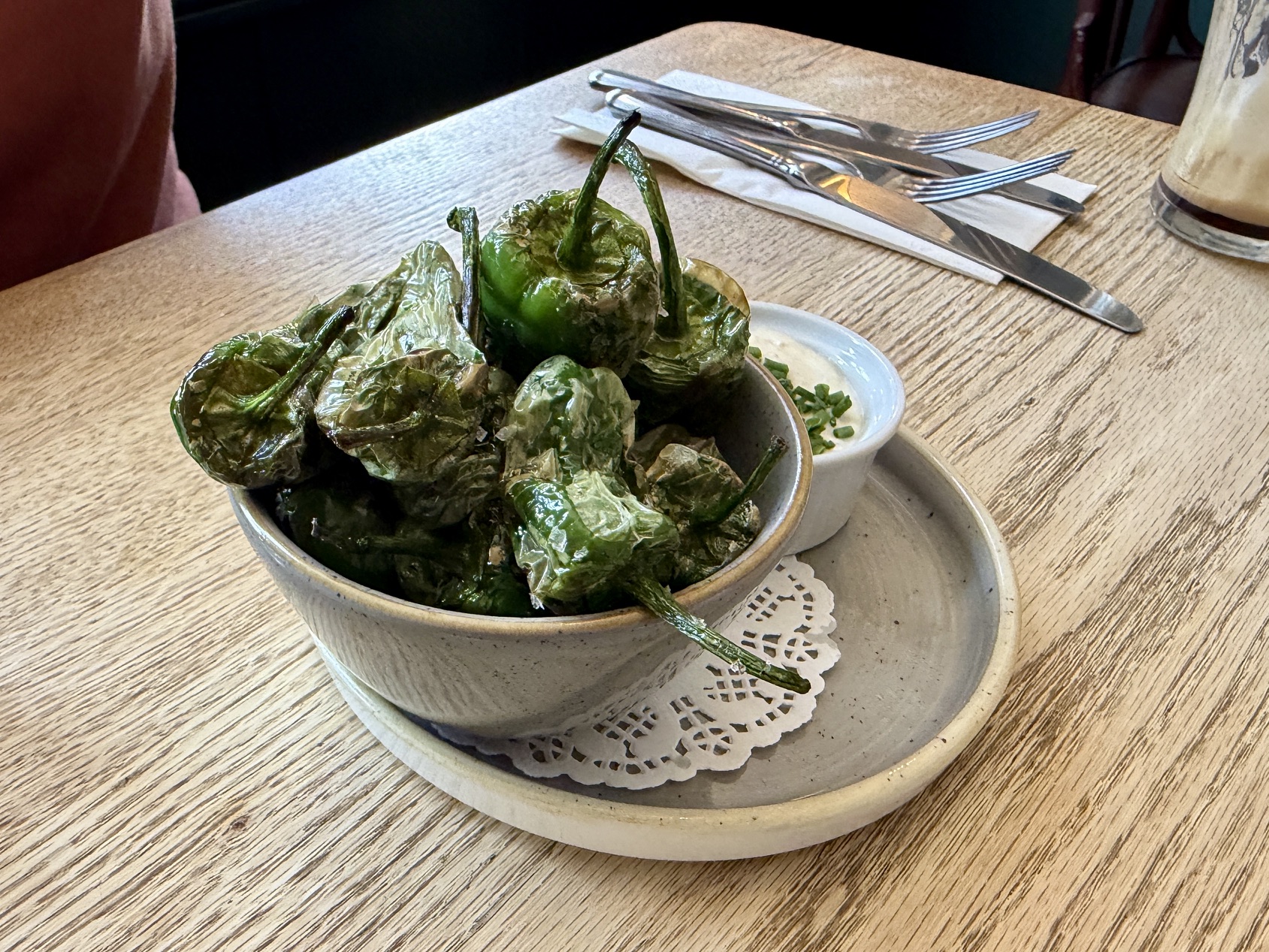
The last of our trio was padron peppers, ordered because Zoë loves them; my stepmother, not unreasonably, said “I can make those at home”, and I’ve always felt I can take or leave them.

But if you do like padron peppers, and plenty of people do, these were as good an example of the genre as you’ll find. I wasn’t sure about the wisdom of serving them with aioli, mainly because I’ve never seen that done before, but the padron pepper expert among us was very happy with them. Also £8.50 for these, which I found a tad strange: the crispy pork felt like a much better return on investment.

I didn’t take a picture of my starter, even though I was sure I had. Can you believe I still make rookie mistakes like that after nearly thirteen years? I’m going to plead extenuating circumstances and tell you that my crispy squid was a knockout, beautifully fried, still tender, plenty of it. You could eat it with a fork, and I started out that way, but once it cooled enough for me to pick it up and dab it in a simple but exquisite dip of honey, soy and garlic I abandoned decorum and did exactly that.

This is a dish you see on pub menus fairly often, but you would struggle to find it executed as well as the Jolly Cricketers do: this would, I discovered, turn out to be a theme. The pub’s menu doesn’t lean too heavily on provenance, but it does say that fish and seafood come from Newlyn’s Flying Fish, a name I recognise which inherently inspires confidence.

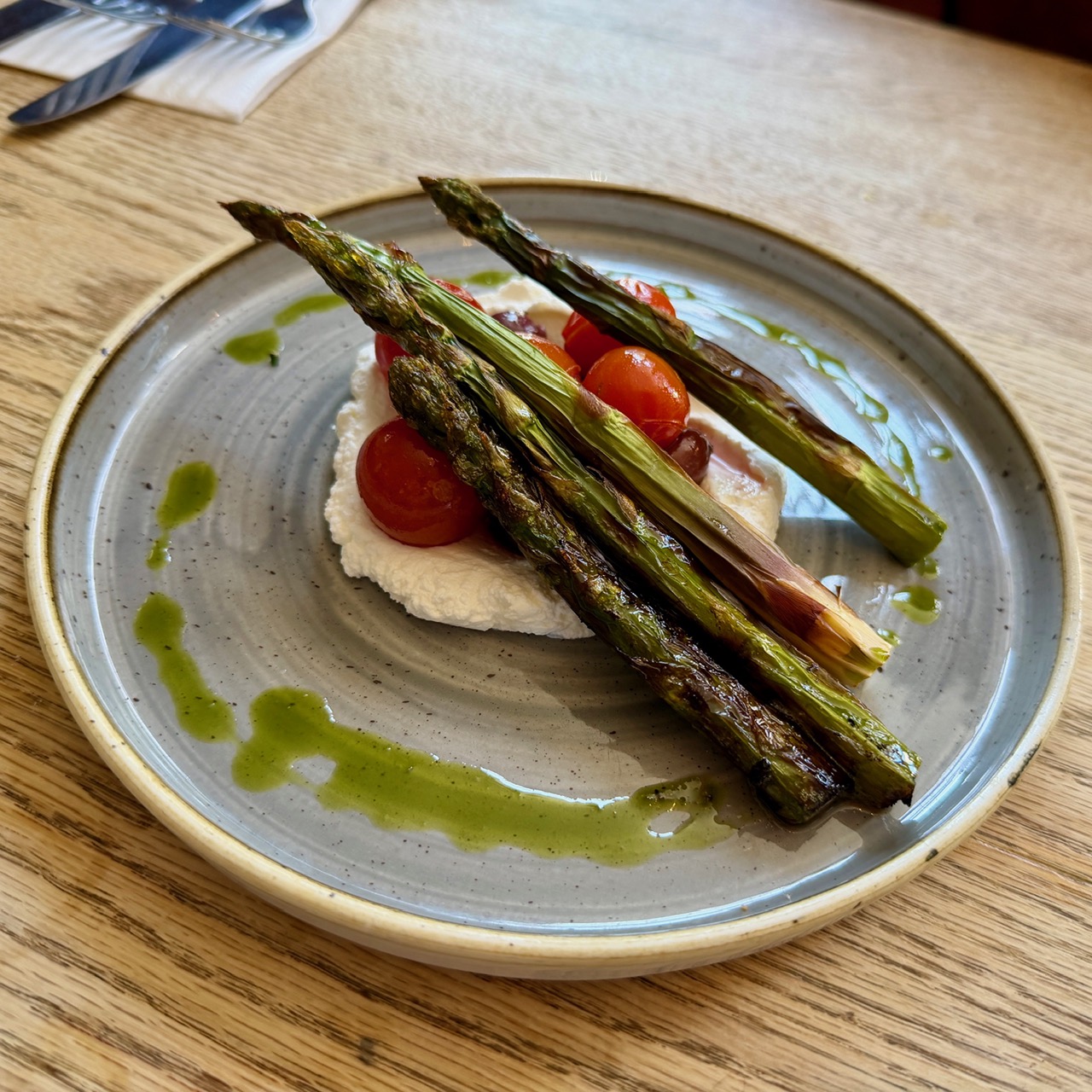
My brother was torn but ended up going for the asparagus. He really enjoyed it, and it had plenty going on with sumac labneh, cherry tomatoes and olives, a moat of the most arresting-coloured extra virgin. I didn’t eat this, so I won’t sit in judgement too much, but just the four spears felt a little underbalanced and it didn’t look like the sourdough crumb made its presence felt. It was the most expensive starter on the menu at £12.50 and I was glad I hadn’t ordered it myself, but for all I know it probably – as wankers like to put it – “ate well”.

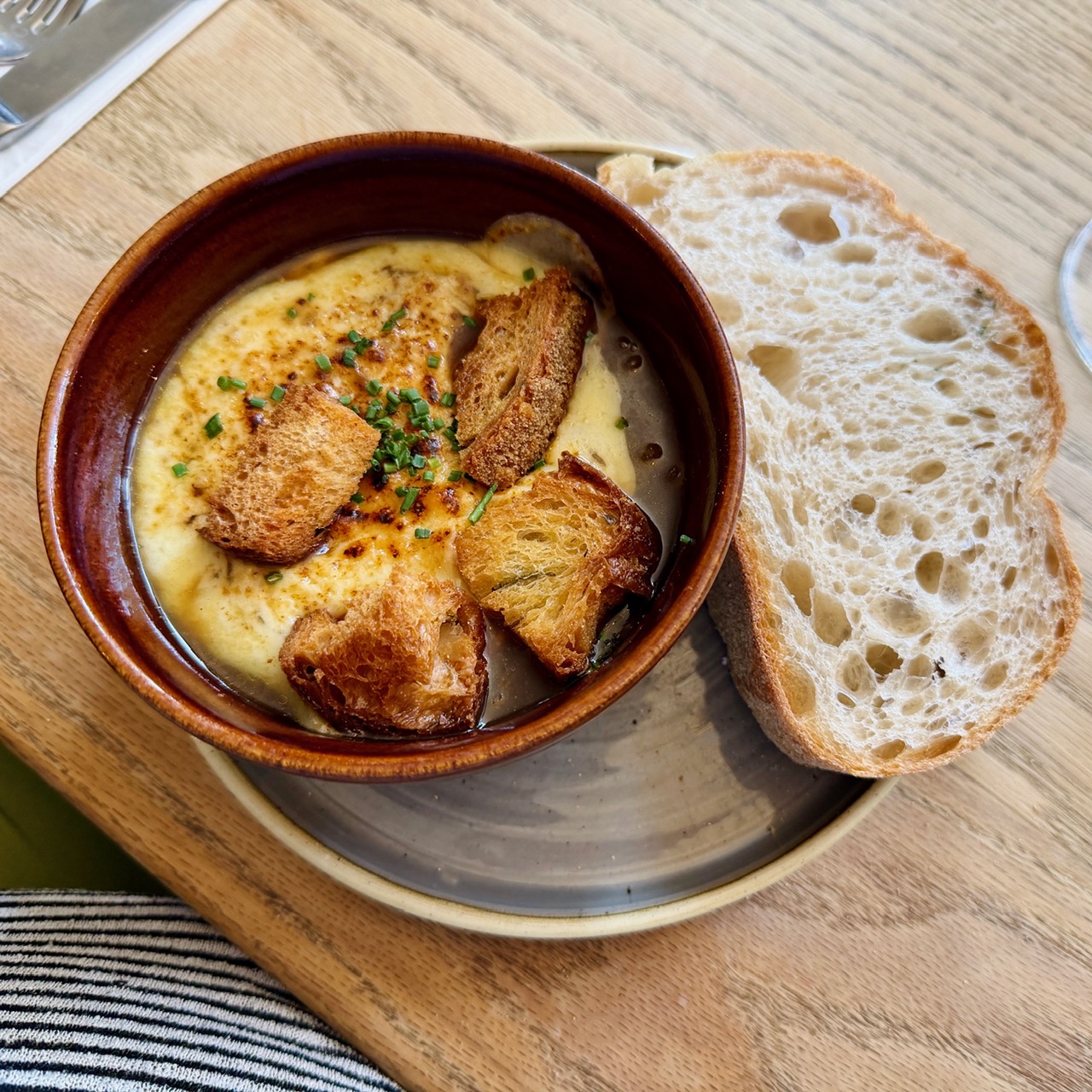
I think the people who really ate well – because repeat after me, dishes don’t eat well, people eat well – were Zoë and my stepmother, who went for the French onion soup. The pub had said recently on Instagram that it was back on the menu by popular demand, and that demand was echoed at my table. It really did look the part, a deep brown panacea packed with onion, topped with a hulking permacrust of molten cheese studded with epic croutons.

And in case that wasn’t enough for you, there was also a thick wodge of excellent bread speckled with caraway seeds: not necessarily that French, but a very welcome interloper. “It was maybe ever so slightly too sweet from the onions” Zoë told me later, “but that’s niggling. Besides, the cheese more than made up for it.”

By this point it looked like we might be the only lunchtime customers in the dining room that day (which goes to explain why the pub also offers a locals set menu lunchtimes and evenings during the week). But if anything, that just made the service even better, without ever being too much. We were always asked if we were happy with each course, just at the moment when we had finished our first mouthfuls and established that yes, we truly were.

Drinks kept coming as we needed them, and we were always asked whether we wanted more just at the point when one of us was thinking that more were in order. There is a real talent to this, especially to do it and make it seem telepathic, and that the Jolly Cricketers’ young and enthusiastic team was so very good at it was one of the many happy discoveries of our lunch.

Pacing was, too: it could be so easy when a kitchen isn’t mega-busy to get into a rat-a-tat rhythm and pepper you with course after course in quick succession. But the pub understood not to do that and actually, on that day of all days, the time and space we were given was one of my many favourite things. By the time our mains arrived, we were ready but not hankering – how could you hanker when we’d been determined to try so much of the menu? – but they were still a happy sight.

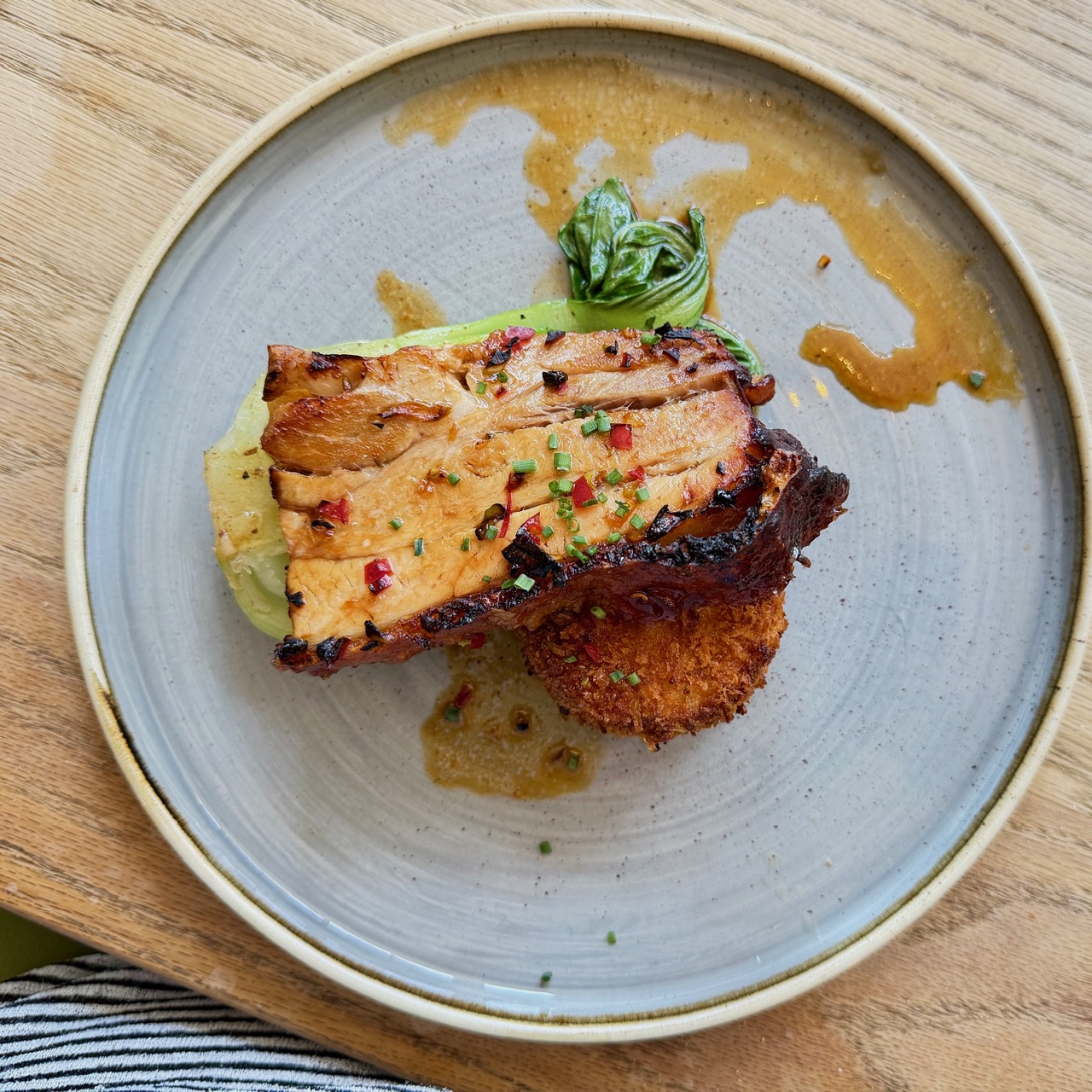
Three of us had chosen the pork belly – from Stockings Farm, less than ten minutes’ drive away – which makes my job far easier than it could have been. On paper it sounded like an unmissable dish: pork belly, crab cake, pak choi and a soy and garlic sauce, so many wonderful things coexisting on a plate. And if it wasn’t quite perfect it was close enough that I couldn’t bring myself to feel anything but indulgent. Because it all worked, it just could have worked slightly better and come together a little more.

The pork was truly magnificent – a whopping striated slab of the stuff, crispy-edged but yielding at its core, some of the best pork belly I’ve had in as long as I can remember (or at least since the crispy pork earlier on). And the pak choi offered an excellent contrast, cooked absolutely bang on. But I would have liked the crab cake to be a little crispier too, a bit less crumbly and to have more of the ginger that was meant to feature. And it needed sauce to bring it together – a proper quantity of it, not a thin trickle that had made its way to the perimeter of the plate, like it was trying to make a break for it.

The crab cake was just a question of preference, but the lack of sauce meant that this dish, made of exceptional parts, didn’t quite cohere into a whole. It made me wish I’d kept the rest of my ramekin of soy, honey and ginger from the squid, because pouring that over this pork and the crabcake would have been the missing piece. Without it, what could have been a perfect dish had to settle for mere excellence.

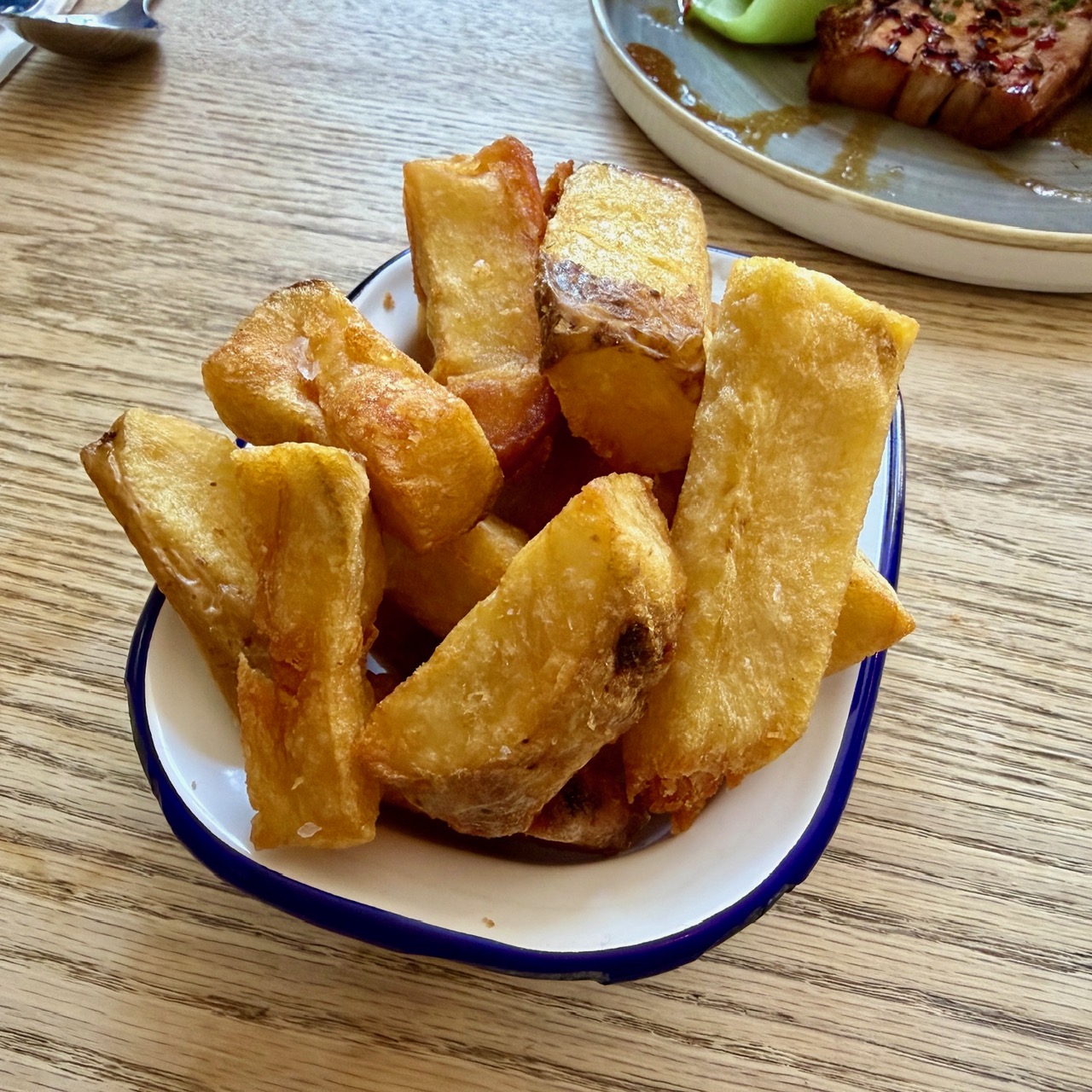
We’d opted for a solitary portion of chunky chips to provide carbs, and in honesty the crabcake was spudded up enough that we probably didn’t need them. But thank goodness we ordered them anyway, because they were textbook: stubby and crunchy, beautifully done with a little side order of rustling scraps in the bottom of the bowl. My stepmother had a couple too, declaring them infinitely better than the fries that came with her main.

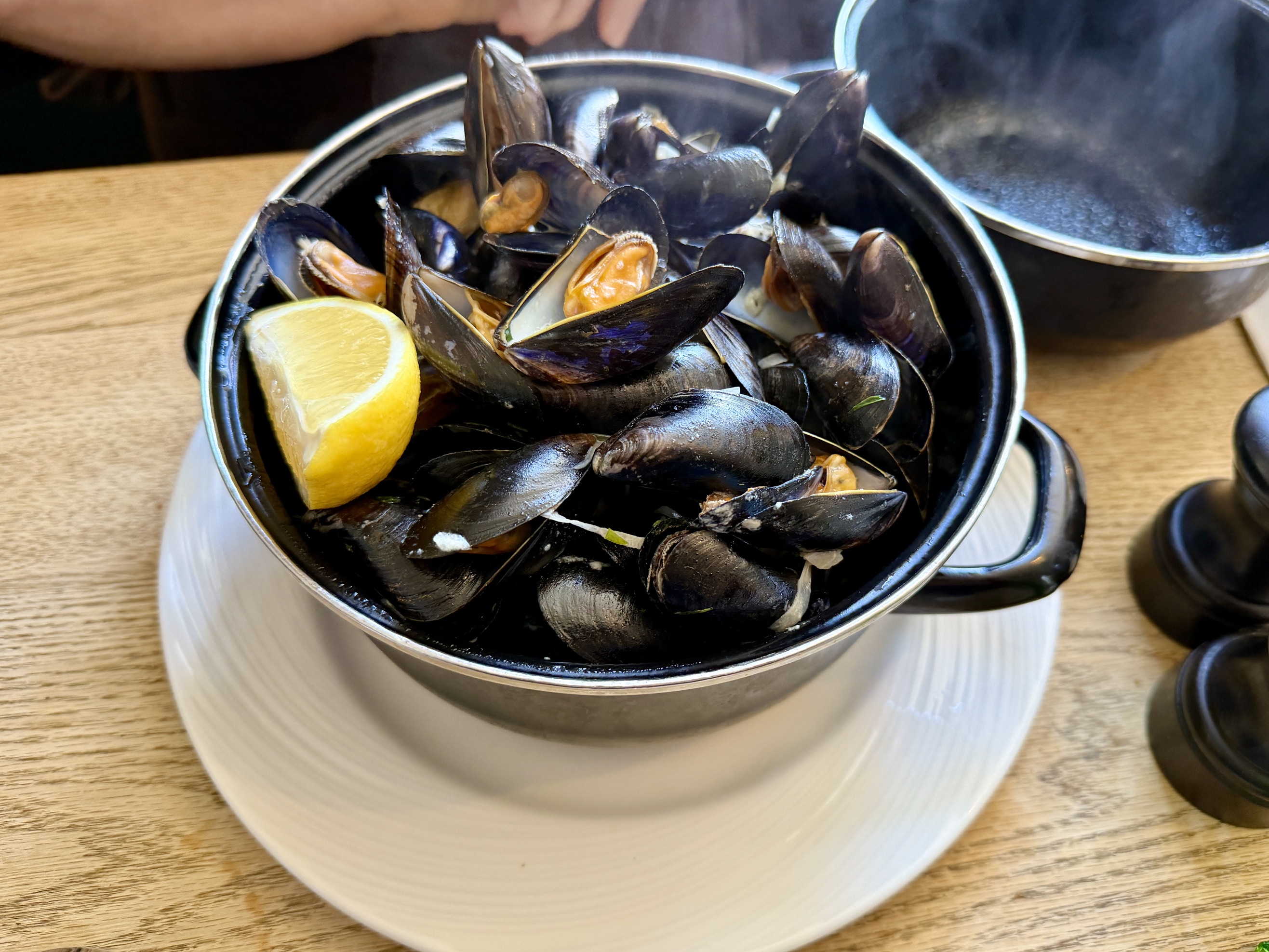
That main was a huge pot of mussels – Welsh, apparently – almost as much still life as treat, gently steaming in their bath of marinière sauce. They were pronounced triumphant and my stepmother worked through them with what looked to me like a combination of diligence and joy. You could have a smaller portion as a starter with what the menu winningly refers to as “mopping bread” or a larger one with fries.

I think, with the benefit of hindsight, my stepmother would have liked the bigger portion with a few slabs of that caraway-speckled bread. But hindsight is always perfect and probably, if we’re being brutally honest, we could all find more laudable uses for it than ordering better at lunch. I said that making mistakes when you order in a restaurant is an essential part of making sure you can find reasons to return and I believe that, even if it’s positively glass half full by my standards.

We split 3-1 on dessert, too, but before that we asked our server about the whole cherry pie thing: why was the village famous for that?

“Do you want the nice answer, or the honest one?” she said. I do love a situation where those two answers are not the same, so of course I asked for the latter. And she told us that Seer Green used to have, for some reason, mass graves and that the cherry orchards were planted on top of those, although the sanitised version was just that the village really loved cherries and had become famous for exporting them to London. She also told us that the cherry pie on the menu was a speciality, and I promise the story behind the village’s nickname was not why we swerved it.

Zoë couldn’t resist crumble, having seen it on the menu, and she rhapsodised about her order. It was apple and blackberry, topped with a gorgeous golden rubble of biscuit, served with an ice cream resplendent with vanilla specks. It prompted a big discussion at the table about the acceptable crumble to fruit ratio: I, conditioned by the Royal Berks no doubt, thought it should be 2:1, while my stepmother would have preferred it the other way round. Zoë, ever the moderate, liked it best 50:50. Which was this, I asked her later? My stepmother would have loved it, she told me.

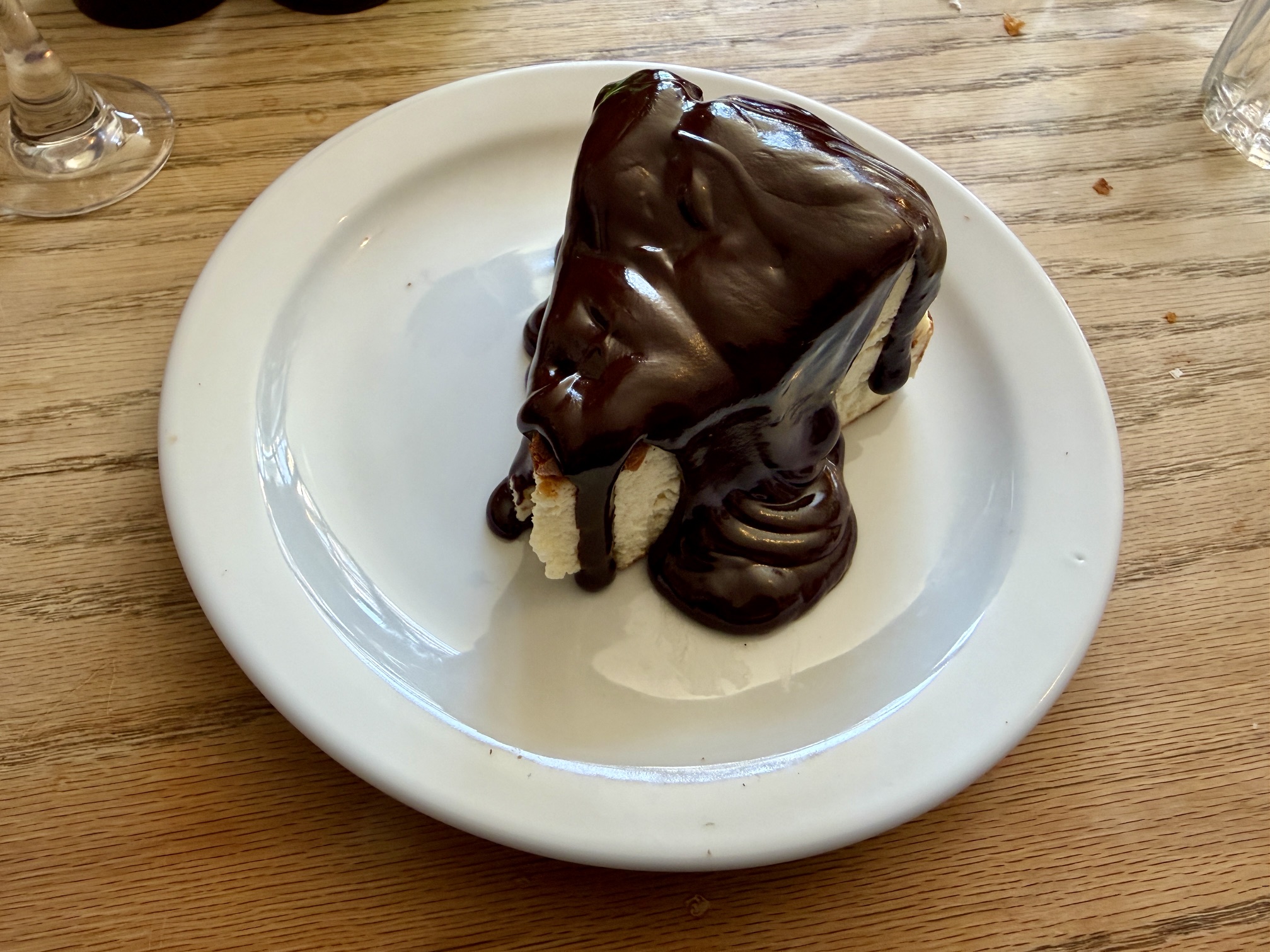
The rest of us had the Basque cheesecake, unusually with chocolate sauce rather than fruit. The slightly warm, exceptionally rich dark chocolate sauce made this dessert, but without it it would have been rather like Snoop Dogg, i.e. slightly too baked for my liking. I like a Basque cheesecake to retain a little wobble, this was a very solid affair. That might have been a conscious choice given the accompaniment, but I wasn’t sure.

Similarly, the menu paired this with a manzanilla, which might have worked if it was just the cheesecake, but the chocolate sauce was crying out for a PX, or a dessert wine of some kind. The menu suggests pairings for all the desserts but none of them are anything sticky: I have struggled to find fault with the Jolly Cricketers, but I’d love it if they fixed that.

We didn’t really want the afternoon to end, in this beautiful pub in this beautiful part of the world on the first day of a strange new phase. So we had coffee – which was extremely good, something I never expected – and eventually, with a heavy heart, we settled up. Lunch for four, pretty much four courses with plenty of drinks and coffee, came to £310 with a 10% service charge thrown in.

I was chatting to our server and she asked where we came from, so I explained that we were from all over, really: Reading, Windsor, New South Wales, and told her why we’d been in the area. And she was so lovely and so sorry for our loss, which happens a lot lately, and I told her not to be sorry. Because I couldn’t think of a better place to be on that day, or better people to be there with.

If I lived near the Jolly Cricketers I would be there all the time, and if a pub like the Jolly Cricketers was near me I might not write a blog any more. It would exert a pull like the Lyndhurst, and you’d find me there whenever I’d had a hard day. And there is a carpe diem message here going back to the very beginning of this: if there’s a restaurant you keep meaning to visit, go there. One day it might not be there, or you might not be. And if there’s a person you keep meaning to call, or take down the pub, or go to that restaurant with, do that too.

My dad would have loved The Jolly Cricketers. It’s a crying shame he wasn’t there that day. But he was, really, wasn’t he? At least in a few of the ways that matter.

The Jolly Cricketers8.8
24 Chalfont Road, Seer Green, HP9 2YG
01494 676308

https://thejollycricketers.co.uk

Since January 2025, Edible Reading is partly supported by subscribers – click here if you want to read more about that, or click below to subscribe. By doing so you enable me to carry on doing what I do, and you also get access to subscriber only content. Whether you’re a subscriber or not, thanks for reading.
Restaurant review: Namak Mirch

Graeme and I are a fine pair when I meet him on Cemetery Junction for our trip to Namak Mirch. He had an operation on his foot in January and is standing there, crutch in hand, wearing trainers for the first time since being discharged: his wife has given him a lift to our meeting point. My injury is more invisible these days – people can only see the beginning of the cursive scar that flows from my elbow to my shoulder when I wear short sleeves – but I still can’t lift much, not until the man who sliced me open is happy with the x-rays.

I crossed the border into my fifties a couple of years ago, Graeme is not far off it: in the pub after dinner we agree that getting old is no fun, even though a viable alternative is yet to be discovered. Graeme says that it seems as if one minute you don’t feel old and then suddenly the tipping point comes and almost immediately you do; I know what he means, and feel like, for me, that happened at the end of last year. I’ve had one of those tough weeks when you feel far older than you want to be. But still, one benefit of ageing is that over time friends become old friends, and you can meet them for dinner.

Graeme moved back to Reading last year and now lives in a pretty house in Newtown, far from his previous place in Thatcham and the bucolic delights of Paggies Bar, a spot he steadfastly refused to take me to. I picked Namak Mirch for us partly because it is practically the nearest restaurant to his house – well, that or the The Fisherman’s Cottage. In the run-up to Graeme’s big move I recommended Deccan House to him ad nauseam, because I’ve enjoyed its takeaways so much in the past, but I’d received some inside information that Namak Mirch might give it a run for its money.

Namak Mirch has taken over the old spot where Star Karahi, the Pakistani restaurant so beloved of Reading’s black cab drivers, used to be. Not entirely – one of the signs outside still gives the old business’ name – but the place is definitely under new ownership. Last October I got a tip-off from Jacqui, a regular reader of the blog, that a friend of hers who previously ran a takeaway business from home had taken on the site.

Jacqui started out buying her samosas, then her Friday night curries, and then she sent me a couple of pictures of a distinctly attractive looking dinner from Namak Mirch: nothing fancy, just a lamb curry, a bed of rice, some grilled chicken wings and a simple salad. You could go past the restaurant in a car and barely notice it, and in fact I did a couple of times including a drive home from my dad’s on Christmas Day. But a glowing report from Jacqui, who knows her food, was enough to place it on my to do list.

The interior of Namak Mirch is about as no-frills as you can get. Three tables, covered with linoleum tablecloths, seat no more than a dozen people, the chairs mismatched and occasional. On our visit we were the only people there, although this was during Ramadan and a delivery driver or two did turn up while we were eating.

But there was something homely about it nonetheless. Some of the starters, snacks and other dishes were on display under the counter, cardboard starbursts in Day-Glo shades taped to the glass giving names and prices, the whole thing strangely retro. Besides that, the menu was all listed on a board overhead, the aesthetics of the greasy spoon somehow appropriated for a restaurant serving Pakistani dishes.

That menu was pretty compendious, a mixture of starters, kebab rolls, curries and biryanis, most available in multiple sizes. Over on the far right of the menu, fittingly, were the crazy choices, the burgers and cheesy chips for wackos who simply refuse to integrate.

There was also a laminated menu on the table, unbranded except for the restaurant’s name written in Sharpie, which didn’t entirely match the one over the counter, including some mixed grills and other dishes not to be found on the blackboard.

Nothing at Namak Mirch was expensive, with the costliest dishes coming in at £12.50 and most far, far below that. The snacks emblazoned on some of those highlighter coloured pieces of cardboard were the cheapest, coming in at £1 apiece.

We started with those and the friendly chap behind the counter, who told us his wife runs the kitchen and makes everything from scratch, was happy for us to order them and decide on the rest of our meal later. There isn’t really table service per se, more that your plates are plonked on the counter and you take them to the table yourself. I didn’t mind that at all, once I realised that expecting Graeme to do that was insensitive in the extreme. His barely functioning foot trumped my partly functioning arm.

So the first things we ate, along with being among the best, were unbelievably affordable. Namak Mirch’s pricing structure can be a bit chaotic, and what you read on one menu doesn’t necessarily match up with what you end up being charged. So for instance, the menu says you get six vegetable pakoras for £4.50. We didn’t know that, so just ordered the four.

They were crisp but not overdone, utterly greaseless and perfect dipped into the little tub of spicy tomato sauce or the raita on offer. I could easily have ploughed through half a dozen with Graeme, in fact I could easily have ploughed through half a dozen on my own. The four we accidentally ordered showed up on the bill at the end as costing £2. Surely some mistake, to offer terrific food at sweetshop prices?

Also costing £2 were a pair of samosas, golden and generous, packed to with minced chicken. These were Graeme’s pick of the snacks, I liked them but I feel I’ve been spoiled by the world-beating vegetable samosas at the Wokingham Road’s legendary Cake & Cream, which last time I went cost something silly like 70p a pop. Despite moving to East Reading, possibly my very favourite part of town, Graeme is yet to try Cake & Cream. I’ll let him off, though: he doesn’t need a doctor’s note for that one.

Even better, and for my money my favourite of the snacks, were the chicken aloo tikki. Deep copper-coloured irregular fritters made with chicken and potato, these – to my mind anyway – took everything that was great about the pakora and the samosas and, à la The Fly, merged them into a single unbeatable snackette. And when I say “for my money” I mean “for one pound sterling of my money”. My goodness. I could just come to Namak Mirch and eat these, if it wasn’t for the inconvenient fact that the rest of the menu is equally loaded with winners.

But I didn’t know that at this point. I was catching up with Graeme, congratulating him on his new home, discussing my recent travails and marvelling at how well a can of Tango Mango Sugar Free went with all this gorgeous scran. I already envied Graeme his new house on one of Reading’s prettiest streets, was I going to end up coveting his local restaurant as well? It felt like it was going that way.

After much reflection, an enjoyable spot of picking out our favourite dishes like we were assembling some kind of gastronomic Fantasy Football team and lots of awfully polite “no, you pick your favourite” toing and froing, Graeme and I had assembled a selection of five dishes to let us sample as much of the menu as possible. We thought we might have over-ordered, but Namak Mirch’s pricing is so reasonable, and we so reckoned we were onto a winner, that we both agreed it was a risk worth running.

When I got to the counter, that slight air of lovable chaos set in again around portions and pricing. Now, I should say that I don’t mean you get diddled with hidden expenses: I mean that you believe your dishes are going to be a certain size and cost a certain amount and then you find that actually, they are somehow magically even bigger or even cheaper. It was baffling and benevolent.

A great example is that I wanted to order us a boneless chicken biryani to share, a large dish that – on paper, at least – will set you back £11. And I was about to do exactly that, when the beaming man behind the counter told me, in the style of once famous local lush and Pride Of Reading Awards uber-ligger Chris Tarrant in Who Wants To Be A Millionaire, that he didn’t want to give me that. He said that as a Ramadan special they were doing a chicken thigh biryani, not on the usual menu, for £3.99. Would I like a couple of those instead, he asked me? It was not a difficult question.

Not only wasn’t it a hard question, but it was an excellent idea. We got two exceptionally generous portions of fragrant rice, studded with tremendous pieces of chicken thigh, the whole thing pungent with cloves. I mightn’t necessarily have wanted to eat this on its own, but as a bed to absorb gravy or curry it was unimprovable. When Ramadan is over I’m sure the chicken biryani will made an excellent alternative – or keema, or paneer, both of which Namak Mirch offers. But really, £3.99? How was Namak Mirch making any money?

The wayward pricing affected a couple of other things we ordered. Graham was drawn to the lamb curry on the bone, and it was a superb choice. The lamb took minimal persuasion to leave home, so to speak, and properly go for a dip in a sauce which was rich, fruity and comforting, with a gentle heat that had me dabbing my nose only towards the end of the meal. Better still was the marrow, eased and winkled out of the bone and enriching every forkful it came into contact with. Graeme reminded me that this was why curry on the bone was better and, despite us both having all sorts of fun and games with our own bones, I couldn’t disagree.

We asked for a large, were billed for a medium and I suspect a medium is what we got. You could almost believe that they knew we’d ordered a little too much but were too polite to tell us. Still, it was a princely £9.50 and would have more than served one person handsomely. On the menu it’s meant to cost £9.95, but that was Namak Mirch: nothing cost precisely what you expected it to.

Further confusion reigned with the tarka dal, something Graeme really fancied. When I ordered it, the chap behind the counter told me it came with homemade roti on a special deal – another special deal – and of course we went for that. What arrived was some perfectly credible flatbread, which had the kind of gaps and holes that said it had been made by hand back in the kitchen. I liked it. but we were too full to properly attack it. It did however suggest that Namak Mirch’s kebab rolls – freshly made in naan, according to the printed menu, merited investigation.

But we also got not one but two metal bowls of tarka dal. We said we’d only ordered one and the chap waved it away, saying we could have the second one anyway. We were hardly complaining, and we complained even less after we’d tasted it – the most perfectly soothing bowl of big, floury lentils in a sauce that gently hummed with garlic without bragging about the time and care that had gone into it. Graeme’s wife Amy is a vegetarian: between this and the paneer biryani I suspect Namak Mirch will have her bit of their next takeaway order well and truly covered.

Again, when the bill arrived it was a bit of a case of The Price Is Right. We had allegedly been charged for two portions, at a cost of £8. You could read their menu from now to the end of the day and never find a permutation of tarka dal that cost either £4 each for two or £8 for one. But either way, two bowls of that faultless dal for £8 felt like some kind of misprint, or cosmic error.

That would have been enough food, but there were a couple of other things I really wanted to try. One, the masala fish pakora, was possibly my single favourite dish of the evening, a big pile of irregular golden nuggets of fish, the coating all gram flour and herbs and the inside pearlescent, cooked no more and no less than each piece demanded. This deft touch reminded me of Kungfu Kitchen’s deep fried fish in spicy hot pot, a spiritual sibling even if it originated thousands of miles away in Chengdu.

By this point the staff had just given us a big squirty plastic bottle filled with raita, the kind kebab shops use to anoint your late night purchases, so we didn’t have to exercise restraint. I think they’d worked out that, on that evening at least, restraint simply wasn’t our bag.

Last of all, we had to try Namak Mirch’s sheekh kebabs (I say had, I mean wanted). These are £2 each or five for £9.50 and when I’d asked for four the owner said he would happily do us five for £9: I’ve never eaten anywhere where the pricing felt quite so optional. I said it would just cause a diplomatic incident if we had to share a fifth one but really, four was plenty.

Again, they looked divine and the lamb in them was superb, the texture impressive, coarse with no bounce or padding. I think they were – almost – some of the best sheekh kebabs I’ve ever had. That almost is because the spicing of these was far more clove heavy than the biryani had been, to the point where it was a little like eating a pomander-flavoured sausage. A liberal trawl through the raita took the edge off it but a slightly gentler hand in the kitchen would turn these into world-beaters to rival – well, to rival the rest of the menu really.
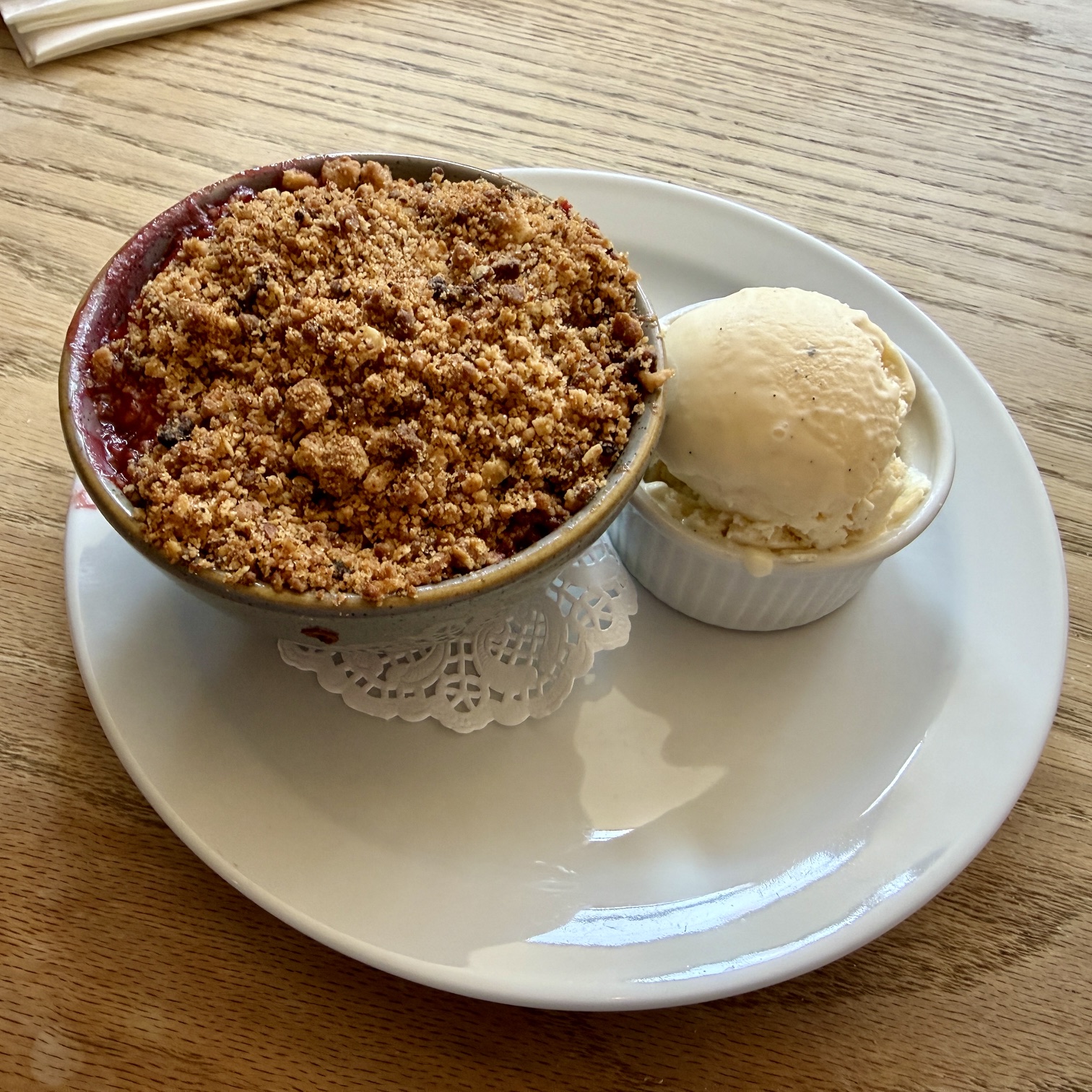
I had no idea what our bill would come to, but when I went up to pay all our food – which may or may not have been part of special offers, Ramadan only deals or spur of the moment decisions by the proprietor – came to just shy of £50, including a couple of soft drinks. That didn’t include a tip, and I insisted on tipping to an extent which surprised the owner. But really, we were the only customers there that night and our food was almost without exception outrageously good, and I worried about how Namak Mirch would survive charging such timid prices.

He told me that they’d only been open a few months, and that things were going well – quiet at times, busy at others, very much impacted by Ramadan, for better and for worse. He seemed delighted that we had so loved our food and reiterated that his wife, out back, made it all from scratch. I told him his friend Jacqui had recommended it to us and he laughed. “That’s my wife’s friend! They’re all my wife’s friends.”

And then, because in my experience some truly hospitable cultures and people feel bad about things like being tipped and immediately try to give you something in return, he insisted that we stop for chai and, about ten minutes later, brought us two beautiful sweetened cups of the stuff. Because that wasn’t enough, we also got a little bowl of dates stuffed with almonds. It was simply lovely: my friend and I sat there sipping our chai as our cups sat on that lino tablecloth, we ate our dates, we watched the traffic hum past, heading into town, and we both reflected on just how good a meal it had been.

Neither of us had missed alcohol at all, either, but that’s because we knew that when we were done we could manage the short walk to the Hope & Bear, which had an acceptable pale for me and an impressive range of single malts for Graeme. We still had plenty to discuss but we did keep coming back to one particular topic, which was just how good Namak Mirch was. On that night, when both of us really needed that kind of warmth and hospitality for our own various reasons, Namak Mirch was a beacon of how things should be, and I was deeply thankful for it.

I hope other people make a pilgrimage there, even if working out the menu and pricing might be beyond even the intellect of Hannah Fry, and that they discover what I discovered. For my part I’m already wondering when I can go back, because I knew before the meal was even over that this one fell into the category of restaurant Zoë likes to describe as why didn’t you take me? Graeme, I have a feeling, might be back even sooner. He lives round the corner after all, the jammy bastard.

Namak Mirch – 8.5
251 London Road, Reading, RG1 3NY
0118 9669492

https://namakmirchonline.co.uk

Since January 2025, Edible Reading is partly supported by subscribers – click here if you want to read more about that, or click below to subscribe. By doing so you enable me to carry on doing what I do, and you also get access to subscriber only content. Whether you’re a subscriber or not, thanks for reading.