Restaurant review: Taste Tibet, Oxford

Magdalen Road in Oxford is a 20 minute bus ride from the train station, out east, down the High and over Magdalen Bridge. It connects two of the three great thoroughfares of east Oxford, Cowley Road and Iffley Road, and you can walk from one end to the other in under 10 minutes. One side of it, at the Cowley Road end, is fairly unremarkable – a general store advertising Lycamobile, a letting agent, terraced houses of various vintages.

Only a huge shop called The Goldfish Bowl, advertising “EVERYTHING FOR THE FISHKEEPER” in big orange letters has even a hint of quirkiness. But then you reach the halfway mark, cross over to the Iffley Road side, and find yourself in Oxford’s most incongruous gastronomic microclimate.

Suddenly everything is very different, and both sides of Magdalen Road are full of independent outposts for food lovers. There’s Wild Honey, an “organic health store” advertising local produce, next to a little pink-awninged spot called The Magic Cafe. There’s a pub, The Rusty Bicycle, owned by the same group as Reading’s Last Crumb. Further down, there’s a little shop selling Scandinavian homewares – earthenware cups, sheepskin rugs, scented candles and room diffusers.

Just opposite that, plant-based café Green Routes stands next to Elle’s Deli, which used to be home to Oli’s Thai, for a long time Oxford’s most critically acclaimed restaurant (you had to book a table months in advance). The deli still serves Thai food, and people were sitting outside on a coldish Saturday morning eating it, but it also sells Superbon crisps, vermouth and jars of every kind of deliciousness from romesco to gochujang.

Travel a little further and you get to another cafe called the Larder, with attractive-looking loaves on sale in the window: again, on a day that wasn’t the warmest people were already sitting outside. And next to that, there’s the roastery for Oxford’s Missing Bean, who do some of my favourite coffee and supply to Reading’s Coffee Under Pressure. And then finally, at the southern end of Magdalen Road you reach the Magdalen Arms, which has long been one of my favourite places to eat in the city.

That little stretch of Magdalen Road seems to come out of nowhere, a strange and wonderful little oasis. Just imagine: in the space of five minutes, out in east Oxford, you can visit as many independent delis and cafes and bakeries as you can find inside Reading’s IDR. If anything, with its joggers and dog walkers, its air of bourgeois contentment, it was almost like a micro-Caversham.

At one point a mum cycled past me on some kind of cargo trike, a contraption with two wheels up front and a big box between them, her kid standing up in it and looking out on the world; the Cowley Road’s scruff and bustle was simultaneously a few minutes and a world away.

I found myself in this neck of the woods to check out Taste Tibet, a restaurant that’s been on my to do list for some time. It’s a no-reservations Tibetan restaurant, owned by married couple Yeshi Jampa and Julie Kleeman. They met in India, fell in love, and moved back to Oxford where Kleeman had a job with OUP. They started out running a street food stall over ten years ago, and during the pandemic they opened this spot on Magdalen Road. Since then success has followed, with a cookbook in 2022 and an honourable mention in that year’s Observer Food Monthly Awards as one of the best value eats in the South-East.

Not only that, but Taste Tibet also provides dozens of meals to vulnerable people in its community every week and its thoroughly charming website links with an excellent weekly blog, beautifully written by Kleeman, that is very frank about the challenges hospitality in general, and its little restaurant in particular, continue to face. I’d challenge you to read a couple of posts and not find yourself rooting for them: I certainly came away from it surprised by how invested I was in their project. As I got there at noon – because you can’t be too careful – Jampa was opening up and he cheerily told me to come on in.

The interior is a lovely, tasteful room but very much in a canteen style, which fits with the lack of reservations. Long tables and benches, which I imagine are communal at busy times, were like a posh reimagining of the furniture you find at every tap room in the land, but the overall effect was very pleasant. There were also seats up at the window, which tempted me, or facing the wall, which didn’t. Jampa told me to hang my coat up on the hooks, which I did at first, but given that the door was left open to attract passing trade I quickly changed my mind and put it back on.

The menu, which changes weekly, is up on a blackboard behind the counter, and many of the dishes are already cooked, in chafing dishes up at the counter. Taste Tibet cannily also offers frozen meals for its customers to enjoy at home, these are in a separate freezer near the front and are a clever way to make sure nothing is wasted. They also had a decent range of drinks, soft and alcoholic, including wines in cans. I was a little disappointed, as always, to see Brewdog as one of the options but I got myself a verbena-infused pale by Earth Ale, a little brewery just outside Abingdon, which I really enjoyed for its fresh citrus and slight bitterness.

On the day I visited, Taste Tibet was offering momo – four or eight, vegan or beef – and four curries, with a mix of sides. They also served a biryani, or a feast option where you got a couple of dishes, dal, rice and a solitary momo for about fifteen pounds. If that pricing sounds keen, it wasn’t unrepresentative -curries weren’t much over a tenner and rice only two pounds fifty. Sides clustered around the five pound mark and momo were four for eight pounds. I ordered some momo, a curry and rice: that, with a tip included, cost me thirty pounds. “I’m in no rush” I said, “so it’s okay to bring the momo out first and the curry after that.”

My momo came out five minutes later, and weren’t at all what I was expecting. Although momo apparently originate from Tibet rather than Nepal they’re so prevalent in Nepalese cuisine, and Nepalese cuisine is so prevalent in Reading, that I thought these would be a known quantity. And with that in mind, I thought four for eight pounds felt a bit steep. But Taste Tibet’s momo were a very different beast to the ones I’ve eaten at Sapana Home or Kamal’s Kitchen.

For a start, they were big: impossible to eat in one go, and challenging even in two. Crimped like jiaozi, they were steamed and made with dough that was thick verging on too thick, but that gave them structure and a pleasing, carby solidity. The beef inside – beef, not buffalo, although whether that’s the difference between East Oxford and Reading or Tibet and Nepal I couldn’t tell you – was properly lovely, coarse and delicious.

This came with a little handful of leaves whose main function was to serve as a bowl for a red sauce which was apparently a home-made chilli sauce: I found it a little meek. But what I did love was the bowl of a darker dipping sauce with a kick of soy. Again, I wonder if that’s the influence of Tibet, because I’ve never had Nepalese momo served with that, and it really did make me see the momo in a slightly different light. I can see the appeal of coming to Taste Tibet, as I used to with Sapana Home, and just going to town on the momo.

Later on, as I came to the end of my meal, couples and families were braving the outside tables and I saw big plates of momo going past on their way to the little terrace. Perhaps that was the way to do this place, or to come with a big group and try everything. One of the reasons I hadn’t ordered the “feast for one” was the presence of that single momo. It felt stingy, but looking at what had been put in front of me one would have been plenty, paired with an exploration of more of the menu.

My request that my curry come out after my momo had been taken a little too literally. Perhaps I should have said “after I’ve finished my momo”, although I didn’t think I’d needed to, but instead the rest of the meal arrived when I was halfway through what I thought was my starter. Really, though, that was me misjudging the place and its similarity to a canteen rather than a mistake on the restaurant’s part. Everything is there ready to dish up, and if you order something that’s exactly what they will do.

I had chosen Taste Tibet’s “famous chicken” because I took famous to mean signature, and I figured that if I was visiting a restaurant on my own I owed it to myself to check out the signature dish. And having eaten it I suspect it’s the restaurant, rather than the chicken, that is famous. It was a big portion with plenty of chicken, plenty of sauce. The chicken was all good and tender, and it was impossible to take exception to the dish.

But although not being offensive is a good thing, being inoffensive isn’t, and that’s what this was. Perhaps if my expectations had been lower I would have seen this as a comforting bowl of food, and celebrated what it was rather than noticing what it wasn’t. But this was like curry from a bygone age, before we got into regional food, started to discover the difference between Kerala and Hyderabad. It felt a bit like a Vesta curry, from forty years ago, and for something famous I expected more: I expected it to be famous for something.

How to make it more interesting, I wondered? I tried spooning in my perfectly cooked basmati rice – Taste Tibet serves both curry and rice in bowls that are just big enough for each, rather than giving you a plate to dish them up onto – but that bulked it without being transformative. I tried adding a spoonful of the dried chillis in a ramekin out on the table, but it lent an acrid pungency without elevating anything. The difference in heat levels was like the difference between sleeping on one pillow and two, going from not enough to too much.

I didn’t want to leave it like that, and I fancied dessert, so I went up to order the only thing on the blackboard that looked like afters. Chocolate tsampa truffles – as seen on TV! sounded absolutely like my sort of thing, and only cost three pounds. I was too full to have the chai that should have accompanied it, but never mind. 

By this point the restaurant was far fuller, with people taking tables outside and the long table opposite me occupied by a group of impossibly young, animated east Oxford types. I looked on them indulgently, remembering a time over thirty years ago when that could have been me: not that I would have had the money to eat in a place like this.

Positively 4th Street was playing over the speakers, and I remembered that thirty years ago I loved that song, and suddenly it was back in vogue. Time can play unkind tricks, and all the things that made me so deeply unfashionable as a student – being a geek, listening to Bob Dylan and Leonard Cohen, playing chess and Dungeons & fucking Dragons – are acceptable now, too late for me. Even some of the shit I wore back then might be in now, I thought.

I felt a little tug of envy and regret, and then I let it go. It was as close to Buddhism as I got in Taste Tibet.

The chocolate tsampa truffles, plural, turned out to be a truffle, singular. A big thing designed, like the momo, to be taken on in multiple bites. I enjoyed it and, again, it wasn’t what I thought it would be. Its texture wasn’t dense or glossy, being more gritty with a feel of granulated sugar to it. Again, that’s down to me for misunderstanding – tsampa was not something that flavoured the truffle, but instead is a kind of flour made from ground, roasted barley, so it was the thing lending that texture.

In any event, the truffle reminded me of the brigadeiros at Minas Café, and I liked it without entirely understanding it. That’s fine, by the way: now I’m in my fifties I realise that provided you like things you don’t always need to understand them.

The rest of my day in Oxford was positively joyous. I stopped at Missing Bean, which was absolutely packed, to buy beans for the weeks ahead; I’m drinking a cup of their coffee as I write this. I strolled down the Cowley Road, past its plethora of Turkish restaurants, past the now closed Gamekeeper that used to meet all my Dungeons & fucking Dragons-related needs as a teenager.

I stopped in Truck Records to get inspiration, I stopped in Peloton Espresso to get caffeination. I bought cheese in the Covered Market, had time for a beer in Tap Social before my train home. It really is a gorgeous city, and it says something about the place that Magdalen Road is one of its little oases but far from its only one.

As you may have gathered by now, although I liked Taste Tibet I wanted to like it an awful lot more than I did. And a bit of me wonders if I’m the one in the wrong. It is a gorgeous spot in a gorgeous neighbourhood in a gorgeous city. It has a great backstory, is clearly loved by the community it’s part of and does tireless and admirable work to support that community. It is run by a committed husband and wife, where he works in the kitchen and she advocates, powerfully and eloquently, online and in the media. They want to tell the stories of where he comes from, through food.

On paper, I should love it: it sounds like other restaurants I love, closer to home.

But perhaps that’s okay. Perhaps Taste Tibet makes perfect sense in its context, in that city, on that little stretch of food and drink heaven. Maybe it doesn’t need people like me travelling to and across Oxford to try it out. It’s a neighbourhood restaurant – its neighbourhood is lucky to have it, and it’s lucky to have found its place in things.

If I lived closer I’m sure I would go back, try other dishes, fill my freezer and become part of their story, as they would become part of mine. But other places have got there first, for me at least. My train home pulled in at Gare du Ding and I thought about Kamal’s Kitchen, my favourite Nepalese restaurant, a short walk from the northern entrance to the station.

Its dining room doesn’t have the stripped-back elegance of Taste Tibet, it doesn’t have a narrative the way Taste Tibet does. I think Kamal and his family do a magnificent job, but much as I’d love them to I can’t imagine them gracing the pages of Observer Food Monthly. They don’t write beautiful blog posts, they have no plans to produce a cookbook that I know of and they won’t be at Hay Literary Festival this year. They let their food do the talking, and for what it’s worth I think their momo beat Taste Tibet’s. A restaurant can succeed in so many ways, but food and service are always king.

Magdalen Road in Oxford is a really fantastic place, and I do dearly wish Reading was a little more like it. But I wouldn’t swap their restaurant with ours.

Taste Tibet – 7.0
109 Magdalen Road, Oxford, OX4 1RQ
01865 499318

https://tastetibet.com

As of January 2025, Edible Reading is partly supported by subscribers – click here if you want to read more about that, or click below to subscribe. Whether you’re a subscriber or not, thanks for reading.

Restaurant review: The Boring Burger, Guildford

After the news that cuddly Mark Zuckerberg was doing away with fact checkers, when the penny dropped that distinguishing between our tech overlords was a similar exercise to using the Bristol stool scale, I read a lot of stuff online about how blogs were making a comeback. Enough of pithily sharing whatever’s on your mind and giving your data away on a billionaire’s platform, they said: time to get back to the good old days when people put their thoughts, longform, on their own blogs. Taking back control – a concept we’ve learned by now can only lead to happier times ahead.

It would be lovely if that were true, but I have my doubts. I’ve been blogging, in one form or another, for over fifteen years and I was late to the party when I started, so you can imagine how behind the curve I am now, waiting for the whole thing to finally be back in fashion. What this world needs is more 3000 word reviews of restaurants is a sentence I’ve only ever heard in dreams. I’m under no illusions – I’m happy in my niche, but I know that’s exactly what it is: a niche.

The tectonic plates of food writing changed last weekend when gastro-blowhard (and life president of the Jay Rayner Appreciation Society) Jason Rayner signed off from the Observer after 26 years, with a review which was ostensibly of an Indian restaurant in Leicester but was really about how great he was and how much we’ll all miss him. Bless.

He replaces tedious Tim Hayward at the FT, who took his leave with a review showing his unerring talent to slip a repulsive sentence into every piece. “I’d compare it to some kind of ecclesiastical erection were it not so determinedly sensuous” he said. Of a restaurant. What’s the opposite of starting as you mean to go on?

But these moves, really, are just shunting deckchairs around on the Titanic of print journalism. So too is the announcement of a new website, Scribehound, amalgamating the output of 30 food writers so that for a monthly fee you get a bit of everything. “Why pay for all those Substacks?” said one of the contributors, making it clear who they’re gunning for.

No, the real opinion formers in food these days are working in short form video, on TikTok and Instagram. I’ve written about Toffjaw before with their nearly 800,000 Instagram followers, but even they pale into insignificance compared to the influencer Eating With Tod, who is followed by more than twice that number.

His real name is Toby Inskip, but “Eating With Toby” would give the game away too early that this is yet another posho telling people what to eat. For the uninitiated, Inskip is a ginger chap with a very excitable plummy voice who always sounds like he’s just about to run out of breath: his many detractors are probably disappointed that he never does. He goes to a range of places and invariably describes them all as the best of their kind in London/the United Kingdom/this galaxy, and he’s on record as saying that he won’t ever criticise anywhere. He’s not a reviewer, he says, his is a “recommendation page”, and by recommendation he means hyperbole.

Whether he pays for his meals or not is unclear, but you get a pretty good idea from a cursory scan through his Instagram what he’s about. With more raves than Ibiza and a seemingly endless supply of gurning at food, Inskip’s techniques are now ubiquitous across a whole genre of ladz reviewing food on TikTok and Instagram.

From the overload of superlatives to the ridiculously exaggerated come face that follows every single mouthful, as if each one is utterly consciousness-redefining, from finger-banging thin air, as if to say that’s what I’m talking about, to the orgasmic waggle of the fork, to the naff chef’s kiss at the end of the video, these techniques have been snapped up by dreary bloke after dreary bloke.

Inskip also misses his mouth. A lot. For someone who has made a putative career out of eating out, he doesn’t appear to be very good at it, so every bite of a burger or a pizza leaves a huge smear miles from the corner of his mouth in a way that makes me feel icky. It’s like watching a toddler. How far we have come, that back in 2014 not being able to eat a bacon sandwich properly disqualified a man from the highest office in the land and in 2025 lacking basic hand-eye coordination is a fast track to thousands of followers? It makes you think.

Anyway, this week’s review found me in Guildford eating at The Boring Burger, and it was largely because of Eating With Tod. He went there last April, as part of his ongoing quest to find Britain’s best burger, and was every bit as aerated as ever. He raved about chef-owner Jamie Kuhls’ “Michelin skill set” because he worked at Claridge’s, although no restaurant at Claridge’s has held a star for something like 7 years. “His attention to detail blows my mind” said Inskip, a man whose mind seems to be blown on a daily basis.

“I could literally just put on a pair of sunglasses and stare at these burgers all day” he said, accompanied by footage of him, sunglass free, holding a burger up and gazing with wonder before taking a bite, smearing sauce on his face and waving his hand in the air with orgiastic abandon. “The best part”, he concluded, “is when you’re ordering through UberEats you can get their brisket mac and cheese bites, and they’re rather bloody tasty”.

That’s the best part? Really? These influencers love to team up with delivery apps for even more free food, another smoking gun that they don’t really like restaurants all that much.

Now, I know I’ve been scathing about poor Eating With Tod – it’s like shooting fish in a barrel – and I could go on. But it cannot be denied that even though he’s a challenging watch, he gets a lot of information across in a short space of time. And looking at that burger, which was infinitely preferable to looking at his boat race, it did look very good. So the seed was planted… should I maybe give it a try?

Anyway, influencers are like buses: you wait ages and then two come along at once. Because last October Bos Finesse, Bristol’s answer to Eating With Tod, also ate at The Boring Burger. And that’s what swung it.

Bos Finesse – real name Oscar Bostock – is an ebullient Bristolian chap who wears a lot of streetwear and has a unique line in hyperbole. For what it’s worth I rather enjoy his contributions to the English language, although I worry terribly about his complexion and his colon, and not necessarily in that order. Bostock has amassed 85,000 Instagram followers and you can’t fault his commitment, eating at highly rated Bristol restaurants, random takeaways in the arse end of nowhere, street food joints, burger vans and even fans’ houses (he also likes Gurt Wings, so he can’t be all bad).

When Bostock went to The Boring Burger he cranked Eating With Tod’s hype-o-meter up to 11. “These might just be the sexiest burgers I’ve ever seen in my entire life” he enthused, before adding that “they aren’t messing about in here, mate”. Bostock also met the owner and said “when you hear about his portfolio of Michelin restaurants you don’t ask no further questions”, despite the obvious question being which ones are they then? Quite the evolution from just having a “Michelin skill set”.

But critical evaluation is not what influencers are about: Bostock grinned like a pig in shit as he was presented with a tray groaning with three different burgers and as many different side dishes and portions of fries. It made me wonder – is it like Masterchef and, after a couple of bites, is the rest eaten by the film crew? Anyway, Bostock loved it and awarded what, for him, might be the highest accolade possible. “Boring Burger: what a gaff” he said. That was it: I had to try it now, so off I went to Guildford on a sunny Saturday morning.

You might well know this already, but isn’t Guildford nice by the way? I don’t think I’d visited it since before the pandemic, and I’d forgotten what an agreeable place it is once you’ve crossed an IDR-style thoroughfare and cut through the decidedly retro Friary shopping centre. The other side of that is a rather fetching, gently sloping cobbled high street that reminded me of a cross between Winchester’s High Street and Windsor’s Peascod Street – or would do if the shops in the latter hadn’t all apparently closed and been replaced by phone repair and vape outlets.

No, Guildford is far more well-to-do than that and on its high street and the little lanes that slope off it you can find a who’s who of businesses Reading doesn’t have: Anthropologie; Coppa Club; Joe & The Juice; Le Creuset. At the bottom of the street a busker was doing a perfectly serviceable job of belting out Set Fire To The Rain by Adele, a song which never even tries to explain the impossibility of its title.

The lanes that head up to the castle have interesting stuff in them, too: I stopped at a very nice wine shop called Corkage and picked something up for later. Continuing my stroll I saw the Ivy and the Ivy Asia, and thought that Guildford definitely had some things Reading needn’t envy.

Boring Burger is up one of those lanes, just across from a Giggling Squid and two doors down from Meat The Greek, a souvlaki place I’ve always rather liked. The sun was shining and at about half-twelve all of its orange tables outside were already occupied, although it shares the terrace with its neighbours and so has fewer tables than you might think. Inside was a very no-frills long, thin room with about ten stools crammed together in a line, all facing the wall.

There was a self-service touchscreen at the front, which seemed a bit jarring, and quite a few orders were takeaways, either from the blokes waiting in the queue or the steady stream of delivery drivers. People must have heard about the best thing about the restaurant, those brisket mac and cheese bites.

The clientele was nearly all men, some of them dragging their partners along, and they all looked like they could easily be acolytes of Eating With Tod. If you can’t take a date, take a mate he always vacuously declaims at the end of his reviews: I, like the loser I am, had done neither.

The menu sensibly keeps it narrow. Four different permutations of beefburger, one chicken burger. Nothing vegetarian that I could see, although I’m pretty sure they used to do a portobello mushroom number. Most of the burgers are twelve pounds, though one with fifteen hour braised brisket costs more, as does having an extra smashed patty. Fries are an extra fiver, unless you jazz them up with bacon and cheese sauce or katsu sauce.

There are a couple of sides, mac and cheese bites – with gochujang, not brisket – or buttermilk chicken tenders, which I was always going to struggle to resist: once I saw them on the menu, in the immortal words of Bos Finesse, you don’t ask no further questions. I placed my order, gave them my name and then managed to find an actual low table with a banquette tucked away right at the back of the restaurant. I couldn’t quite believe my luck. A doubled up smashed burger, tenders and fries cost me twenty-eight pounds, and they told me it would be about fifteen minutes.

In reality it was half an hour, but I didn’t mind. It was fun to see the bustle behind the counter, the burgers turning up for the family of four who had camped out in a row at the end of the ledge. One thing all the influencers went on about was Boring Burger’s attention to detail: designing and making their own buns, making all their own sauces, hand-cutting fries every day the way Honest do. In fairness those influencers also talk with wonderment about restaurants “making everything from scratch”, I guess because some of the places they review don’t.

This is an exceptionally silly thing to say about a restaurant whose fame has entirely spread through a visual medium, but Boring Burger’s food really does look terrific when it lands at your table. The bun is burnished and glows, the fries are the perfect shade of golden, the tenders look gnarled and toothsome. I don’t know if I could have popped on my shades and stared at it all day, but fair play to Boring Burger: you eat with your eyes and in that respect you eat very well there. I could see why this stuff appeared in grid after grid.

But could it live up to that when you actually tasted the stuff? In the case of the burger, yes – a hundred times yes. I’d gone for the eponymous Boring Burger, their signature, and it was the best smash burger I’ve had in this country and one of the best I’ve had full stop. The patties were beautiful, especially at the edges where they were crinkled and crispy, the fabulous bits of burger overhanging the perimeter of the bun. Doubling up was probably overkill, but I felt like I ought to do it properly.

The dill pickle, sliced mandolin thin, added crunch and tartness, and the bun – toasted, another nice touch – was the perfect antidote for anybody tired of brioche. Eating With Tod said the buns “hold their shape like a bodybuilder”. Err, I guess. They definitely had the structural integrity to carry the show. No soggy mulch at the bottom as even happens sometimes with Honest’s more overloaded burgers.

Even the bacon – they dry age it themselves, apparently – was bang on. I don’t think I shared everyone else’s wide-eyed enthusiasm about the burger sauce, which was fine but no more, but honestly: this was one of the best burgers I’ve tried. I’ve had ones at this standard in France, but nothing to live up to it in the U.K. – neither Honest nor Reading’s much missed Smash N Grab came close.

That’s why it so disappoints me to say that Boring Burger’s golden touch deserted it with the rest of my order. Fries were meant to come with rosemary and tossed in confit garlic oil, and if they had done I imagine I’d have been as evangelical about them as I was the burger. But they just came, skin on, fried in oil with very little rosemary, which meant that they were about up there with Honest’s chips when Honest has a good day, which it doesn’t always.

For five pounds, on top of the price of the burger, I was hoping to see them glistening with garlic oil and honking of the stuff, so I was disappointed. This is the problem with hyping stuff, you see, it means that something that’s only thoroughly decent can still feel poor. It’s also, by the way, the problem with someone who only creates content to say that everything is absolutely bloody amazing all the time.

Even more disappointing were the tenders. Properly disappointing, and the gulf between style and substance is rarely so marked as this. On paper, and in the photo down there, they look like a profoundly good way to spend eight pounds fifty – huge, drizzled with sauce, bearing the promise of crunch and euphoria.

But they looked good in the way that some people’s lives look good on Instagram, purely cosmetically. Because the coating – wanky food bloggers call it the “dredge” – didn’t have herbs or spices in it. I’m not sure what it did have in it, because all it really tasted of was undercooked flour. Which was strange, because the texture was there, in the coating at least. Yet the chicken breast underneath was a little too firm, a little too easily parted from the shell housing it. It didn’t feel like it had been brined, or if it had something had gone amiss.

The sauces were a gochujang that felt red and anonymous with no funk or complexity and a miso mayo that just tasted of mayo. I was hoping to find something that challenged the primacy of Gurt Wings as the best chicken tenders I’ve ever tasted. Instead, I ate something that made me appreciate Honest Burgers. That wasn’t how that was meant to play out: looking good on camera is all very well, but it’s not everything.

It’s also worth noting that a combination of giant quantities and underwhelming quality meant that I did something I rarely do: I left food. I ate nearly all of the burger, maybe half of the fries and two of my tenders. That partly says that if you go to Boring Burger you should share those things, but it also says that I felt no wrench at all leaving three huge chicken tenders. That’s something that happens about as often as Michael McIntyre saying something funny.

As I left, noting ruefully that a table in the glorious sunshine outside had just come free, I was determined to find some other nice spots in Guildford just to flesh out this review and give you another reason to go there.

So I’m delighted to report that Guildford has a lovely little craft beer spot called Kerrera, down another little alley, where I sat with my people and enjoyed the fruits of them having a tap takeover by Bristol’s Left Handed Giant. They had a menu with very tempting-looking toasted sandwiches on it, and next time I might try them out: their social media is properly winning, and made me want to go back. I was delighted to see they were solidly booked that evening.

After that I walked across town to Canopy Coffee, an Australian owned café with a view overlooking the Waitrose car park. And I had a beautiful latte, in a very tasteful cup, watched people coming and going and thought that Guildford has easily enough going on to justify the forty-five minute, fifteen pound journey on the train. I’m glad I went, and really delighted that the day I visited the sun finally played ball. I didn’t take a date or a mate, but it was quality time nonetheless.

But is Boring Burger worth going to in its own right? Actually, if you like burgers, yes. Its burgers alone, for me, justified that trip and set a bar that I will mentally return to every time I have another burger for at least the next year. So if that’s your kind of thing I can unreservedly recommend the place. Just pair it with the wine bar, or the café, or the craft beer spot, rather than with fries or chicken tenders, and you’ll have a wonderful time.

I doubt any of the influencers who have covered Boring Burger will read this review, and if they did they probably wouldn’t understand a conclusion like this. That’s okay though, because I know by now that you will. It’s called nuance. They should look it up sometime.

The Boring Burger – 7.2
15 Chapel Street, Guildford, GU1 3UL
01483 374090

https://www.instagram.com/theboringburger

As of January 2025, Edible Reading is partly supported by subscribers – click here if you want to read more about that, or click below to subscribe. Whether you’re a subscriber or not, thanks for reading.

Restaurant review: Rosa’s Thai

Be honest: without scrolling to the bottom, do you have an idea which way this one is going to go?

On one hand Rosa’s Thai is a chain, and has come a long way from its origins as a single restaurant just off Brick Lane. It has close to fifty branches, from Leamington Spa to Liverpool, all that thanks to private equity and, more recently, a whopping £10m more funding from Barclays. And if there’s one thing private equity is good for, as chains from Bill’s to Strada have shown, it’s throttling the soul of an indie restaurant concept as it’s photocopied and plonked in any town and city where vultures like Hicks Baker can find a vacant site.

This is where I slip in the obligatory mention of Rosa’s Thai’s landlord in the old Jackson’s Corner building, noted local philanthropist and walking personification of the Pride Of Reading Awards, John Sykes. Has to be done, I’m afraid. And shall I point out that I had Rosa’s Thai’s Deliveroo Editions takeaway in lockdown and thought it was bang average? Possibly not.

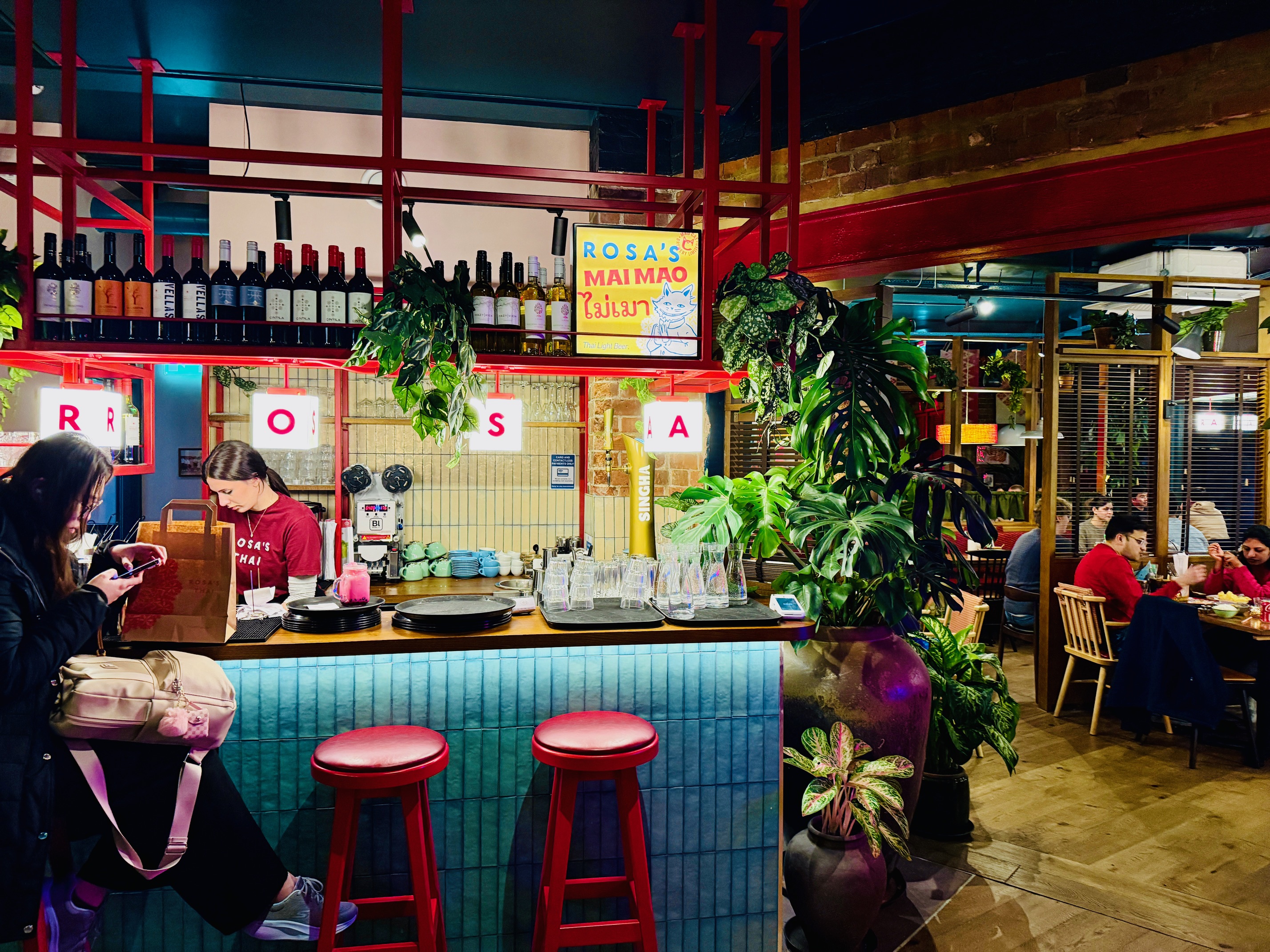
Yet, on the other hand, there are chains and chains. Rosa’s Thai is probably closer to the likes of its near neighbours Honest Burgers and Pho than it is places like Jollibee or Taco Bell, more jewels in the crown than dog ends in the bin. The interior of Rosa’s Thai’s Reading site was dreamt up by local legends Quadrant Design, who did such a beautiful job of Reading’s branch of Honest. The menu, freed of the constraints of only being able to serve dishes that travel, looks interesting, with enough to pique your curiosity.

And let’s not forget, our local media went nuts about the place. I was invited to a soirée at Rosa’s Thai last month by the company handling their PR, and as I don’t do invites I thanked them kindly and said no. But who did pop up on the night of gratis grub? Why, it was our good friends the Reading Chronicle. Because as they put it “when the talented Saiphin Moore – the founder of Rosa’s Thai – offered me a seat at her exclusive opening supper club I would have been a fool to decline”. Or, as they didn’t put it, #AD or #INVITE, words which were conspicuously missing in action in all the social media posts the Chronicle did to promote Rosa’s Thai and its largesse.

Still, you can’t say Rosa’s didn’t get what they paid for, even if the Chronicle got what it didn’t pay for. “The experience begins as soon as you walk through the door when you are greeted by warm and friendly staff pleased to welcome you into the brand-new venue,” the reporter gushed, describing the experience everybody has entering almost any restaurant where you don’t order using a self-service touchscreen.

From that point, the meal at Rosa’s Thai sounded like one culinary orgasm after another. The calamari apparently created a “burst of flavour on the taste buds”. “This first-time diner was salivating over the creamy and rich Massaman Beef Curry,” the reporter went on – surely TMI – before saying that “the curry offers just enough spice to have your tastebuds tingling”. But there was more. “After a taste of all the famous dishes… my taste buds were tingling with both the breathtaking flavours and spices.”

So much tingling, so little time: maybe that’s why they were too flustered to call it out as an advert for Rosa’s Thai. Presumably somebody had to pour the reporter into a taxi at the end of the meal. So I’m not sure why I’m even bothering to write this. Rosa’s Thai clearly has “exquisite food” and “supreme service”: the Chronicle says so, and they would know.

So, a chain backed by private equity, John Sykes as a landlord, an interesting menu, a beautiful fit out and the local paper couldn’t say enough good things about it. Which way was this one going to go? If you have a good idea of that already, you’re doing infinitely better than I was when I turned up with Zoë on a weekday evening to check it out.

Subscribe to continue reading

Become a paid subscriber to get access to the rest of this post and other exclusive content.

Restaurant review: Creperie Doux Sourire

I’ve written before about the factors that make a restaurant perfect for solo dining: a good table that doesn’t face a wall or, worse still, the bogs; a great view to enable people watching; a menu that doesn’t make you feel like you’re missing out – no small plates or other “everything has to be shared” formats – and staff that respect rather than judge the choice made by solo diners.

Get all that right and, whether you’re up at the window at Mama’s Way or tucked away in a corner of London Street Brasserie, you’ll have a brilliant time. Take a book, if you want to pretend you’re not going to scroll your phone, order a glass of wine, sit back and enjoy. I really like solo dining these days: so much so, in fact, that I was even quoted to that effect in the Independent. Fancy, right?

The criteria for picking a restaurant to review on your own, though? That’s another kettle of fish.

The thing is, reviewing restaurants is about giving readers a representative picture of what a place is like to eat at. Some of that – the room, the service, the view, the background music – is largely the same whether you have a table for 1 or 11, this is true. But it falls down when you come to the food, because in many restaurants you want to see a decent range of what the kitchen can do. With two of you, that can be six dishes – more, if you’re greedy. On your tod it risks giving a lopsided perspective.

What that means is that when I review solo, I think some kinds of restaurants lend themselves especially well to that. Places where most of the dishes – be they pizza, tacos, momo or biryani – are variations on a single theme are ideal: I may like or love my pizza, for instance, but the one someone else might have eaten with me will share a lot of its DNA. It’s a safer bet that my view of that restaurant will be a typical one.

Casual places tend to be better too, because people are more likely to eat at those alone, possibly in a rush – although it’s a hill I will die on that an unhurried solo meal is one of life’s great joys. And some restaurants are particularly unsuited to reviewing solo, and here’s where the overlap with the opening paragraph comes in: anywhere with small plates or dishes designed for sharing, for instance, is a bust.

I always think of my poor friend Jerry, who went on a solo holiday to Valencia determined to try paella, only to find that the restaurants there would only serve it for two people; he came home with a paella pan but no first hand experience of the city’s most famous dish. Personally I’d have ordered for two, got them to box up the leftovers and eaten them in my hotel room the next day, but Jerry is far less gluttonous than I am (and awfully nice and polite, for that matter).

The reason I tell you all this is that this week’s review was meant to be of a fancy food pub out in the sticks, the kind of place that as a non-driver I don’t review anywhere near as often as you might like. But my dining companion, who has a lovely car and enjoys giving it a run-out, cancelled on me at fairly short notice, leaving me looking at my to do list and scratching my head, trying to work out the best option.

So this week you nearly got a review of Paesinos, the new pizza place that has opened opposite Jackson’s Corner, a perfect candidate because one pizza will tell you if the dough, the base and the tomato sauce are good. And I nearly dropped in next door instead to Just Momo: even the name suggests they only do one thing, although they offer chow mein too. I also considered Biryani Mama, although their name is misleading as biryani is a fraction of the dozens of dishes on their menu: they do more different kinds of chicken starter than biryanis, for crying out loud.

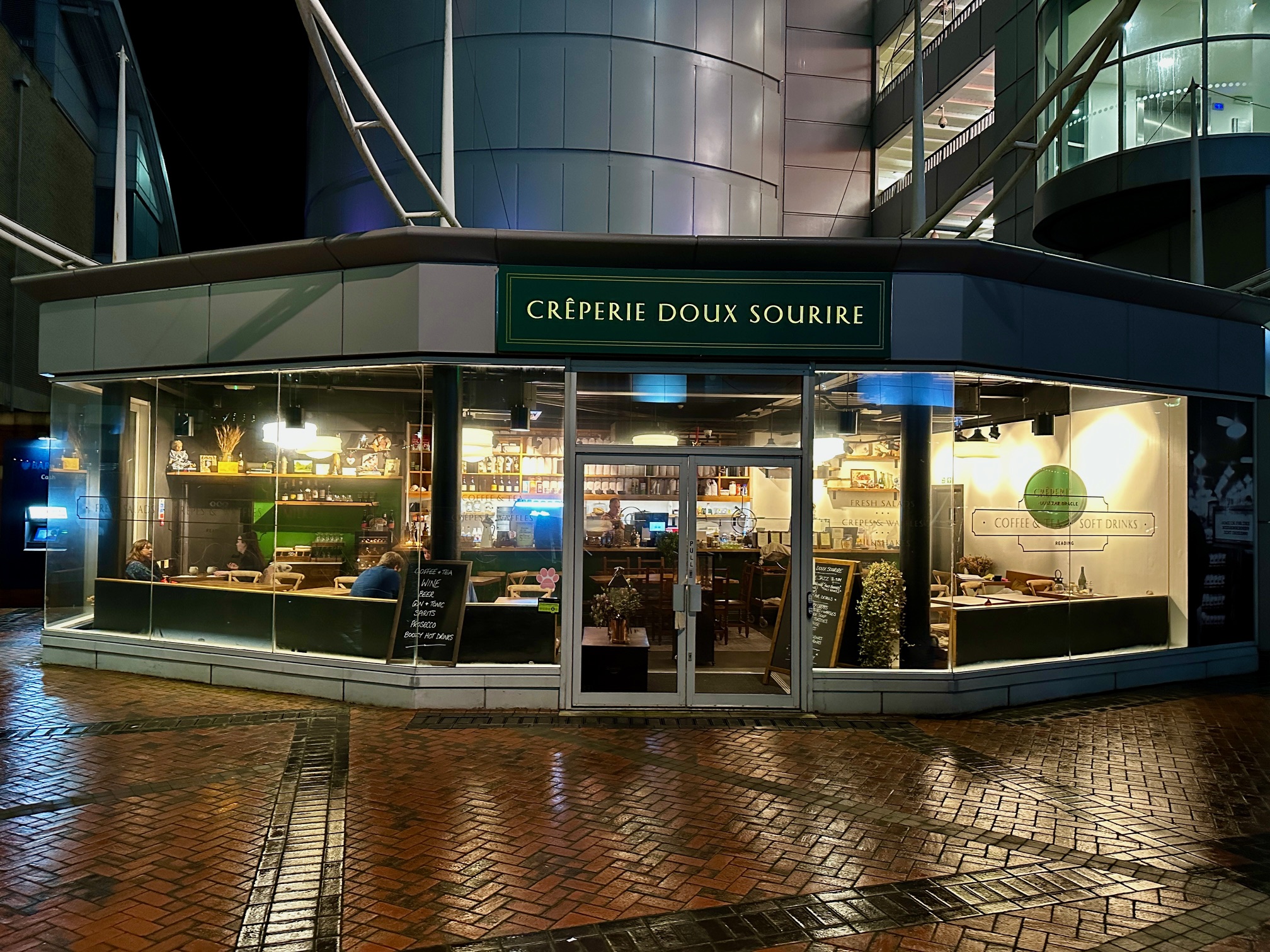
I swerved all those places because I had a better option in mind. Creperie Doux Sourire (it translates as “sweet smile”, and if you thought it meant “two mice” you and that Duolingo owl need to have a word) has been open since late last year in the glass-fronted site on the Oracle Riverside next to Vue Cinema. It’s their second branch: the first opened last May in the salubrious surroundings of Windsor station, although it looks like it was either a replacement or a rebrand for a wine bar called Gregory & Tapping that used to occupy that pitch.

Subscribe to continue reading

Become a paid subscriber to get access to the rest of this post and other exclusive content.

Restaurant review: Paulette, Little Venice

Formosa Street, an enclave in Little Venice less than twenty minutes’ walk from Paddington Station, could be the platonic ideal of a London street. It has a little cafe, a chocolate shop, a ludicrously handsome Victorian pub with wood-panelled walls and glass compartments, with tiny doors linking them together. It has a little Italian restaurant that has been there thirty years, and a craft beer place two doors down, the past and the present coexisting cheerfully.

It doesn’t have a butcher, although there’s one just round the corner on Clifton Road. But tucked away seconds from the Tube station, one stop away from Paddington, a stone’s throw from the strikingly modernist St Saviour’s Church, it is a deeply pretty pocket of London that few people know about. If this was your neighbourhood, you would be very happy indeed. Of course, if this was your neighbourhood you would also be filthy rich.

I’ve frequented this part of the world, on and off, for many years. I think I ate in that Italian restaurant not long after it opened, and I’ve drunk in the handsome Victorian pub a fair few times. Just before lockdown, I tried out the craft beer place a couple of times, and I’ve admired the steeple of that modernist church on more occasions than I can recall. I am no closer to living there, or even pretending that I could do, but it’s nice to try to pretend.

Just before lockdown, five years ago, Zoë and I went for dinner at a small French restaurant on Formosa Street called Les Petits Gourmets. At the time, I had the idea of publishing some London reviews, of places close to Paddington, thinking they might be useful to people wanting somewhere good to eat before grabbing an off peak train home. And it might have been a good plan, if I hadn’t hatched it about a fortnight before people stopped taking trains in general, going to the office or indeed leaving their houses.

So I never wrote a review of Les Petits Gourmets, although that might have been for the best because it was small, eccentric and nuts. On arriving we were told that their oven had packed up, so we could have whatever we liked from the menu as long as it was something they could cook on the hob. The place was dark and atmospheric, our table tiny and cramped. Another table, weirdly shaped and right next to the bar, with a couple of high stools, was so bad that a couple came in, were offered the table, had a shouting match with the staff and stormed out.

I can’t remember anything about what I ate, but I do remember that. And I was tempted to publish a review, if only because it was so surreal, but what would have been the point? It was just a place you would never have heard of, and a review that wouldn’t have sent you rushing there, at a time when you couldn’t have rushed there anyway – even if, for whatever reason, a dingy spot with no working oven and some shocking tables was right up your alley.

I thought no more about Les Petits Gourmets, really, until last summer when I read a rave review in the Standard of a French restaurant in Little Venice called Paulette. I know that area, I thought. I wonder where it is? And then I checked the address, and thought Isn’t that where that weird French place used to be? And then I Googled some more and discovered that it was exactly where that used to be, and opened later in 2020. Les Petits Gourmets was an early casualty of the pandemic: perhaps the cost of fixing that oven was the final straw.

The review I read of Paulette made it sound like everything I had wanted its predecessor to be, so I made a booking there and on a drizzly Saturday morning I caught the train up into London, ready for a long overdue lunch with my cousin Luke, last seen as baffled as I was by supercool Haggerston spot Planque. Fun fact: both Planque and Paulette featured in Conde Nast Traveller‘s listicle last summer of London’s best on-trend French restaurants although, as we will see, they couldn’t be more different.

The walk from Paddington is a lovely one. You start out exiting the station right by the Paddington Basin and cross over it, right by the floating barge restaurants, walking past craft beer and pizza spots and impossibly spenny-looking modern apartment complexes. The route ducks under the grime and bustle of the Westway and then, suddenly, everything is beautiful: the streets widen and are flanked with gorgeous redbrick mansions, huge buildings made up of pinch-me-if-I-live-here flats. And then you’re at the canal, and you wonder how such a fetching residential area can be hiding in plain sight here, in Zone 1.

I stopped for a latte at the brilliant D1 Coffee, a stone’s throw from the waterway, and thought to myself that as usual I was trying to pass myself off as congruous in a neighbourhood far, far above my station. I chatted to the couple next to me about giving up smoking – something I did twenty years ago and still think of as one of my greatest achievements – and as we did, countless cosmopolitan types ambled past, walking dogs or just chatting happily. One was carrying a MUBI tote, and I wondered how it had happened that I’d wound up living in a postcode so far from my tribe. It’s almost as if I just hadn’t tried hard enough to make something of myself.

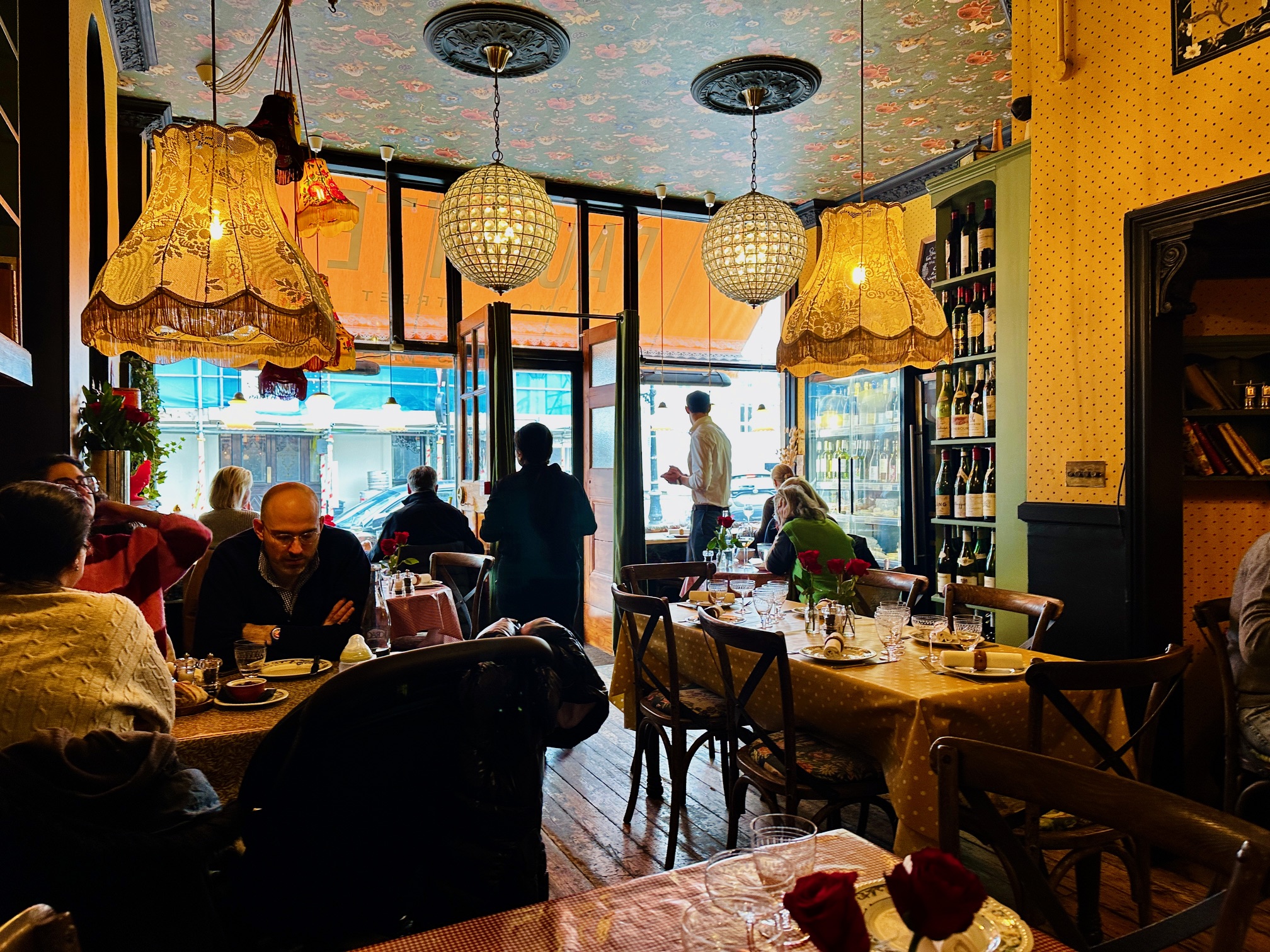
I got to Paulette before Luke did, and it was unrecognisable from the room I’d eaten unsuccessfully in five years before. Still eccentric, yes: all mismatched patterns on the walls and ceilings, mismatched cloths on the tables, mismatched light fittings, all maximalist and unashamed. But it was bright, cheery and welcoming. Even with the canary yellow awning out, light flooded in from the full length windows and all the tables were full of people who seemed profoundly happy with their life choices. I ordered a kir while I waited for my cousin, and it was sweet sunshine, a liquid escape from rainy London. Even noticing that the gorgeous Victorian boozer opposite was closed for renovations couldn’t dent my joie de vivre.

Nor could the discovery, when Luke turned up and ordered a Meteor Zero, that he was off the sauce. He explained that he’d bust his hip and that alcohol interfered with his rehabilitation regime: news to me, as I’ve always found Dr. Booze an invaluable consultant I’ve involved in my recovery from pretty much anything affecting me.

I thought it would bother Luke, a man who runs more marathons in a year than I’ve eaten Marathon bars in my lifetime, but he was surprisingly sanguine about it. “I figure everything goes through a fallow period” he told me later in the pub, showing a kind of Zen perspective I’d have loved to have twenty years ago when I was his age: come to think of it, I haven’t attained that mindset even now.

That meant that I had to forego the delights and dilemmas of choosing a bottle from the enormous wine list, seemingly covering all of France in compendious detail. But it wasn’t all bad – just under twenty wines were available by the glass, a great spread including half a dozen dispensed using a Coravin. I picked a Sancerre, which was terrific, and we started doing a bad job of making our choices from the menu and a much better job of catching up.

The menu was a tad lopsided, with about a dozen starters and half that of mains, but everything on there was tempting. Many of the things I’d read about in advance and hoped to encounter, like a Roscoff onion tarte tatin with mascarpone, were missing in action, but even so the challenge was very much what you missed out on, as much as what you picked. On another day you would have wound up hearing about the classic onion soup, the scallops or the halibut with sauce Meunière, but I will have to try them next time, assuming they haven’t been whipped off the menu by then.

As it was Luke and I agreed to share a few things to try and cover as much as we could, helped by pricing which encouraged you to try a bit of everything. Starters tended to be at or around the fifteen pound mark, with mains mostly between thirty and forty quid. But everything was so fabulous, and generous, that I didn’t object to that in the slightest.

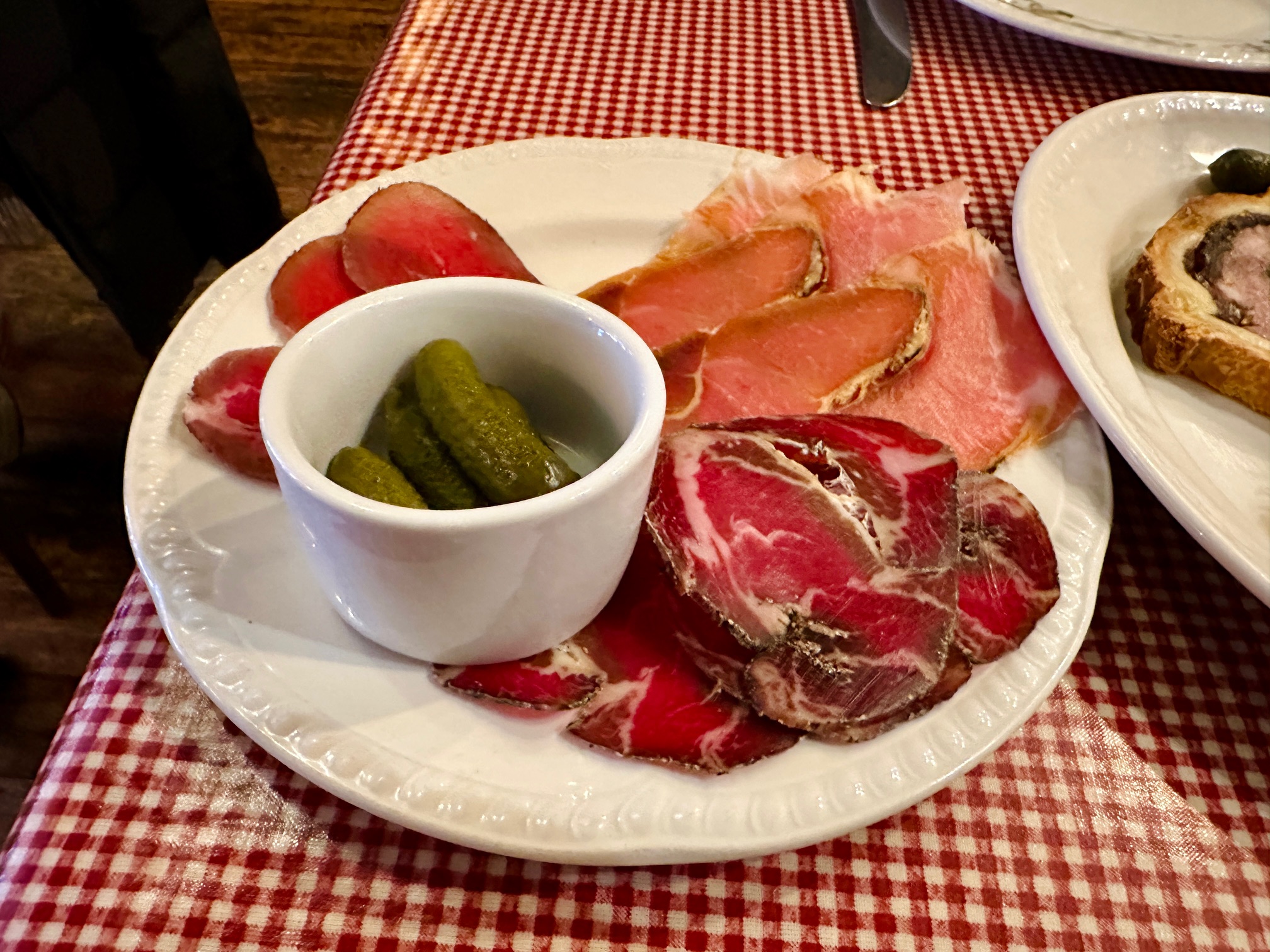
We kicked off proceedings with a small selection of charcuterie, which was easily enough for both of us. All of it was marvellous, from the bresaola to the pork loin but especially the coppa, dried and intense, and a doozy of a jambon de Bayonne: again, dry and coarse, which very much said tiens ma bière to both Serrano and Parma ham. This came with bread (which should be a given but isn’t always), butter (which was a very welcome surprise) and, best of all, a ramekin containing a deeply acceptable quantity of sharp, tart cornichons.

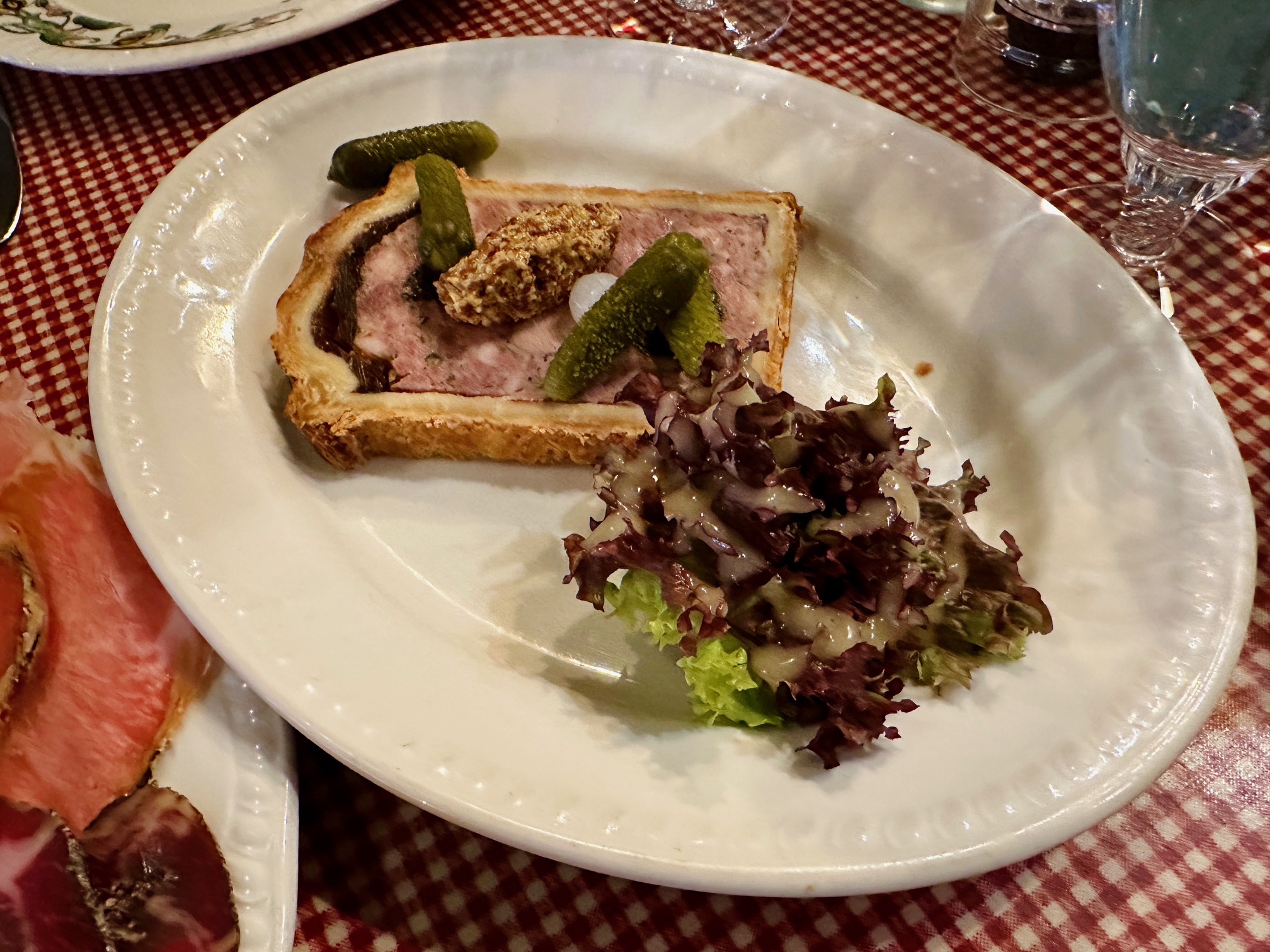
Fourteen pounds for all that, and for a pound more our second starter was every bit as stellar. I love pâté en croute, and Paulette’s version was the best I’ve tried – a glorious slab of heaven, golden burnished pastry housing coarse pâté, shot through with dark prunes. On occasion I’ve had this kind of dish in Paris and it’s been painfully close to Pedigree Chum, but no such worries here: no dodgy jelly, just densely packed meat – pork and duck in this case – topped with yet more pickles and a quenelle of exceptional whole grain mustard. A very well-dressed salad completed an impeccable plate of food.

I wish I’d had one of these to myself, but to do that I’d have had to go without the charcuterie. This is the problem with sharing food, isn’t it: you always end up wanting twice as much of everything, everywhere, all at once. I was about to start a sentence with Next time, but I’ll try to stop myself or I’ll be doing it for the rest of the review. Truth be told, even by this point the only question in my mind was when exactly that next time would be. It was already a given that it would happen.

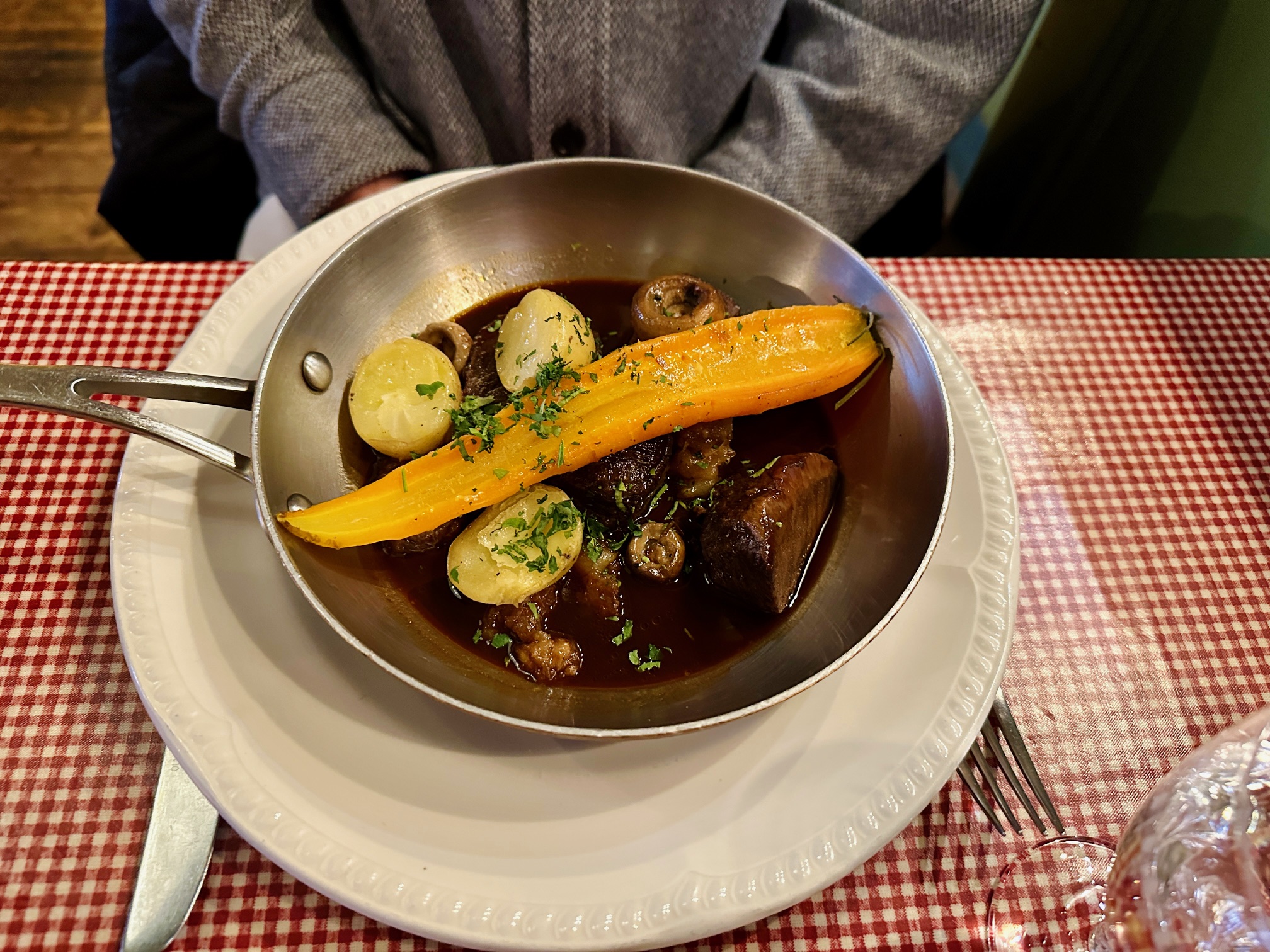
I gave Luke first pick of the main courses and, torn between the fillet of beef and the bourguignon, he eventually chose the latter. He chose extremely well. The pan brought to his table was a one-stop shop of pure happiness – a deep, reduced sauce full of wine and care, with a few waxy potatoes, plenty of mushrooms and a transverse beast of a carrot, heftily substantial and yet superbly cooked.

But of course, none of that gets top billing in the name of the dish, and this all comes down to the beef itself. I’m used to having this dish with shin or chuck, but Paulette opted for beef cheeks and, with hindsight, it was an inspired choice. The food writer Harry Eastwood once said that cheek was perfect for this dish as, in her words, “the meat surrenders completely”. I can’t improve on that description, so I’ve nicked it instead.

And it’s true, but only if the kitchen is absolutely on top of its game and the beef is braised to the point where any gelatinous quality is gone, replaced with that terrific stickiness where the beef and the sauce become a symbiotic dream team. That’s what had happened here, and it was a wondrous thing. Trying a forkful I thought back to my friend Graeme’s bourguignon at Côte the previous month, and the difference between good and great. The difference, it turns out, is nine quid and forty miles.

“This is the best French food I can remember eating” said Luke. I’m a relatively frequent visitor to France, but I could see what he meant.

If I had been Luke, I would have wished that I’d saved some bread to mop up that final layer of sauce coating the bottom of the pan. But if I’d been Luke he’d probably have a forty inch waist and far less success online dating and would get over the disappointment of busting his hip (which would be more likely to happen by, say, getting out of bed awkwardly) by medicating with the finest mid-price reds the restaurant had to offer. Instead I offered him some of my frites, and after refusing twice – he is Canadian after all, so awfully polite – he took me up on my offer.

I’ve seen quite a few reviews online talk about how Paulette does the capital’s best frites. They might or they might not: I’ve had nowhere near enough frites in London to be qualified to judge, but they were up there with the best frites I’ve had in this country or any other, irregular, golden, salted and decidedly moreish. They were so good I wasn’t sad that I didn’t get to try the gratin Dauphinois, and frites have to be pretty damned good for that to happen.

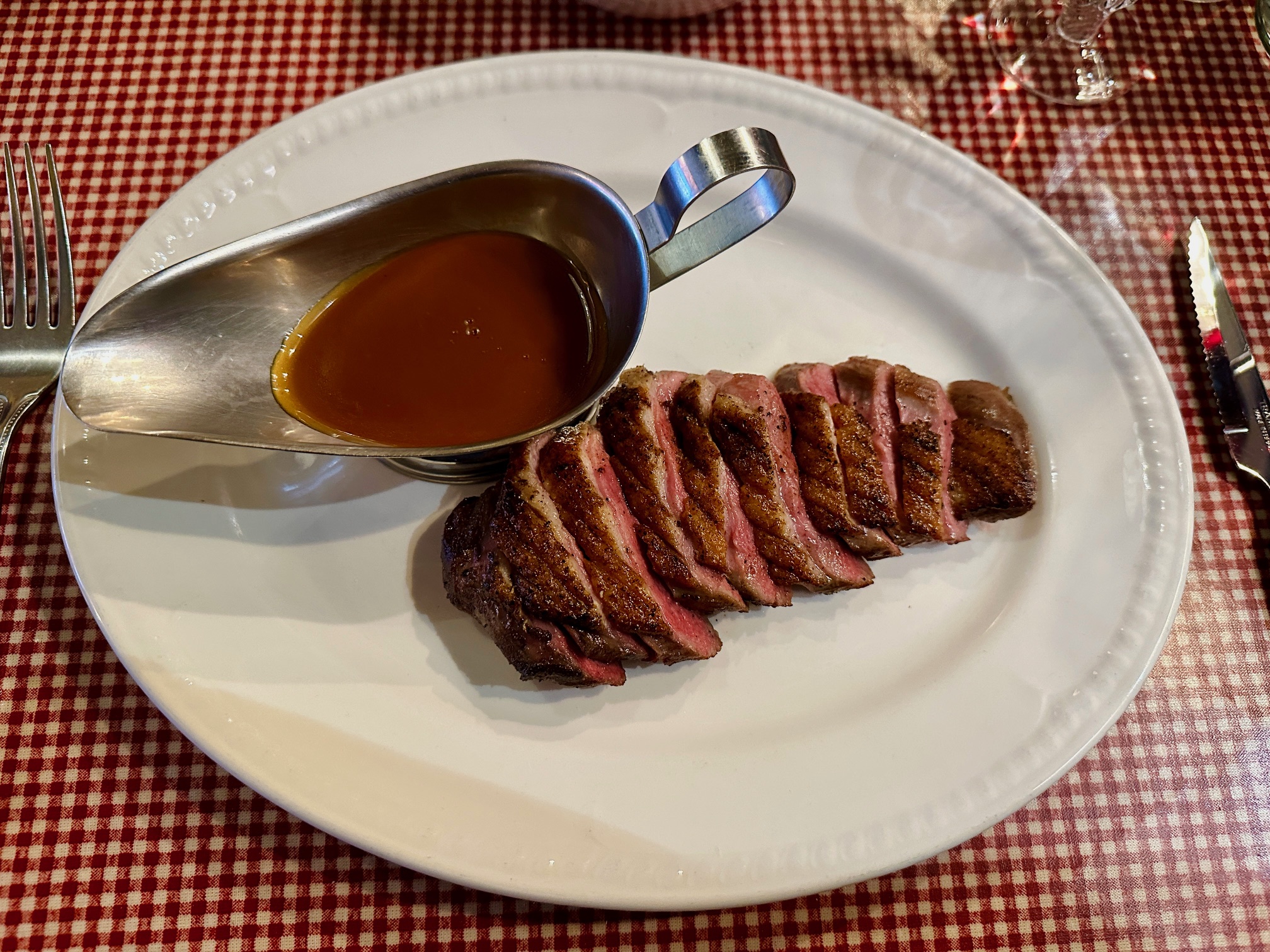
My frites accompanied my order from the specials board, duck breast cooked pink, sliced and served simply with a boat of what was described as a duck velouté, in practice one of those ultra-reduced, fantastically concentrated sauces that French cuisine seems to do better than almost anybody else.

I’ve had duck breast many, many times in my life and a lot of the time, afterwards, I wonder if I’m doing it because I think I should like it rather than because I do. It’s often a tad tough, a smidge fatty, somewhat poorly rested: much like me, most weekday mornings. This was more like me after a full day in Nirvana Spa, utterly relaxed, thoroughly cosseted, treated like a king.

The analogy breaks down at that point, because this duck was also enormously tasty and I imagine most people wouldn’t be able to get enough of it. But it was good while it lasted.

By this point I had moved on to a Saumur, which was perfect with the duck: Paulette has the sort of outstanding staff who will compliment you on each of your wine choices even though you’re the poor schmuck muddling your way through the list of wines by the glass.

Luke and I decided to eat as Frenchly as possible, which meant a cheese course and then some dessert: the wine list distinguishes, winningly, between “cheese wines” and “dessert wines” so I nabbed something from the former section, a 1986 Muscadet. I have no doubt the Coravin was involved here, and the result was stunning, an amber marvel with a hint of sherry sweetness, outstanding complexity and length. A 50ml pour, in this case, was plenty.

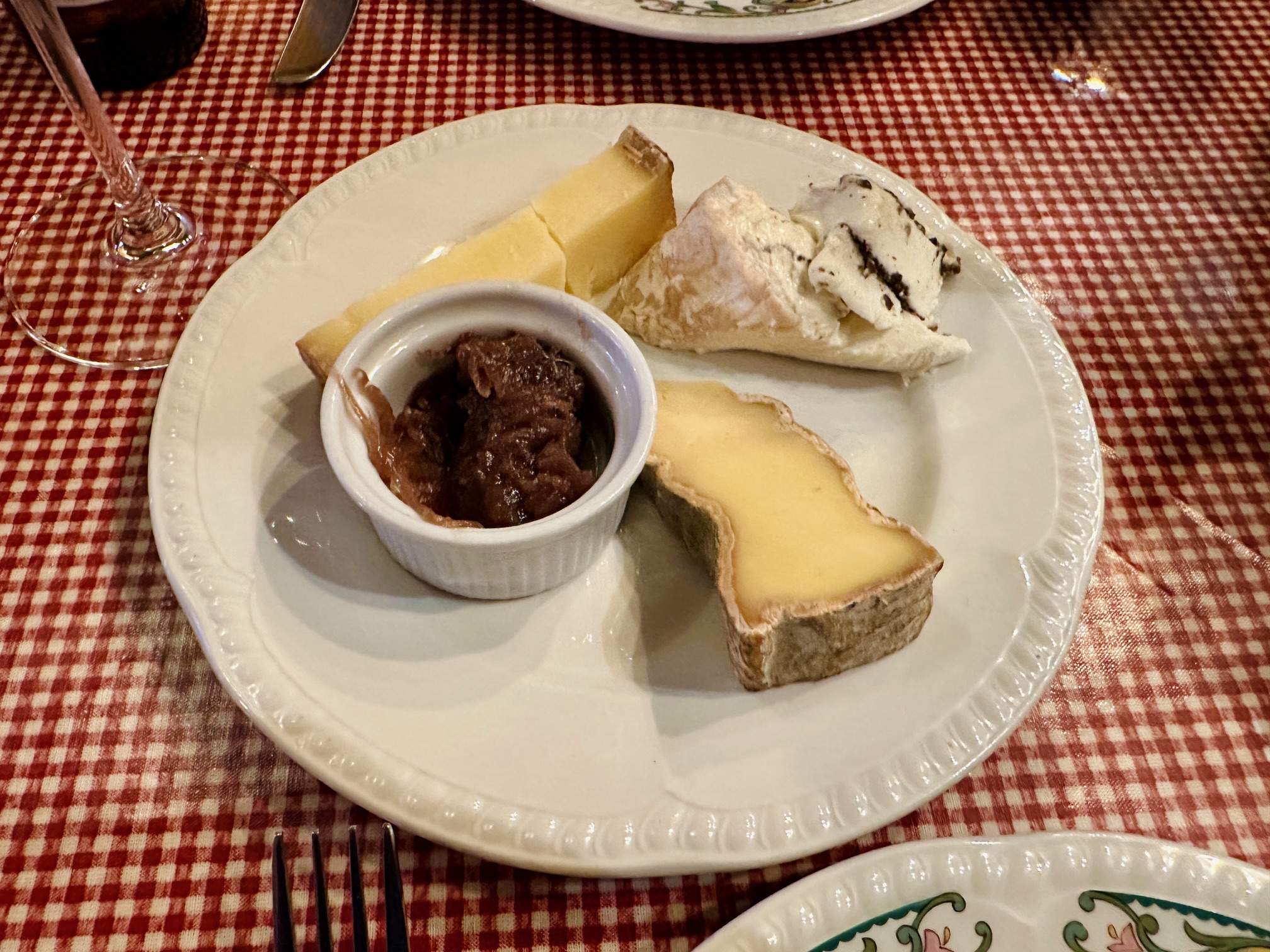
Paulette does a small or large assiette de fromages with three or five cheeses respectively, and they are in principle a deli too, so I did wonder whether you could pick which cheeses you had. When our server authoritatively told us you got a Comte, a truffled brie and a Saint Nectaire I realised this was a choice best left to the experts, so that’s what we had.

The picture here probably doesn’t fully convey this, but it was a generous wodge of each, easily enough to share without needing a scalpel and a protractor. They were all outstanding: the Comte with all the crystalline grit you would want, the Saint Nectaire, not a cheese I’d ever seek out, bringing a savoury depth to justify its seat at the table.

But the truffled brie – oh my goodness. Luke and I agreed that we shared a suspicion about truffle being brought out to zhuzh up the ordinary, but in this case it turned a gooey, creamy delight into a total showstopper. As with the charcuterie, this came with a generous helping of bread but once we had finished all of the bread and nearly all of the cheese the twinkliest of our servers returned with a couple more slices, urging us to use them to clean up the very last of the brie. We did as we were told.

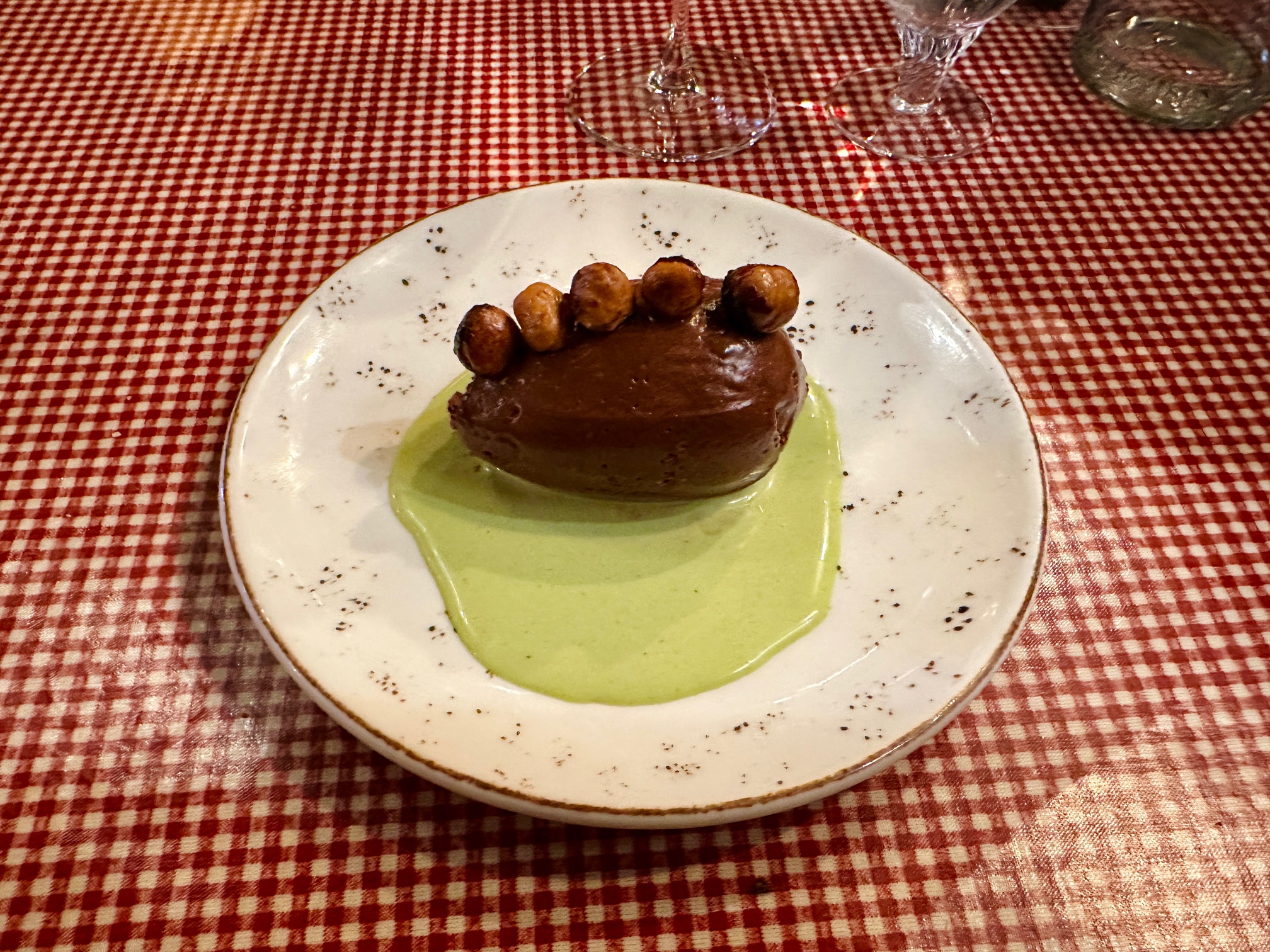
Normally I would have a different dessert to my dining companion, but I figured we’d got through a decent range of dishes already and I’d seen the chocolate mousse being carried past to other tables and decided there was no way I was leaving without trying it. I mean, just look at it in the picture below: a stegosaurus of a thing, plump and shiny, with a spine of caramelised hazelnuts sitting in a pastel-green lake of pistachio crème Anglaise. How could I not order that? How could anybody?

And it tasted every bit as beautiful as it looked. By now I’m used to chocolate mousses in fancy Spanish places where they drizzle it with extra virgin olive oil and pop some salt crystals on top, the modish way to revamp a staple. But this had no interest in playing those tricks, so like everything else at Paulette it was a classic rendition of a classic dish, prepared by a kitchen that revered the classics.

Don’t get me wrong – there is a place for deconstructing, reconstructing and reinventing, and I’m a fan of those things as much as anyone. But whatever that place is it isn’t Paulette, I’m very glad to say. This was a dark, glossy miracle – so smooth, almost not aerated at all, and I wished every spoonful could have lasted hours. The final spoonful, as it always does with such dishes, came too soon, and I found myself wishing there was some sweet equivalent of bread I could use to mop up those last bits of crème Anglaise. Maybe that, rather than ruining burgers, is the point of brioche.

When you book lunch at Paulette you get that standard issue we want your table back in X hours gubbins that London restaurants so often do. But none of that happened here, and over three hours after I ordered that kir pretty much every table was occupied by somebody new despite it still being mid-afternoon, the evening service around the corner.

I’ve never understood restaurant reviewers who insist on eating at a place twice before writing a review – mainly because they need to get over themselves – but if I could have eaten at Paulette again that evening I would have seriously considered it. But the craft beer place a couple of doors down was calling to us, and the pub after that, so it was time to reluctantly pay for the wonderful time we had had. Our bill for two, all that food, a couple of beers for Luke and five different glasses of wine for me, came to just over two hundred and ten pounds, including a 13.5% service charge. It felt as much like a bargain as I suspect any meal will this year.

Later on, Luke and I were in the Bear, just around the corner from Paddington, having one last drink and comparing notes before going our separate ways.

“The only thing that stops it getting the highest mark, for me” said Luke, “was that it just lacked that thing that would make it a truly transcendental experience. That and the bread, I guess, the bread could have been better.”

I knew what Luke meant, but I also suspected that looking at Paulette that way missed an important point, which was that Paulette had no interest in being that kind of restaurant or delivering that kind of experience. It was more interested in transporting you completely by delivering something unfussy and unfancy but, in its way, truly outstanding. Paulette was about as good an example of this kind of restaurant as it’s possible to find, and I loved it. Absolutely loved it, unreservedly, from start to finish.

It’s twenty minutes from Paddington, and Paddington is thirty minutes from Reading. Just think about that: you could be at Reading station, and within an hour you could be eating in this place. If I don’t do so a couple more times this year, I will be extremely surprised, not to mention deeply disappointed. I know most of my London reviews, lately, have been of spots in the centre where you hop on the Elizabeth Line to get there, very much a tribute to the march of progress in the capital. But this? Simply timeless.

Paulette – 9.3
18 Formosa Street, London, W9 1EE
020 72862715

https://www.paulettelondon.com

As of January 2025, Edible Reading is partly supported by subscribers – click here if you want to read more about that, or click below to subscribe. Whether you’re a subscriber or not, thanks for reading.