Restaurant review: Antep Kitchen, Oxford

Taking a Friday off and meeting my old friend Dave for lunch in Oxford felt like such a good idea when we made our plans. There’s something magical about a long lunch – and especially one on a Friday, starting your weekend before most people, knowing there’s no rush to anything and that, if you choose, you still have two lazy days and lie-ins in your future. What’s not to love about that?

Reality, unfortunately, had other plans. Because the Friday we chose, a couple of weeks ago, was at the height of the latest heatwave and everything was brutal. There seemed to be no other word for it. The rail network struggled, with a slew of cancellations: my train was delayed, Dave’s stopped outside Didcot for what felt like an eternity. Finally disembarking at Oxford it felt, if that were possible, hotter even than Reading – a cruel, searing heat with no respite. All the times that anybody had ever complained about Britain’s indifferent summers were coming back to bite us: I’d say be careful what you wish for, but nobody wished for this.

I grabbed a table outside Society Café with a latte that I immediately realised was the wrong order altogether, and waited for Dave. It turned out that even being in the shade didn’t make matters much more bearable. My little John Lewis fan whirred away, its efforts close to futile, and I got sympathetic looks from the ladies at the next table: I like to say I’m built for comfort, not speed, but I was definitely not built for heat.

When Dave arrived we quickly ruled out any more hot beverages and decided on a drink before lunch, opting to get our schlep into East Oxford out of the way first and reward ourselves with a pint. We ruled out taking a bus on the basis that they would be purgatorial, but it’s hard to imagine they could have been more punishing than the walk we did. The High, wide and handsome, was frying in the sunshine with no relief to be found anywhere. We headed over Magdalen Bridge, hot and bothered, and I could already feel the ghost impression of the sunburn on my forehead yet to come.

It didn’t help that Dave’s first choice of watering hole turned out to be closed until 4, or that my backup plan didn’t open until an hour even after that. So eventually, a full three quarters of an hour later, we wound up in the almost-shady and very fetching terrace of the Rusty Bicycle while I drank a pint of cider with indecent haste and wondered if I would ever stop sweating.

Huge, gorgeous-looking chicken burgers turned up at the adjacent tables and I was very tempted to junk this whole restaurant reviewing lark for the day and stay there. Have a burger, drink some of Dodo Pubs’ excellent peach lager, chat and resolve to move no further than walking to the bar or the loo, until it was time to go home. And I nearly suggested it, too, because something about that gruelling heat made doing anything – moving, thinking, deciding – close to impossible.

But we had an appointment with Turkish restaurant Antep Kitchen on the Cowley Road, a place that had been on my list to visit for well over five years. In lockdown, when reviewing restaurants was out of the question, I ran a series of interviews on my blog with some of the great and the good of Reading. It was my tribute to the weekly Q&A in the Guardian, which I read without fail every Saturday.

One of the questions I asked was What one restaurant do you wish you could pick up and drop in Reading?, and when I interviewed Mohamad Skeik, then manager of Reading institution Bakery House, Antep Kitchen was one of the places he chose. And I remember thinking that if the manager of Bakery House said somewhere in Oxford could match it for grilled meats I really should go there one day.

Six years on Skeik has parted company with Bakery House, but his recommendation had always stayed with me and gradually, as I worked my way through reviewing restaurants in Oxford, it moved closer and closer to the top of the list.

It’s been open for nearly 9 years, the name being taken from Gaziantep, the Turkish city widely thought to be the culinary capital of the country and the birthplace of owner Bilal Gilgil. Going inside my first overwhelming sentiment was relief, because despite a huge charcoal grill the full length of the open kitchen, the aircon was on full blast and I experienced a feeling of coolness for the first and only time that day.

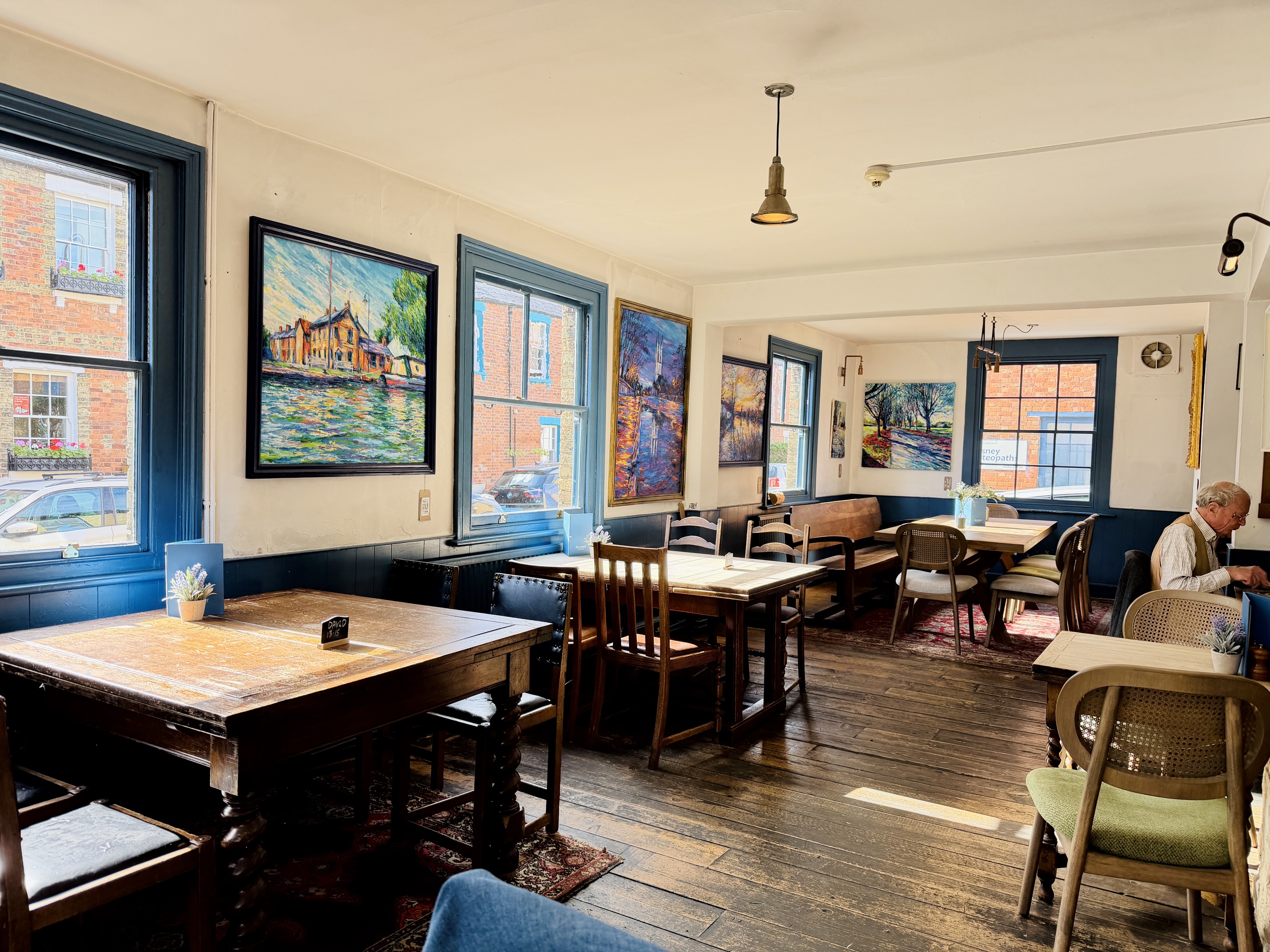
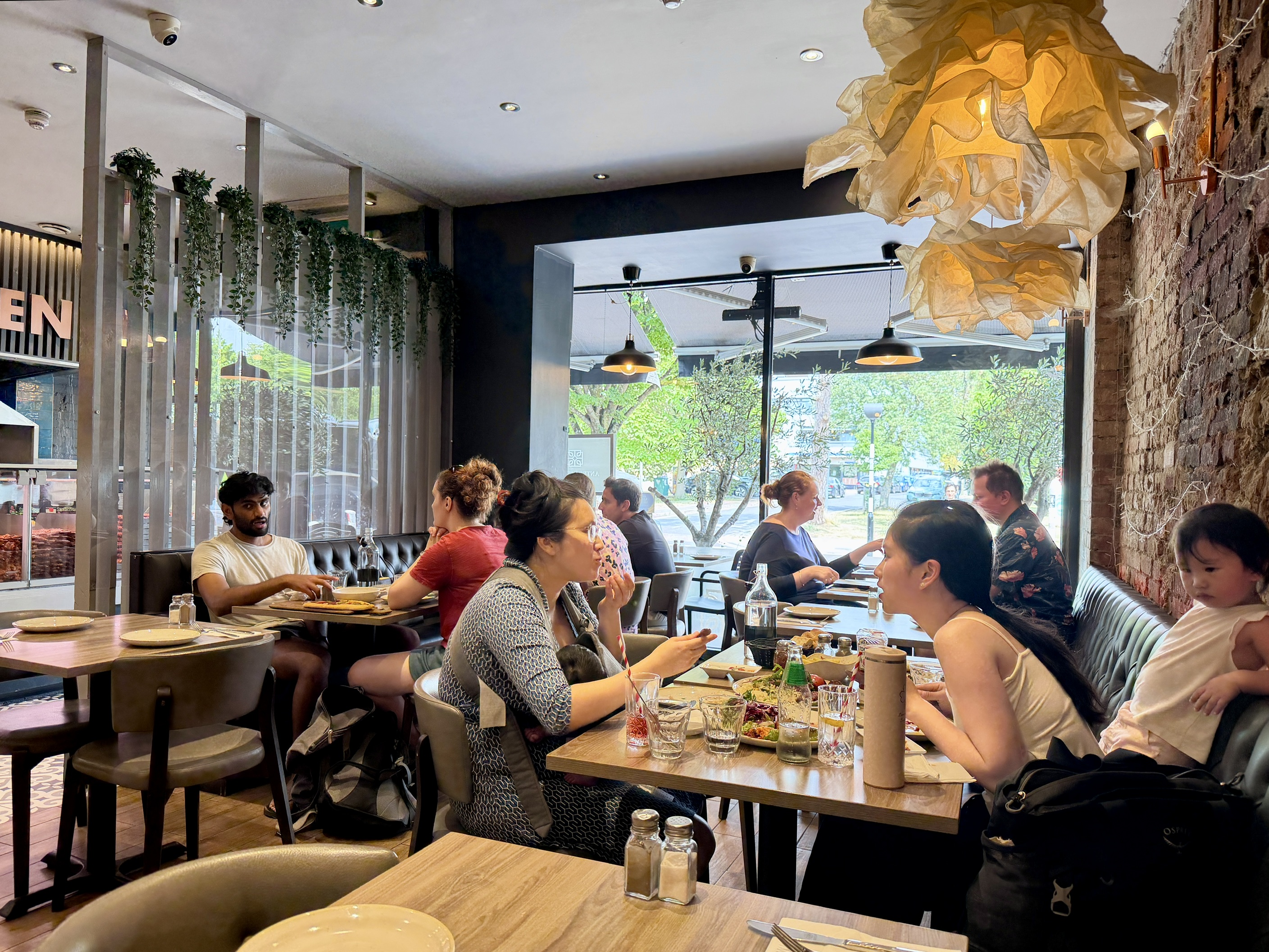
Once that euphoria had worn off, I took in my surroundings. It’s quite an attractive restaurant, busy on a Friday lunchtime, with tasteful banquettes and tables, bare brick walls and a plethora of woven lightshades descending from the ceiling in the bigger back room, the one with booths and less natural light. I imagine that space comes in very handy on a hectic Friday or Saturday night – I also imagine it would be hard to hear yourself think there – but I was glad they’d put us in the smaller front room. There’s even a little terrace on the pavement, although you’d have to be certifiable to have eaten there that day.

The thing that really struck me was the sheer diversity of the clientele at Antep Kitchen – all ages, all demographics, all types and sizes of groups seemed to be taking the opportunity to lunch here, from friends to couples to families: they even managed to find space for a pair of middle-aged men on the verge of heatstroke. I was especially impressed by the number of solo diners I saw, all women, who came in, took a table on their own, ordered something off the grill, read a book, ate their food, paid their bills and went on their way.

If Antep Kitchen was anywhere near me I’d be sorely tempted to follow their excellent example of a lunchtime, especially as you can get a two course set menu until 4pm for £14, and they throw in a soft drink with that. But we hadn’t travelled all that way in such arduous circumstances to pick off the set menu, so we immersed ourselves in Antep’s full repertoire. It is a huge menu full of familiar sights, which makes the whole process harder than you’d think. Cold mezze cost no more than £6.50, hot mezze max out at £8.50 and unless you’re having a Turkish pide most of the mains range between £17 and £25.

The majority of those come off the grill, as you’d expect, but there are other options like moussaka, kleftiko and güveç, or Turkish casserole: I doubt Antep Kitchen was shifting many of those, though, on a very hot day. And although there were a couple of vegetarian mains on the menu – vegetable kebab, vegetable güveç – I don’t honestly think you’d bring a vegetarian here unless you didn’t much care for them.

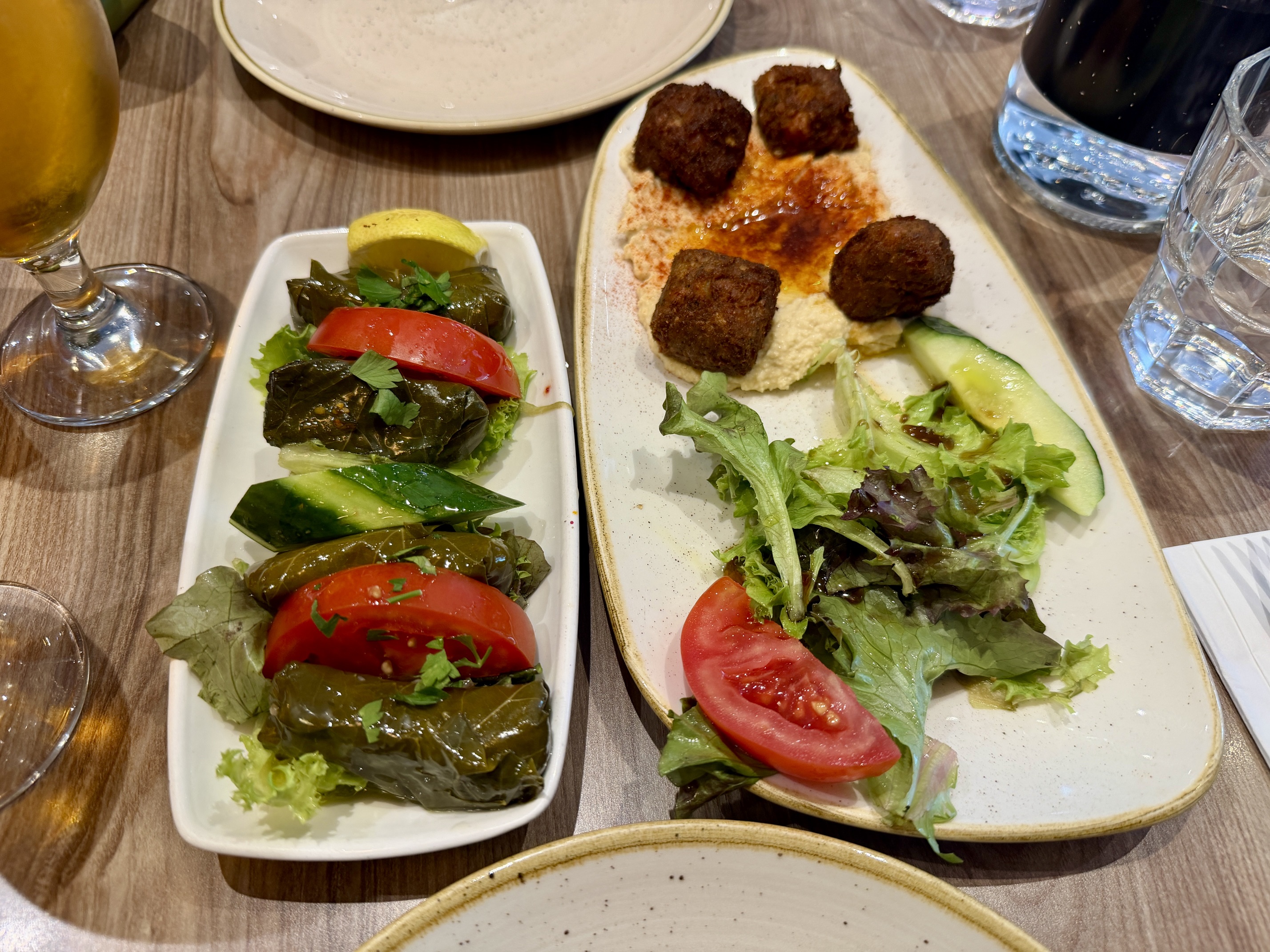
That said, it just so happens that both of our starters were vegetarian. Stuffed vine leaves have been a weakness of mine since that first childhood family holiday to Corfu in 1987 – yes, I am that old – and I’ve always been a sucker for a well-executed one, that freshness of rice and mint, that tang of lemon, that taut green casing.

They always catapult me back to that summer, when I was so skinny, so nerdy and so very English and was suddenly confronted with a different life of heat, indolence and amazing food. But powerful though nostalgia is, I could see through it and realise that these were perfectly good but not amazing. Allegedly they feature both pine nuts and blackcurrant: I could only discern the former, but didn’t miss the latter.

Antep’s falafel were good, too, but felt like an exercise in portion control. Four dense nuggets, very different from their crisp-shelled Lebanese cousins, were genuinely very nice – made with chickpea and broad bean and with the hugely enjoyable surprise of huge, firm chickpeas in their core. I liked them a lot, and they came perched on a smear of houmous that I also quite liked. A little basket of pleasing airy pide came along shortly after, and the whole thing worked well. But at £7.50 did I expect a few more falafel and maybe a little less padding, like the handful of salad from a bag whose main purpose was to squat on half the plate? Possibly.

None of that felt enormously important at the time. We were cool, at last – have I mentioned that it was a hot day? – and we had food in front of us, and a cold beer. An Efe Draft which, confusingly, is not on draft but actually comes in a squat, round glass bottle. And besides we had pushed the boat out for our main, a sharing platter that served two to three people, which meant that as two ravenous people we were about to eat very well indeed.

But being the day it was, nothing had gone completely to plan and nor did this. I will say that the platter which came out was so huge, and our table so packed, that some serious Tetris had to take place to fit everything on, removing some of our starter plates, shifting beer glasses and water glasses and so on. But that might tell you more about the size of the tables, on reflection.

It also tells you something about pacing – this came out five minutes after our starters, which came out ten minutes after our order. Usually I know I’d have a right old whinge about that but I do sometimes know how to read the room, and this kind of room, menu and pricing are for unapologetically casual dining. So my knickers remained untwisted, which under the circumstances was probably for the best.

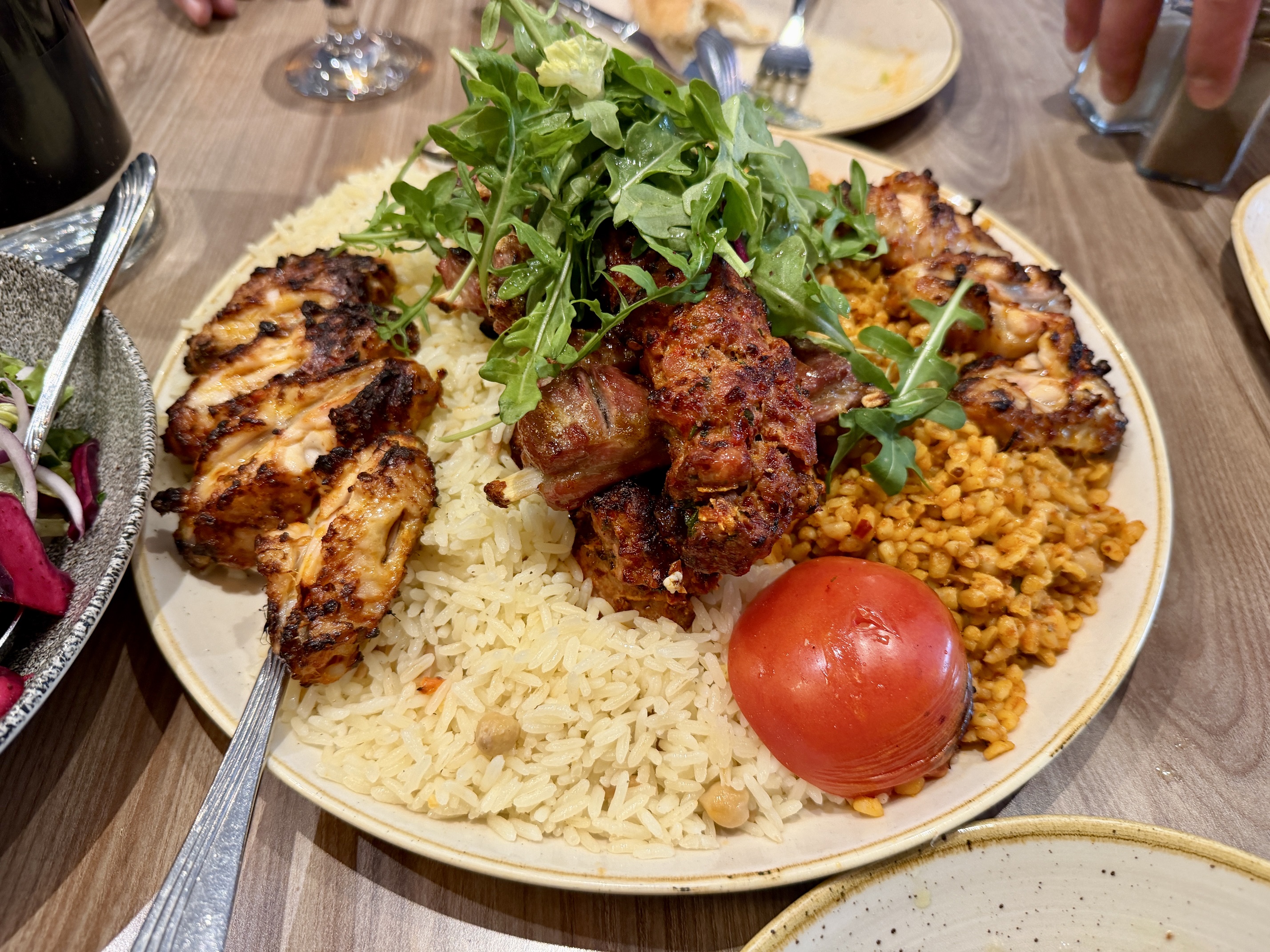
Here it is. It rather flattered to deceive.

Now, in fairness there was much to like here. It was a greatest hits trawl through the grill section, so you got a skewer of chicken shish, a skewer of lamb shish, a lamb kofte, a skewer of lamb ribs and what might have been two skewers of chicken wings. In terms of quality, you would struggle to fault any of it. The chicken wings were surprisingly good, with excellent char: I broke the habit of a lifetime and ate them with my fingers, without my usual prissiness. And the chicken shish was better still, the marination working its magic.

And those were probably the least impressive things on offer. Lamb ribs were a new one on me but rewarded the effort, the fat glossy and sweet, the whole affair genuinely succulent and a proper revelation; it made me wonder just how good Antep Kitchen’s lamb chops might be, and whether they matched the masterpieces down the train line at Didcot’s Zigana. The kofte was another standout: coarse, gnarly, expertly seasoned and with caramelisation that wasn’t to the detriment of the core.

But the real surprise package for me was the lamb shish: I am so used, even in Greek or Lebanese restaurants that I rate, to making excuses for the shish, finding it more leather-adjacent than I would like. I won’t do that any more, because Antep Kitchen proves that it absolutely doesn’t have to be that way: these were expertly marinated and cooked, with phenomenal texture and a little blush, and I could order and eat them all the live long day.

But again, that padding reared its head. The way it was dished up, with a sheaf of unnecessary rocket heaped on top, felt like it was meant to distract you slightly from the way the protein had been rationed. It came with a single grilled chilli, which I liked, and half a tomato which was distinctly under. And you got both rice and grains: the latter, giant couscous with a faint red hue and, again, whole chickpeas here and there, was well worth the time. The rice less so.

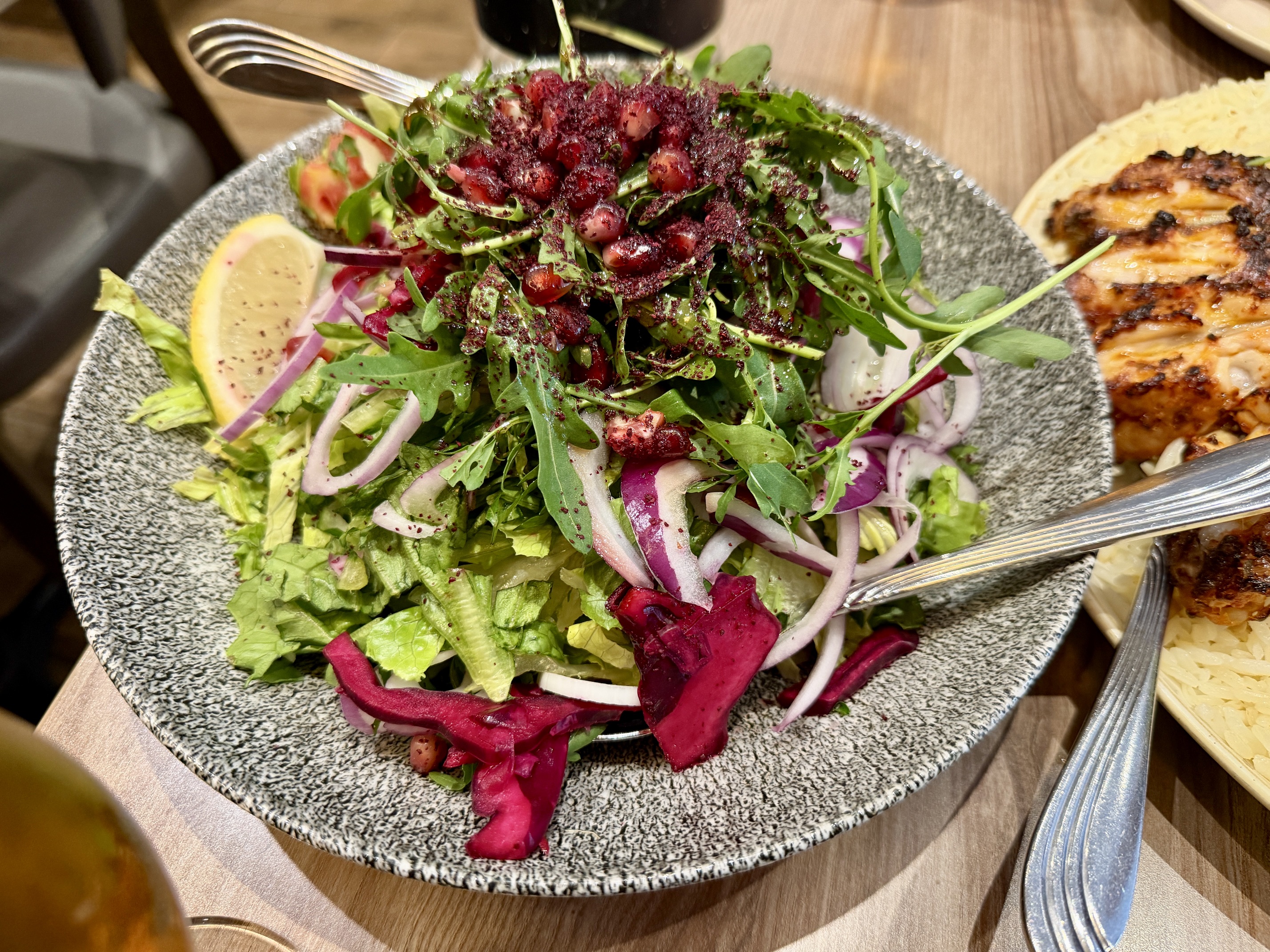
And then there was the salad, which was good but huge, topped with pomegranate and sumac, with a certain pleasing heat and grit. But at the end of the meal there was a lot of salad left, and quite a lot of rice, and that made me think it was out of kilter. It made me wonder whether, if you’d had that shish as your main, you’d have got one skewer or two, because the five things we had felt only just enough between two. I wouldn’t have wanted to split that between three – not unless one of them was a vegetarian, in which case I’d have gladly donated my salad.

Dave tended to agree, I think, and he isn’t as much of a gannet as I am. He liked it, though (“this is far more my kind of thing than fine dining” he said, which made me wonder if he’d quite forgiven me for lunch at Juliet). We did agree, on balance, that it was perhaps another kofte away from being truly satisfying. At least it left room for dessert, I told myself.

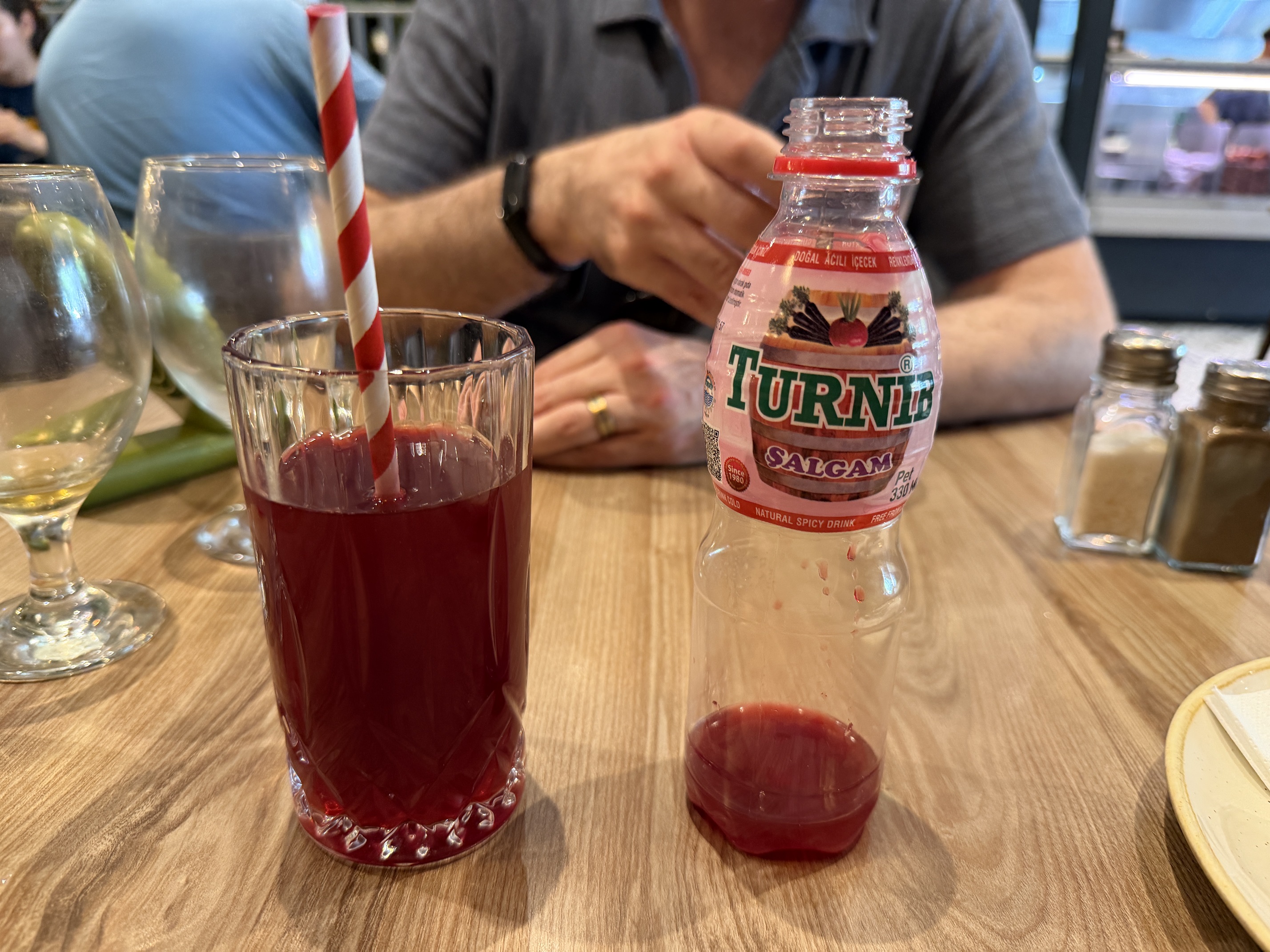
Before that, though, we looked at the drinks menu. Neither of us felt like chugging another Efe, but I was intrigued by a few of the things in the soft drinks section. I asked about ayran first, as I’ve always rather liked it, only to be told that they didn’t have any. So that left something called Salgam, billed as refreshing Turkish turnip juice. Did I dare give it a go? I asked one of the brigade of dapper, waistcoated servers.

“The Salgam – is it sweet?”

He gave me the kind of smile that’s hard to read.

“No, it’s spicy.”

How bad could it be, I thought? So I ordered it. And then I found out.

Salgam comes in a bottle with TURNIB on it in block capitals, and an illustration of a barrel with what looks like some kind of mutant cross between a turnip and a giant spider ominously climbing out of it. Tasting it, it didn’t really taste of turnip at all, but of pickle juice. Which I don’t necessarily mind, in its place, but this didn’t feel like its place. I took a slurp with my straw, and Dave enjoyed my discomfort in the way only a very old friend can.

“It’s sort of like a Bloody Mary where they’ve forgotten the vodka and swapped the tomato for, err, turnip.”

“You’re selling it to me, mate.”

“I think for solidarity you should drink what’s left in bottle.” He reluctantly agreed, and took about as long to finish it as I did my whole glass. Maybe it was delirium from the long walk to the restaurant, but I found myself laughing uncontrollably.

“They have a barrel on the bottle” I told Dave, “but this has clearly been made by scraping the bottom of it.”

“It’s not great.”

“The thing is, the more I have of it, the worse it gets.”

I thought to myself that ordering the Salgam was the right decision. It’s what Anthony Bourdain would have told you to do, I suppose, although I’m not sure how good a role model he turned out to be. Anyway, by the time I’d finished it I didn’t dislike it so much, although that might just have been the Gaziantep equivalent of Stockholm Syndrome. Subsequent research has shown that it isn’t even primarily made of turnip, instead being largely the fermented juice of pickled carrots “flavoured with aromatic turnip”, which is surely the best kind of turnip.

I’m glad I tried it, anyway, and that’s more than I can say about, for example, the novels of Zadie Smith.

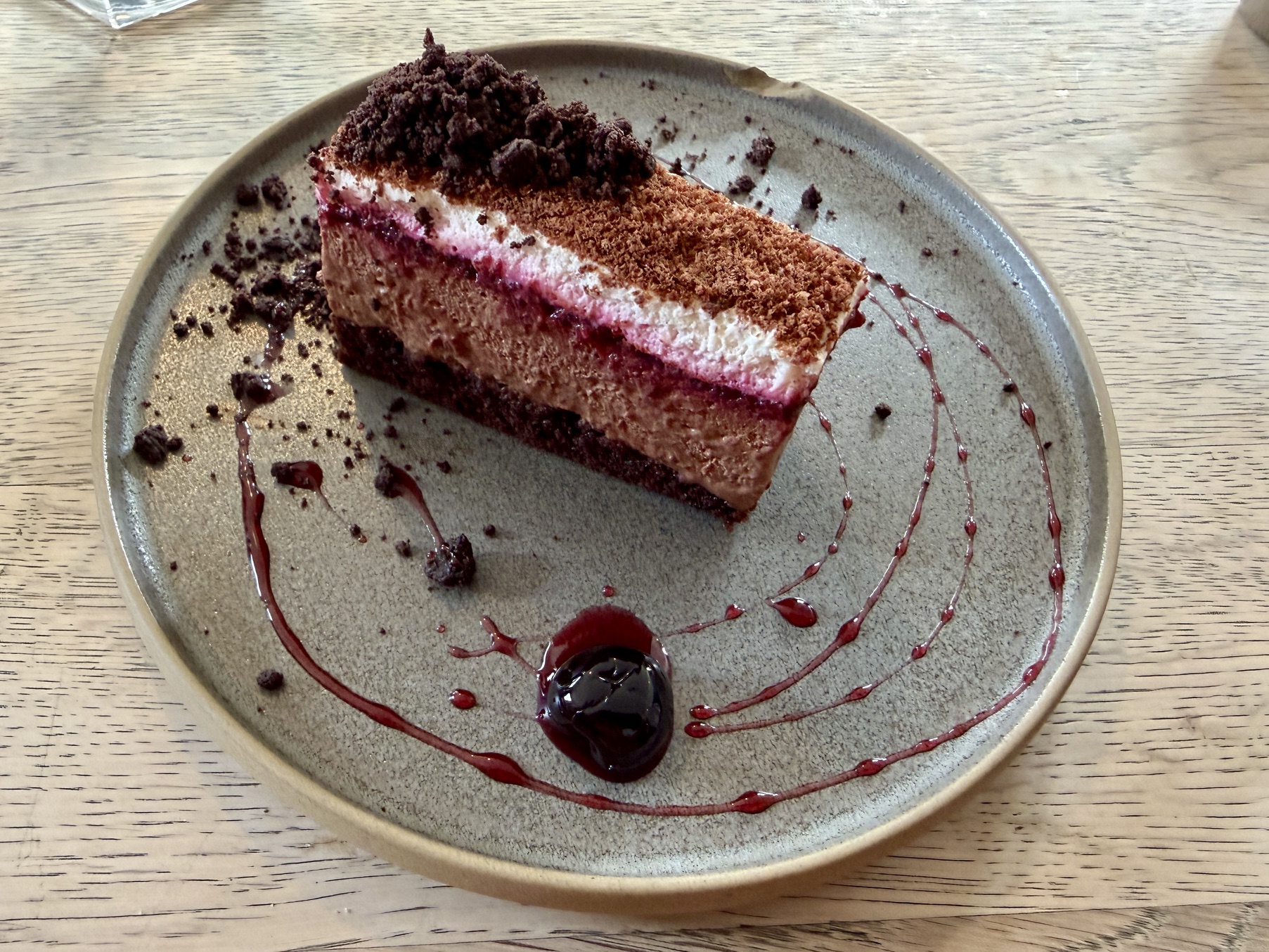
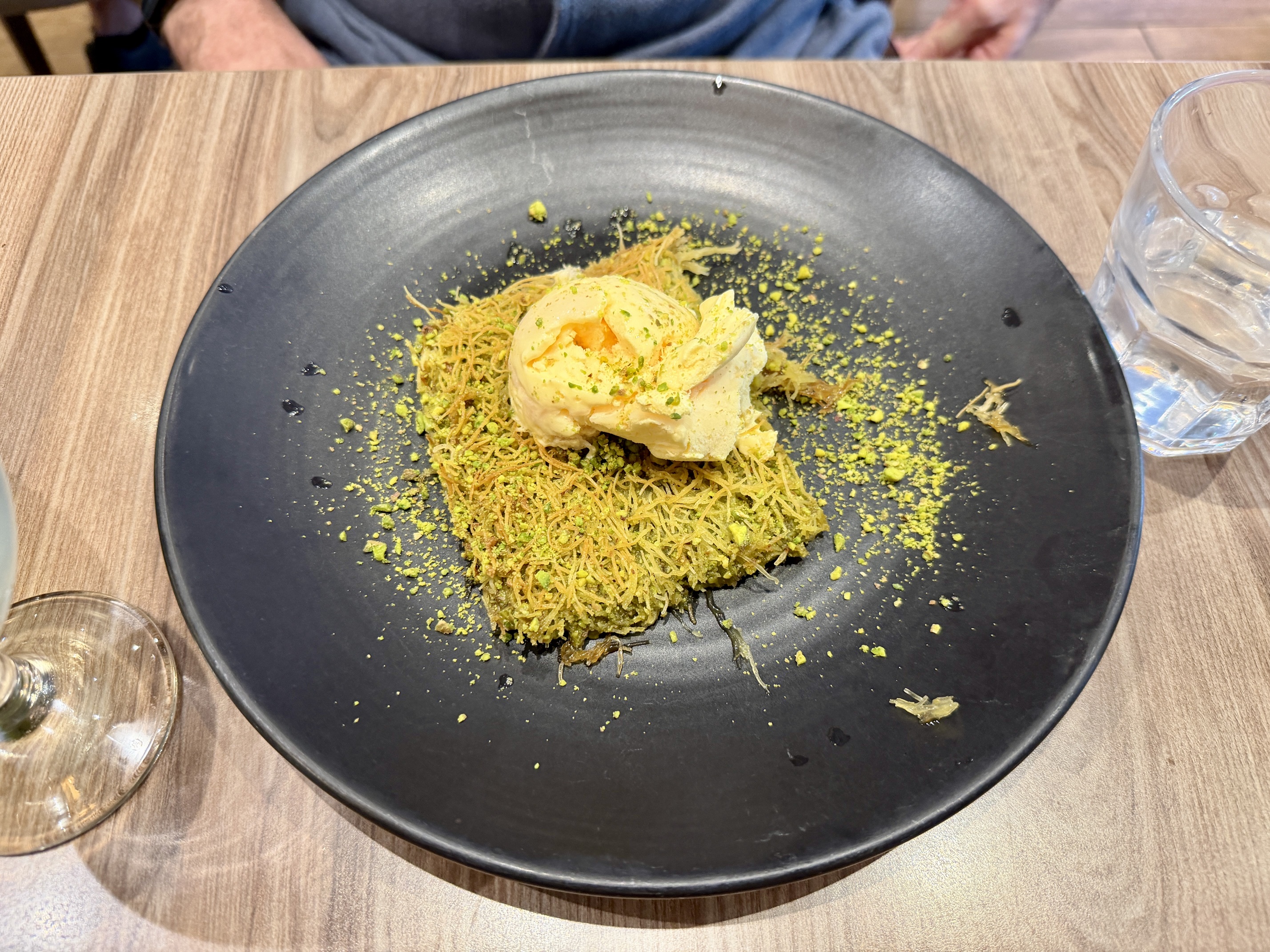
We closed with desserts which were variations on a single theme but, between them, were strong enough to redeem some of the flaws that had gone before. Dave’s kadayifi was a brick of that familiar Shredded-Wheat-a-like, baked in sweet syrup and carpet-bombed with pistachio, topped with a scoop of good vanilla ice cream. It looked the part, and tasted good enough that Dave didn’t envy the baklava turning up at the next table: four generous pieces, clustered round more of the ice cream.

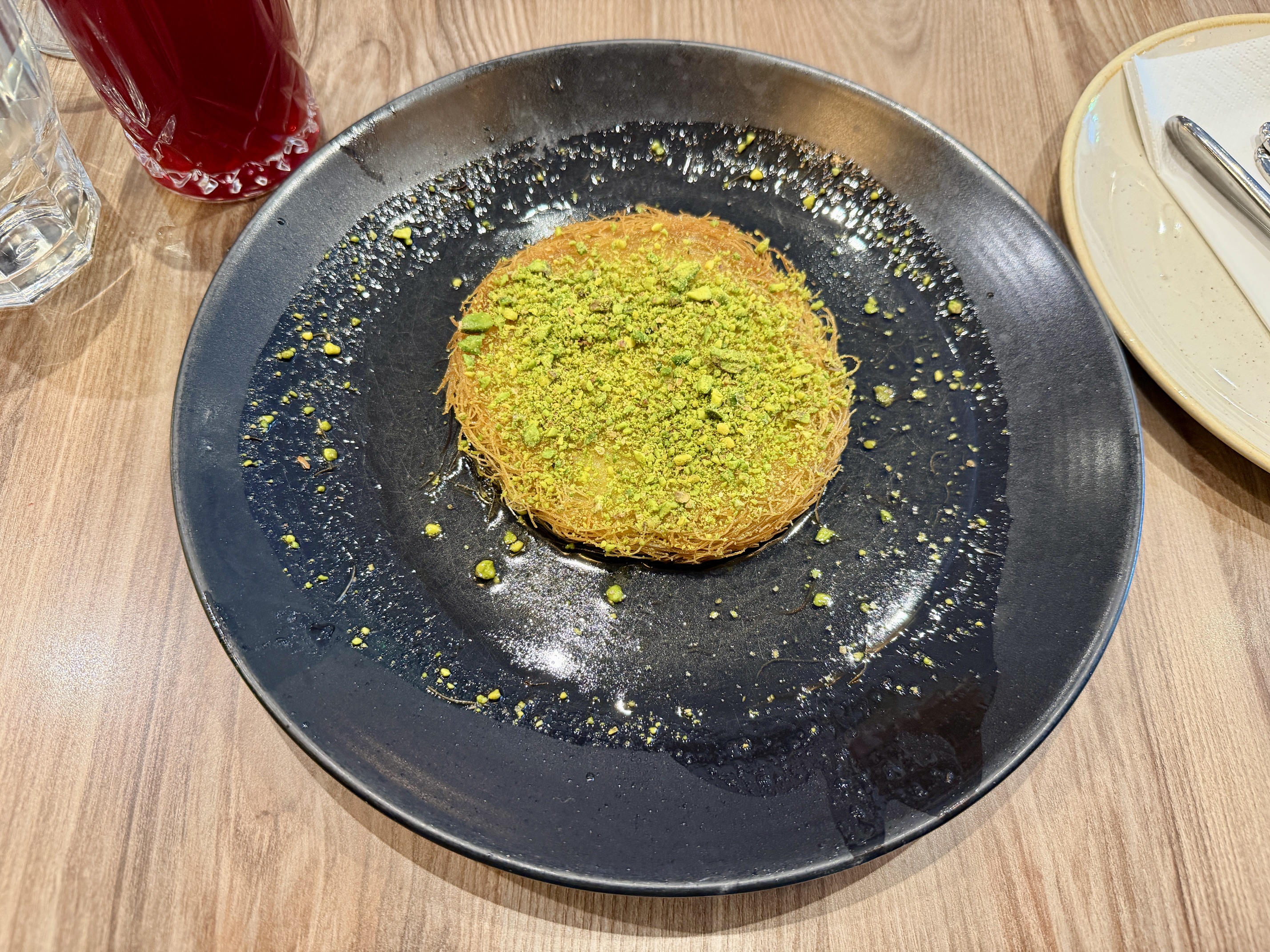
I think, uncharacteristically, I did better. I’d seen a video of the restaurant making their künefe on social media and it completely sold me on it: two layers of that crispy fried dough sandwiching a gooey core of stretchy cheese. The same syrup – the whole thing swimming in it, instead – and the same festooning of pistachio, but for me an infinitely more satisfying dessert. One of more contrasts and extremes, the syrup heightening the peaks of sweetness and yet, somehow, the cheese adding an almost savoury note that stopped it all being oppressive.

Our bill for two came to £113.30, not including service – and I thought the service was very good, even if they didn’t stage an intervention when I tried to order fermented pickled carrot juice. You could eat there for less, especially on the set, but I think there are probably better ways to spend money there than ours. Have a main each, stay away from the platter and maybe make the most of the wine list: Antep Kitchen stocks half a dozen Turkish wines, and none will set you back more than £30 a bottle. As we left the restaurant I saw, out on the pavement, a huge pallet loaded with charcoal, and I wondered whether the coals would get hotter than I’d felt.

Our day in Oxford ended as it began: stagger to a pub, have a pint in the beer garden and find that the beer garden is intolerable. Take the pint inside and find that inside is also intolerable. In the end we wound up drinking alcohol free beer at the Tap Social pub in the Covered Market, finding that “least hellish” was the best we could settle for. Dave’s train home stopped in Didcot for reasons that were never explained beyond the general inadequacy of our rail network, he took two hours to get home and missed some of the evening’s World Cup match. It was not our finest meal out together, but we concluded that it was still a better way to spend Friday than being at work.

And Antep Kitchen played a part in that: not only because of its excellent air conditioning but because it’s a brilliant illustration of, as Mohamad Skeik said in 2020, a restaurant you would love to pick up and drop on your doorstep. Any neighbourhood would be lucky to have it, and its neighbourhood definitely is. But is it worth crossing the country to visit? Much as I liked it I am less sure of that, but I’m really glad I’ve tried it. Just bear in mind some of the other things I’ve said that about recently: Salgam, I’m looking at you.

Antep Kitchen – 7.5
228-230 Cowley Road, Oxford, OX4 1UH
01865 247555

https://www.antepkitchen.co.uk

Since January 2025, Edible Reading is partly supported by subscribers – click here if you want to read more about that, or click below to subscribe. By doing so you enable me to carry on doing what I do, and you also get access to subscriber only content. Whether you’re a subscriber or not, thanks for reading.
Restaurant review: No. 1 Ship Street, Oxford

Oxford, probably my favourite city in which to review restaurants, ostensibly has little in common with Reading. One has pretty old buildings and winding lanes, a shopping mall that doesn’t bump off your will to live in the space of five minutes, a bustling market with food, drink, coffee and cheese and shedloads of independent retail. The other has Forbury Gardens and a very good bus network.

That sounds like I’m doing Reading down. Perhaps it’s more accurate to say that Oxford complements Reading nicely: if there’s something you wish Reading had, you may well find it thirty minutes down the train tracks. And to be fair to Reading, Oxford may beat it for wine bars – because it has some and no, Vino Vita doesn’t count – and it has some lovely old pubs, but Reading is streets ahead when it comes to craft beer. Oxford is brilliant, but it has no Nag’s Head.

One thing they do have in common, though, is that their best restaurants are rarely found in the centre. Reading has some solid restaurants inside the IDR – your Me Kongs, and Mama’s Ways – but they’re the exception rather than the rule: it’s mostly chains and I suspect it always has been. The independent restaurants chasing that status right in the centre are probably London Street Brasserie and The Reading Room, neither of which quite pulls it off, but beyond that you might find yourself heading north of the river, or west down the Oxford Road.

Oxford is similar. If you overlaid the Oxford restaurants I’ve reviewed over a map of the place, it would look like my metaphorical attempts to hit a bullseye down the pub: everything everywhere but in the middle. Out east you have the Cowley Road, Iffley Road and St Clements, all with great places to eat, and Headington beyond that. Head north and you reach Little Clarendon Street before the myriad of choices available in Jericho or Summertown. But what about the centre?

Oxford has a mall, the Westgate, and it’s nicer than the Oracle. But that means it still gets chains, just fancier ones. It has the kind Reading doesn’t attract: Mowgli; Shoryu Ramen; Six By Nico. Notably it has a branch of award-winning small chain Beefy Boys – it would have been a coup, if they had chosen Reading. But in the rest of the centre it’s largely a mix of chains we have, chains we used to have and chains we can probably live without. It has Cosy Club, for people who wish the Lounge group were fancier, and The Ivy, for people who wish Cosy Club was, I don’t know, more showy.

Oxford readers would probably be the first to tell me that’s a slight oversimplification. Oxford has a few long-standing central restaurants with a durable fan following, like Chiang Mai Kitchen or Edamame: it tells you something about their longevity that I’ve eaten at both, each case long before I started writing this blog. It has a branch of Permit Room, the Dishoom offshoot that is so far limited to a mere five locations nationwide.

Beyond that, if you’re talking more upmarket restaurants, it has Quod, a buzzy brasserie on the ground floor of the Old Bank Hotel owned by the same group as Gee’s. And the conversion of the old Boswell’s department store into a hotel has given the city Treadwell, a new all-day restaurant whose menu looks a bit like somebody took Quod’s, gave it to the kitchen and said “make it quirkier”: whether fish and chips needs kimchi tartar sauce is anybody’s guess.

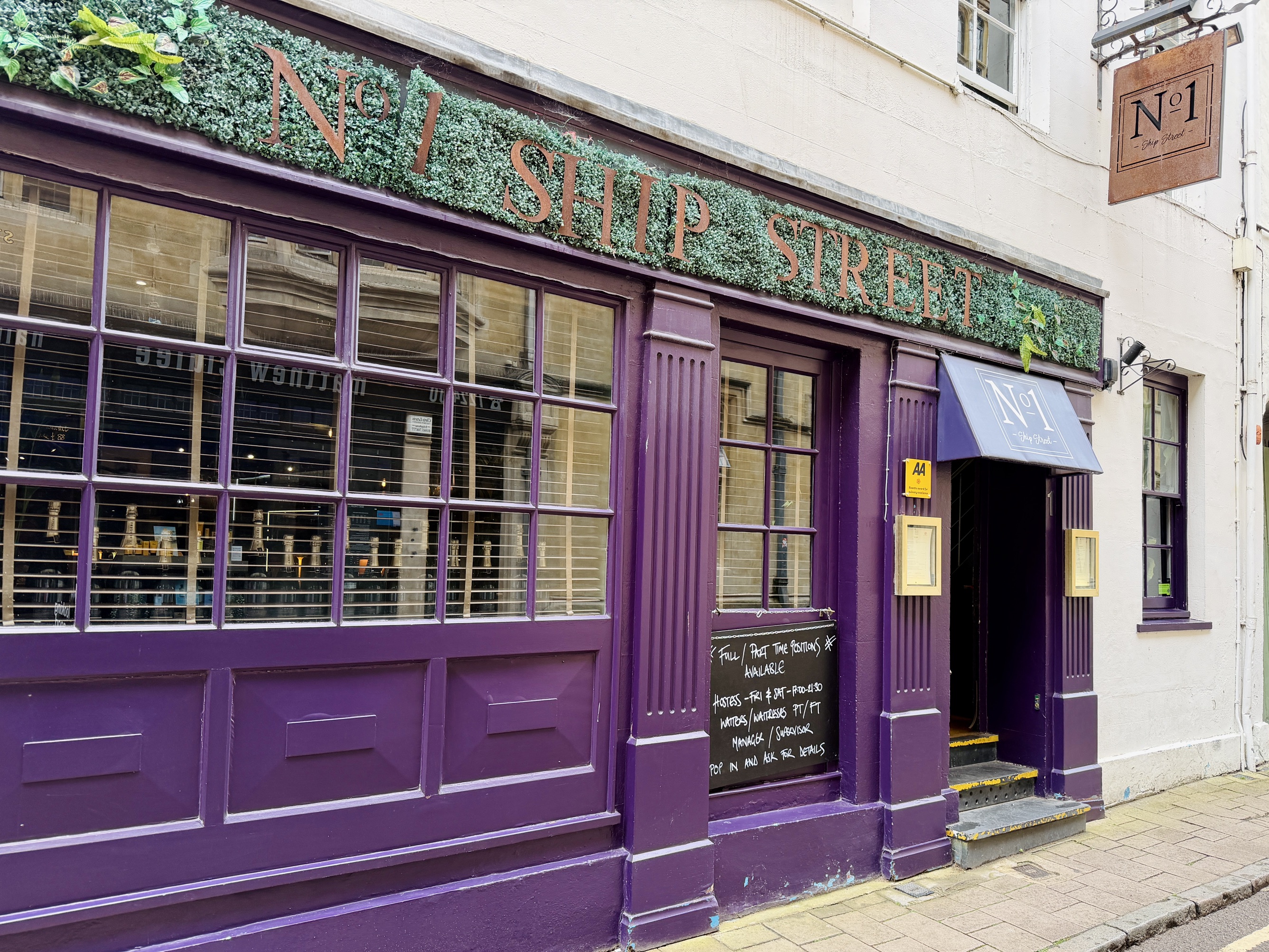
Having lost all my Reading readers with seven paragraphs about Oxford, and all my Oxford readers with seven paragraphs which aren’t about the restaurant I’m reviewing this week, let’s finally get to the point and talk about No. 1 Ship Street, the subject of this week’s review. It’s resolutely small and independent, it’s been open for nine years this summer and it’s very much in the city centre, just off the pedestrianised hellscape of Cornmarket Street, just around the corner from the Covered Market.

Chef Owen Little has been there from the very start, and No. 1 Ship Street shows no signs of slowing down as it reaches the end of its first decade, having been named last November as one of OpenTable’s Top 100 U.K. restaurants: to put this in perspective, nowhere in Reading featured on that list, and nowhere else in Oxford did either. I explained all this – fortunately for him in far less depth than I have here – to my dear friend Jerry as we had a pre-prandial beer in Teardrop, the tiny pub in the Covered Market.

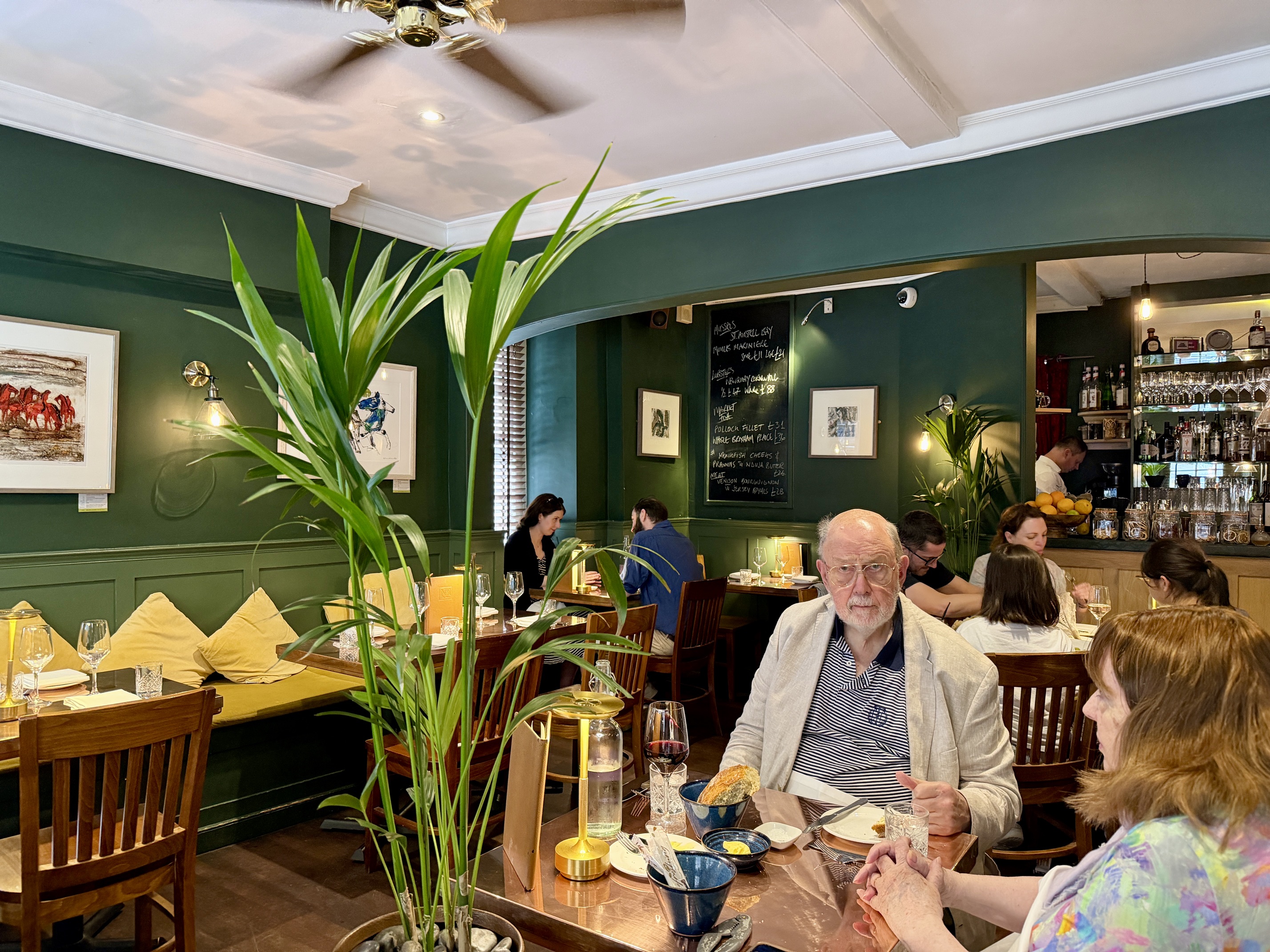
Owner Ross Drummond apparently celebrated winning that award from OpenTable by giving the place a refurb for the New Year. I think it was a subtle one, because the bones of the dining room were already there: beautiful racing green walls, well-spaced tables, the whole thing sleek, luxe and unfussy. They’ve removed the slightly tacky spider lights and the tables now are gorgeous and copper-topped: Jerry, mentally making notes for his flat, was taken with those. 

It was difficult to believe that the horrors of Cornmarket Street were a stone’s throw away, but No. 1 Ship Street had created a beautiful, grown-up oasis dangerously close to its borders. I should say that we asked to be seated in the main dining room: I’m sure the one on the other side of the entrance is lovely of an evening, but I didn’t want to lunch in a windowless room on a June afternoon.

After a disappointing run of small-plates-for-sharing restaurants, some honestly described and some far less so, No. 1 Ship Street’s menu came as a blessed relief. Terms like appetisers, starters and mains might be increasingly recherché out there in the wild, but in this restaurant they were alive and well. There was no spiel about the concept, because the concept was “remember how restaurants used to be?” and the conversational gambit wasn’t “do you need me to explain the menu?” but instead my personal favourite, “are you ready to order?”

Not that we were, at first, because No. 1 Ship Street’s menu was just tricky enough. The starters seemed to be where the more experimental bent came out – burnt aubergine soup, foie gras crème brûlée, frog’s legs and the like – while the mains were more conventional. So yes, there was a burger, and a steak, and a risotto. I guess you don’t survive nearly a decade in the centre of Oxford by taking massive risks.

Starters clustered between £10 and £16, mains began at £20 and climbed up from there. If you wanted oysters, lobster, a tomahawk or the restaurant’s surf and turf (which combined the latter two and cost £160) you could spend an awful lot more, and a specials board introduced about half a dozen other options, nearly all of them fish and seafood.

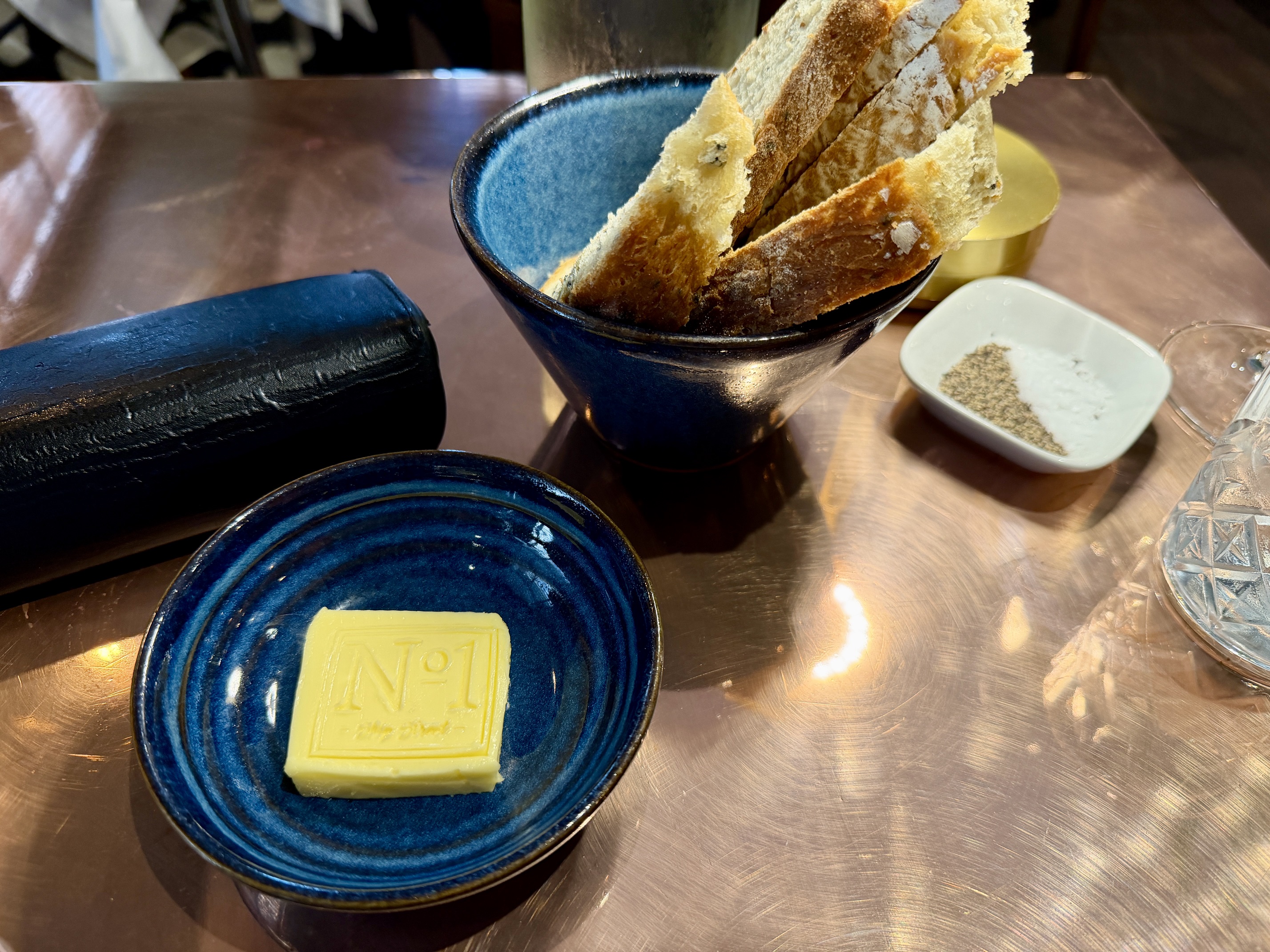
It was difficult enough that we ordered some appetisers and apéritifs while we decided – and No. 1 Ship Street is that happy kind of restaurant that brings them and gives you the time and space you need for that. Jerry’s bread was good and generous, speckled with nigella seeds and very enjoyable. Good salted butter at room temperature, embossed with the name of the restaurant, was a nice touch. For £6, the bread needed to be this good, and gladly it was.

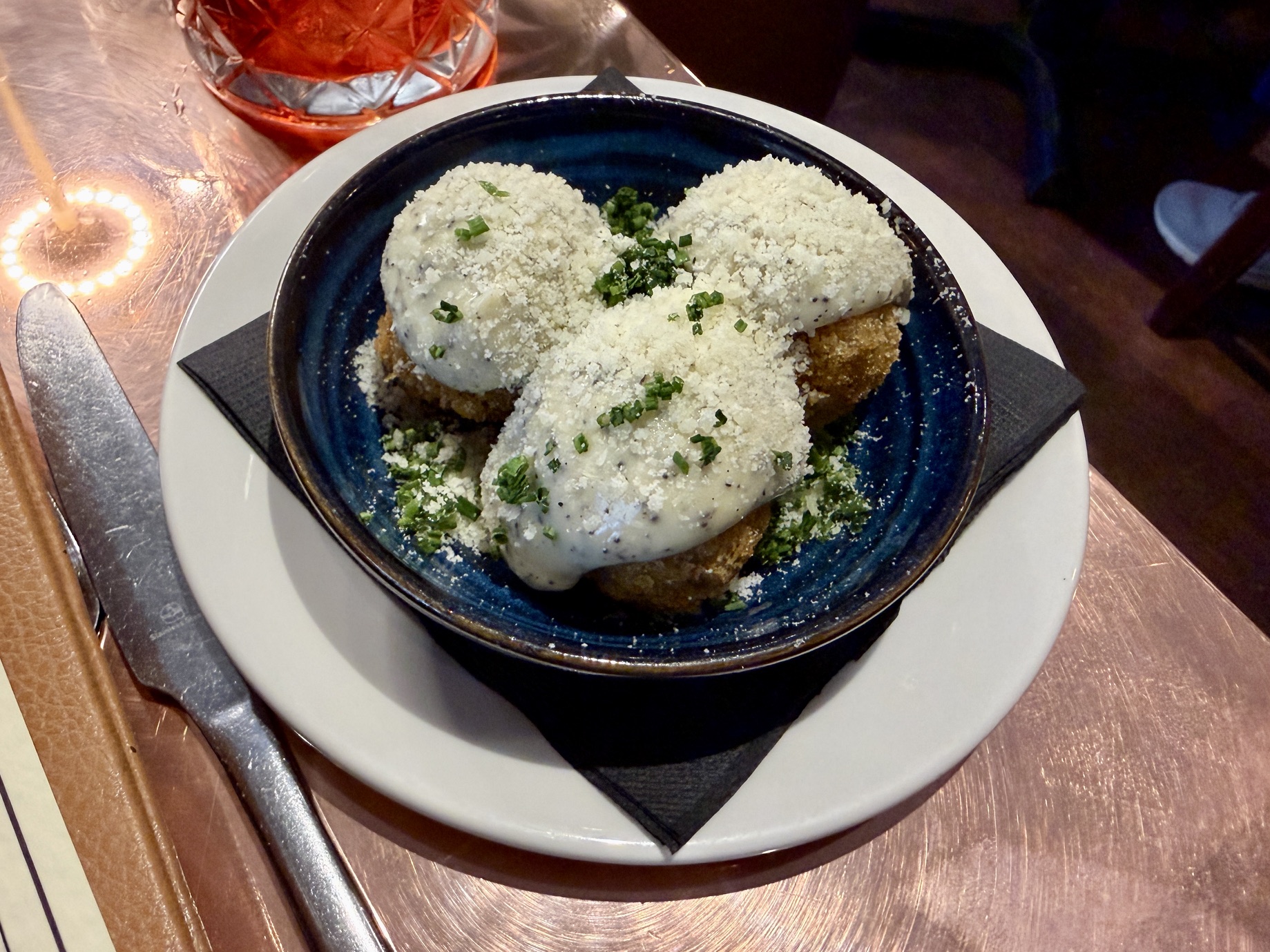
My truffle and porcini arancini were the first evidence that the kitchen might quite like being tricksy for the sake of it. They were very good, the texture acceptably crunchy and the inside studded with mushroom. Not indecent value at £6 for three either. Whether they needed to be submerged in some kind of hot truffle mayo and then carpeted in Parmesan was another matter. I thought less might have been more in this instance.

Jerry tried a bit but revealed to me that he really wasn’t a fan of truffle. And I was reminded of the recent meal where I discovered he had been humouring me all these years by drinking white wine when he only really liked red wine. It turned out that my happy memory in lockdown of sitting on a park bench with Jerry demolishing a bottle of red and inhaling a packet of Torres’ superlative truffle crisps was actually more evidence of Jerry being too nice to say he didn’t enjoy something. Let’s hope that somewhere out there he isn’t writing a blog telling the world what a terrible dining companion I am.

Never mind. The apéritifs, by the way, were knockout: mine a variant on a negroni sweetened and mollified with the substitution of amaro for vermouth and Jerry’s a champagne cocktail with a little cognac in the mix, sugar cube effortlessly effervescing at the bottom like buried treasure. We followed this up with an excellent South African Chardonnay – yes, a white – recommended by the very knowledgeable server, from the Elgin Valley. It had plenty of citrus and elegance, it was £48, and I liked it a lot. Jerry said he did too, and hopefully he meant it.

Starters were where things started to wobble. Jerry was torn between a number of options, one of which was the foie gras.

“I love it, but I know I shouldn’t, so I don’t order it these days” he told me. And I’m afraid I took that as an opportunity to deliver a tone deaf homily about not denying yourself things you like – I wish I could say it was the negroni talking, but such conduct is me all over – and so he chose it.

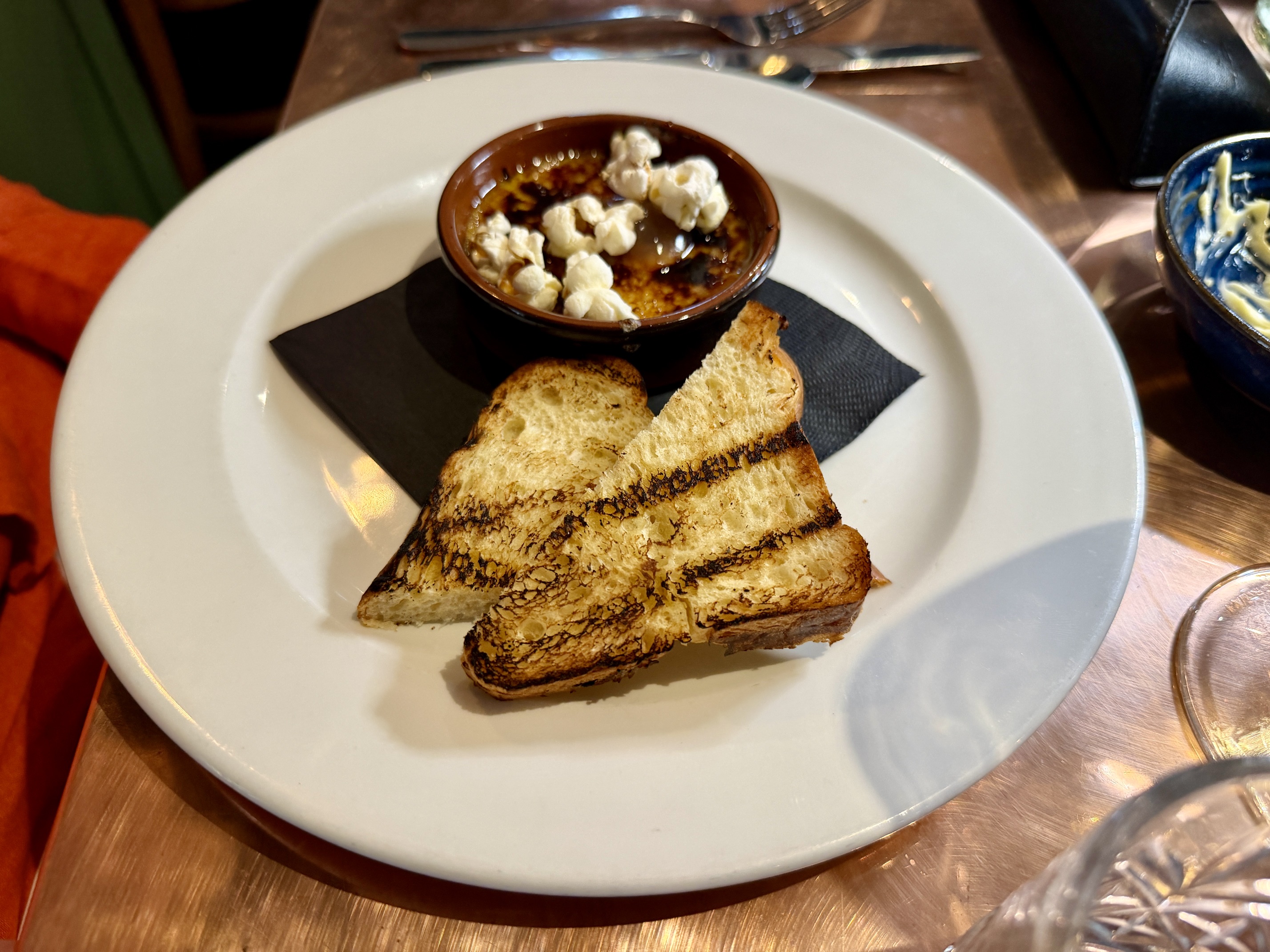
It was meant to be a foie gras crème brûlée with vin jaune gel and toasted brioche, and I’m sorry to say this, but the resemblance stops at the photograph, and possibly before that. A crème brûlée is meant to have a satisfying burnt top and be set underneath. It’s not meant to be a murky puddle of bumf. And it’s not meant to taste so little of foie gras that you wonder, as Jerry did, whether he’d accidentally been given something from the dessert section, a theory lent credence by the pointless popcorn on top.

Poor Jerry – all the guilt of having ordered foie gras without the corresponding enjoyment of getting to eat the bastard stuff. I felt personally responsible.

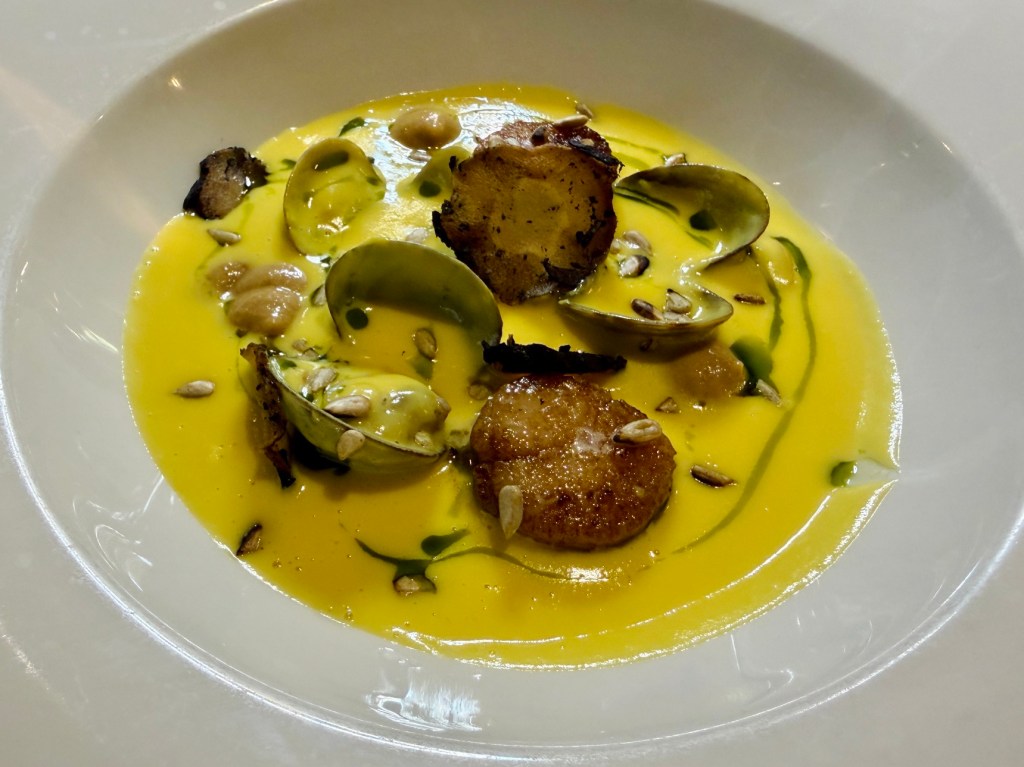
I felt less bad about it, though, because my starter was also disappointing. What was billed as seared scallops with clam velouté and parsnips was in fact a thin puddle of soup with a single scallop, cut in half, three clams and a crispy disc of perpendicular parsnip.

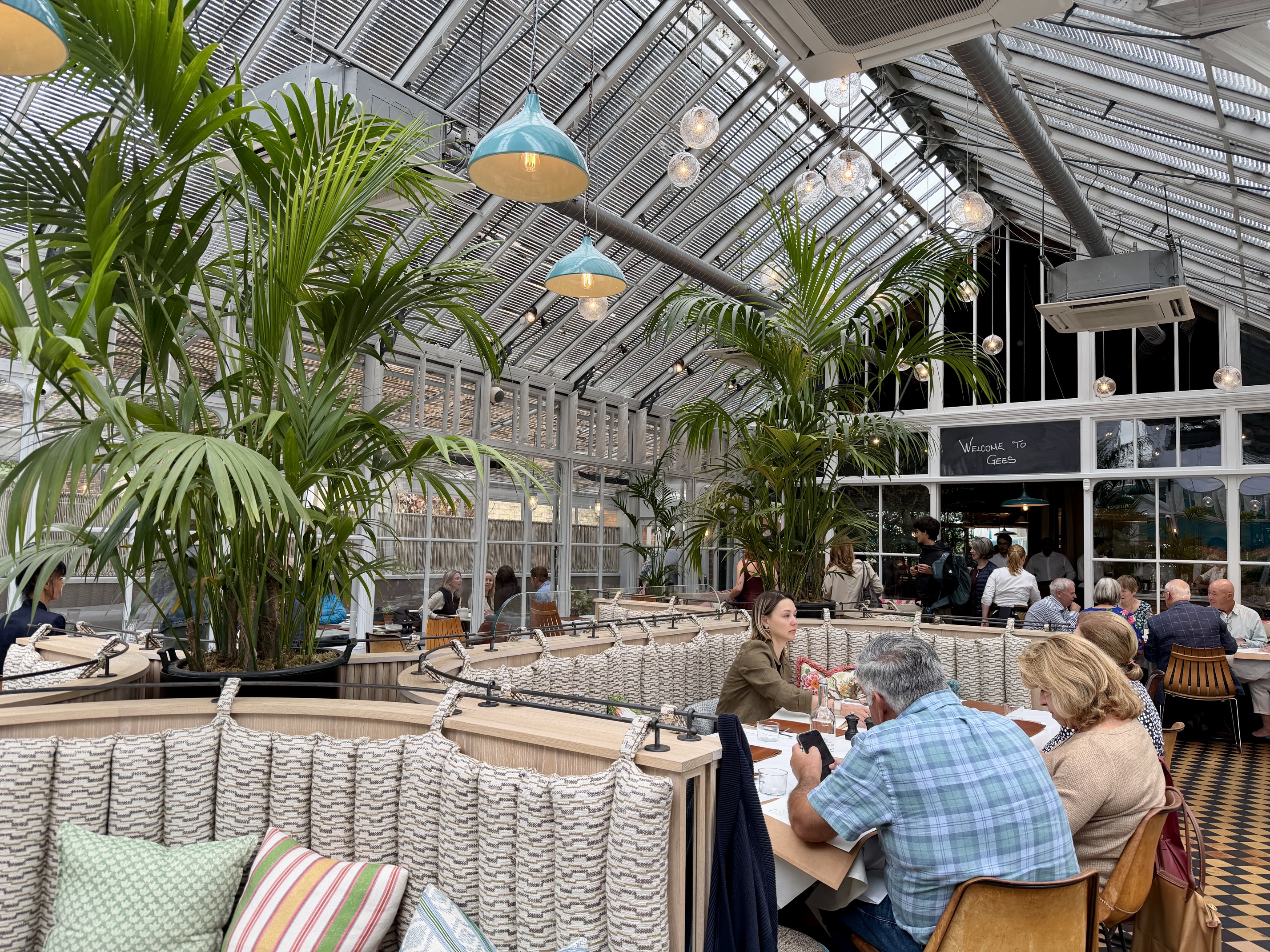
The overall effect, apart from masterful cost control in a £16 starter, was an oversweetened, unsubtle cacophony of a dish. Just like the foie gras crème brûlée, what turned up wasn’t in the slightest what the menu implied you would be tucking into. No wonder they brought you a spoon with this one. I once ate at Oxford restaurant Gees and wondered if I’d accidentally wandered into the U.K.’s most expensive salad bar. No. 1 Ship Street, by contrast, was beginning to feel like a spenny soup kitchen in disguise.

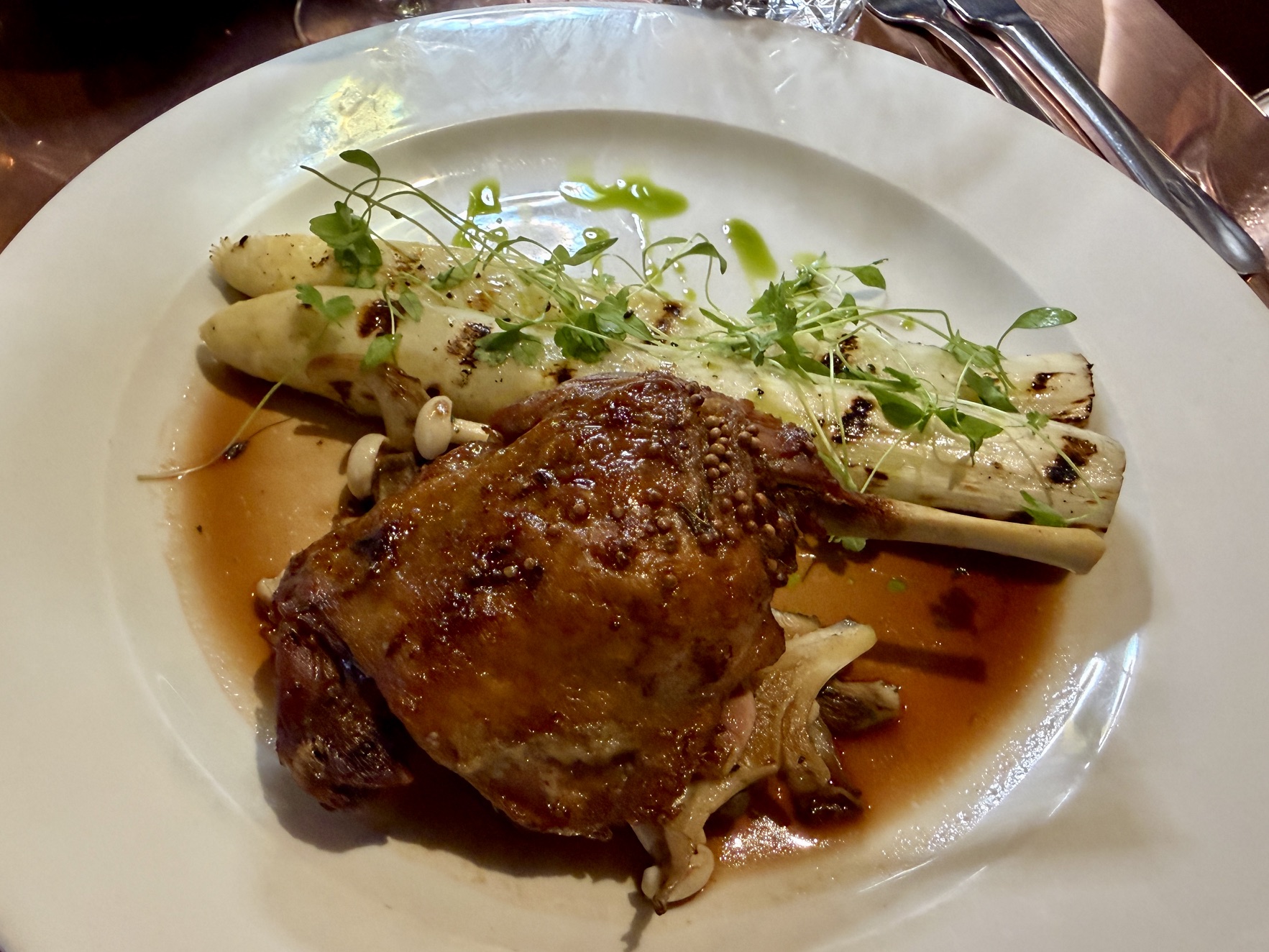
Were the mains, when the restaurant stayed closer to the mainstream, any better? Mostly, I would say. My confit duck almost worked: the skin was gloriously crisp, the fat rendered and the flesh underneath giving in all the right ways. Perching it on a pile of wild mushrooms, enjoyable ones at that, was a bit like giving the dish platform shoes: it made it look like you got far more duck than you did.

The white asparagus was thick and generous, with just enough bite, beautifully cooked to avoid the bitterness this variety can sometimes have. “It looks like a pair of dildos” was Jerry’s unvarnished take: I laughed like a drain and warned him that I planned to quote him verbatim. This is the bit in the description where I’d love to say and a plum jus brought it all together beautifully but instead I have to say that there was a thin drizzle of blandness that didn’t add enough moisture or flavour.

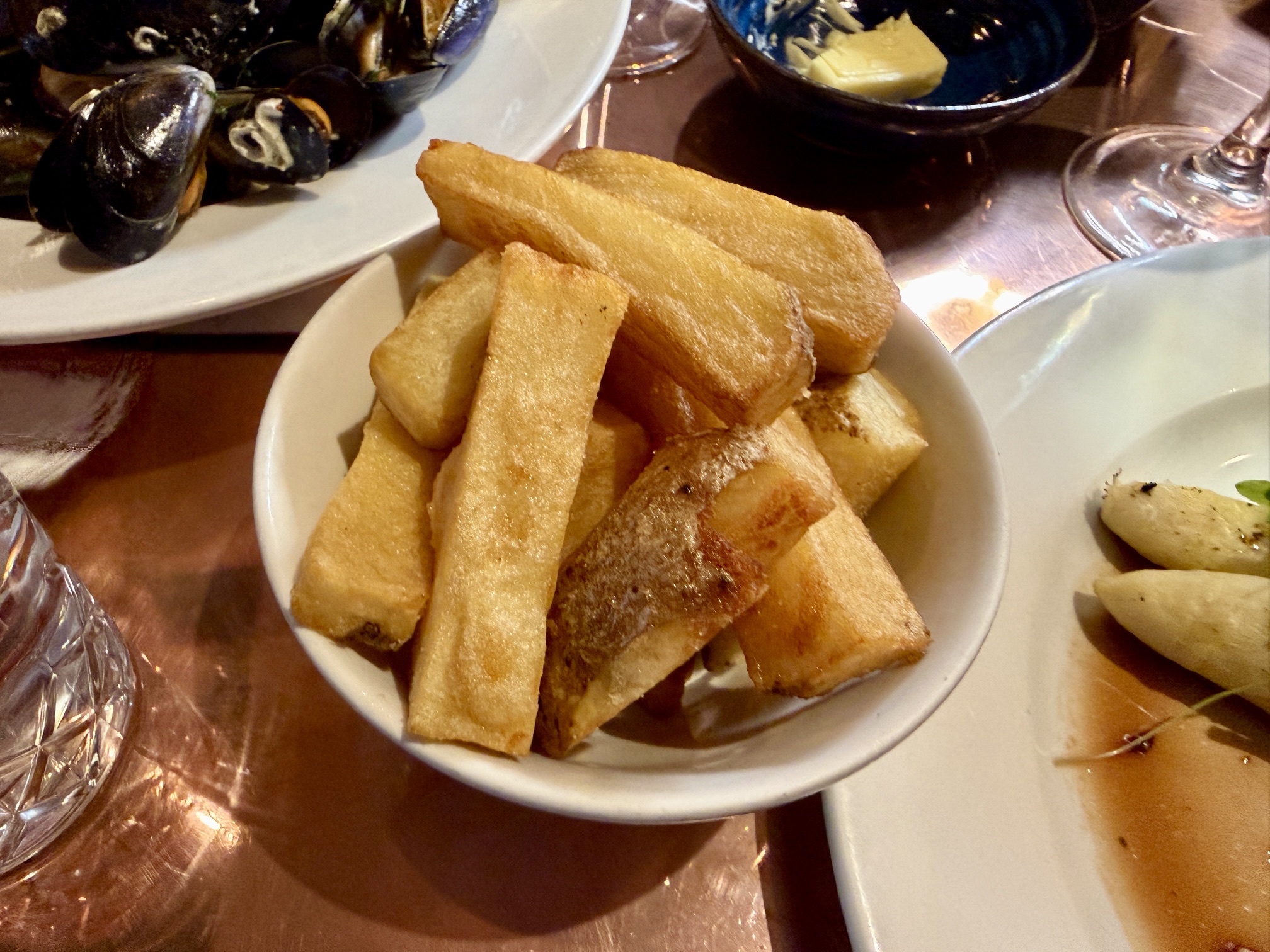
This dish needed carbs and didn’t have them, so I ordered some chunky chips. And these were well done, but with the main course so unrelentingly dry there was nothing for these to soak up, or act as a vehicle for. It also means that my duck dish, with chips on the side, cost £30. That’s a lot for not quite enough, there’s no way around that.

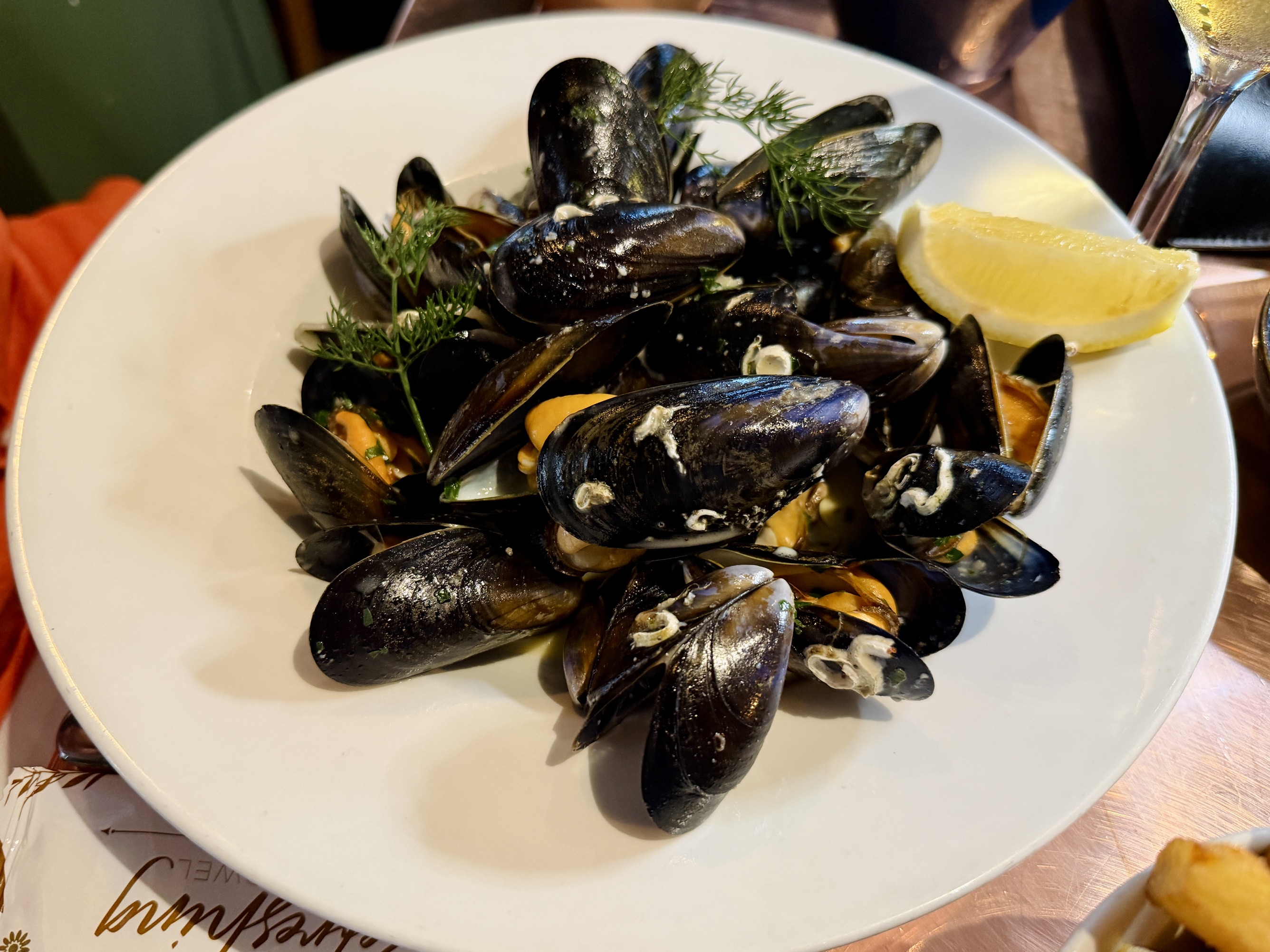
Jerry picked better I think, moules marinière from the specials. They were plump specimens, from St Austell Bay according to the blackboard, and Jerry thoroughly enjoyed them. They came with frites, and as with No. 1 Ship Street’s chips they were well executed.

But ironically, for me, this dish had the converse problem to both those starters. The mussels were high and dry, clustered in a wide-brimmed bowl. The joy of moules marinière is the bit at the end, when all the shells have been vanquished and you’re left with a bowl of that creamy liquor, to trawl with a spoon, picking up stray mussels, to drink like broth, to dab with bread or to tip your frites into. It makes it two meals in one.

But here, that last stage was a bit like some people I see prancing around on Instagram, too shallow to be worth persevering with. It seems that No. 1 Ship Street only dished up soup when you didn’t want it to. Jerry, mind you, loved it.

Despite all that, and perhaps paradoxically, we stopped for dessert. Because despite the food not being spectacular, and in some cases being downright weird, we were still having a lovely time. No. 1 Ship Street somehow, through its gorgeous, calming room, its very pleasing booze and unstintingly charming staff, created a space where you knew, on some level, that things could and should be better but didn’t mind as much as you should.

In that sense, it was almost the inverse of so many experiences I’ve had on duty lately, restaurants I ought to have liked more than I did. Here, instead, I found myself almost willing to suspend critical judgment. Only in the moment, really, and as I write this I remember all the things they got wrong. But weirdly, remembering them is almost like trying to recall a dream. I wonder how many people No. 1 Ship Street has pulled that trick on over nearly a decade. I’m not seeking to denigrate: it’s a neat trick.

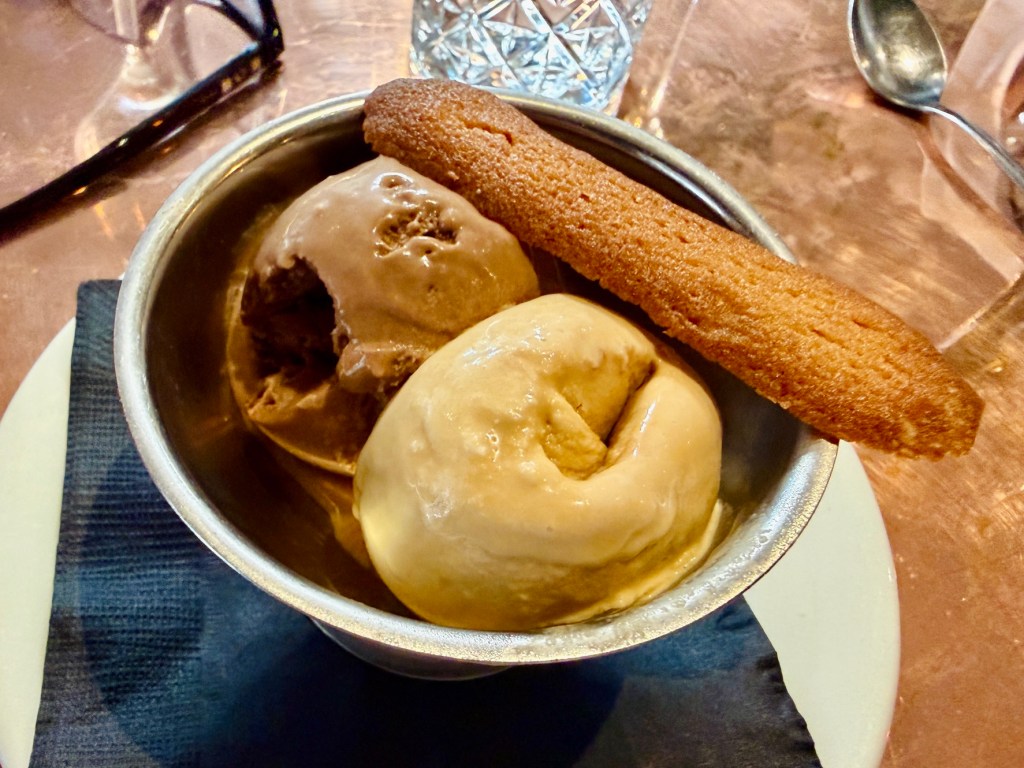
Anyway, they saved some of the best for last. They make their own ice cream, and both the chocolate and salted caramel were smooth, rich, crystal-free and as good as anything you could get in George & Davis, if not quite the standard of Swoon on the High. The range of flavours was quite pedestrian, which surprised me: they save the cheffy stuff, the rose and rhubarb ice cream or the basil sorbet, to accompany Actual Desserts. £6 for two scoops with a beautifully light langue de chat was probably the bargain of the day.

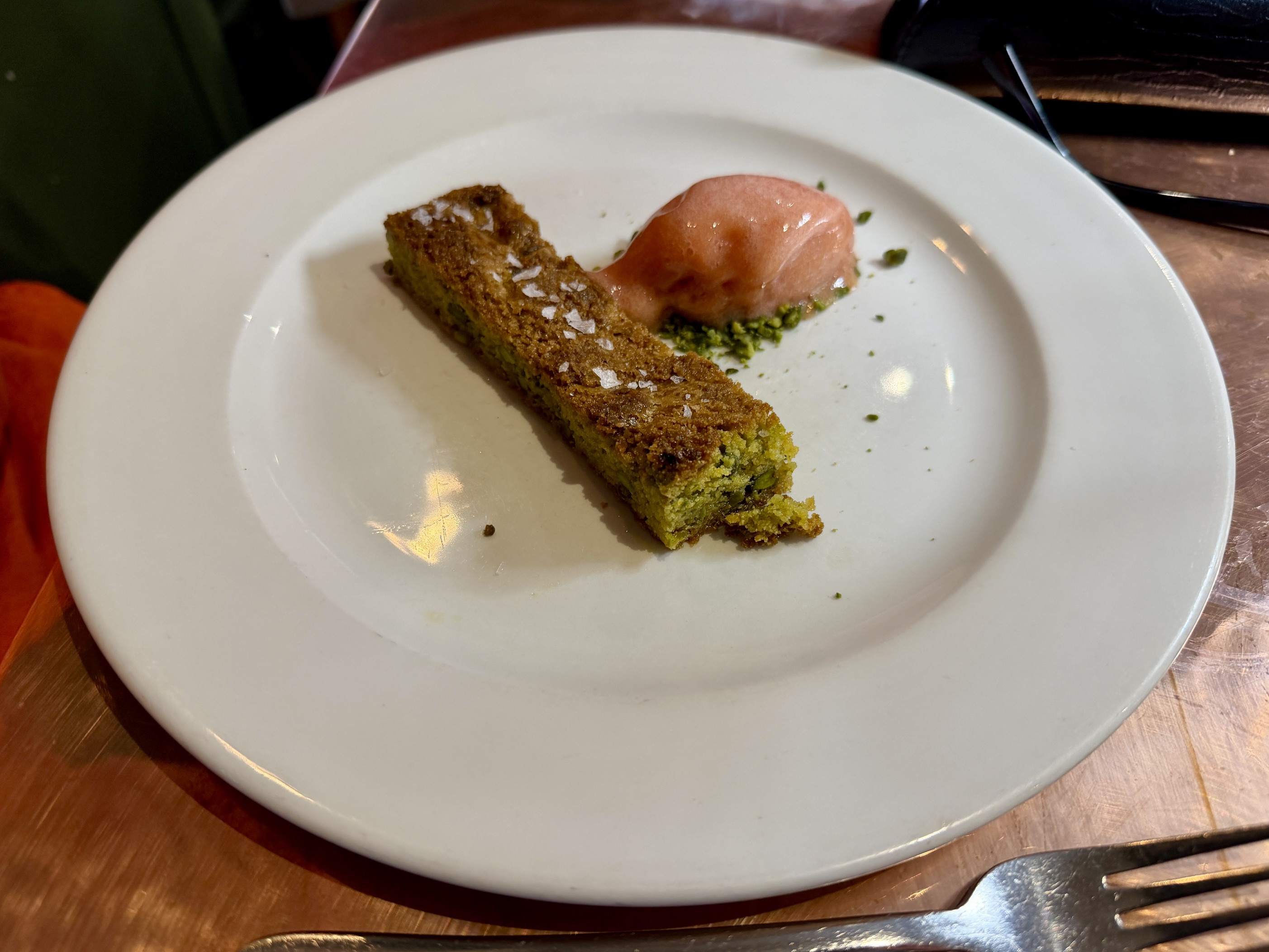
Jerry was happy with his pistachio cake. I don’t know if I would have been, it was a thin, uneven slab of the stuff with something that did not look like basil sorbet. Maybe it was grape and basil sorbet – the menu, as so often, made it difficult to work out what you were going to get.

And again, that’s not necessarily a problem. In a restaurant where the words on a menu are just a jumping-off point, in the hands of the right kitchen, a meal can be a life of surprises. Underpromising and overdelivering is one of the great talents of hospitality done well, and the thing that makes memories – as much as anything does, over and above the people you bring with you. The problem with No. 1 Ship Street, for all I keep saying that it’s not a bad restaurant, is that none of the surprises, on balance, were good ones.

All that set us back £214, including the standard 12.5% tip, and more than usual I couldn’t really work out whether I’d been stiffed or not. We were there for the best part of two and a half hours, we had a marvellous time – although for me, lunching with Jerry, that was a given – and we were very well looked after.

Perhaps in the centre of Oxford, given the alternatives, No. 1 Ship Street is as good as it needs to be. Or maybe it had a bad day when I went, or I was too finicky. But I was left again marvelling at their powers of misdirection: how could they have created the semblance of a fantastic meal from such inconsistent food? Appropriately, it had the feel of being through the looking glass about it.

But I didn’t feel that way at the time, I only feel it now. At the time, Jerry and I agreed that we’d had a lovely meal, and off we strolled to the Rose & Crown to enjoy the refurbished outside space and improved beer offering. It had been another classic visit to Oxford, and if something was niggling at me it would take a couple of weeks for my reservations to fully germinate.

Restaurant reviewers are pontificators by nature, and never miss an opportunity to tell you what a restaurant Means, what it is All About. I’ve read a couple of think pieces lately about how it’s okay for a restaurant to be just good enough, in defence of the unspectacular, the “fine” or “ordinary”. Well, I suppose it’s one way to try and jazz up a boring meal, or meet your latest deadline at the Financial Times. You’ve got to have an angle.

But for the rest of us, who spend our own money, that’s not the axis you plot things on. It’s not unremarkable versus showy, hyped versus anonymous. Most of us deal in good or bad, or perhaps good enough and not good enough. No. 1 Ship Street’s failing is to try and show off, when it could just get the basics very right and send a lot of people away very happy indeed. It has the room, it has the service, it has all the ingredients to do that.

But somehow, for some reason, it chooses not to and, to give it credit, it almost gets away with it. But what do I know? If you clock up a decade slap bang in the centre of Oxford, even with the dearth of competition, you must know a thing or two. Even so, I can’t help feeling their second decade might prove more difficult.

No. 1 Ship Street – 7.0
1 Ship Street, Oxford, OX1 3DA
01865 806637

https://www.no1shipstreet.com

Since January 2025, Edible Reading is partly supported by subscribers – click here if you want to read more about that, or click below to subscribe. By doing so you enable me to carry on doing what I do, and you also get access to subscriber only content. Whether you’re a subscriber or not, thanks for reading.
Pub review: The Port Mahon, Oxford

The conventional wisdom is that food trends start out in London and, like the light from a dying star, by the time they reach Reading they are just memories of something that is no longer there. Something about the eternity it takes them to hobble down the M4 strips them of any interest or novelty value, and it’s the same for restaurant chains: with a few encouraging historical exceptions, like Honest or Pho, by the time anyone opens a branch in the RG1 postcode the Fonz, waterskis strapped on, has well and truly cleared the shark.

The truth is, if anything, more nuanced and even more cheerless than that. First of all, most food trends never become a thing anyway. Every January the broadsheet food Stattos, a wan bunch of gastronomic psephologists, proclaim what the big trends of the next 12 months will be, and the majority of them never come to pass. Just as life is what happens when you’re making other plans, food trends tend to ambush everybody: nobody sees most of them coming.

Secondly, most of them never make it to Reading. You could wait a lifetime for a small plates restaurant, a tapas spot, a natural wine bar, a chop house or anything else for that matter. I don’t know what it is about our mixture of attractive affordable buildings with plenty of outside space that catch the sun, our kindly and philanthropic landlords and our imaginative and not remotely complacent local authority, but for some reason entrepreneurs look at all that and say Nah, you’re all right. What spoilsports they are.

Instead we get a Cosy Club, and a Rosa’s Thai, and a Popeyes, and a Taco Bell, and a regular attack of the glums whenever we set foot inside the IDR. Lucky, lucky us. So it goes: head to Oxford, Swindon or Newbury for tapas, small plates or natural wine, because you’re not getting that stuff in Reading.

As a result we get our own micro trends which often seem to have nothing to do with what’s going on anywhere else, like the year we got a glut of sushi restaurants, or biryani places, or pizza spots. And the funny thing is, the result of everyone trying to jump on those bandwagons is that nothing is sustainable. Biryani Mama closed recently on St Mary’s Butts, and Biryani Boyzzz has been fined shitloads of cash for poor hygiene: perhaps all those Zs are reflective of the fact that they fell asleep at the wheel.

And remember our influx of great pizza restaurants last year? By all accounts Paesinos has sacked its chef, Amò is still closed due to challenges with the building for nearly five months and counting (read into that what you will) and since Dough Bros has changed hands it’s removed all pork and ‘nduja from its menu, leaving you instead with turkey ham and “spicy beef chunks”. Fair play to them, I suppose, but that’s not Dough Bros any more. All that’s left is Zi Tore, which is the gastronomic equivalent of Ringo being the last surviving Beatle.

This year’s Reading trends are, to me at least, profoundly depressing because they reflect a poverty of culinary imagination, of degradation disguised as progress. You might get excited about vans serving jacket potatoes, and Reading now has a couple, but I remember when the Broad Street Mall having a Spud-U-Like made it a figure of fun, not a lifestyle destination. Are we really meant to see this as an improvement? Did people ever really think “fuck an affordable bistro, what this town really needs is a jacket spud loaded with tuna and cheese?” I hope not.

The other Reading food trend this year has been the munch box, a phenomenon with its own Wikipedia page, highlighting its origins in Scotland (“the selection of foods included in some boxes has been criticised for being nutritionally poor” Wikipedia says, with a talent for understatement). So naturally, for the times when a baked potato is too cheap and cheerful and you want to splash out, why not go crazy and buy a munch box? Treat yourself.

“I’ve found the best munch box in Reading” said some goon on Instagram recently, coming to you live from a car park. That’s great: I’m sure the whole town will sleep easier now. It’s all very low rent, but that’s 2026 for you. Nobody can afford rent.

A trend which emerged last year in London was one I would dearly love to see in Reading: rotisserie chicken. The Observer called it about this time last year and, late to the party as ever, the Telegraph chimed in to that effect in January. Both mentioned London venues like Borough Market’s Café François and Shoreditch’s Knave Of Clubs along with Bébé Bob, which so underwhelmed me a couple of years ago. “The rise of luxe rotisserie chicken”, enthused the Observer. “How France’s most famous market food became a cult British hit” was the Telegraph‘s summary.

It’s true, though. Rotisserie chicken is huge on the continent, and nowhere to be seen in Blighty and I personally consider that a terrible pity. When I remember Montpellier, where the twice weekly food market under the aqueduct boasts multiple traders, all selling delectable looking chicken, I think it’s a great shame that it’s never caught on here. And that’s just markets, but the restaurants! When I recall the glories of eating at Montpellier’s Les Freres Poulard or Lisbon’s Bonjardim I wonder what’s taken this movement so long to even consider crossing the water.

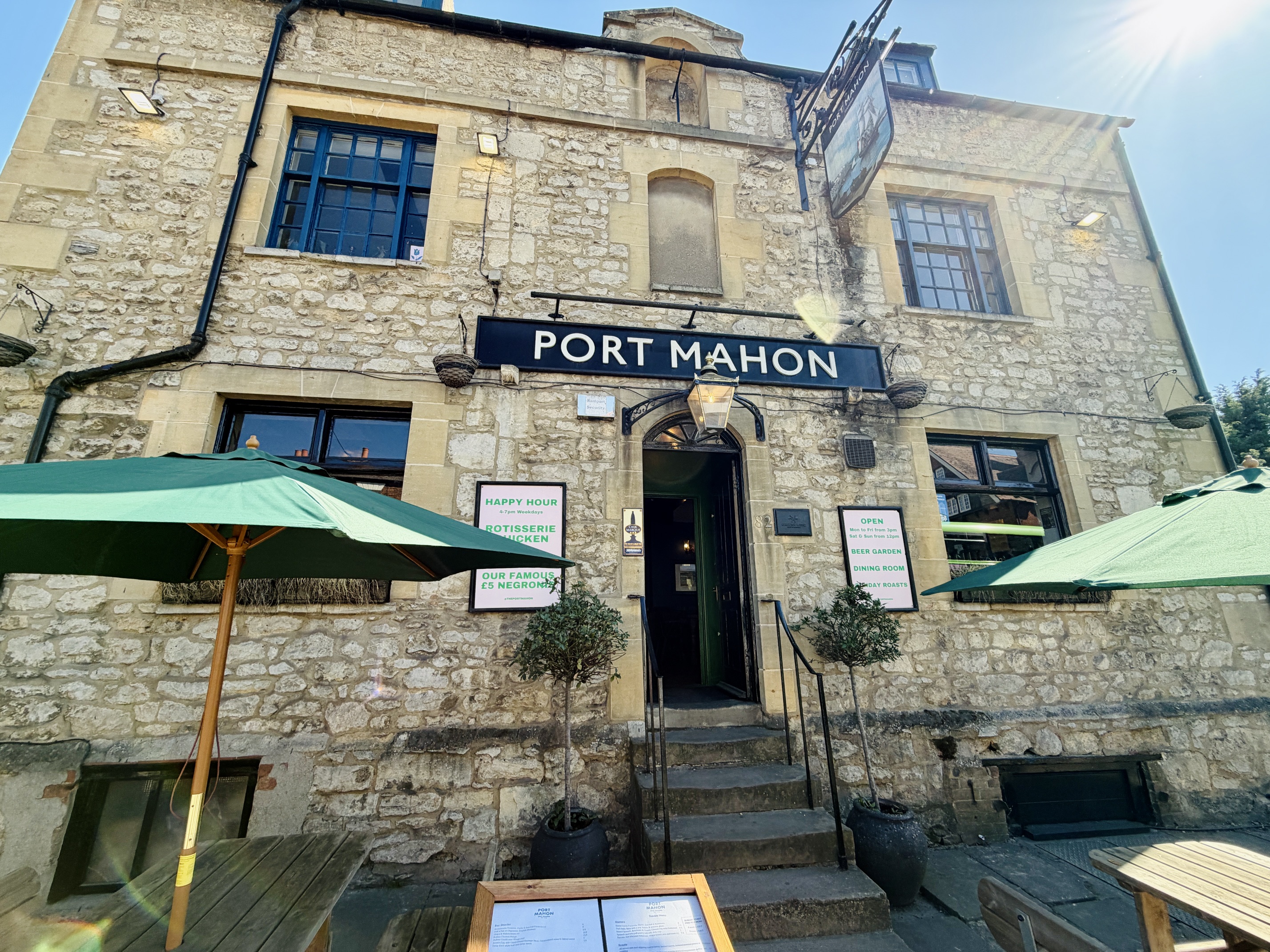
So imagine my surprise earlier in the month when I discovered that this particular trend – with lightning speed, in the scheme of things – had bypassed Reading completely and taken root in Oxford. I’d just had lunch at Cuttlefish with my dear friend Jerry and, on the way to our pub for the afternoon, we walked past another pub, the Port Mahon. I’m incapable of doing that kind of thing without rubbernecking for a menu and there, on a sign out the front, it boasted ROTISSERIE CHICKEN and, come to think of it, OUR FAMOUS £5 NEGRONIS. They had me at the chicken, the negronis were just a bonus: I made a mental note to investigate further.

Back home I did some research and the pub looked promising. Although it’s been around since 1710, it seems that a couple of years ago it came under new ownership and, by the looks of it, decided to focus on food, taking on chef Paolo Cangiano. A new dining room followed last year, as did positive reviews on both of the main Oxford food websites. Although the majority of those visits were comped: Bitten Oxford extracted 3 free meals from the Port Mahon in the space of 7 months but, of course, all views remain their own.

Nonetheless I saw enough to nudge it to the top of my list so last week, on the most glorious Saturday the U.K. has seen so far this year, Zoë and I hopped on a train to investigate, stopping only to collect a lot of cheese in the Covered Market, sample one of Hamblin Bakery’s excellent sausage rolls and grab a pre-lunch coffee in Peloton Espresso’s wonderful back garden. Spring had well and truly arrived, and I’d had my first sunshine pints in the Last Crumb the weekend before, after a brilliant and buzzing readers lunch. So this is what al fresco life in Britain can be like, I remembered thinking.

The pub is actually very handsome. I think it’s a Greene King (although that isn’t necessarily an obstacle to doing amazing food) and the labyrinth of rooms inside, all on slightly different levels, is cosy and attractive, all bentwood chairs, pews and red curtains. On my wander through I managed to somehow miss the dedicated dining room completely, but from the pictures I’ve seen it’s also a lovely, grown-up space.

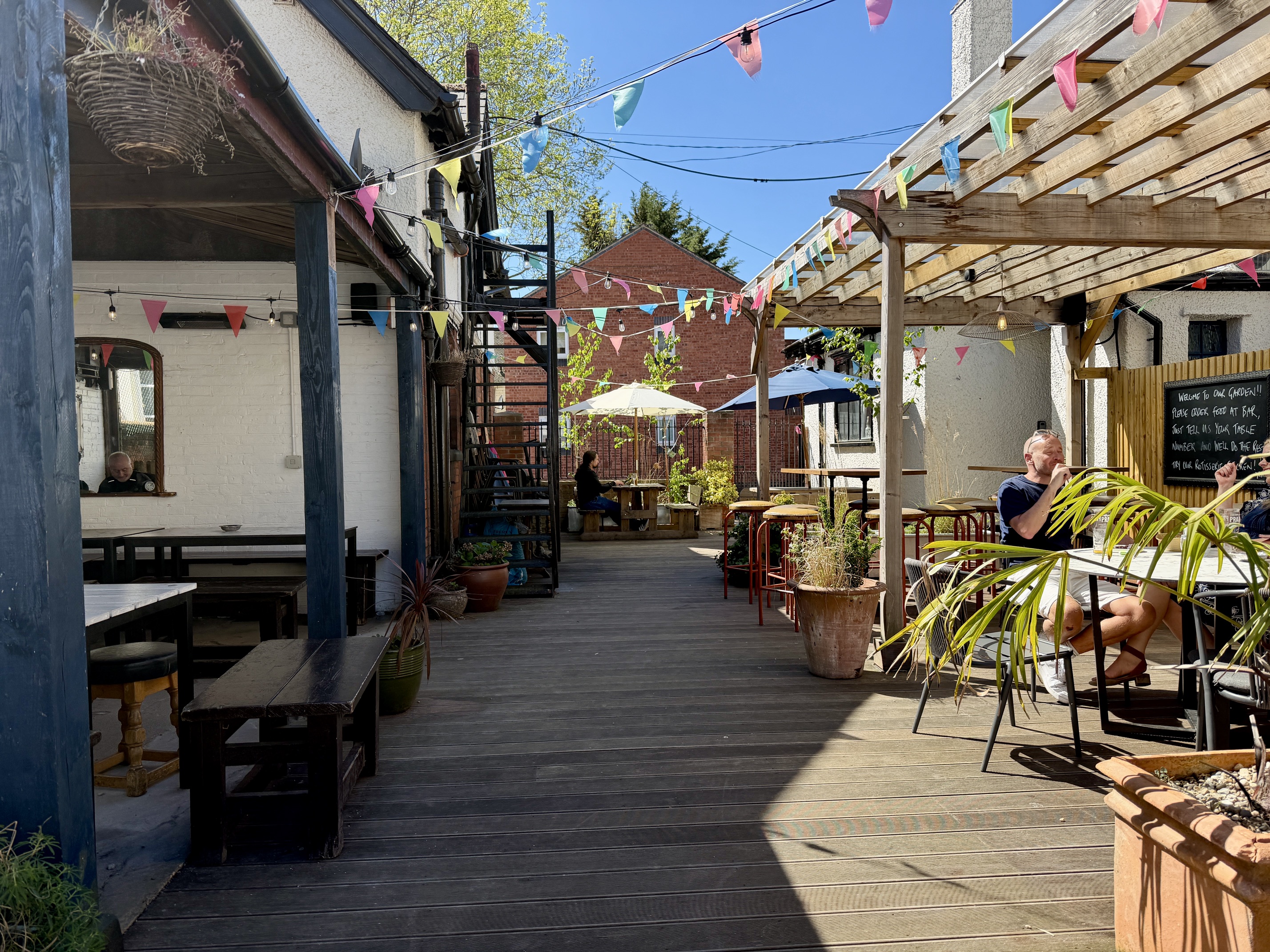
That makes the Port Mahon somewhere you could go for food or just for drinks, and from the interior I could easily imagine doing either. But we were greeted by Cangiano himself and asked where we fancied sitting, and the outside space called to us. Again, it’s surprisingly large and much of it catches the sun, and it was a thoroughly agreeable spot with bunting, covered areas and a real feeling of lightness and buzz.

It reminded me – in Oxford terms – of the sadly departed Jam Factory, which used to be one of my favourite spots to stop for a pint before catching a train home: I still miss that place. It also reminded me, to talk about Reading for a moment, that nowhere in Reading boasts outside seating this pleasing where you can also get really good food. The Nag’s has a great beer garden but limited food, Park House is pleasant enough for both but not stellar. That the Rising Sun is as good as it gets rather sums up the state of affairs: I haven’t updated my guide to al fresco dining in Reading since 2022, but perhaps I’ll just put up a page saying Don’t bother.

It was too hot a day for those £5 negronis, and a pint of something cold and refreshing was required. I was pleasantly surprised by the Port Mahon’s selection, so although it had macro lagers and ciders in spades there were just enough pales to make it interesting: the sessionable A Little Faith by Northern Monk and Pale Fire by Pressure Drop. The latter was our choice and it was absolutely what the moment demanded. The sun beat down, and our first sip – this was rather a late kick-off given a happy time at StageCraft the night before – made everything right, all grievances forgotten.

The Port Mahon has, I would say, pulled together a very pleasing menu. A good array of snacks, all of which lend themselves to sharing, five starters and eight mains sent out all the right signals about not trying to do too much, and if I hadn’t gone with rotisserie chicken on my mind I could have tried countless other dishes. Next time, perhaps I’ll try the meatball pappardelle or the butterflied seabream with orange and fennel salad. But it also gave me confidence that next time the menu might well be different: after all, this set of dishes was very different to the one I’d seen online.

You could potentially argue that the pricing was slightly wayward, with some of the snacks coming in more expensive than the starters, but I thought that was to suggest they were bigger portions to share. Again, a pub where you could drink great IPAs in the sunshine and keep yourself topped up on beer snacks sounded like something I would love in Reading. And nothing was expensive, really: starters maxed out at £8.50, only a couple of mains were north of £20.

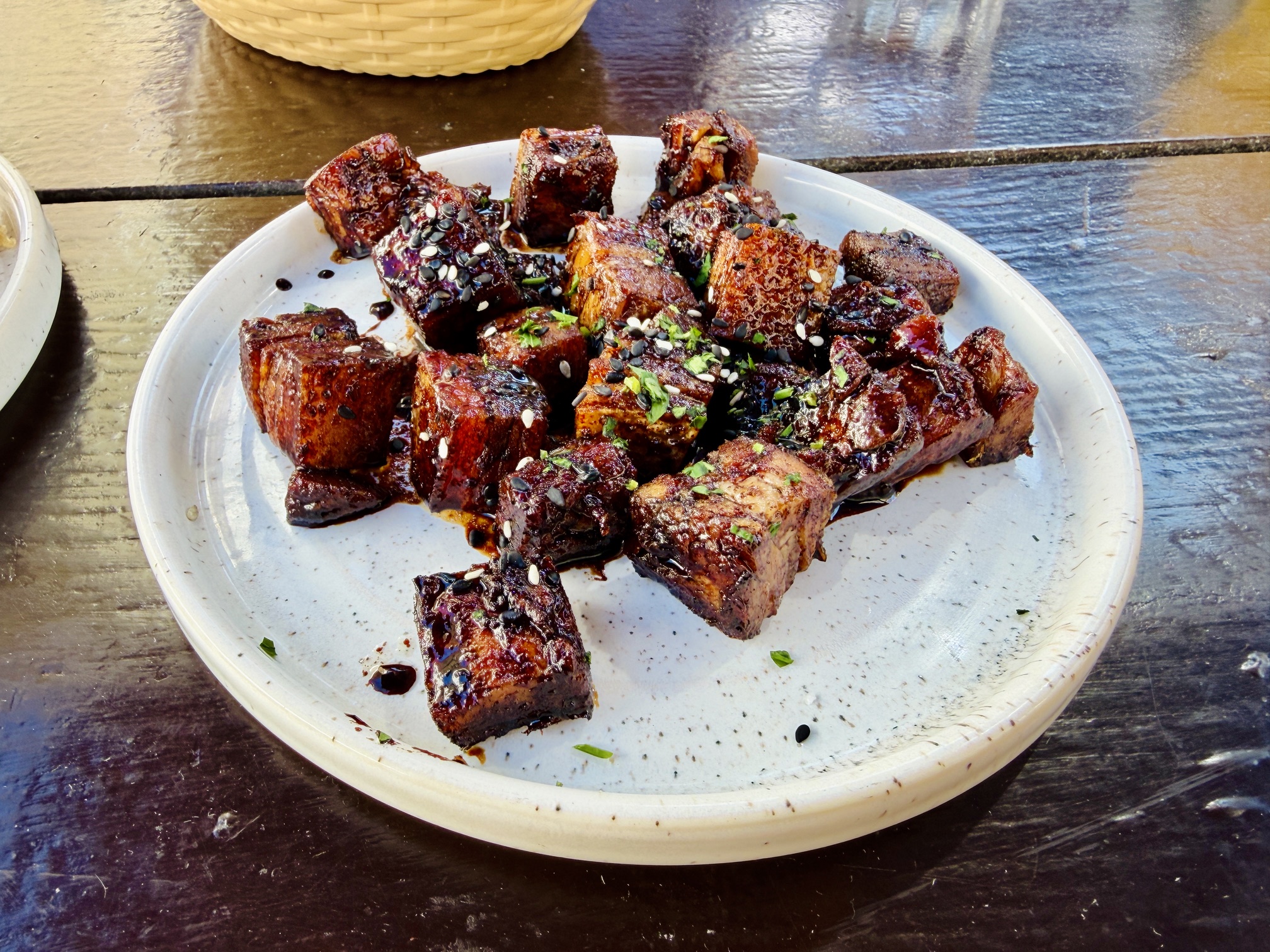
One dish that seemed to have been on the Port Mahon’s menu since they reopened and Cangione came on board was the pub’s pork belly bites in soy, honey and sesame and, rotisserie chicken aside, they were the first name on the team sheet. They were a winner, a tumble of nicely caramelised cubes, fat rendered enough and the glaze sticky, sweet and potent with a slight building heat. I would have put these in the beer snacks section, personally, but what do I know about menu taxonomy?

Either way these were a real pleasure and the kind of dish any menu could find room for somewhere: about as different from their siblings last week at the Jolly Cricketers as I am from my sibling but, just like me and my own sibling, equally lovable. Also they were £8.50, so better value than either of us.

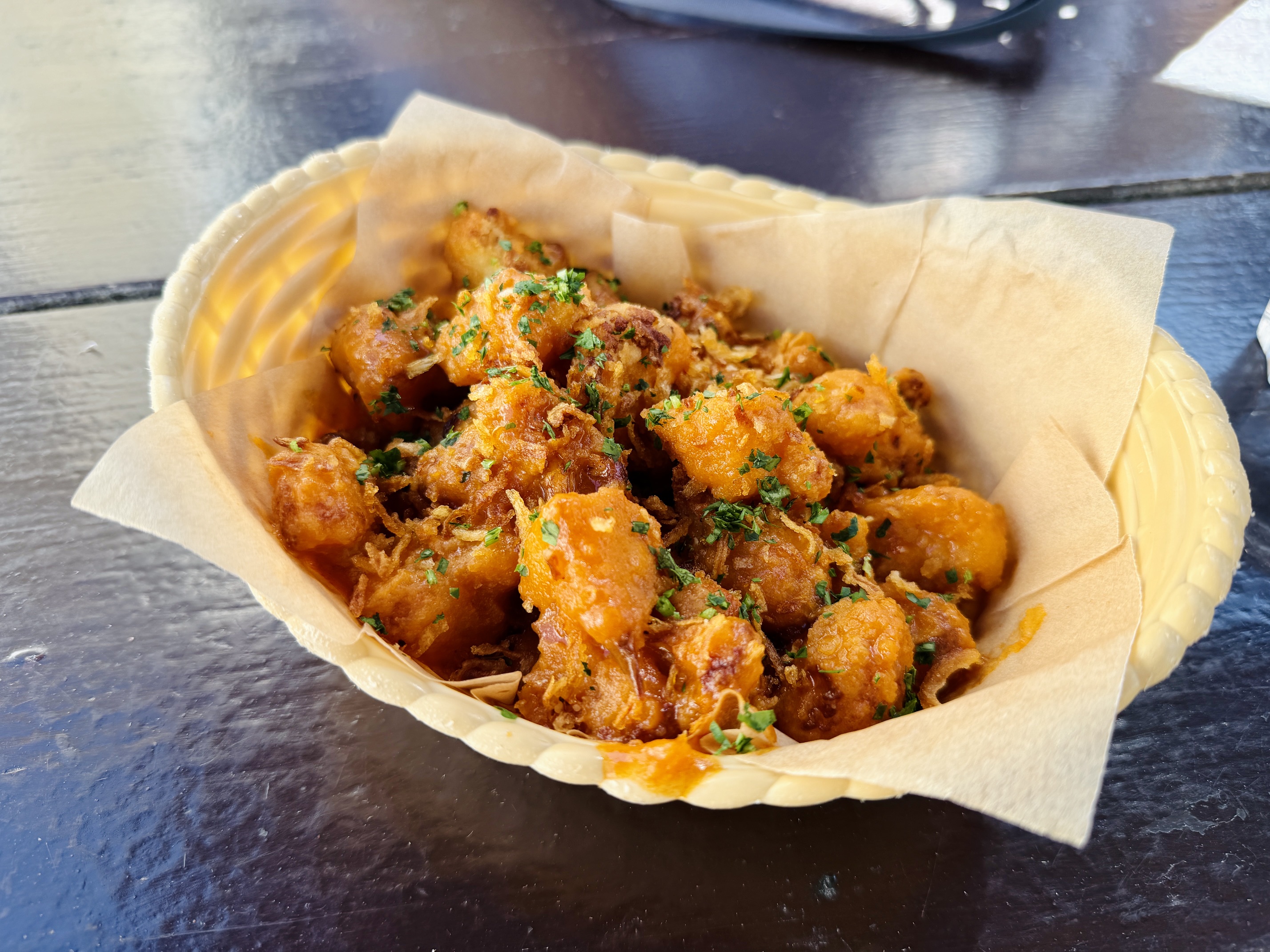
We also went for the buffalo cauliflower wings, from the snack section of the menu. These were a bit pricier at £12.50 but, as I’d suspected, very much sized to share. They were very close to spot on, but with something like this it’s human nature to focus on how they fall short. So I really loved the pub’s buffalo sauce, which had exactly the kind of acrid, vinegary heat I’m looking for. The little bits of what I thought were fried onion on top were a nice touch, along with a little verdant flash of herbs. And the cauliflower was nicely done, not too soft, not too unyielding.

If I’d known in advance that it would be a sort of mulch of cooked cauliflower in a superlative buffalo sauce I might have still ordered it and, as I did, I would have enjoyed it. But I’d like the coating to have crunch and to adhere, and for the whole thing to be tossed in the sauce at the end and brought to me tout suite before everything started to go awry and soggy. That didn’t happen here, I don’t think, and it was the only thing marring what would otherwise have been another perfect beer snack.

The chicken wings, at the same price, might have pulled this off better but I really couldn’t be doing with all the faff. I would have these again in the hope that the pub pulls them off, and if it didn’t I would be a little disappointed but, as I did this time, I would still eat every last morsel.

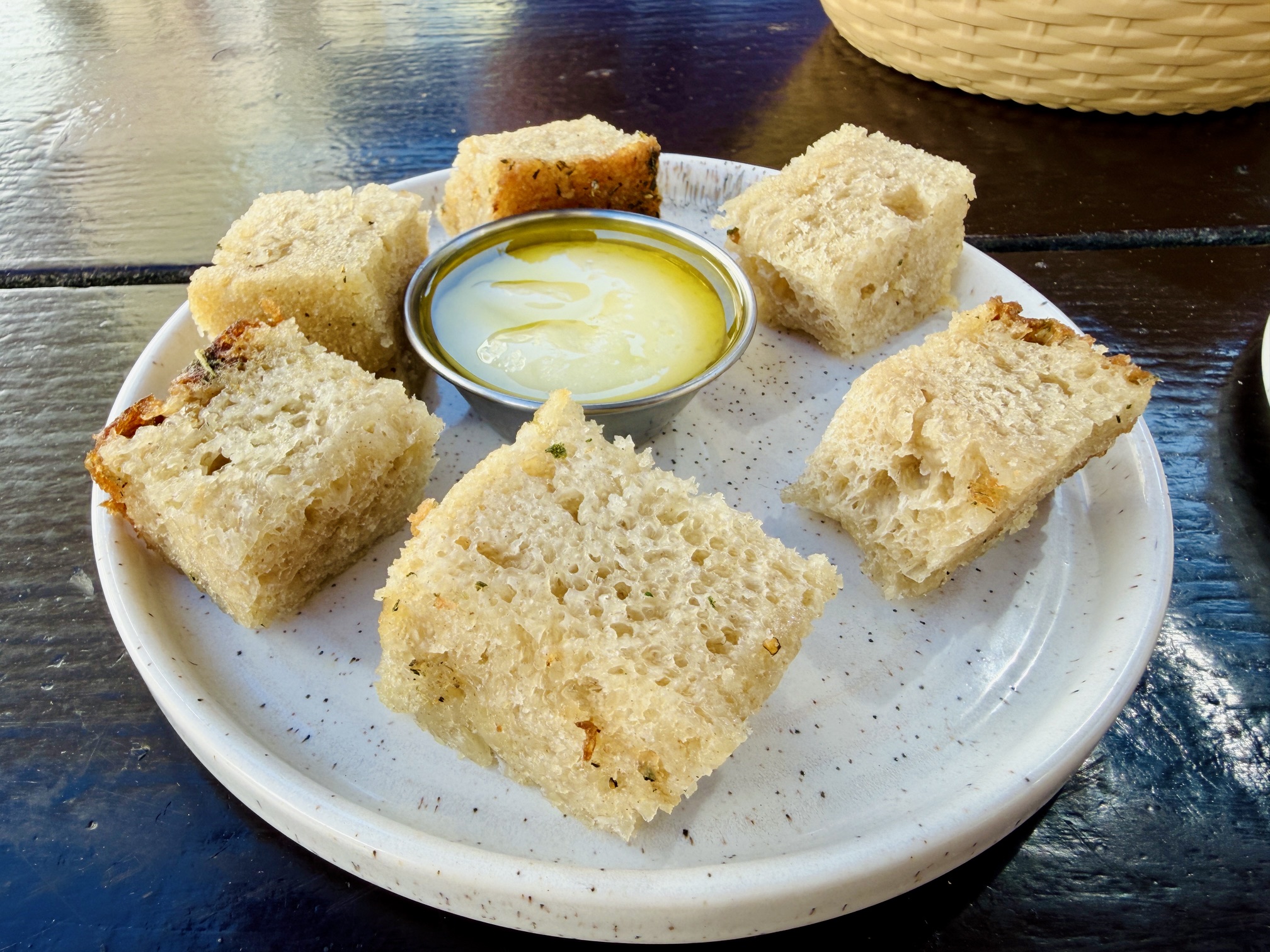
The biggest disappointment, for me, was the focaccia. It was, to be fair, only £4 but it was dense and doughy, no air, no crust and no crackle, just some spongey, cakelike cuboids that were a little bit too much like hard work. I’m not sure what the dip in the middle was: it looked like mayo but had a sizeable whack of vinegar. But the focaccia had a job to do anyway ensuring that not an iota of the buffalo sauce, or the soy and honey glaze, went to waste. No harm done, ultimately.

Service from everybody in the pub, from the chef to the cheery chap behind the bar to the servers who brought our food out, was bright and infectious, and the Port Mahon gave the impression of being a happy little brigade. We were asked whether we wanted our main course straight away or wanted to wait a while and – rather uncharacteristically, I guess – we told them to bring it on. That’s rotisserie chicken for you: it realigns the priorities.

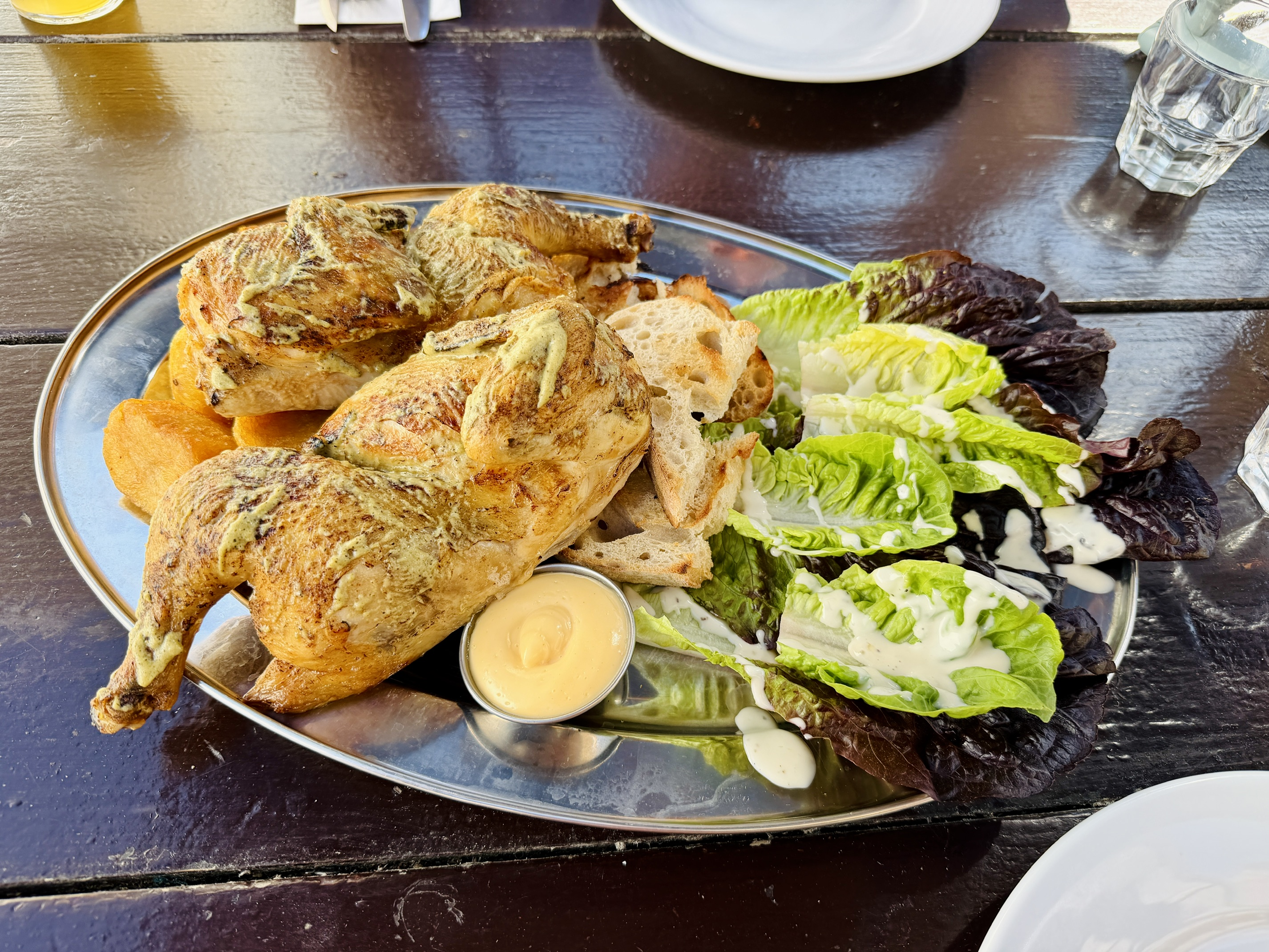
Sometimes, when I eat on duty without Zoë, we play this little game where I send her pictures of my food and ask her to guess whether it was good or not. Let’s play it now: what do you reckon to this?

First things first: this is a really generous plate of chicken and gubbins for two people, for just over £32. I think the Port Mahon has taken a tip or two from the Chester Arms’ legendary steak platter without, like Headington’s Six Bells, ripping it off lock, stock and barrel. So you get everything you could possibly want on that steel plate, no need for sides or add-ons.

And everything that goes with it is corking: the big, handsome lettuce leaves pooled with Caesar dressing, the substantial croutons with just enough give, the little sunshine-yellow ramekin of what they call ‘Mahon mayo’ (surely Mahonnaise?), they’re all marvellous. You could almost make yourself a Caesar salad with this, although the menu already boasts one which also includes eggs, bacon and anchovies and a healthy dose of I-almost-wish-I’d-ordered-that.

But the Caesar salad would omit the chicken fat potatoes, and they really are very nice indeed. The texture of them was ideal, the crunch to fluff ratio almost impossible to fault. I’d have liked that chicken fat to make its presence more felt, I’d have liked them saltier, but I’d like many things I won’t get and that, in some way I don’t fully grasp, will eventually make me a better person. Possibly.

That’s all well and good, you’re asking, but what about the chicken? And well you might. Well, like a lot of it, it was a lot of the way there. The leg meat was a tiny bit tough, almost gamey, and there wasn’t perhaps as much of it as I’d hoped. But the succulence of the breast made up for that, and the flavour that had permeated it did too: I don’t know whether the Port Mahon brines it, but I got lemon and I enjoyed the green sauce that had been sparingly drizzled over it. All that was truly serviceable, and then some.

But the other thing it really missed, the thing that makes rotisserie chicken so miraculous, was crispy skin. If you get that right, a lot of the other stuff either falls into place or, more likely, just doesn’t seem so important. It was the single biggest thing that the Port Mahon needs to work on, whether that’s by rubbing with salt and lubricating with butter or any other form of chicken-centric witchcraft, but a rotisserie chicken with slightly elastic skin is one that hasn’t lived up to its potential. Trust me on this: as someone with a lifelong track record of not living up to mine, in the words of Jason Lee in Mallrats, we can smell our own.

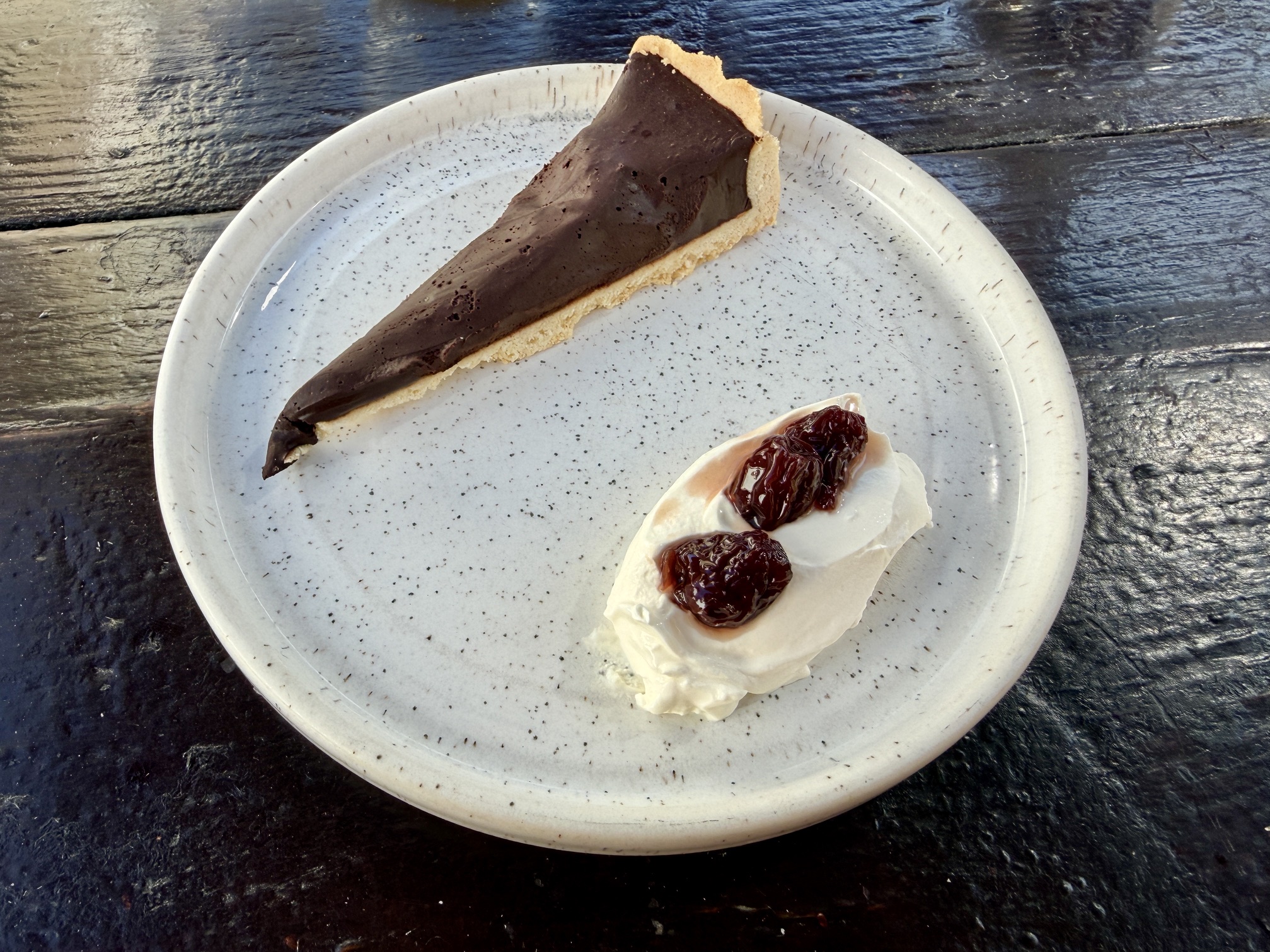
The dessert menu just has three items on it, and despite the retro appeal of a raspberry ripple Arctic Roll, the chocolate tart got both our votes. What a strange dessert it turned out to be! I mean, it was delicious: the ganache rich and pleasingly irregular, the pastry dense if perhaps slightly underbaked. I really loved the boozy cherries, both of them, and the little heap of crème fraîche they perched on: crème fraîche would always be my accompaniment for a dessert this rich.

But the size of it was just so strange, such a thin sliver. I know it was only £6.50, and perhaps that’s how the Port Mahon keeps it at that price, but it felt jarring. Somebody had a protractor in that kitchen, and they liked it slightly more than they liked customers: considering the manifest generosity on display everywhere else on the menu, this felt like a blip.

I might have stayed longer and ordered more drinks but Oxford’s best beer garden, in the shape of the Star on Rectory Road, was beckoning and I was conscious that Zoë had never been there before. So we settled our bill – £95, including service charge – and were on our merry way.

The rest of the day was another reminder of everything that makes Oxford a great city – pints of Steady Rolling Man at the Star, a sneaky Swoon gelato on the way to the station and a beer at Tap Social in the Covered Market when we realised we had time before taking the train we wanted. I am very lucky that my Oxford reviews always do quite well in terms of readership, but then it’s never a chore to write about somewhere with such abundant charm.

Reading’s part-time visiting academic and full time transphobe Julie Bindel recently wrote a laughable article in the Spectator – of course it was the Spectator – about how she couldn’t stand gastropubs. It was so full of bad, inaccurate observations that at first I mistook it for a Michael McIntyre routine, but Bindel’s central assertion, under the sophisticated and nuanced headline I hate gastropubs, was that pubs should stick to cheese sandwiches and Scotch eggs, and of course she had a swipe at sourdough and triple-cooked chips, because apparently it’s still 2010.

Just to generalise further about a world Bindel doesn’t actually live in, these pubs are apparently all staffed by “blokes with sleeve tattoos and beard oil”: it’s a wonder she didn’t throw in the word ‘new-fangled’ while she was at it. To be fair, her article also included the quote “As a rule, I am not a fan of pubs” which rather makes you wonder why the Spectator paid her to write an article that is essentially a big steaming heap of Bean Soup Theory.

Still, it’s nice to know that Bindel can be wrong on multiple topics: I guess the Brexiteer ghouls who read the Speccie lap all that up. The point is, call them pubs or call them gastropubs – who really cares? – but either way they are, in all their forms, a big part of how people eat in this country in 2026. And when they’re done well, they are terrific places to eat and drink, or just drink, or pick at snacks with a really good pint. Getting hung up on what you call them completely misses the point that they’re an essential element of food culture here.

Whether they are the centre of village life, like the Jolly Cricketers, or bravely trying to do something else with a centuries-old boozer like the Port Mahon, they matter. And even if the Port Mahon doesn’t get everything right, it does enough to deserve plenty of support while it works on the rest. I liked it a lot, I’m rooting for it and I’m sad that Reading, for all its pubs, doesn’t have anyone even trying to offer something like this.

That’s another food trend that hasn’t really bothered with our town. I’d love an excellent independent food pub, I would really love somewhere doing rotisserie chicken like the very best of the stuff on the continent. Both of them in a single venue? Don’t be ridiculous: it will never happen.

The Port Mahon – 7.7
82 St Clements St, Oxford, OX4 1AW

https://www.theportmahon.com

Since January 2025, Edible Reading is partly supported by subscribers – click here if you want to read more about that, or click below to subscribe. By doing so you enable me to carry on doing what I do, and you also get access to subscriber only content. Whether you’re a subscriber or not, thanks for reading.
Restaurant review: Cuttlefish, Oxford

“This should be lovely” said my dear friend Jerry as we took a table in the window at Cuttlefish, a couple of minutes’ walk away from the far side of Oxford’s Magdalen Bridge. “A fish restaurant!”

I was spending Good Friday with Jerry, in what I rather hoped would become an annual tradition – last year we spent it lunching at Gees – and as is habitual I had given him a range of options to choose from in advance. He passed on the London candidates I gave him: only the smaller plates appealed at Andrew Edmunds and The Hero, and the offal-heavy selection at Borough Market’s Camille was dismissed in a split second. That left Oxford, where Jerry was tempted by No. 1 Ship Street but thought, on balance, that Cuttlefish had more to tempt him.

All this worked out rather well, in truth. People have been bemoaning the lack of a fish restaurant in Reading for a long time – the easily pleased since Loch Fyne closed eight years ago and the more exacting since long before that. The nearest thing to it we have, I suppose, is Henley’s Shellfish Cow, but it always feels to me like a restaurant where they chose the name because they liked the pun and everything else followed from there.

Given that lacuna in Reading’s food scene a short hop to Oxford to see if there was anything suitable sounded like an excellent idea. Besides, after my last Oxford review there was a request to install Jerry as my permanent Oxford correspondent for all long boozy lunches: let it not be said that I never, ever give the people what they want. So Jerry and I rocked up at the start of the long weekend, the sun finally out, ready to investigate.

My preliminary research, however, had given me a bit of a sinking feeling, not that I told Jerry that. The fanciest thing about the website was Cuttlefish’s fetching logo, but lurking beyond that was a menu that seemed a little bit strange, a little bit cheap, a little too large and somewhat lacking in fish. Sure, they sold oysters and caviar and seafood platters, but for a fish and seafood place there appeared to be little fish on the menu.

Perhaps, I told myself, it was all in the daily specials depending what they could get that day. But it also felt a little all over the place, with classic fish and chips sitting uneasily next to squid ink spaghetti and “mixed seafood and chicken paella”.

Maybe some of that could be explained away as overlap with the La Cucina, the Italian restaurant next door under the same ownership. But that was before you got on to the five different types of burger, the steak frites, the brunch menu featuring eggs benedict and chorizo tortilla. Nothing about it shouted that Cuttlefish was a restaurant which had decided to focus on doing a few things very well.

That was sort of borne out by the dining room. It didn’t boast loads of jarring nauticalia, and the pictures on the walls were tasteful black and white numbers. But the Tolix chairs – would that I could go back in time and buy shares – felt low rent, as did the vinyl tableclothes meant, seemingly, to imitate planks of driftwood, which rather clashed with the attractive bare wooden floorboards. Never mind: we took a nice spot in the window and I wedged my arse into a Tolix. Behind Jerry, I could see that the paintwork of the bay windows was a little tired.

Service was lovely and friendly, but it started off shakily and never quite recovered. Jerry is a lovely and self-effacing man who always puts other people first, the kind who volunteers to take the crappy single bed in a communal Airbnb. Maybe it’s his Irish Catholic upbringing, but he is congenitally predisposed not to want his own way, to the point where he sometimes apologises even for having a preference.

I discovered this at lunch because, given that we were at a fish and seafood restaurant, I rather assumed that we’d be attacking a Picpoul de Pinet or an albariño, a riesling or a Chablis. Cuttlefish’s wine list, as you would expect, boasts all of those things, although it never gives a vintage and, in some cases, also neglects to mention the producer. But it was on this day, after years of friendship and several meals on duty, that I discovered that Jerry doesn’t especially care for white wine.

“I’m really sorry” he said, getting that apology in early. “But we can have white if you want.”

I stopped and thought. This was news to me, and I’ve been out for lunch with Jerry numerous times – including twice in Oxford – where I’ve pressed on and ordered a bottle of white without ever realising that Jerry only really enjoys red.

“No, don’t be silly! I’m not a purist about drinking white with fish.”

So we asked our server for help and that’s where our problems began. It felt like there was an unbridgeable language barrier between us, because I was unable to explain, somehow, that we wanted tips on which the lightest and fruitiest of the reds on the wine list was. It didn’t give many clues and there were no obvious candidates like, say, a Fleurie. It didn’t help that this part of East Oxford is a mobile reception not spot: no Vivino to come to the rescue.

“Do you mean the red wine that’s the least strong?” she said.

“No, I mean – which is the fruitiest. You know, not heavy. Which one would go best with fish?”

You’d expect the reds on this list to have been selected with this eventuality in mind, but perhaps not.

“Well, there is the Picpoul de Pinet” she said.

“No, I mean reds. That’s a white wine.”

There was a pause, and I wondered if I was expressing myself exceptionally poorly (if you’ve read enough of my reviews, you’ll know that sometimes happens). The pause lengthened into a silence, and I wondered if time was standing still. No: Jerry was still moving.

“I will get my colleague.”

By the time he arrived we’d given up and settled on a French malbec. This server smirked slightly as we ordered it, as if it was a bad choice, but really, by that point we’d done quite enough deciding and wanted to do some drinking.

It was called Beauté du Sud and the markup on it was reasonable to the point of baffling: £32 for a wine that will apparently set you back £25 retail. If I’d paid £25 for it retail I’d be beyond disappointed, but in a restaurant it wasn’t bad: not too heavy but perhaps a little jammy. Tom Gilbey would probably have had something to say about the sugar levels.

So by this point my hopes were not high, and that was compounded by another cardinal sin: our starters must have come out about five minutes after we ordered them, and you probably know by now how much I love that i.e. not very. But that’s almost the last bit of criticism you will hear from me, because from this point onwards – against all the signs and much to my bemused pleasure – nearly everything was rather good.

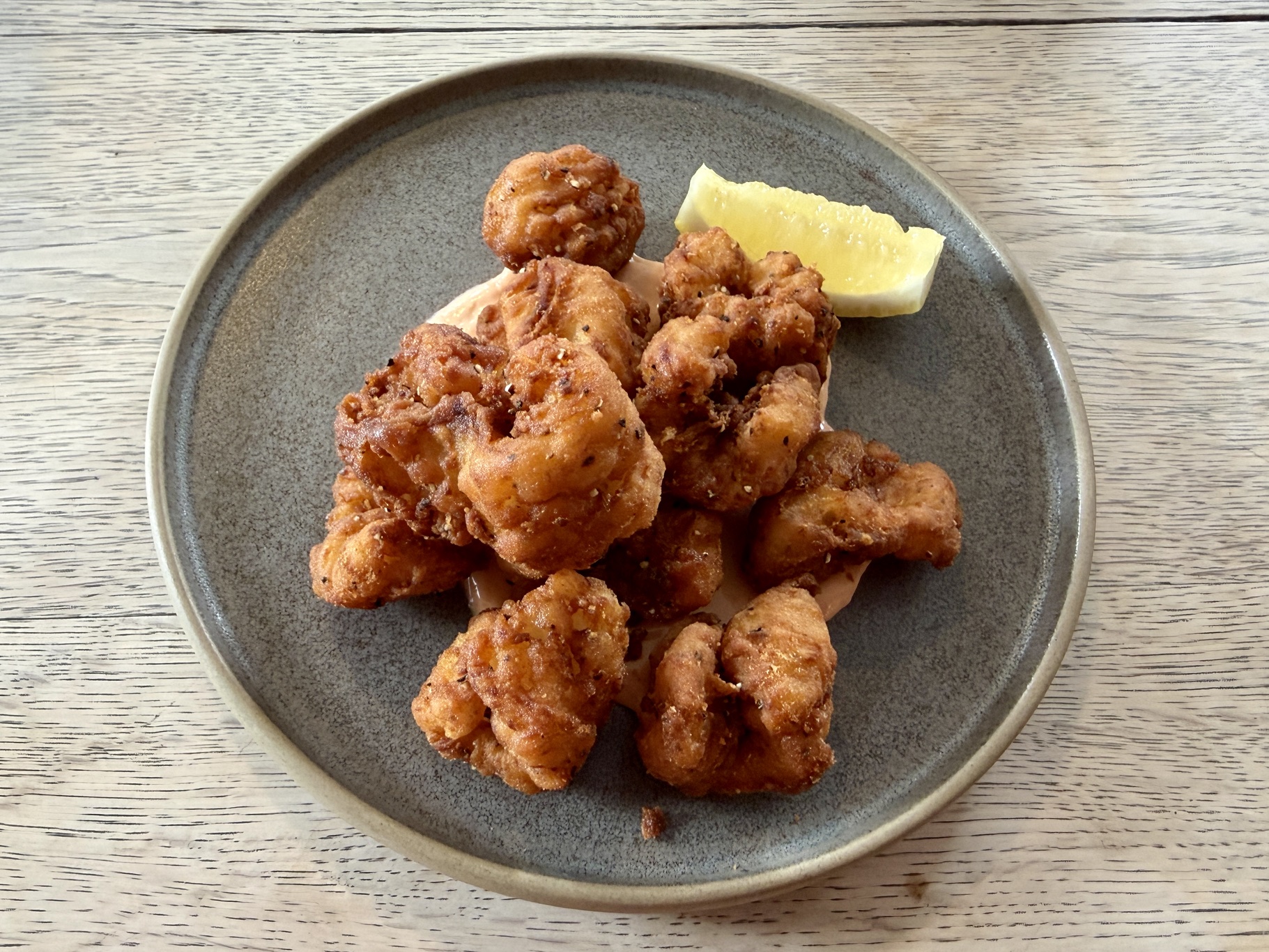
Take my calamari, for instance. They even looked pedestrian, and I was half expecting to wade my way through a bowl of breaded rubber bands. So imagine my surprise when I found they were delicious, lightly dusted with a coating that adhered, had crispness, and that they were tender without the slightest twang of elastic.

Dressed with liberally squeezed lemon and then dipped into a ramekin of golden aioli, they were the kind of dish the idea of this restaurant promised, a promise the reality of the restaurant looked as if it would renege on. It wasn’t the hugest portion for £9, but I liked it too much to care about that.

And would you believe that Jerry’s starter was equally good? He’d ordered crab, white and brown, with toast, and it was a simple and surprising – that word again – dish.

“This is so much nicer than those meagre pots you get at the supermarket” enthused Jerry, and he was right. I love the purity of white crabmeat but the dark meat is where the flavour is and this was rich and thought through, with a slowly building heat in the mix which, again, you might not expect. Even the tiger-striped block of toast was considered, was the perfect thing to load the stuff onto. I always think salads are padding in a dish like this, and this one definitely was, but even without it this felt like a very creditable way to spend £11.

By this point the restaurant was still less busy than you’d hope it to be on a long weekend, but there was a regular, if small, trickle of customers arriving and leaving. The people watching potential couldn’t match a spot in North Oxford, or down the Cowley Road, but Jerry and I had plenty to catch up on, so that didn’t matter.

We were having such a good natter that I didn’t even spend my time worrying that our mains would turn up as quickly as our starters did, so I was pleasantly surprised – yes, surprise once more – when they turned up a very agreeable half hour or so later.

That said, I wish they’d given mine a little longer. The blackboard propped up outside the restaurant had promised two specials but one had already gone by the time we turned up at half-one, so I chose the other, the octopus. And on paper this dish had everything I could have wanted: firm, roasted baby new potatoes with a flash of bronzed skin, a little carpet of still-crunchy samphire, a beautiful sauce with plenty of sweet cherry tomatoes.

It almost was, and could have been, a taste of the Mediterranean (of Greece, where the octopus is usually previously frozen because stocks have never quite recovered from all that madcap dynamite fishing they used to do).

But the problem was that octopus is a tricky beast to get right and, unlike everything else the kitchen tried, their sure touch deserted them here. It was a proper chewy workout for the jaws, more than I would have liked, and it made me apprehensive about my forthcoming dental appointment and the inevitable top up of masseter botox which would follow. If I showed my dentist a picture of this octopus, perhaps he’d give me slightly more this time.

Only the narrow end of the octopus, blackened and crispier, was easy to eat. Even having said all that, I liked the dish so much that I was prepared to be forgiving: to get so close to the perfect dish, somehow, made me celebrate the 90% they had achieved rather that the 10% where they had fallen short. The whole thing sang with summer flavours, made the crummy weather of the previous week feel like an optical illusion, and for £18 I thought that was no mean feat.

Jerry very much enjoyed his fritto misto, although I think it was more his thing than mine. One element, the calamari, was shared with my starter, but the other components were a couple of enormous prawns, some pieces of whiting and a lot of whitebait. You might, as Jerry does, like whitebait rather a lot, in which case I’m delighted for you, but I personally never eat anything that can beat me in a staring content. And whiting might be a perfectly worthy fish – the bit I had tasted decent enough – but somehow it felt a little basic to me.

Then again, this fritto misto was £15, so can you complain? Pricing at Cuttlefish was a little erratic, with many of the mains costing little more than some of the starters. I guess I had been conditioned to think it should have been more expensive, but then again it’s not like they were dishing up whole Dover soles or thick steaks of swordfish. I’d have liked it a little better, I think, if they had been.

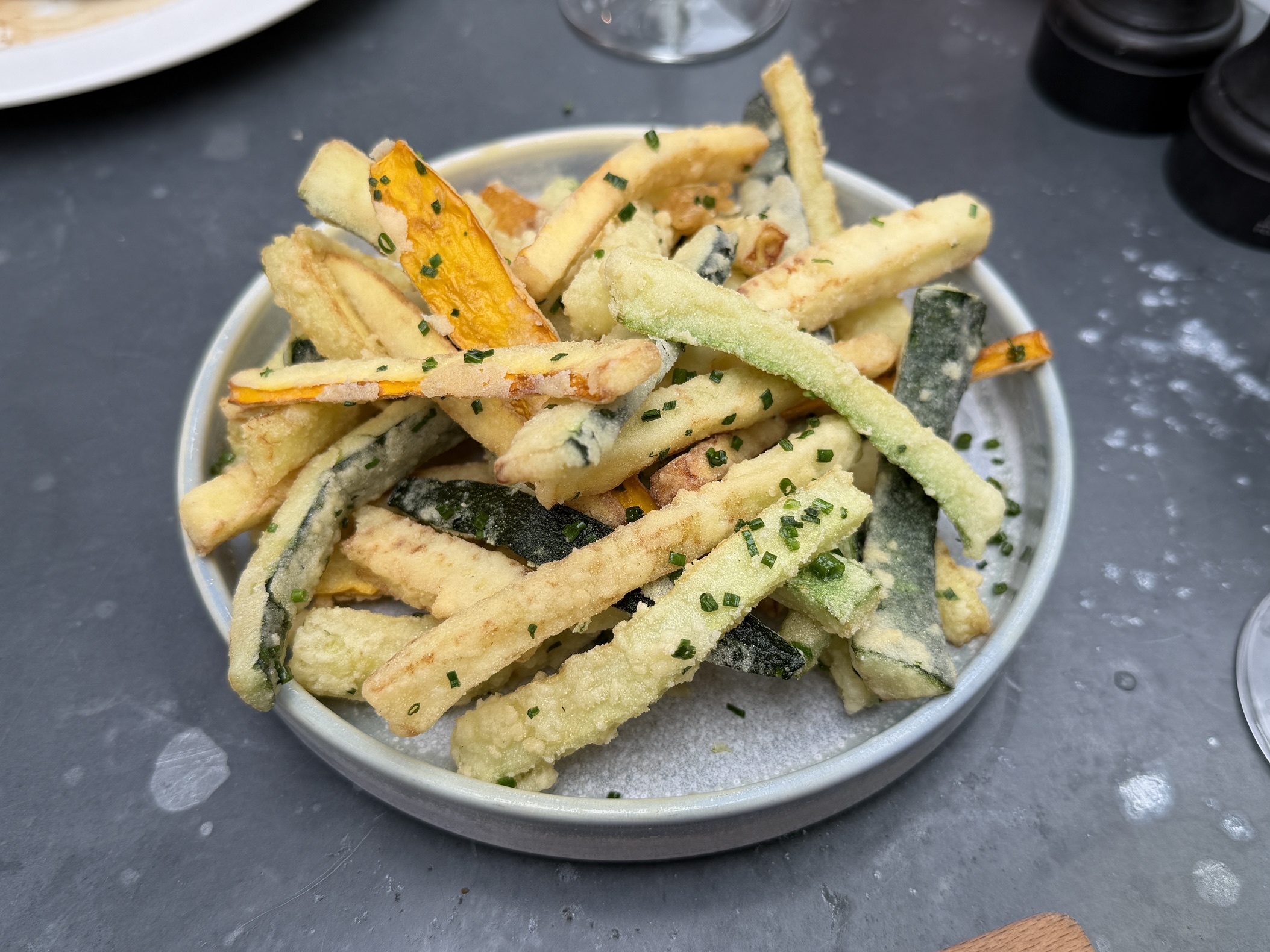
We had a couple of side dishes – Jerry because his main needed one and me because I’m greedy. My zucchini fritti were thick, soggy and under-battered, lacking salt or fun. Jerry’s french fries almost certainly came out of a packet and were served in the sort of miniature frying basket that dreary observational comics on Twitter used to slag off ad infinitum. I didn’t finish my courgette fries because they felt like empty calories. Jerry didn’t finish his frites because he just didn’t have room: I half expected him to apologise to our server for that.

After an impressive run I guess it was always a risk that the weird service would return and cause a dip, and so it did. We were asked if we wanted to order dessert, we asked if we could finish our wine first and were told “well, the kitchen is closing”. Nothing on Cuttlefish’s website says that it does that and, indeed, people were still taking tables shortly before that. But never mind: the dessert menu was full of staples like brownies, cheesecake and sticky toffee pudding and they did offer a glass of an unspecified Sauternes if you wanted to push the boat out, no pun intended.

Jerry went for ice cream, a classic Neapolitan trio of chocolate, strawberry and vanilla. I don’t know if they were supplied by others or made by the restaurant, but they were as pleasing as their pastel shades might lead you to believe they would be. A couple of the scoops had ice crystals in them, which strangely left me with the impression they were less likely to be bought in, but either way it was a solidly nice and thoroughly unexciting dessert.

I picked from the specials, most of which were dessert with extra booze, be it a pastel de nata with a glass of port or an affogato with Frangelico on the side. I genuinely loved my two spheres of lemon sorbet with limoncello, and thoroughly enjoyed anointing the former with the latter. It felt like the kind of dessert you don’t see on menus much these days, a resolutely old school, tried and tested combo.

As it gradually melted to become the kind of Slush Puppy Oliver Reed would have considered a decidedly good time, I started to feel increasingly well disposed to Cuttlefish, despite its repeated efforts to stop me becoming so. £10 for this, and despite somehow costing more than the larger £7 selection of ice creams I couldn’t say I felt begrudging.

“This has been so nice” said Jerry. “So much better than those snouts and bollocks and trotters in London would have been.”

When our bill arrived it was only £113, not including tip, which did nothing at all to dissipate our collective goodwill. I think Jerry liked Cuttlefish more than I did, but Jerry is also a man who will take the single bedroom in an Airbnb to make his friends happy. In short, he’s just a spectacular human being. And yet I liked Cuttlefish too: I may be a crabby sod who needs to be worn down or won over, but I get there in the end. Once I do I’m as much of an advocate as anybody.

After that our afternoon took a happy, well-rehearsed trajectory. We wound our way to the Star Inn on Rectory Road, one of my two favourite Oxford pubs. Jerry sipped Asahi and I glugged Steady Rolling Man and, despite the utter lack of mobile reception, we got by the way people did in the days before smartphones, by simply chatting and gossiping and not looking things up when we didn’t know them, because there was no way of doing so.

We got into a chat with the academic at the next table, mainly because Jerry fell slightly in love with Nico, her greyhound, but he told himself it was okay that he couldn’t get away with dognapping Nico. “Greyhounds don’t lick”, he said to me. “I need a dog that’s going to show me proper affection.”

Nico’s owner told us stories about the fates faced by ex-racing greyhounds – she adopted him after an unsuccessful month-long career as a racing dog – and both of us came away from the conversation bitterly opposed to racing in all its forms. I have become a cat person in my middle age, but I’ll always make an exception for greyhounds.

It was in short a textbook Oxford outing, the kind to which I’ve become extraordinarily attached. I’m already looking forward to the next one, especially now I have a mandate from my readership to take Jerry out for lunch in the dreaming spires at every available opportunity.

I am increasingly aware lately that happiness can be fleeting, and you have to appreciate it as it happens, rather than simply realising further down the tracks with the benefit of hindsight. I had a brilliant time, and I don’t want these trips to Oxford – on Good Friday or otherwise – to ever come to an end. Fortunately, the city seems to have plans to keep me more than occupied.

En route to the Star I spotted a pub, the Port Mahon, which has decided to specialise in rotisserie chicken and mentally I made a note to put it near the top of my to do list. Once we got to the Star I couldn’t help but notice that they now have a permanent pizza trader. One who also serves a pint of dough balls in garlic butter and Parmesan: I saw them turn up at a neighbouring table, and it took all my strength not to order some. Next time. Or the time after that.

Cuttlefish – 7.4
36 St Clement’s Street, Oxford, OX4 1AB
01865 243003

https://www.cuttlefishoxford.co.uk

Since January 2025, Edible Reading is partly supported by subscribers – click here if you want to read more about that, or click below to subscribe. By doing so you enable me to carry on doing what I do, and you also get access to subscriber only content. Whether you’re a subscriber or not, thanks for reading.
Restaurant review: Pompette, Oxford

This review begins, as a couple of mine have before, outside the Missing Bean on Turl Street in Oxford, a little before noon. I have grabbed a couple of seats outside on the cramped little benches, my dear friend Jerry is inside ordering lattes and pain au chocolat. It will rain later, but the morning is still surprisingly bright, fresh and clement. Loads of people are enjoying their coffee al fresco, sharing in the sharp and long-awaited happiness of being able to do so, all contented smiles and budging up to make room for others. Those that aren’t are just walking past, adding to the rich pageant of an Oxford morning when it feels like spring is within touching distance.

Jerry and I have met in Reading station, just next to the ticket machines, and been those annoying people in our train carriage nattering and catching up – his holiday in Gran Canaria, my continuing convalescence – all the way to Oxford, the first thirty minutes of a conversation that, all told, will go on for about twelve hours unabated. Jerry and I are in Oxford to explore somewhere new for lunch, and all is right with the world.

That makes this the third instalment of a trilogy of Saturday lunches with Jerry in Oxford. It began indifferently last spring, when we braved Gees, a restaurant that turned out to be the city’s largest, most expensive salad bar (fun fact: the owner was recently charged with murdering his centenarian mother).

It continued in the summer when we sat outside Arbequina on the Cowley Road, drinking Asturian white wine in the sunshine and enjoying one of my meals of the year. It was meant to conclude in November at Pompette, the French restaurant out in Summertown, but the weekend of our reservation I was sleeping at home, freshly discharged from hospital.

So it’s surprisingly emotional to have it back in the calendar and to see it happen, to sit on the train with my friend, to drink coffee with him in one of my happy places, lunch just around the corner. The welcome blast of sunshine suggests that winter is nearly over, that nature is healing, but I am healing too.

Pompette celebrates its eighth birthday this year, and in that time has cemented itself as one of the only restaurants in Oxford to get any visibility outside the city. It got glowing write ups in the national press shortly after opening, and since has made its way into the Michelin guide and the Good Food Guide. The critics stop reviewing places after a while, but the guides always keep score, and Pompette was again listed last year by the Good Food Guide as one of Britain’s 100 best local restaurants. It’s in good company, along with the likes of Clay’s, Upstairs At Landrace, Paulette and overall winner – and one of my favourite discoveries of all my time writing this blog – Lucky Lychee.

I have eaten at Pompette a couple of times, but not for something like five years. I went the winter after it opened with a group of my friends known as the Guild Of Ponces and thoroughly enjoyed it (to read about a meal we had at a less convincing French restaurant, click here) and then I took Zoë there the summer after the pandemic. We had a lunch there that was good but flawed, and at the time I decided not to write it up: after all, it was 2021 and it didn’t feel like the right time to say “here’s a hit and miss meal only a train and bus ride away”. Who would have cared?

But Pompette always hovered high on my Oxford to do list, and as Jerry and I ambled through the door bang on time for our reservation I was reminded why. It’s a big space but a very, very attractive one, split into two large dining rooms with space up at the bar and a private dining room upstairs. It’s impossible not to love, with the exposed brickwork, calming deep blue walls, gorgeous framed prints and handsome furniture: even the shelves of merch – cookbooks and tote bags – are appealing.

You would think the sheer scale of it would make it feel vast and impersonal, but I was impressed by how little that was the case. It takes some doing to create a sense of intimacy in a dining room built to these proportions, but our little table in the window was nicely spaced from our neighbours. Shortly after we were seated, just after one o’clock, a group of speculative diners was turned away: at the time I didn’t understand it because the room was still sparsely populated, but before long nearly every table in our half of the restaurant was occupied.

And they had multiple lunchtime sittings, too: a studious group left the table for four next to us just after we left and a lively, fun pair of middle-aged couples swiftly took their place, bedding in for an even boozier lunch than mine and Jerry’s. By then Jerry and I had already kicked off proceedings – a manzanilla for him and something called a Picon Bière for me, a half of Méteor with orange bitters in it, an Aperol for the Untappd classes.

I absolutely loved it, and like the demi pêche my friend Dave discovered last year, or the panaché I loved in Montpellier it gave me a new-found respect for the ways the French have worked out to make beer all fancy. We toasted one another’s good health over a little bowl of almonds, gleaming with oil and dotted with salt, just like the ones I’m used to buying in Malaga.

Pompette’s menu is ostensibly French – chef Pascal Wiedemann hails from the Alsace, although he made his name in London at French restaurants Racine and Terroirs – but it wanders well beyond the Alsace and, to be honest, beyond France’s borders too. I’ve had vitello tonnato there before, and the menu the day Jerry and I visited boasted stracciatella, pumpkin gnocchi with Gorgonzola, boquerones with Manchego and croquetas; in that sense it’s almost the same ball park as the sleek pan-European fare at Branca. There’s also hispi cabbage, which very much places it as a restaurant in the U.K. in 2026.

But the spine of the menu is Gallic: cod brandade, pot au feu, jambon de Bigorre and cervelle de canut, a Lyonnais dip made from fromage blanc, speak to that. And that’s the other thing I would stress about Pompette: don’t read too much into the menu on their website. Jerry and I agreed on the train up that it looked, from our research, pretty limited but was boosted on the day by a trio of very tempting specials. Without that, if you couldn’t find anything you liked, you might end up resorting to steak, which always feels to me like something of a fallback in very good restaurants.

The years have ravaged the pricing: when I look at the picture of my receipt from 2021 the main course was shy of £20, whereas nearly everything is £30 or more now. But none of that feels like it matters so much when something knocks it out of the park, and that’s exactly how I felt about my starter. A puck of boudin noir came encased in bronzed but fluffy brioche, the whole thing moated with the kind of thick, reduced sauce you can almost see your face in. A little wedge of beautiful quince was a fig leaf to wellness, dusted with espelette pepper which I thought the dish could probably do without.

But really, this was one of those plates where, for as long as it’s in front of you and some of it remains, the world is a kind and happy place. When I think about what it was like, I can only remember eating anything comparable in France and when I described it to my boss the following week – he is a keen Oxford fan, especially of the Daunt Books just round the corner from Pompette – he said “so it was sort of like an incredibly middle-class hot dog, then”. Well, no. No but also yes.

Jerry was determined to conquer the gastronomic spectre of his trip to Gran Canaria, where he trudged through a very disappointing fish soup, so he braved Pompette’s soupe de poisson. But, spoiler alert, no bravery is really required when you order somewhere like Pompette. At Pompette, it is all about everything – from the cooking to the eating to the meal itself – taking absolutely as long as it needs to take, of perfecting over time and distilling to an epitome.

Just as this became the epitome of the perfect Oxford lunch with Jerry, the soup was its best self, utterly reduced and concentrated, so deep in flavour that you needed a metaphorical diving suit. Jerry adored it. I didn’t try it, although if I’d had a spoon handy I’d have given it a go, but even after it was finished that aroma, intense with fish and lightly coaxed with aniseed, stayed with me, making me wish I’d ordered it. The rouille, Gruyère and croutons were all present and correct, and Jerry made me try a bit of the crouton because he couldn’t believe its lightness. I did as I was asked. I couldn’t believe it either.

By this point we were slightly ahead of the table next to us, so we got to earwig on their conversation with the serving staff, who without exception were absolutely at the top of their game. The server told our neighbours that although you felt like there ought to be shellfish of some kind in that soup, there was none: but they used every single bit of the fish, guts and all, to produce that extraordinary flavour.

At this point we were caught by our neighbours paying far too much attention, which led to some good-natured bickering across the rest of a very happy lunch. One of the couples were locals – and very lucky to be, too – and their friends were up from Oxford. One was a lawyer who occasionally worked in Reading, so I made sure to recommend Clay’s to her. Our interest in their advice from the wait staff was eventually mirrored by their interest in seeing what Jerry’s and my food looked like, and by the end I think they were half tempted to join us in the pub for a post-prandial debrief. Anyway, two of them ordered the soup and both of them loved it.

One of the chaps at my table couldn’t persuade his friend to order the special Jerry and I had, which meant I felt bad when it turned up and was spectacular: he had to settle for sharing an enormous pork chop instead, which looked like a more than serviceable consolation prize.

But fortune favoured me and Jerry, in the shape of the most beautifully cooked duck breast swimming in a thick, glossy bigarade sauce – more of that bitter orange from my apéritif – and festooned with rind. Again, Pompette’s preturnatural talent with sauces was deployed to stunning effect: I think of all the cuisines out there French is my favourite, and it’s because of things like this. They are the clincher.

It turned out that Jerry was trying to lay ghosts to rest with this order as well, having cooked duck at home a while back and found that it came out tougher than Tom Hardy after a crash course of anabolic steroids. By contrast this was pink, the fat soft and moreish, the skin crisped and burnished, every contrasting texture timed and rested to be spot on all at once. “I bet this duck had a fantastic life” mused Jerry. Not as fantastic as ours right now, I thought.

The accoutrements with this were also bang on. I have never much liked endive, but Pompette has the talent many great restaurants do, where it can win you over on ingredients you thought you didn’t care for. This, braised and blackened, was a perfect foil. If I had one criticism it was that the splodge of celeriac purée, great though it was, was pretty small.

But on the other hand the thing on this plate you wanted to be huge was, and that was the croquette of duck leg. The picture down there doesn’t do justice to how big this was, or how substantial, how dense, how utterly crammed with shredded duck leg, herbs, salt, fat and nothing else. The duck breast was in the middle of the table, but this was the star of the show. And this main, to share, was £60 for two.

Ironically, the reason the gents at the table next to us didn’t order the duck special was that the dissenter didn’t like the sound of the duck leg croquette. I told his friend that he should consider making new friends. There was a pause, and I worried I’d gone too far, and then he spoke.

“Thank you!” he said.

By this point we had polished off a bottle of red that was a new one on me, a Vinsobres from the Rhone Valley. The wine list was absolutely magnificent, and will part you from plenty of money if your resolve weakens for a moment. Our server recommended a handful of reds from Jura’s legendary producer Tony Bornard, and they all sounded right up my alley, but I struggled with spending £100 on one: to Pompette’s credit, most of them are £50 retail so that markup is positively encouraging. But again, our server was superb at navigating us to something more kindly priced – £54, with a more conventional markup – but quite exquisite. We swirled it in huge, fishbowl-like glasses, and enjoyed every drop.

Pompette’s dessert menu is small – just the three options, plus a cheeseboard, with suggested wine pairings for all of them. I always give dining companions the first choice, but I was delighted that I could easily have ordered any of them. Once Jerry had chosen I was torn between the rhubarb and custard tart or the kirsch choux bun with warm chocolate sauce, and my server made the clever point that the latter had been on Pompette’s menu since day one so would always be there for me, whereas rhubarb had a season. I was sold. This argument also worked on the neighbouring table, roughly as we were settling up.

It was an absolute joy – a mild custard with just enough wobble, an acceptably thin pastry base and a gorgeous lacquered, almost tiled top level of rhubarb. I’m not used to being given a knife and fork for dessert but this dish did need it, because the rhubarb still had fibre and resistance, and otherwise would have slid clean off the rest.

But having a proper cross-section, as was intended, you realised what a precise balance of sweet and sharp it was. A puddle of crème fraîche next to it was topped with a splodge of rhubarb compote stewed beyond the point of resistance. See, it can also be like this, it seemed to say. I had this with the Jurançon they recommended for Jerry’s dessert, because it interested me more than the suggested pairing. £12 for the tart, £6 for a small glass of golden dessert wine, absolutely zero complaints.

Jerry went for a seemingly less French choice, a slab of sticky ginger cake with a coconut and rum sorbet slowly melting on it. This was perhaps French by way of Guadaloupe, and for me the best and most interesting thing about it was a glorious wedge of roast pineapple. Jerry liked it, and was determined to have dessert over cheese (with hindsight, I should have pointed out that they weren’t mutually exclusive), but the sorbet was the weak point for him. I think he was right – it was all coconut and very little rum, and something sharper might have worked better.

I know comparisons can come across as invidious, but I couldn’t help but view my companionable, libatious, drawn-out lunch at Pompette through the lens of my whistle stop tour of Hypeland at The Devonshire, the subject of last week’s review. This meal was less expensive – including tip our snacks, apéritif, three courses, bottle of wine and glasses of dessert wine set us back just over £216, slightly less costly than the Devonshire. Pompette’s room was nicer and more spacious, the service absolutely faultless.

And it was the kind of meal I wanted, a celebration of lunch, of good company, of having nowhere to go and eating in a restaurant with no desire whatsoever to move you along. The best part of three hours passed in a flash, and at the end of it we availed ourselves of the very tasteful loos and gorgeous-smelling hand soap and made our way back out into North Oxford knowing we’d had a lunch for the ages. Daunt Books followed, and then racing the rain to North Parade, our second Parade of the day, where the back room of the Rose & Crown had a table with our name on it and crisp cider behind the bar. It was, as days go, pretty unimprovable.

Reading doesn’t have anywhere like Pompette, despite the fact that Caversham would very much like to be Reading’s Summertown, or Jericho. That Reading can’t attract this kind of place is one of the eternal mysteries which I fully expect to be bemoaning until either I get bored or you do (let’s be honest: you’ll get bored first). That Oxford is a 30 minute train ride away, and Pompette is a short bus ride from the city centre is something, on the other hand, you will never hear me complain about.

I’ll almost leave the last word to Jerry this week. “It would be a perfect special occasion restaurant” he said. He’s too modest to appreciate that every lunch with him, for me at least, is a special occasion. But he does read this blog, so now he knows.

Pompette – 9.0
7 South Parade, Oxford, OX2 7JL
01865 311166

https://www.pompetterestaurant.co.uk

Since January 2025, Edible Reading is partly supported by subscribers – click here if you want to read more about that, or click below to subscribe. By doing so you enable me to carry on doing what I do, and you also get access to subscriber only content. Whether you’re a subscriber or not, thanks for reading.