I was having a chat with my friend Reggie the other day, and I told him that my upcoming review was of Bánh Mì QB, the new Vietnamese restaurant on the ground floor of what used to be called Kings Walk. I’d been there earlier in the week, I told him, and I just needed to write it up.
“You know what the problem with that place is, don’t you?” he said.
“The landlord, I know.” The whole of that space, Atlantis Village or whatever it’s called this week, is owned by Sykes Capital, the company founded by noted philanthropist John Sykes. I should apologise at this point: if you had an Edible Reading bingo card, or were playing an Edible Reading drinking game – even at half eleven on a Friday morning – you’d fully expect me to name drop Sykes, Reading’s answer to It’s A Wonderful Life’s Henry F Potter, nice and early in the proceedings. I know I’ve probably lived down to your expectations: I’ll try not to mention him again.
Subscribe to continue reading
Become a paid subscriber to get access to the rest of this post and other exclusive content.
When it comes to food and drink, Reading is an especially interesting place. You may find this hard to believe at times, but it’s true.
I don’t mean all the stuff that’s obvious to you, especially if you’re a regular reader of this blog. I don’t mean our coffee culture, or our street food scene that’s the envy of towns for miles around. I don’t mean our two local breweries with taprooms, or excellent pubs like the Nag’s and the Castle Tap selling fantastic craft beer and cider. I don’t mean the jewels in our restaurant crown – places like Clay’s, the Lyndhurst, Kungfu Kitchen or Vegivores. I’m not even talking about our network of local producers and the independent shops, like Geo Café and the Grumpy Goat, which sell their stuff. You know all that already, although I suspect a lot of people who live here still don’t.
No, I mean interesting in terms of the world outside our food-loving, indie-supporting echo chamber. Because a lot of businesses have clocked that Reading – with its university, its prosperous populace and its tech employers, just the right distance from London – is the perfect place for them to open another branch of their restaurant chain and make pots of cash. They have us down, mistakenly I like to think, as something of an Everytown, the perfect testbed for their particular flavour of the hospitality experience.
In fact, two very different types of businesses have Reading in their sights. The first, tapping into that affluent, well-educated demographic, are smaller, more targeted chains. They’ve often seen Reading as their first attempts to expand west (Honest, Pho) or east (The Coconut Tree), or just picked it as one of the first stops on a journey to nationwide ubiquity (Itsu). And this still continues, albeit to a lesser extent: we’re getting a Leon and a Wasabi this year, don’t forget.
But the second type is more interested in Reading as Everytown, and often we are the lucky Petri dish they squirt their pipette into before deciding whether to open branches elsewhere. And this is, I’m afraid, often an American thing. It’s no coincidence that Reading got one of the first Five Guys, got a Chick-Fil-A, albeit briefly, got a Taco Bell and a Wingstop and a Wendy’s and has a Popeyes on the way. Such is life: newly added to the Tube map, but somehow equidistant between London and the good ol’ United States.
These big American chains with plenty of money are aided and abetted in their mission to slightly worsen Reading by our local media – which posted dozens of stories about Wendy’s, mainly because they were too dumb to think critically for even a split second about whether Reading getting the first Wendy’s in the U.K. was actually a Good Thing. But it also points to just how much is going on in Reading, and how interesting the battle will be between all these factions fighting it out for your money. No wonder Jonathan Nunn, the editor of Vittles, called our town a “fascinating anomaly”.
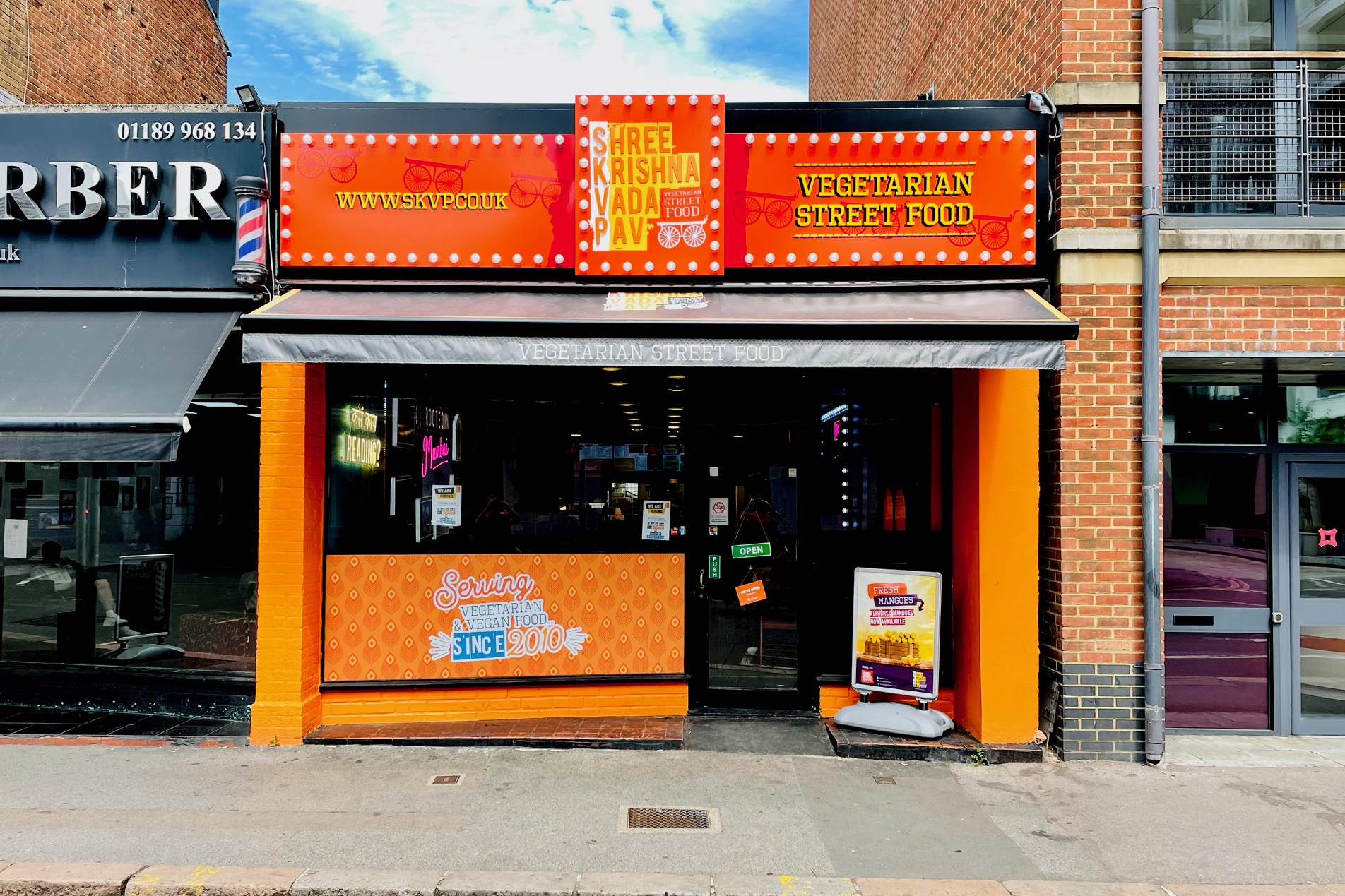
“Why is this the subject of your interminable preamble this week?”, I hear you say. I thought you’d never ask. The reason I talk about all of this is that the subject of this week’s review is that rare thing, a chain choosing to plonk a branch near the centre of town that people can get genuinely excited about. Because Shree Krishna Vada Pav, a small chain selling vegetarian Maharashtrian street food which started out in Hounslow and only has three branches outside the M25, comes here with an excellent reputation.
Subscribe to continue reading
Become a paid subscriber to get access to the rest of this post and other exclusive content.
What’s your favourite restaurant? Your absolute favourite, I mean. I ask because a couple of weeks ago I was sitting in my friends James and Liz’s back garden in Bristol, drinking white wine on a sunny afternoon and having exactly that conversation. The wedding we’d been to the day before – on a Wednesday, no less – was that miraculous thing, a wedding where you’re not hung over the morning after, and so the day stretched out in front of us, feeling partly like a Sunday, partly like something else.
James refused to take part: he didn’t believe in picking a single favourite. So we talked instead about possibly allowing everyone to choose three. But if anything, that made it more difficult, because then you had to pick at least one from your home town and then you were forced to choose just the two restaurants from everywhere else you have ever been.
Liz said that you couldn’t pick somewhere you’d only been the once, but that didn’t help either. Zoë started waxing lyrical about Eetkaffee De Lieve, a little gem in the sidestreets of Ghent, and I daydreamed about sitting outside at Uvedoble in Malaga, demolishing a little brioche stuffed with suckling pig. But which restaurant in Bologna to pick? And how could you leave out Paris? It was just too much of a puzzler.
“I think my favourite restaurant right now is Marmo” said Liz – with a hint of trepidation, because we had a table booked there that evening. And I understood that nervousness better than most, because there’s little as nerve-wracking as telling people that somewhere is good, knowing they’ve gone there because of you and then sitting there waiting to find out whether they’ve lost all faith in your good opinion. I get that all the time.
We went to Marmo with Liz and James’ friends Ed and Ben, a very entertaining couple they’d been telling me about for some time. It was clear straight away, as we took our seats at a Belgian beer bar in the old city, that they liked the finer things in life, which always makes me feel like I’ve found my tribe but also brings out the imposter syndrome.
On our walk to the restaurant Ed and Ben asked me which restaurants I liked in Bristol, and I couldn’t help but feel that this was a test. I didn’t go to Bristol often enough to be on top of the latest developments, but then I mentioned my love of the sadly departed Wallfish, a little neighbourhood restaurant a stone’s throw from Clifton Suspension Bridge, and there was a tacit nod that indicated that I might have just about scraped a pass.
Marmo is a single, buzzy room – all handsome white wood panelling and framed prints on the walls that you daydream about nicking (I also would have loved one of the branded wineglasses, come to think of it). There’s a tiny kitchen at the back, clearly in view, where all the magic happens. Our table was in the heart of things, close to the bar, and I tried to remember what this place had looked like in its previous incarnation as Bar Buvette, a wine bar I’d loved that made you feel like you were somewhere in the eleventh arrondisement.
The menu made you want to order everything, and was compact enough that we nearly did. There were a few snacks and then a 3-4-2 formation of starters, mains and desserts respectively, with one fish dish and one vegetarian dish on offer for each course. The menu looked carb light, but the waiting staff explained that you could have an intermediate pasta course to fix that, as the Italians do, or just have some bread. Starters were around nine pounds, the most expensive main was eighteen pounds fifty. The wine list – of which Marmo seems particularly proud – had a superb selection of red, white and orange wines, with a few producers I’d heard of and many I fancied trying.
In short, it was a menu to get lost in, and we did that while drinking glasses of Muz vermouth, served properly with ice and a wedge of orange. I loved it, and said that the tangy, fruity note in it was strangely reminiscent of brown sauce. There was an awful moment while I waited for someone to tell me I was talking bollocks, and then to my huge relief there was agreement around the table (Zoë didn’t enjoy the rest of the vermouth from that point onwards: “I tried”, she told me later, “but all I could taste was the vinegars”).
Aperitivi deserve accompaniment, so we kicked off with Marmo’s textbook sourdough. It came with butter, which no doubt would have been fantastic, but we were all more keen to dip it in smoked cod roe, perfectly salty and pastel pink, with a pool of olive oil at its centre. Also pastel pink was the mortadella, draped over gnocco fritto, little fried parcels of joy. I’ve never liked mortadella, not even in Bologna, but I loved it here; Marmo, like the best restaurants, can make you enjoy ingredients you wouldn’t normally look at twice.
We’d been torn between a couple of white wines – one from Jura which would have had more funk, and a more conventional Riesling from Staffelter Hof, a producer I recognised because one of their wines crops up on Clay’s fancy new wine list. I tried to palm the casting vote off to Ed, who clearly knew his wine, and he eventually plumped for the Riesling (I’m sure the fact that it was called “Little Bastard” was an unintended bonus).
But then the staff came over and said that they only had one bottle of Riesling left, so we went for one of each. Those of us who tried the Riesling were delighted by its cleanness, the slight effervescence on the tongue. Those who decided to drink the Jura were pleased to have picked something so unusual, with agricultural notes of scrumpy and sherry knocking about harmoniously in the same glass. We all changed ends at half time, tried the other white wine and in the end decided that they were both terrific.
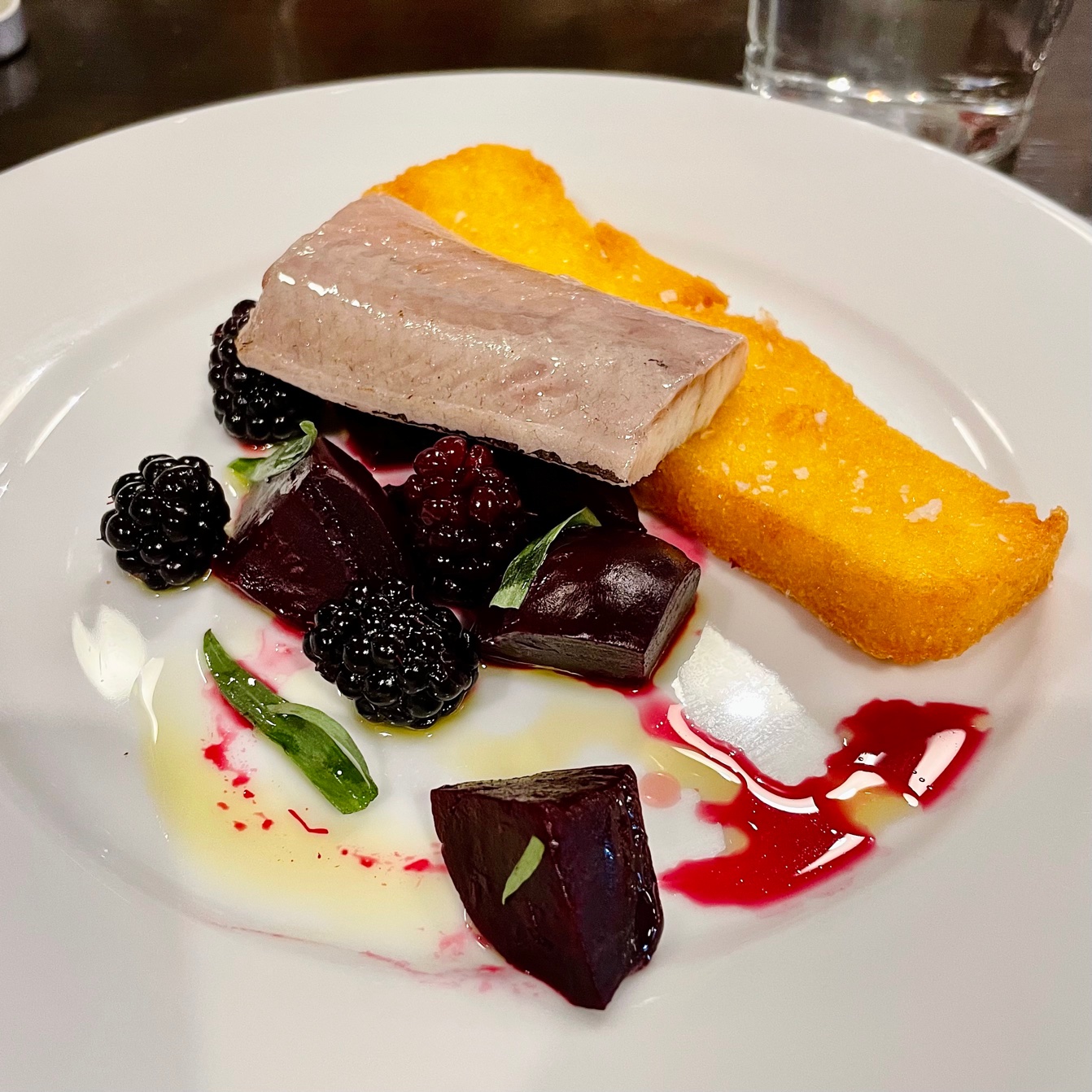
By this time the starters had turned up, and I got my first sign that I was in for an evening of sustained brilliance. I had gone for smoked eel, beautifully muscular and only lightly smoked, on an oblong of crunchy fried polenta. So far so delicious, but teaming it up with bright cubes of beetroot and blackberries with a balsamic sweetness was a killer blow. I could have eaten this all the live long day, and it left me wanting more – or, to be more specific, another portion. That’s what great starters do.
Although it was the most popular starter, a couple of us tried something else. Liz spoke highly of her marinated peppers, buried under an avalanche of Ticklemore, and I could see that I would have been equally happy with that. Ed had chosen the beef tartare, topped with chives and a slow-cooked egg yolk, flavour soaking into the bread below. How could you have food envy when you’d enjoyed your own starter so much?
I was sitting between Ed and Ben – the kind of civilised couple who don’t have to sit next to one another all evening – and, being a civilised couple, they passed plates back and forth across me, or behind me, or through me so that neither of them felt left out. But I was having such a good evening that I was more than happy to be the proverbial dumb waiter.
They were in the holiday mood – Ed’s mother was visiting their cottage in the Chew Valley over the weekend and then they were off to Cornwall for a well-earned break eating and drinking their way around that part of the world. They would spend much of the following week in their own favourite restaurants. I recognised kindred spirits, the kind of people – like me – who plan a holiday entirely around lunches and dinners, who enjoy going to places they know and love, experiencing the comfort, familiarity and total relaxation that comes with a pilgrimage like that. At the tail end of my own holiday, I couldn’t help but feel envious.
Given that Marmo was at least nominally Italian, I felt like we should have at least one Italian wine with our meal, so I chose a Tuscan red called Infraded, a deep, velvety Syrah. Ordering wine had been delegated to me by this point, but I was almost merry enough to be happy with that. Again, I felt like I’d committed a faux pas when the waiter told us this one was best served chilled, but Ed reacted with delight and I decided that on balance, I’d got away with it. It was, as you can probably guess by this point, predictably wonderful, and I made a mental note to see if there was anywhere you could buy some when I got home and Bristol was just a distant, happy memory.
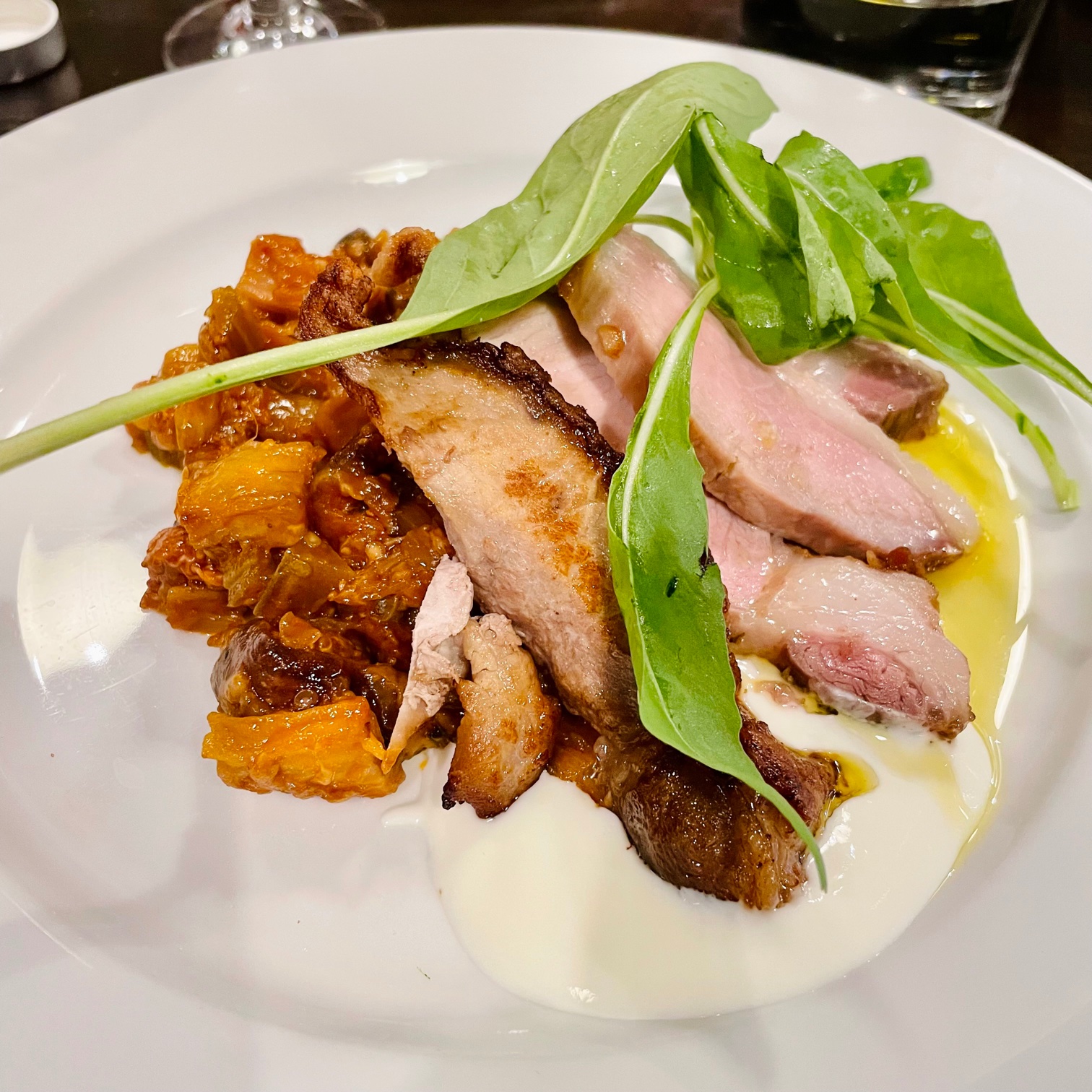
The main courses brought more fireworks. I’ve always heard Mangalitza pork spoken of in hushed tones as the Kobe beef of the pork world, but I’d never tried it before so I was keen to pick it off the menu. It came in glorious marbled slabs, just-pink and tender with the most beautiful melting fat: eating it I could understand why the Italians got so excited about lardo, and the idea of eating fat on its own. It was served simply with a handful of other elements, a wonderful caponata given a fresh edge with the judicious addition of fig, some good oil and a little slick of yoghurt. It was as good a single dish as I’ve eaten this year: I looked over at James, who had ordered the same thing, and saw him lost in a reverent silence.
That silence was eventually broken by Ed telling a story from the time when he used to manage a bookshop in Oxford.
“We had lots of celebrities in while I was there, but the best rider we ever had was from Roger Moore. And Roger Moore only asked for two things.”
“Really?” I tried to imagine exactly what vintage of Château Mouton Rothschild would feature in Sir Roger’s demands. “What were they?”
“A bottle of Jacob’s Creek and a Pret crayfish sandwich. That was all, every time. And by the end of a signing he was always absolutely fucked.”
This couldn’t help but make me warm to the great man. And of course, Ed had a picture on his phone of him with Jacob’s Bond, although it wasn’t clear how much wine had been taken by that point. Ed’s main course was a very attractive-looking pollock dish with mussels, and although he was taken with it, it it didn’t give me any buyer’s remorse about the Mangalitsa pork. Liz had chosen the vegetarian option, a very accomplished spinach and ricotta ravioli dish. Again, although it looked the part, missing out on it didn’t fill me with regret.
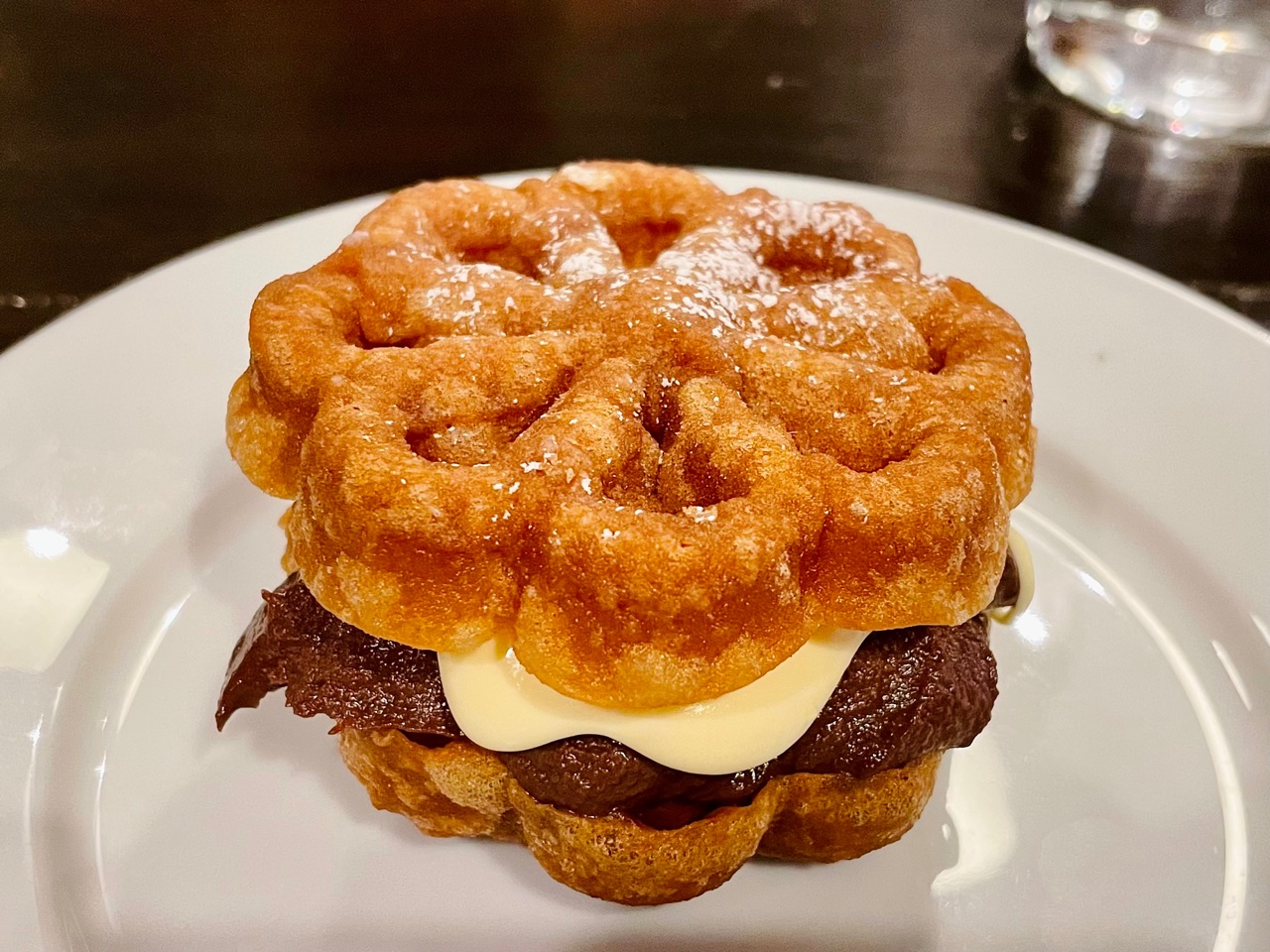
There were only two desserts on the menu and we all fancied the same one, the chocolate and hazelnut fritter, so five of us went for that while Ed nursed a grappa. It was an exemplary way to end the meal, a deep, smooth chocolate mousse, sharpened with cream and sandwiched between layers of the lightest of batters. Looking at the picture, it resembles nothing more than a witty dessert take on the ubiquitous burger: would that it was anywhere near as easy to get hold of, but it seems you have to travel to Bristol. We accompanied this with a sweet, fresh and generous glass of Coteaux de Layon (always a better bet than Sauternes, if you ever see it on a menu) – although Zoë had a negroni, because she’s developing a taste for them.
If I haven’t talked much about service it’s because they were so good. Completely unobtrusive but always there when you needed them, really friendly and enthusiastic and very good at what they did. We needed to pay at the same time as ordering our dessert so Ed and Ben could make their taxi on time, and all of that was no trouble and very efficiently sorted.
Our meal for six, including a discretionary ten per cent service charge, came to just over four hundred and ninety pounds, or something like eighty-two pounds a head. That might sound like a lot, but we really went for it – aperitifs, snacks, a three course meal, plenty of wine and dessert wine. You could spend less and I have no doubt you’d still have a superb meal, and if you find yourself in Bristol at lunchtime they have a set menu which is even more impressive value. But either way I had no regrets – a couple of nights before I’d eaten at Paco Tapas, Bristol’s Michelin starred tapas restaurant, where I spent significantly more, eaten and drunk considerably less and not had quite as much fun. You pay for a meal, but you pay for memories too.
Even as I was eating at Marmo, I knew that the marker had been set down for the rest of this year and probably most of the next: as complete, satisfying and perfect three course meal as I could imagine. I would go to Bristol to eat here again, and I would plan trips to Bristol just so I could. It’s not my favourite restaurant – if only because you can’t give that accolade to somewhere you’ve only eaten at once – but it was my favourite meal for a long time. And if you ever wonder why I don’t give out higher ratings more often, this is why. I save the big guns for the great meals, and this is the kind of standard Reading restaurants need to aspire to, slowly but surely. I still hope we’ll get there. But in the meantime, we’ll just have to hop on a train.
As of June 2024, Kungfu Kitchen has moved to a new site on 62 Christchurch Green, a minute’s walk away from its old site.
I love lists, to an extent which probably verges on unhealthy. At any given time I have several on my phone: things to do; shopping to get; household chores to finish; people to see. I enjoy the feeling you get – and if you’re wired like me, you’ll understand what I’m talking about – when you add something to a list for the sole reason of immediately ticking it off. Really, I ought to have a list of all my lists where I rank them in order of preference, but even I know that might be taking things too far.
Anybody with a to do list will also know that there’s always at least one thing on any to do list that you keep shunting to the bottom. You look at it, you’d like to be the kind of person who tackles it right away, but in the end you know you’re really the sort to leave it to another day. Some days, every item on your to do list looks like that: those are the days when personally, I’d rather just stay in bed.
Kungfu Kitchen, the Chinese restaurant on Christchurch Green, has been on my reviewing to do list all year without ever getting to the top. There’s a website, which is stunningly uninformative, and a Facebook page which has a couple of decent-looking photos but nothing more. They’re on Twitter, but they haven’t Tweeted this year. (N.B. Following this review Kungfu Kitchen has updated its website with a full menu – the link is at the end of this review – and has become much more active on Twitter.) The menu looked on the authentic side, as far as I could tell, but the Tripadvisor reviews were mixed to put it lightly. So my regular accomplice Zoë and I walked up the hill towards the university area with a certain degree of trepidation, not at all sure what to expect.
Subscribe to continue reading
Become a paid subscriber to get access to the rest of this post and other exclusive content.
One question I’m often asked is: why are your reviews so bloody long?
Well, it’s a reasonable observation. When I wrote a piece for the editor of Explore Reading, she gave me a word count of 800 words and expressed some scepticism about whether I’d be able to stick to it. “You normally haven’t even got round to talking about the food in one of your reviews by then” she said. A fair cop, I suppose: there’s always something to be said first about the context. There’s scene-setting to do, not to mention introducing the person you’re going to dinner with. And if all else fails, I can always get on my well-worn soapbox and pontificate about Reading (although not Caversham: heaven knows I’ve learned that lesson). The first eight hundred words fly by – to write, anyway, if not necessarily to read.
The problem is that, this week, that’s harder to do than usual. After all, Soju isn’t Reading’s only Korean restaurant. It’s not even the first: Gooi Nara up on Whitley Street opened before Soju (and I had a lovely time when I went there). It’s not necessarily that unique within the gastronomic Bond villain lair that is Atlantis Village – or whatever it’s called at the time of writing – because small chain Pho opened just across the way offering Vietnamese food (and I had an okay time when I went there). So where’s the angle? There probably isn’t one, but on the other hand Soju is a genuinely independent restaurant in a prime central spot in town, and it’s traded for a while without coming a cropper. That has to be worth a visit, I thought.
Subscribe to continue reading
Become a paid subscriber to get access to the rest of this post and other exclusive content.