Thames Lido

Click here to read a more recent review of Thames Lido, from December 2024.

Here’s something that happens quite a lot: I have friends who read the blog and some have been known to put in a request to accompany me on particular reviews. “Anyone coming with you to Taberu?” one will say, or “Next time I visit you for lunch, shall we go to Comptoir Libanais? You could write it up for your blog.”

Not that I mind: it’s nice that people take an interest, and better to be spoiled for choice with dining companions than to have to ask nicely or, worse still, beg. But some reviewing opportunities are more prized than others, and none more so than Thames Lido. It opened last year, after years of money-no-object, it-takes-as-long-as-it-takes restoration work, extensively catalogued online in a series of beautiful pictures (whatever else you might think of Thames Lido, they get social media right in a way which puts other Reading restaurants to shame).

In the run-up, there were glossy pictures and features in the broadsheets, and after it opened it received a blandly positive review in the Guardian (which described it as “just off the Reading ring road” – thanks for that). This is no surprise – the original Lido in Clifton is well-established and well-reviewed and has impeccable connections – but the overall effect is that Thames Lido is probably Reading’s first ever destination restaurant. Just don’t tell anybody it’s in Reading, is the implication, in case it puts them off.

So who to take? The decision was made for me when Kat told me, in no uncertain terms, that she was accompanying me. I said yes, because I owe Kat a favour, but she was – on paper at least – an unlikely candidate. Kat has an interesting diet which involves eating sweet and sour chicken balls in the bath, and she’s partial to a battered sausage or a Tesco all day breakfast sandwich.

“Are you sure the Lido is for you?”

“Don’t be silly, I’ve eaten at hoity-toity places before.”

The way this was said reminded me of Rizzo The Rat from Muppet Christmas Carol. Oh well, I had my angle: the irresistible force meets the immovable object, Reading’s destination restaurant meets one of Reading’s most unreconstructed diners. What could possibly go wrong?

My misgivings were exacerbated in the run-up to the visit when Kat sent me a message.

“I’ll also be packing a Gregg’s sausage roll, in case the portions are too puny” she said. “I won’t whack it out on the table or anything, don’t worry. Although, practically speaking, a Ginsters chicken and mushroom slice is more appropriate. A sausage roll doesn’t have the necessary structural integrity.”

What have I let myself in for? I thought to myself as I approached the restaurant with Kat, emergency pasty presumably stowed away in her handbag for later.

When I say “approached the restaurant” that makes it sound like an easier process than it was, on foot on a gloomy March evening. It’s a little tricky to find an entrance – down the side road without signposts or the main road without pavement? – and one of the entrances takes you in to the restaurant while the other one, the main one I suppose, takes you in to the Lido proper. Even picking the right entrance, it was a bit confusing finding our way to the restaurant (and that flair for signposting, or lack thereof, extends to the bit partway through the meal where you try to find the loo). A minor thing, I know, which only applies the first time you go, but first impressions and all that.

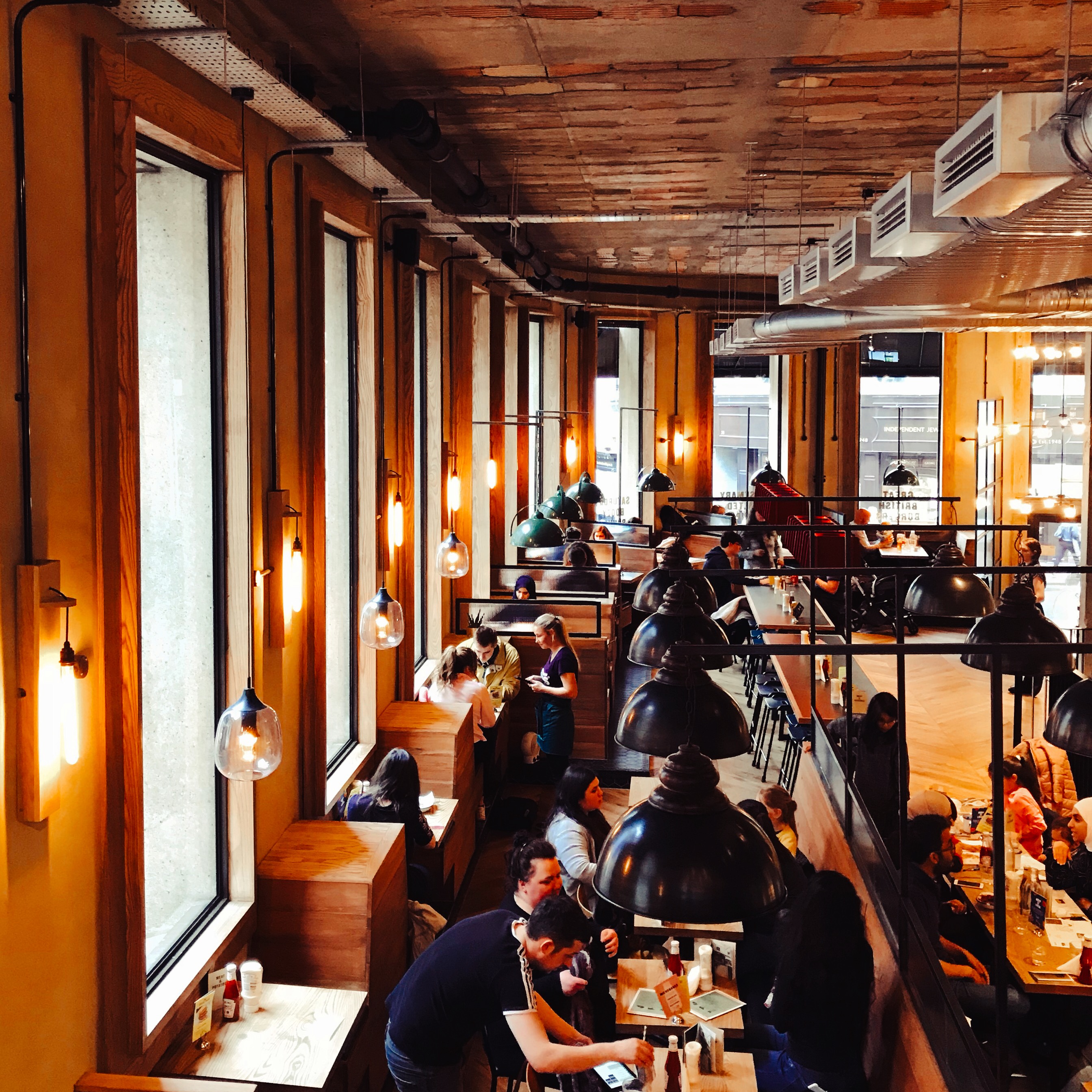
The restaurant itself was – as so often – a long thin room, a shape that’s mandated by its position running alongside the pool. The view was spectacular, with steam rising from the heated pool, the fetchingly retro changing booths beyond. The occasional intrepid swimmer bobbed past and, like no doubt everybody who has visited Thames Lido, I was very impressed by the quality of the restoration. It carried through into the furniture – sturdy, handsome tables, generous and roomy for two people, and the kind of chairs you could imagine settling into. It’s a high-ceilinged, airy space and thought had even been put into that, with fabric panels hanging from the ceiling to absorb noise.

If you get a table alongside the pool, that’s great. The other tables – like the one we were given – feel far less special and force one of you to forego the view and stare at the bare brick walls. We asked to move as a poolside table came available and they moved us without complaint. The menus didn’t come with us and it took a fair amount of flagging down staff before they reappeared at our table.

We started by hitting the gin menu, which is divided up on the good/better/best principle with some at £7, some at £9 and some at £11.50. Yes, you read all those right, and tonic is extra. Only two tonics are available, so you get Schweppes for £1.50 or Fever Tree for £2. That makes most of the gins more expensive than the Lido’s cocktails, and some of the gins are also very oddly priced. I was surprised, for example, to see Gin Mare, readily available in supermarkets and pubs like the Fisherman’s Cottage, on sale for £11.50. Each of the gins had modish tasting notes made up of three adjectives, although how Gordon’s tastes of “historic” is anybody’s guess.

Do I sound cross? It’s probably because I was, a little. I’ve been to lots of establishments with gin lists, from pubs to Michelin starred places, and they all make great effort to pair the gins with different mixers, different garnishes, serve them in big balloons so you can almost breathe in the botanicals. Not so at the Lido, where both gins turned up in a highball with ice and lime, nothing more. The Jinzu with Fever Tree (total cost thirteen pounds fifty) was pleasant, light, sweet and floral, but the main thing I thought with each mouthful was just how expensive it was. “Hotel prices”, murmured Kat disapprovingly. The Psychopomp Woden with Schweppes was punchier, a brutal mixture of fennel and grapefruit, and a relative snip at ten pounds fifty. You only got 125ml of Schweppes as opposed to 200ml of Fever Tree, another thing the menu neglected to mention.

The gin took a while to arrive, so we grazed on the complementary bread with olive oil. Again, I had heard great things but this was tough going – nicely seasoned but dense and heavy with no light, crispy crust, more murder weapon than appetite whetter. “I was here for the set lunch earlier in the week and the bread was so much nicer” said Kat. “It was warm, soft inside and the crust was brilliant.” I couldn’t help wondering if this was the same loaf, a few days later.

The menu managed that rare feat of being interesting and nice to look at without having anything on it that you absolutely had to order. I was expecting some kind of plea bargaining with Kat (and if they’d still had the slow cooked ox cheek in Pedro Ximenez on the menu that might have happened) but as it was, neither of us had a first choice to go into battle for. We eventually placed our orders with the waiter, a rather disengaged man who spent much of his time serving us looking around, as if hoping to speak to someone more interesting (“he’s like a really rude date” was Kat’s observation).

I was in the mood for a leisurely evening, but even so I was pleased when the starters made their way to our table. They represented the high water mark of the meal. Kat’s wood roasted asparagus with almond sauce and cecina looked like the kind of dish to provoke full-on food envy: a generous sheaf of asparagus, thinnish spears, with the almond sauce and what looked like jamon, and a hoard of toasted almonds, little grenades of flavour, hidden underneath. I assume the asparagus was very early season – although it was odd that the menu didn’t mention this – and it was terrific stuff. Kat waxed lyrical about the almond sauce, saying it was salty but with a sweet edge, in a manner which suggested I might have misjudged her after all. If I was being pedantic, I’d say that cecina is normally beef rather than ham, but that hardly detracted from how delicious the dish was.

Burrata, if not as good, was still thoroughly enjoyable. Serving it with heaps of broad beans and peas, if anything, made it even cleaner and fresher, a little reminder that spring was just round the corner, even if it didn’t quite feel like it yet. A slightly funkier note was introduced with the liberal dusting of dukkah, which added spice and edge and saved the whole lot from being just a little too nice. I didn’t get the promised yuzu, but it didn’t feel like the end of the world.

Our wine arrived almost immediately after I uttered the words “do you know what, I’d really like my wine now” to Kat. The gins were nearly finished (well, you want to take your time on something that expensive), the starters had long since been dispatched and the main courses were about to turn up. It felt truly odd that the wine hadn’t materialised by that point. The waitress who brought them – and served us from that point forward – was considerably more likeable, chatty, knowledgeable and clued up than the chap we’d been talking to before, a clear reminder of the difference between being served and being looked after. We’d gone for a Jeune Musar, a pretty entry level Lebanese red at £33 (although still about a three times markup from retail price) – I liked it, it was nicely balanced and although it started out a little tannic it opened out nicely given a little time. A shame it wasn’t given more time, really.

I’d gone for the lamb leg (Pyrenean, no less) and was generally pleased with my choice. The lamb was cooked beautifully – I could have stood it a little pinker, but it was close enough – with a lovely layer of fat and a beautiful salty char on the outside. The beans, some of which I think were pureed or mashed, added a nice earthiness. The salsa verde was packed with parsley and mint and absolutely made the meal; I could have eaten it with pretty much anything. Only the rainbow chard – pretty but tough going – misfired, it felt like it had been added for betterment rather than enjoyment.

Kat, on the other hand, picked the dud: hake, with mussels, celeriac and saffron broth. The fish was a nice piece but it was underseasoned, with only half the skin crispy. “It’s all a bit bland except the broth”, she said “and that just gets saltier the more you have of it”. I had a taste and couldn’t disagree. Weirder still was the marriage of chickpeas – which you’d absolutely expect in this kind of dish – and lashings of dill, which you just wouldn’t. Dill is a distinctive enough taste that you’d expect it to be mentioned in the menu, but no joy. Kat left some, and Kat – as you can probably tell from the emergency pasty – is not someone to leave food.

The side dish I really fancied – cauliflower with lemon and zata’ar – was sold out so we went for the crispy fried potatoes with rosemary and garlic. The taste was good, but the texture felt neither crispy nor fried. It was almost like someone had just lobbed them in a baking tray for half an hour, and there was certainly no evidence that they’d ever seen hot fat. I couldn’t help thinking how much better Honest’s rosemary fries were. I couldn’t even be sure these were significantly better than Café Yolk’s fried potatoes, and they came out of a packet. Again, we didn’t finish them. “If they’d actually been crispy you’d have had to fight me for them” said Kat.

The reputation of the Lido’s ice creams precedes it – they make up most of the dessert menu, after all – so it felt almost compulsory to order some to round off the meal. It’s six pounds for two scoops, and although many of the flavours were tempting Kat and I fancied the same ones so we decided to just go for it (with hindsight, the tasting flight to share would only have cost a little more and would have made a better option). They came in beautiful little bowls, and bringing each flavour in a separate bowl was a lovely little touch, because this is an area where you really don’t want to cross the streams.

Of the two, the chocolate and beer ice cream was by far the best, a clever thing where the chocolate hit you first and then the malty darkness of the Estrella “Black Coupage” snuck in at the end. The salted butter caramel I found less impressive – it seemed to lack much in the way of salt. Kat liked the caramel shards, I found them a tad unnecessary. Overall I quite liked the ice cream although I wasn’t entirely sure whether I six pounds liked it. The texture, although free of crystals, was gritty rather than smooth and maybe not quite special enough.

“It’s okay” said Kat, “but, like everything else, it feels about a couple of pounds too expensive. Also, and I know this sounds silly, my ice cream is too cold.”

“I know the way to fix that. You just wait.”

The glass of dessert wine we had with it – a Banyuls, like a slightly sweeter take on port – was terrific. Lovely, if a little pricey, and consequently both an excellent and fitting way to bring the meal to a close. Dinner for two, including an optional ten per cent service charge, came to one hundred and sixty-six pounds. It’s possible to eat for less, but even if you skipped the gin and the dessert wine it would still have clocked in at over a hundred pounds.

This has been a tricky review to write, and it’s a particularly difficult review to conclude. It can’t be denied that the Lido is a fantastic restoration project. What they’ve done with the building is amazing, it looks beautiful and it does make you feel a little prouder of Reading just to see it. And I can easily see that it’s an expensive labour of love, and those costs need to be recovered somehow – whether that’s through swimming, or massages, or packages, or through the restaurant.

I’m also aware that practically everything I’ve read about the Lido has been glowing praise, so I stick my head above the parapet with no great enthusiasm to say that, good though it is in places, it’s not quite good enough. The building has a wow factor the food can’t live up to, and everything feels just a little bit too expensive. The service didn’t match the surroundings either. Maybe it would have been different on a night where the dream team of Matt Siadatan (previously of Mya Lacarte) and James Alcock (from London Street Brasserie) were on duty, but as it was everything felt patchy. The restaurant was far from packed, but from the wayward service you’d think they were run ragged.

I might consider going again for the set lunch, and I can see that jumping off the train on a summer afternoon and having tapas at the poolside bar could be hugely enjoyable, but as a standalone restaurant it didn’t leave me in any hurry to return. “It’s a real pity, isn’t it?” said Kat. “I was hoping to find THE place in Reading, and I really thought the Lido could be that, but it isn’t.” Let’s not leave the last word to Kat though, let’s leave it to Kat’s pasty. I have it on good authority that she consumed it for a late breakfast at around half-ten the next morning. As a review of the Lido it’s a lot more succinct than what you’ve just read, but it’s as good a summary of the verdict as the number at the bottom.

Thames Lido – 6.9
Napier Road, RG1 8FR
0118 2070640

http://www.thameslido.com/

Fidget & Bob

One of the saddest events of last year was when Tutti Frutti (Reading station’s terrific ice cream café) closed abruptly back in October. I found out while on holiday: on the Monday morning I grabbed my regular latte from Paul before jumping on the RailAir – a holiday ritual I’ve always loved – and the next thing I knew I was drinking in a plaza in Andalucia and hearing troubling reports from Blighty that Tutti Frutti was no more. They were correct; I’d had my last latte there and I hadn’t even known it. By the time I got back to Reading all the kit had been taken out; five months later, the signs still say a new store is “coming soon”.

This is why we can’t have nice things, I ranted on Twitter for what may have been a week but, to many, probably felt like longer. I was cross with Network Rail for not treating Tutti Frutti better. I was cross with our local media for not celebrating the place more (the piece they eventually ran about the closure was an apology of a thing). I was cross with the people of Reading for going to Costa or Starbucks instead, when brilliant coffee and service were a stone’s throw away.

After I’d got over it – and, I suppose, myself – I realised the truth was more complicated. There was another reason why nobody had seemed to know Tutti Frutti was there. Several other reasons, in fact: no website; limited Facebook presence and a Twitter feed which made it look like the place closed a long time ago (the last Tweet dated from June 2015). Could anybody rely solely on word of mouth in this day and age? Was it enough to expect your customers to do your advertising for you?

Subscribe to continue reading

Become a paid subscriber to get access to the rest of this post and other exclusive content.

Pho

To read a more recent takeaway review of Pho, click here.

“You never go on a review with two other people, do you?” said Reggie as he, Claire and I took our seats at Pho. I’d been due to go on duty just with Reggie, but Claire and I were having a quick drink after work when Reggie came to join me and we had one of those “let’s put on the show right here” moments. Looking across at my two friends, side by side like an interview panel, I realised that they might well spend much of the evening taking the piss out of me. Oh well, at least I’d get to try more starters.

“Well, not recently. I mean, I have in the past. It’s not like I have a legion of friends to choose from.”

Reggie smiled. “Three people, I like it. It might be a bit quirky.” Reggie is a big fan of Tony Blair and, like Tony Blair, I sometimes think he’s a little too worried about his legacy. Claire did a face I recognise, where she looked like she was rolling her eyes without actually doing so: it’s a neat trick, if you can manage it. I resolved to write a review as lacking in quirks as possible: that’ll teach him, I thought.

Subscribe to continue reading

Become a paid subscriber to get access to the rest of this post and other exclusive content.

Honest Burgers

I’m no expert on Where Reading Is Going. I read our “Vision For 2050″ (which seemed to have precious little to do with Reading) and was none the wiser. I don’t understand what “Reading UK CIC”, “Living Reading” and the “Business Improvement District” actually are, or what they’ve achieved, and what with having an actual job I never get to attend cultural talks at 6pm on campus or the First Friday Club in Brown’s listening to the movers and shakers.

I’ve never been to the Reading Cultural Awards or the Pride Of Reading Awards (Danyl Johnson’s one guaranteed gig every year). I wasn’t on the bus to Tate Modern recently to join a discussion about the arts in Reading, almost exclusively peopled by Reading folk, in London. I have no idea why we keep appointing people from out of town to run our cultural events instead of our excellent home grown talent. Answers on a postcard for all of the above, please, to the usual address.

It does strike me though, in my ill-informed way, that Reading’s at a bit of a crossroads. What kind of town do we want to be? We could try to emulate somewhere like Bristol, with its blossoming cultural scene, superb market, brilliant food scene and countless independent shops. I love Bristol partly because it doesn’t try to be a lesser clone of anywhere. It ploughs its own furrow and – this is something Reading could really learn from – is fiercely proud of its culture, its history, its traditions, even the accent.

Alternatively, we could simply become Zone 8 – added to the Tube network through Crossrail, with all the London chains expanding here and all the trends eventually arriving here too, a few years after they’ve stopped being hot. With the snazzy new Westgate Centre up the road in Oxford, we finally have some local competition. We may have a Franco Manca, but they have a Pizza Pilgrims. Oh, and Oxford has a Leon and a Thali Kitchen, neither of which currently operate here. The big brains of Reading must worry about how to guarantee their supremacy (it all reminds me of the legendary Reading On Thames take on Downfall).

Where does Honest Burgers fit into that narrative? Not another chain, said some people when they announced they were coming to Reading. Not another burger restaurant, said others. But Honest is a more interesting beast than that. For a start, if it is a chain it’s a very small one – predominantly in London apart from a branch here and in Cambridge. The expansion seems slow, careful and considered rather than the result of a huge injection of capital and a relentless business plan (the way that all chains tarnish).

Subscribe to continue reading

Become a paid subscriber to get access to the rest of this post and other exclusive content.

Gooi Nara

Click here to see a more recent review, from June 2026.

I first went to Gooi Nara in late 2016; I was on what I suppose you could loosely have classed as a date, with somebody I suppose you could loosely have classed as a vegan. I sat there trying to sound enthusiastic about tofu (not a skill I’ve ever mastered, truth be told) and then I ate my disappointing bibimbap while all around me, the other diners were wolfing down Korean barbecue, grilling a plethora of delectable looking meats on the hot plate in the middle of their tables. They all seemed to be really enjoying themselves, and as the weeks passed I came to think of that evening more as a metaphor than as an actual meal.

Naturally I wanted to take a more suitable dining companion when I went back on duty and, on reflection, there was only one suitable candidate – my friend Claire. Not only had she actually been to Korea but she’d written a review of Korean restaurant Soju for Explore Reading which was responsible for teaching me pretty much everything I knew about Korean barbecue (admittedly not much).

Much has happened since Claire last accompanied me on a restaurant review, most significantly that Explore Reading had begun publishing restaurant reviews. A lot of people have asked me if I mind that, and of course I always say I don’t mind in the slightest, Reading benefits from a variety of restaurant reviews and that it’s not right for one site to have a monopoly. That said, it’s a running joke between Claire and I that she’s going to take me down; first she took on Alt Reading, which finally announced that it was quitting – for the time being, anyway – this week, and now she’s coming after me.

I’m mainly joking, of course. Mainly. In the run-up to our trip to Gooi Nara I make some gags about how it will be like the infamous dinner at Granita where Tony Blair and Gordon Brown agreed when the former would stand down in favour of the latter. After doing the joke I realise I’m not entirely comfortable being cast as everybody’s favourite grinning war criminal.

“I’ve always had a soft spot for Gordon Brown,” says Claire, “but then I like an underdog.” It made sense, on reflection: we each spend a lot of time championing Reading, so perhaps we both do. In any case, I strolled up the hill to the restaurant on a quiet Monday night with no plans to announce my retirement.

I’m always struck by how often I start a description of a restaurant by saying “it’s a long thin room”, like it’s the equivalent of “it was a dark and stormy night”. Well, brace yourself, but Gooi Nara is indeed a long thin room, but a surprisingly attractive one. One side was covered in slate-effect tiles, with a couple of wood stores in the wall that would no doubt come in completely useless in fuelling the fake fire showing on the wall-mounted widescreen television. The other side was a vibrant burnt orange, with oblong shelving units populated, in a slightly OCD manner, with little objets. There were dark wooden beams spanning the ceiling, such a pleasant change from the ten-a-penny industrial pipes and bare bulbs which always give a place a slightly unfinished look. I really liked the place.

“It’s funny, I wouldn’t necessarily say this is authentic Korean, but it has that feel about it” said Claire. “It’s sort of homely, but in a good way – even down to the windows.”

The first surprise came when I looked at the menu. Gooi Nara has a sister restaurant in Guildford called Sushi Nara, and as a result I was thrown to see that aside from a Korean menu there was also a whole menu of Japanese dishes – sushi, sashimi and the like. It was tempting to order some, because Reading still needs an excellent Japanese restaurant and Taberu, on the Oxford Road, is still doing delivery only at the time of writing. On reflection, though, I decided to remain steadfast: I had turned up to eat Korean barbecue, and eat Korean barbecue I bloody well would.

Not that you have to do that, of course: the Korean menu alone was massive. There were plenty of starters, although some, like takoyaki (octopus balls) and pumpkin korroke felt like they were on the run from the Japanese section of the menu. There were soup dishes and rice dishes, noodle dishes and hot pots and – as I remembered from my previous trip – plenty of tofu and bibimbap. But the trick with barbecue, Claire told me, was to order your meats of choice, cook them on the hot plate in front of you and dip them in vinegar and sesame oil before placing them on a lettuce leaf, adding kimchee and beansprouts and then wrapping the whole thing up and popping it in your mouth. I’m not the biggest fan of finger food, but put that way it’s hard to imagine a more enjoyable way to eat.

Before that though, we tried one of the starters I had my eye on – the seafood pancake. It turned up cut into squares, on a paper doily on a wicker serving dish, a bit too fiddly and faffy (“We Want Plates need to be told about this” said Claire, waspishly). It was a little fiddly too to pick up with chopsticks and dab into the dish of dipping sauce which, as so often, was too small to be useful. That all said, it really was lovely stuff. Claire told me these were made with wheat flour, but if anything the texture was so starchy that it reminded me of a potato cake – more like a latke than a pancake. Despite that, it wasn’t heavy at all, and the spring onion throughout gave it texture and freshness. I got squid in the pancake, and I may have missed the shrimp – we all make mistakes – but the menu also advertised octopus and I’m pretty sure I’d have noticed that. Still, the pancake was seven pounds fifty, so if it seemed too good to be true, perhaps that’s because it was.

The support act out of the way, it was time for the feature attraction. The waiter came and switched on the hot plate at our table, the meat arrived and, not for the first time, I wondered how anybody ever managed to convince themselves that they enjoyed eating tofu. We’d decided to try all three of the main food groups – pig, cow and chicken, don’t you know – and the first to go on the barbecue was the spicy sam gyup sal, long thin slices of pork belly, deep-red with marinade, a veritable bar code of meat and fat. On the hot plate, the smell was terrific and the transformation beautiful, and Claire and I took it in turns to poke and turn with the tongs until it was impossible to hold back any more (I spent most of that time banging on about the Maillard reaction, and Claire spent most of it nodding and humouring me).

It tasted even better than it looked or smelled, and I loved the ritual of coating it in vinegar and sesame before tenderly resting it in the centre of a lettuce leaf, topping it with brick red kimchee and devouring the whole lot. The kimchee added sourness and crunch without being quite as fiery as some kimchee can be. The spice on the pork, again, built to a crescendo rather than went off like an explosion, and the whole thing was the kind of dish that you can’t help but grin while eating.

It would be a lazy piece of observational comedy to say that you’re basically paying money to cook your own food, but that would be to underrate the service; every time a hot plate got too crusted with meat and residue to use, the waiter would come along, deftly hook it out with a nifty device and pop in a new one. He also gave us advice on what to grill in which order, and regularly kept us topped up with bottles of Asahi (Claire offered to give me a crash course in Soju, but then said it was basically vodka, at which point I found myself really fancying a cold beer).

“Do you know how they clean these?” said Claire, probably well aware that my answer, inevitably, would be no.

“No.”

“They use a lemon. You just scrub the hot plate with a lemon and it all comes off.”

I found myself thinking of those colour supplement adverts that tell you vinegar has magical powers and can clean pretty much everything around the house.

“So, the pork is better than Soju, I think” said Claire, “although here they bring it already cut into strips and at Soju they sort of bring it in a big slab and you cut it up yourself with scissors.”

It would be an even more lazy piece of observational comedy to say you were expected to chop your food as well, so I decided not to mention it. In any case, more meat was on the way. I wasn’t sure how I felt about the ju-mul luk (the beef) when it arrived, because it was in thick cubes and I had been expecting thinner slices. But any doubts I had were caramelised into oblivion as the beef sizzled on the grill, the coating of garlic and sesame searing and producing the most glorious aroma. It was far more tender than its thickness might suggest, with a splendid whiff of garlic which lingered long in the memory (and possibly even longer on my breath).

Last of all, we went for the chicken bulgogi gooi, thighs marinated in soy and sesame. These were probably the most disappointing thing we had – it had been sliced too thinly and broke up into very small pieces on the barbecue. It also had less marinade, so it was the only thing to keep sticking to the hot plate and burning. Still pretty good, but just a bronze medallist in this setting.

“It’s a shame really, because bulgogi is the thing in Korean restaurants” said Claire.

“And it’s the one thing they could have brought out whole” I said. “Just imagine laying a marinated flattened thigh out on that hot plate.”

“The chicken is definitely better at Soju, but the rest is probably better here. And that pork is incredible.”

Claire was right about that. I was also struck by just how good value everything was. Each plate of barbecued meat was a hefty, generous portion and the chicken and pork only cost seven pounds fifty. Even the beef was still less than a tenner. We’d ordered three different plates, but two people could easily get by sharing two – well, two people where one of them wasn’t as greedy as me, anyway.

“You can tell this is good”, I said, “because I’m already trying to work out what I’ll have when I come back.” In my mind, I was already mentally choosing between the feather blade beef and the prawns with lemon and pepper and – predictably – deciding it really wouldn’t be a crime to order both. And possibly a bibimbap. But there were limits even to my hunger, so we stopped there. All that food and six bottles of Asahi came to sixty-eight pounds, including a pre-added ten per cent service charge which I had no problem at all paying.

On the walk down the hill to the Hop Leaf for a post-meal pint and debrief, I asked Claire how she would describe the clientele at Gooi Nara.

“Oh, it was mixed. The table behind us were clearly Chinese – I heard them talking – but the big table nearest the loos were definitely Korean. And this restaurant is near the university, so I expect they get a lot of university students.”

Claire had effortlessly clocked all the other diners, their nationalities and the likely market for Gooi Nara’s food, all while pretending to listen to me talk about the Maillard reaction. She’d had her back to the lot of them. It was like something out of The Bourne Identity, and not for the first time I found myself thinking that if she starts reviewing restaurants regularly it might be the end of my blog. It was a suspicion compounded when we compared notes in the pub about what ratings we’d give Gooi Nara: they were a cigarette paper apart.

I’ve thought a lot about the right word for my visit to Gooi Nara since the meal, and it boils down to a really simple one: it was fun. Fun is an underrated quality in eating out, I think. So much about restaurants is either po-faced or functional at the moment, and when it’s not it’s the type of enforced jollity and zany fun that always reminds me of mandatory corporate away days. But Gooi Nara was properly enjoyable from beginning to end, with an element of playfulness that set it apart from the formula of starters, mains and dessert. I can imagine going back with a big group of people and mucking in, although the one thing I would say is that the barbecue takes up a lot of space on the table, so things could get decidedly cramped in a bigger group. But that aside, Gooi Nara comes highly recommended and I’m really looking forward to going back. Having fun, eating great food and making new friends: I wouldn’t be at all disappointed if this visit, too, becomes as much a metaphor as a meal.

Gooi Nara – 7.9
39 Whitley Street, RG2 0EG
0118 9757889

https://www.facebook.com/GooiNara/