Kyklos

N.B. Kyklos closed in January 2014. I’ve left the review up for posterity.

One thing I’ve learned so far in my – admittedly limited – experience of reviewing restaurants is that some reviews are easier to write than others. Let’s say, for example, that I have a good meal in a good restaurant (or a restaurant that I think is good, anyway). To some extent that review writes itself, and my main worry is doing it justice so that you’ll think it sounds good and hopefully want to eat there yourself. Going to a bad restaurant and having a bad meal also makes for an easy review – less fun to eat, but more fun to write and often more enjoyable to read. But the tricky one is when you go to a restaurant that, in so many ways, is “good” – the room, the service, the little touches – but the food just isn’t up to scratch. But hold on – isn’t a good restaurant a place that serves you good food and a bad restaurant one that serves you bad food? Is it possible to have a bad meal in a good restaurant?

All very Carrie Bradshaw I know, and perhaps I’m showing my cards too soon, but I’ve been thinking about this a lot this week because of my visit to Kyklos. So many things about it work, it should be a good restaurant on paper, but the food doesn’t quite live up to expectations.

I’ve been to Kyklos a few times since it opened. It’s in that spot that’s a bit of an elephant’s graveyard for restaurants, above Burger King in King’s Walk, having at various times been Topo Gigio, Mari E Monti and the Himalayan Momo House. They’ve done a nice job on refurbishing it; it used to be quite a sterile, unappealing space but looks much better now with smart white walls and very fetching white shutters overlooking the Walk itself. The long, thin room has been broken up (with some lit glass partitions with an olive motif which are, I’ve discovered, surprisingly hard to describe) so it doesn’t have the chilly air that its predecessors had, and the bar area at the front has some welcoming seating for those waiting for a table.

The greeting at the entrance is incredibly warm – I’ve only been a couple of times, and not for a while, but I was welcomed by the waitress as if I was a friend rather than a customer. This was definitely the shape of things to come, too; Kyklos does service very well.

Sitting down we were given three menus; food with a wine list on the back, a set meze menu and a short Greek wine list – three whites, three reds, nothing over twenty-five pounds. This was a bit of a disappointment in itself, actually; Greek wine can be very good and is much underrated, and I was hoping central Reading’s only Greek restaurant might do more to show that off. On a recommendation from the waiter we ordered a bottle of Greek white, a Malagouzia which I’d never heard of, let alone tried. We couldn’t decide who should taste it so the waiter poured a little for each of us, which was a nice gesture. Their range of Greek wines may be a bit narrow, but this was gorgeous – fresh, light, floral, not too dry (very dry whites have never really done it for me) and good value at £23.

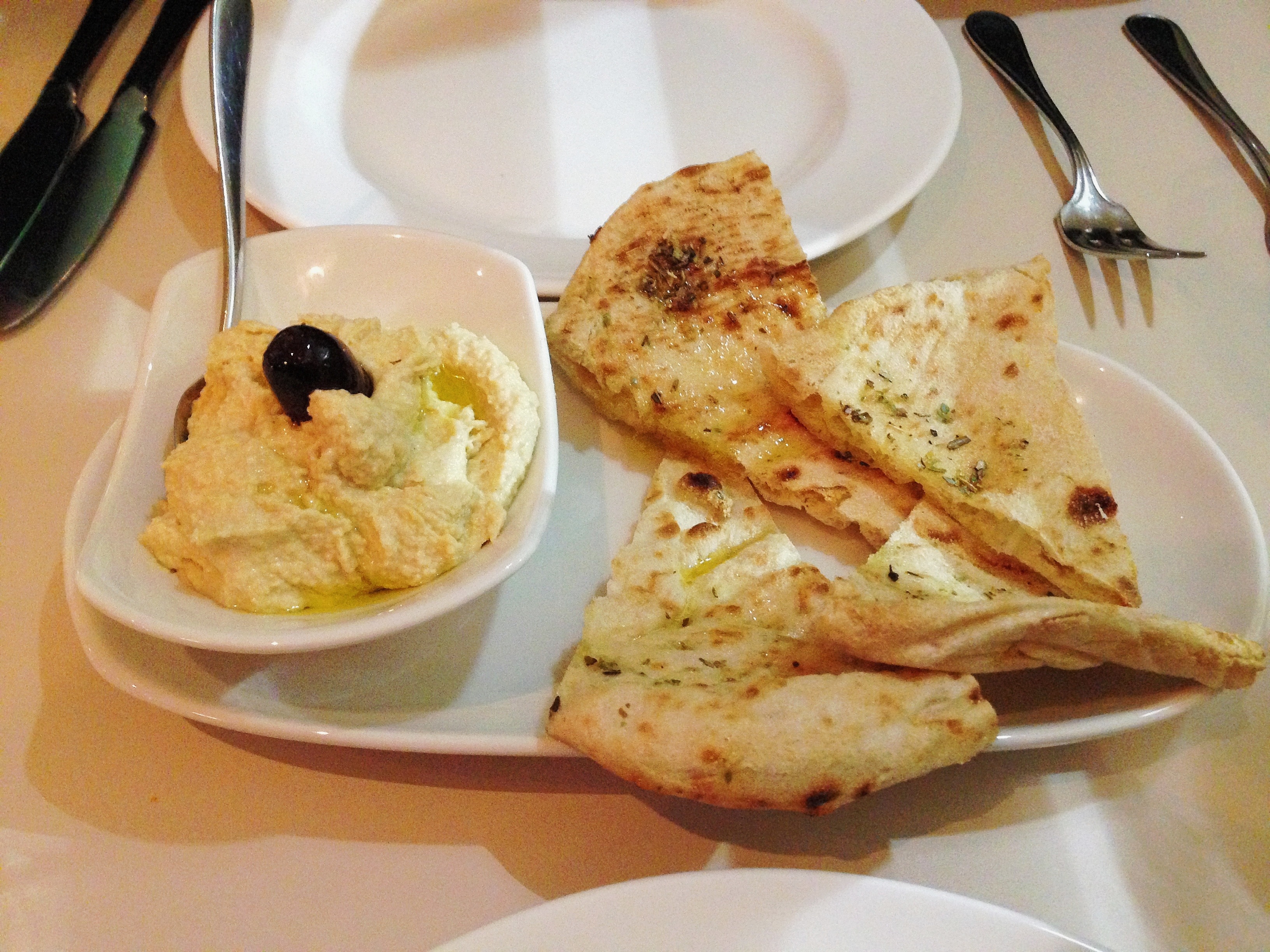
Our starters, a selection of meze, were the first indication that we might be about to have a middling meal in a good restaurant. Houmous was very tasty – often they have a strong smoky taste or are pungent with garlic, but this one was rich with tahini and somehow tasted lighter and cleaner. The pitta, though, was stingy – one warmed pitta slices into triangles, drizzled with oil and sprinkled with herbs. Loading all that houmous onto a single pitta was a challenge, although of course we managed it – heaven forbid that anything went to waste.

Salted cod in beer batter with skordalia was equally frustrating and inconsistent. The batter on the three fingers of fish was light and perfectly done, but the flesh underneath was uncomfortably chewy. The skordalia was plain disappointing; it’s meant to be the kind of garlic mashed potato that can make enemies on public transport the following morning, but this was a lumpy school dinner effort and finding garlic in it was completely beyond me.

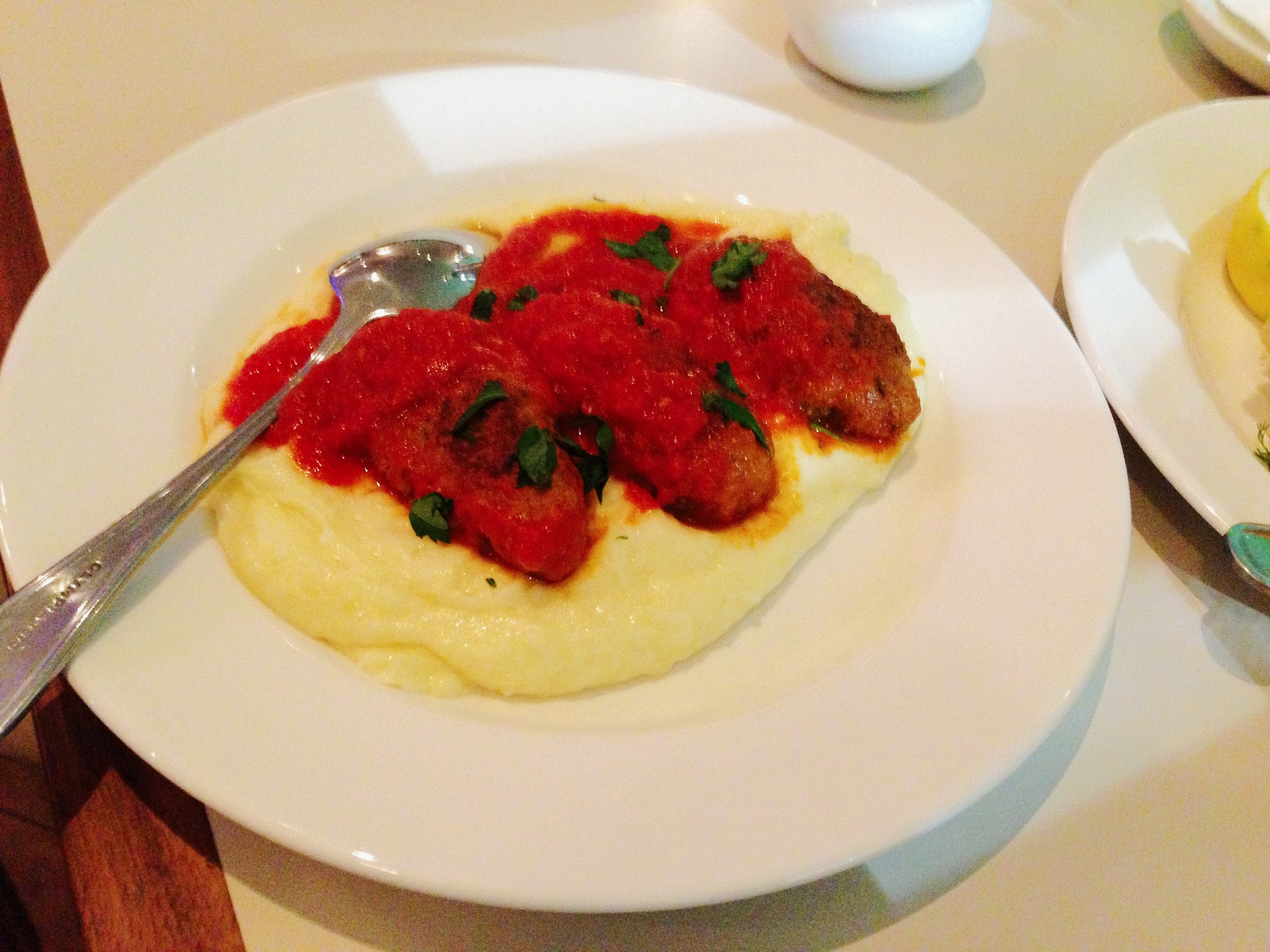
The best of the bunch was the soutzoukakia – beef and lamb meatballs with aromatic mash and cinnamon oil. These were lovely – coarse without being bouncy, three generous meatballs in rich tomato sauce on a bed of gorgeous, smooth mash. I couldn’t quite believe that the same kitchen could dish up two such different examples of mashed potato, but the one that came with the meatballs was far superior, if a little runny (dishing up was fun, put it that way). The flavours, though, were great – and the hint of cinnamon in a savoury dish, so often a feature of Greek food, worked beautifully.

The mains were further evidence of an inconsistent kitchen that was either terrified of, or had run out of, garlic. We went for the chargrilled whole sea bass with French fries and aioli, mainly because I’d had plenty of grilled fish on holiday in Greece at the start of the year, and wanted to relive happy memories from what felt like a lifetime ago. It arrived whole – which was my choice, although I did have the option for the kitchen to fillet it – and was underwhelming. Grilled fish on holiday is a wonderful thing partly because of the crispy skin; almost burnt but not quite, beautifully salty, dressed with lemon and oil. This however didn’t look like it had gone anywhere near a grill – it looked baked at best, and the skin was soft and slippery. Once I’d filleted it there wasn’t much left – and I’m no slouch at filleting, even if I do say so myself. The starters at Kyklos are quite big so this wasn’t the tragedy it could have been, but the fact remained that this dish cost sixteen pounds and felt like very little fish for the money.

The French fries were also false advertising, being nothing of the kind – they were very respectable chunky chips, the right blend of crunchy and fluffy – but they weren’t what I was expecting. I was hoping to have a sheaf of skinny crispy fries to dip in my rich aioli, and I didn’t get that. And, as you can probably guess by now, I didn’t get aioli either. It didn’t taste remotely of garlic – if anything, what I got was tarragon which wouldn’t have gone with the fish at all.

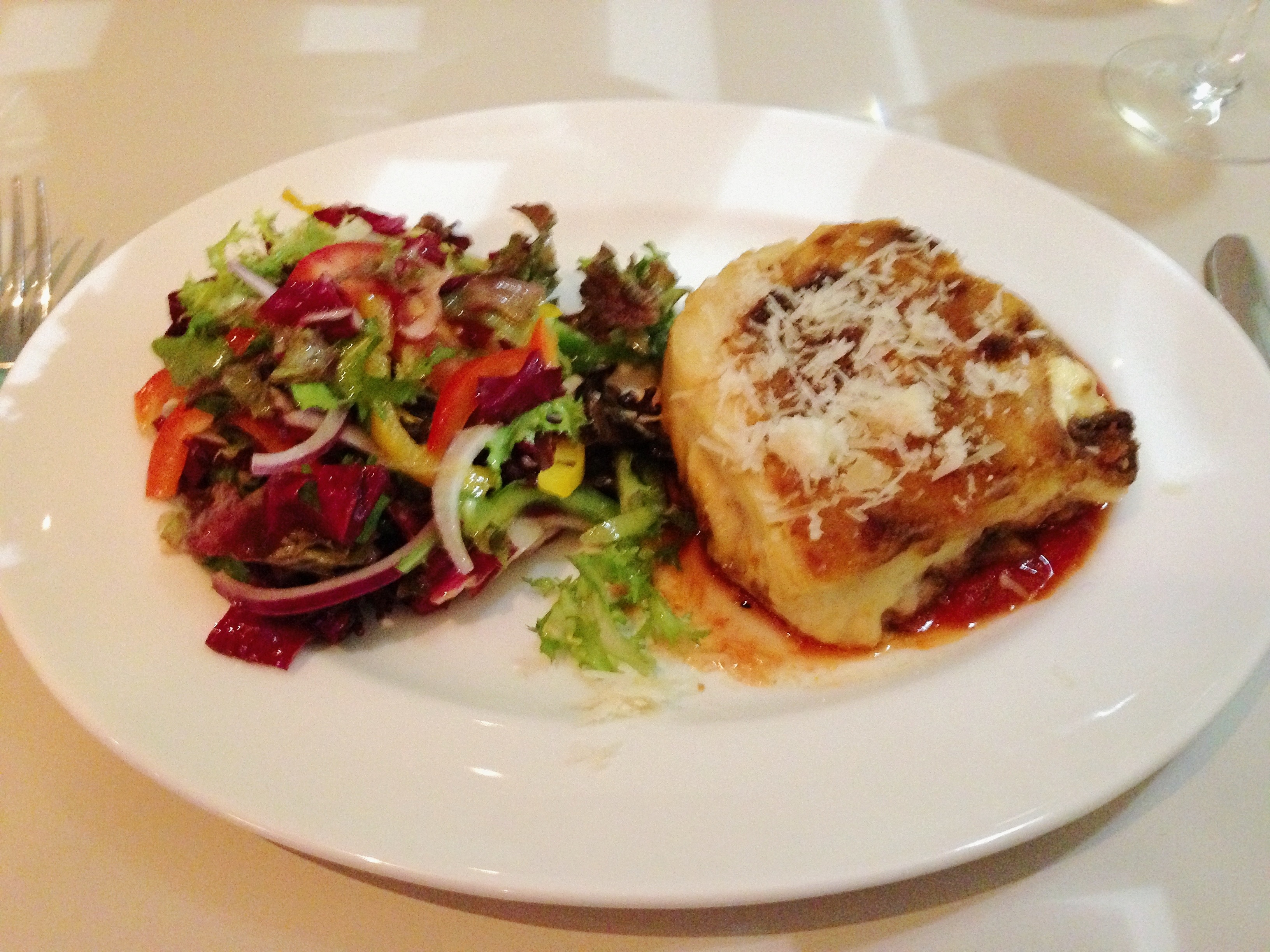
The other main, the moussaka, was a generous slab of béchamel sauce with a distinctly ungenerous layer of meat, aubergine and potatoes at the bottom. My photo isn’t brilliant, but it gives you a good idea just how much béchamel we’re talking about. For twelve pounds, or indeed for less, I would have liked a smaller slab of béchamel sauce with a more generous layer of meat, aubergine and potatoes at the bottom. It tasted nice enough but my companion said that towards the end he felt as if he was eating it for no reason other than stubbornness, and that’s never good. The “feta mousse” which was meant to accompany it, as promised on the menu, failed to appear; perhaps it too was supposed to contain garlic.

Between us we only had room for one dessert. I asked the waitress to help me pick between the panna cotta with rose water (which I thought might be quite light) and the walnut cake (which I thought would be quite Greek). She instead recommended the vanilla custard in filo pastry with cinnamon and mango ice cream as it’s home made in the restaurant. What this means for the other desserts, I don’t know but I’m easily led so I accepted her suggestion. This was a good plan, as it turned out. The dessert is known as galaktoboureko in Greece, though I’ve never found it outside of Crete, and it’s delicious; layers of filo pastry filled with smooth semolina custard with a light syrup poured over the top (similar to how baklava is served), all warm and inviting. The curl of ice cream on the side, on the other hand, was completely superfluous and didn’t taste of cinnamon at all, just mango.

I think, on reflection, that the dessert I had is representative of Kyklos as a whole. The core elements are really good: an attractive room, excellent, friendly service, some delicious ingredients and some authentic Greek flavours. But some things miss the mark completely: the flaccid fish, the lumpy mash, the lack of garlic in the skordalia or seemingly anywhere else, the pointless ice cream. I kept thinking if only: if only I’d ordered different dishes, the kleftiko perhaps, or the octopus stew with chick peas. But if it’s a good restaurant, it shouldn’t be possible to order badly – right?

So all in all, I’ve found this a difficult review to write. I want Kyklos to do well; a good Greek restaurant in the middle of town would be a wonderful thing. I really wanted to love it and to score it highly, but on the night I went there were too many let-downs and too many mistakes. You might have a different experience, and I wouldn’t entirely want to discourage you from finding out, but I do want to warn you. I suppose the last thing to add is that Kyklos is not a cheap place: our total bill was £75 for three starters, two mains, one bottle of wine and one dessert. I know I could go to Kyrenia in Caversham for the same money and have a considerably better meal. But then that’s a different review.

Kyklos – 6.3
Kings Walk, 19 – 23 Kings Street, RG1 2HG
0118 9500070

http://www.kyklosreading.com/

The Warwick

N.B. The Warwick reopened as Bali Lounge in Jan/Feb 2015 with a slightly different emphasis and a different, shorter menu. Bali Lounge itself closed in early 2018. I’ve left the review up for posterity.

First the bad news; as much as I wanted to like The Warwick there were a few hurdles to get over.

The decor is pleasing to the eye, with lots of Buddhas (is that the plural of Buddha? Buddhae?) and Ganeshes (likewise) dotted about the place. The lighting is muted (you’ll be able to see that from the photos) with fairy lights strung around the windows and signage which give it a romantic feel. Sadly, though, the furniture is an odd mish-mash of things; they’re all in keeping but the variation from hard wooden rustic style chairs (which, worryingly, all sway slightly when pushed) to fully upholstered dining chairs means that there are definitely good and bad places to sit, which means good and bad tables.

Actually, I suspect they’re all bad tables, just in different ways: we started at a table where you could see what you were eating, but moved because we were sitting on rock hard yet rickety chairs and I don’t think my bum could have coped with two hours of that. We moved to a different kind of bad table; better chairs, but atmospherically lit at best and, because the table was so low, we struggled to fit our legs under the table. Never mind. We’re British, dagnabbit, so we stayed put. You can ask to move tables once and you get away with it, do it twice and you run the risk of having a foam added to your meal where no foam should be.

Another hurdle: I don’t think wine is really the Warwick’s thing. We ordered a bottle of Albarino. The bottle was coated in a fine layer of condensation and the felt cold to the touch but when poured the wine was just not cold enough. This was tricky to explain to the waiting staff who didn’t quite understand what the problem was – not in itself an encouraging sign. A friend of mine reported a similar experience when she ate there recently – which they tried (and failed) to rectify by chucking ice in the wine cooler. Maybe their fridge just isn’t turned up high enough (or low enough, depending on which way you look at it). A second bottle of Albarino felt no colder, so we turned it down and said we’d order a red instead. They were so baffled at why this wasn’t acceptable that I almost felt guilty, even though they were the ones at fault.

The red was a bottle of Fleurie – it was okay at twenty-four quid but not exceptional, and it didn’t have quite the light fruitiness I associate with Fleurie. Even ordering this was plain weird – they brought the bottle over, showed it to us and then wandered off to remove the cork out of sight. When it came back, the waitress poured some into my glass. I kept waiting, expectantly, for her to stop so I could taste it, but she just filled it right to the top and then proceeded to fill the other glass. Again, I felt like I was the one who looked stupid, even though I knew I wasn’t.

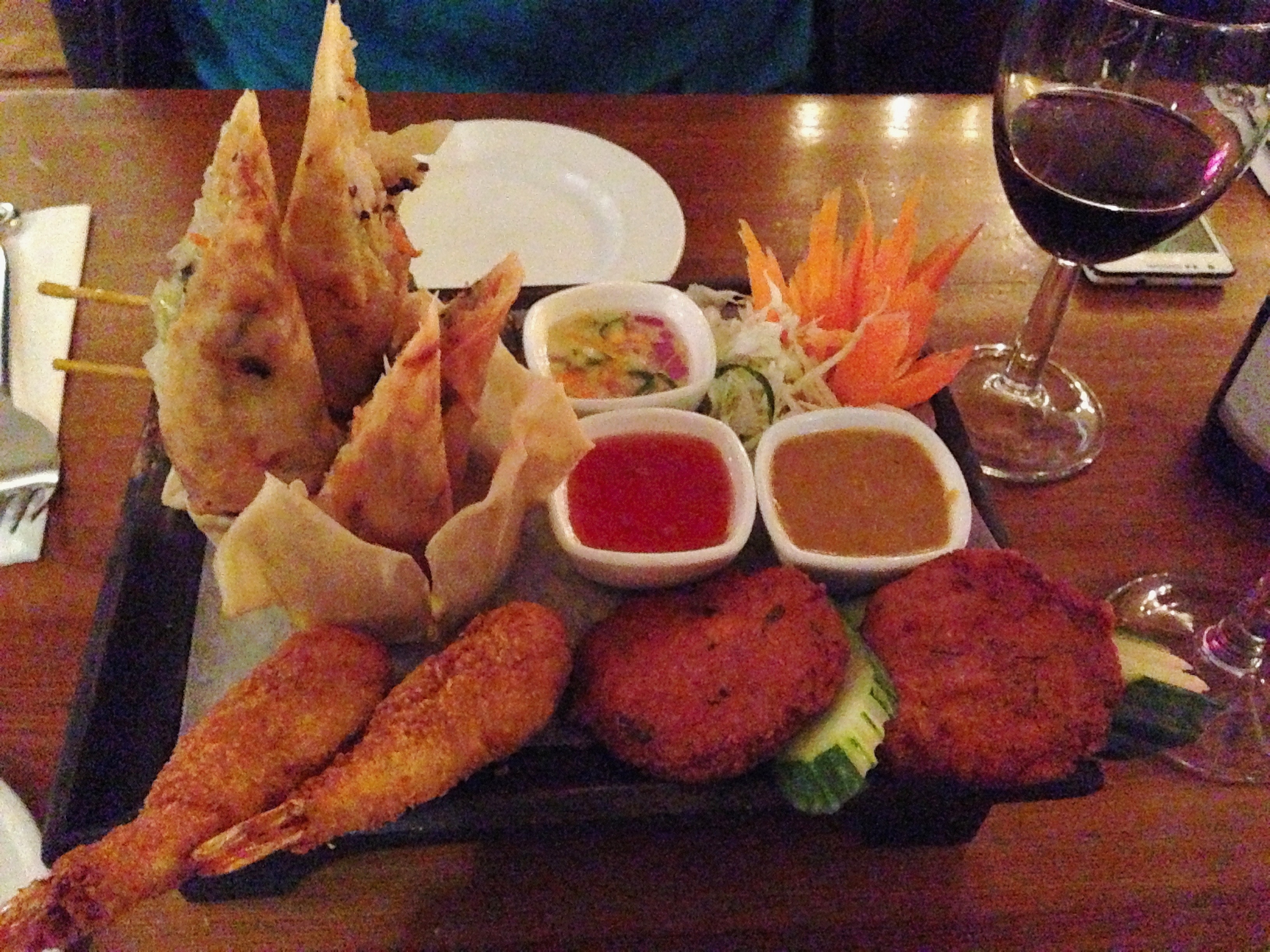
Now comes the good news. The food. We went for the Island Spice starter platter which is your usual fare – the ubiquitous fish cakes, satay chicken (out of sight in this photo), a breaded prawn and a spring roll each. Yes, I know it’s poor. I know I should have opted for a more interesting, more authentic dish rather than this greatest hits package and yet I always seem to do this in a Thai restaurant. It’s like the Quality Street of ordering – you know what you’re getting, there’s some variety, and you can always swap the culinary equivalent of the coffee cream (the Thai fish cake, in my case) with somebody else. Besides, it was only £5.50 a head, the same price as most single dishes on the starter menu.

Processed with VSCOcamActually, as it happened, this selection box had no coffee creams in it and my fish cake remained untraded. Normally I find them a bit floppy and tasteless but this one was very fragrant, lightly spiced and spongy rather than bland and flaccid. The prawns were unrealistically huge (split, I think) with a thick coating of breadcrumbs but they were tasty enough, especially once dipped in some sweet chilli sauce. The satay was proper chicken rather than something which had been “chopped and shaped” or (the horror) “formed” and the spring rolls were fabulous – proper fresh tasting shredded vegetables, including red and white cabbage, in a crispy layer of pastry. These in particular were the biggest hit of the selection – and I say that as someone who will often refuse to order a dish without meat in it. In hindsight, the Quality Street analogy maybe sold it a bit short.

The Warwick does a lot of main courses – stir fries, curries, pad thai dishes and house specialities. There’s even a separate regional section, all of which have a three or four chilli rating – the menu rates all its dishes from “a little spicy” to “ouch! my mouth is on fire” or words to that effect, which I found so endearing that it almost made up for the use of Comic Sans. To compensate for the obvious choice of starters, we decided to steer clear of the usual massaman lamb or green thai curry and try something a bit more interesting.

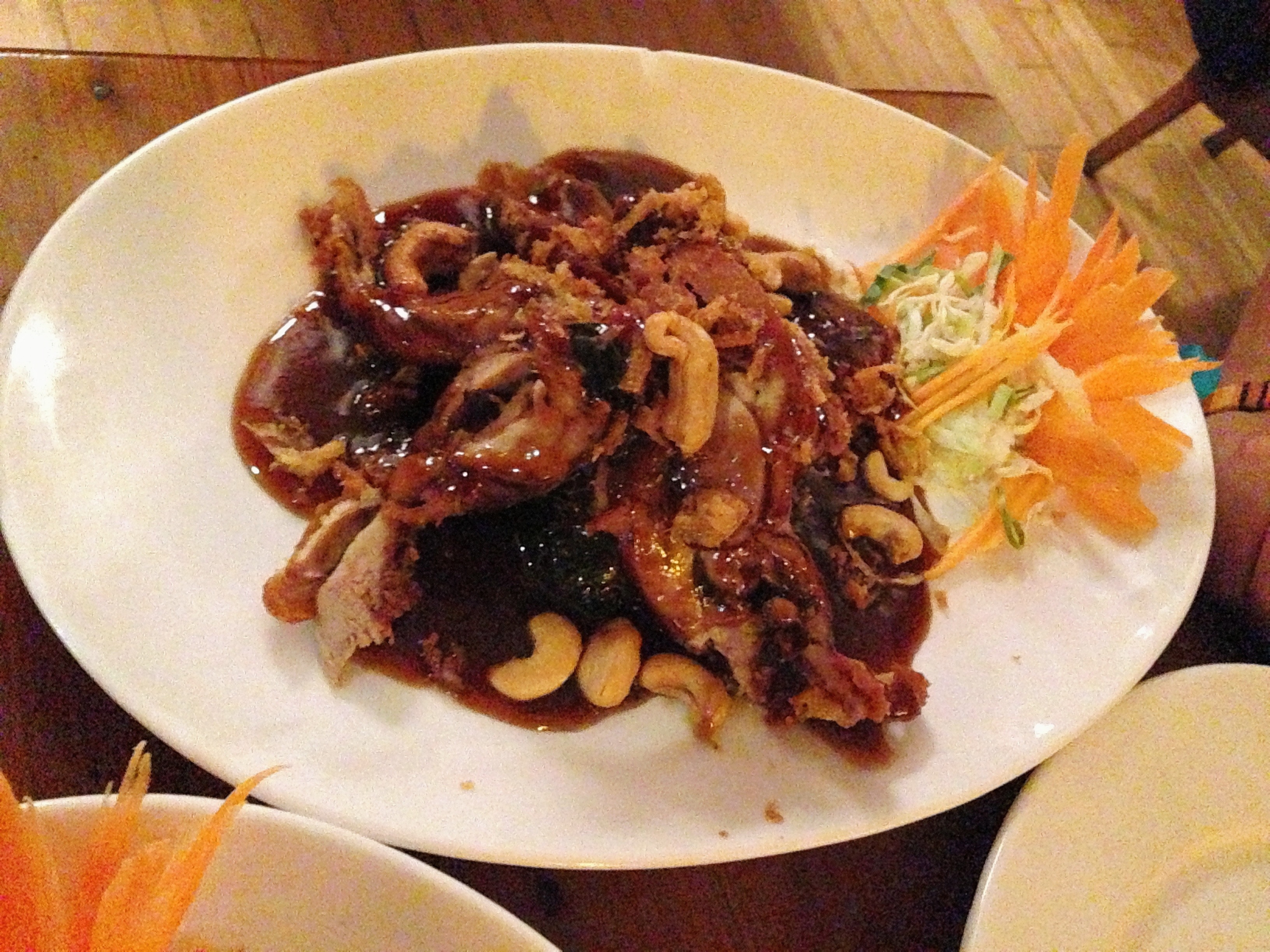
The ped makarm – crispy duck with sweet herbs and a sweet tamarind sauce – was a revelation. I rarely order duck in restaurants, because I’ve never been a fan of pink pan fried duck with that thick layer of wobbly fat on top. But there aren’t many pairs of words more beautiful than “crispy duck”, so I took the plunge. What’s not to like? This came on a little bed of broccoli (tasteless, but I think it was just there to prop up the duck) in a pool of rich, dark tamarind sauce with a few cashews sprinkled on top. And the gamble paid off, because it was magnificent. So many gambles in restaurants don’t – we all have experiences where you stray from your usual thing and are rewarded by a truly middling meal – but there’s something magical about picking something you wouldn’t normally order and having your socks knocked off.

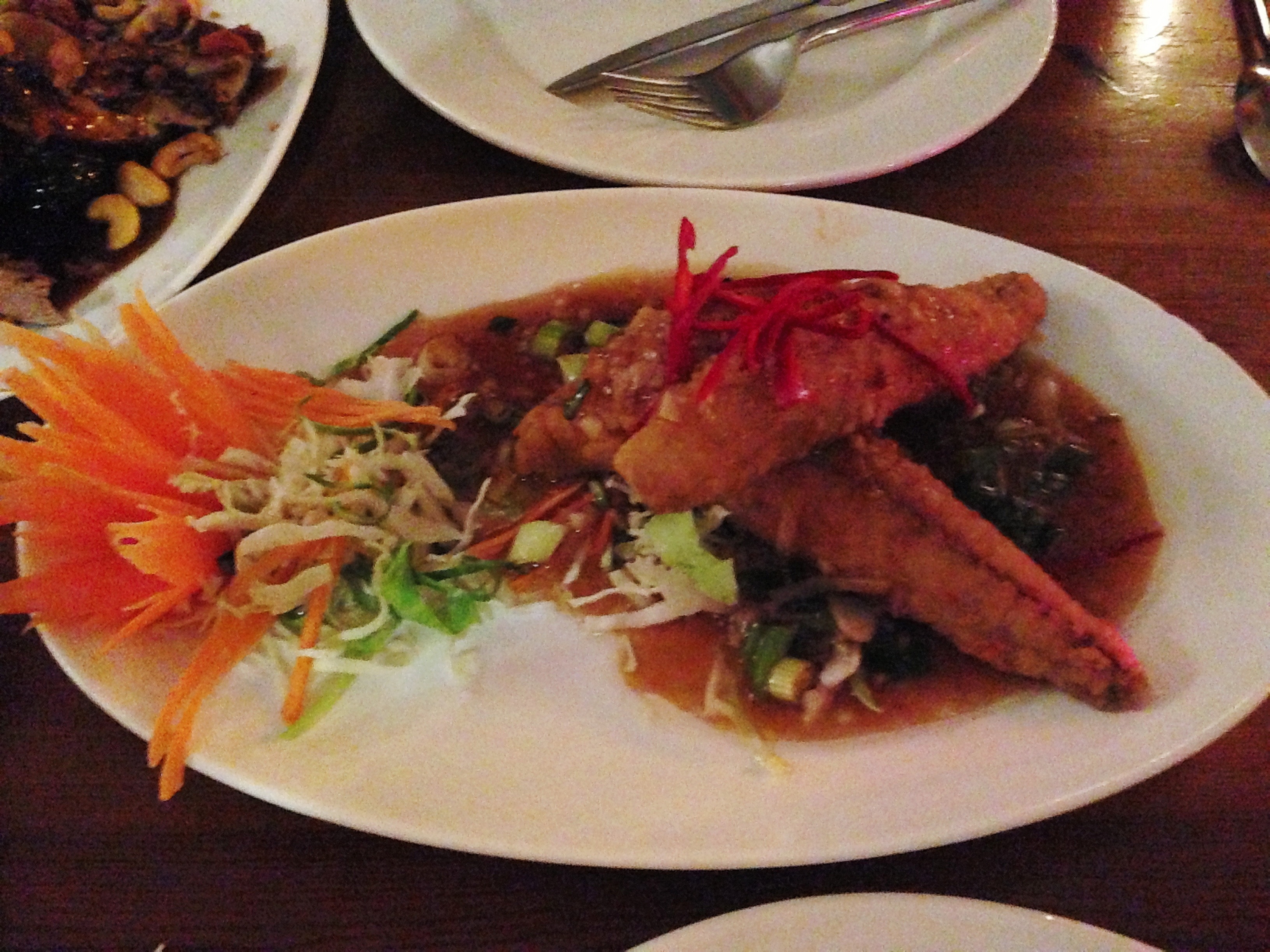
Processed with VSCOcamThe other main dish was sea bass with stir fried garlic, coriander root and oyster sauce (kra tiem prig thai). Again, it was spot on. Two generous sea bass fillets, fried until crispy, skin and all, served with a rich sauce that honked of garlic (I pity the people at the desks next to us at work the following morning, put it that way). The only drawback, which I guess I should have appreciated, is that although you get a reasonable amount of sauce it’s never going to be quite as saucy as a Thai curry. The delicious bit at the end of a Thai meal, where all you’re left with is coconut rice soaked in rich sauce, was not to be a feature in our evening.

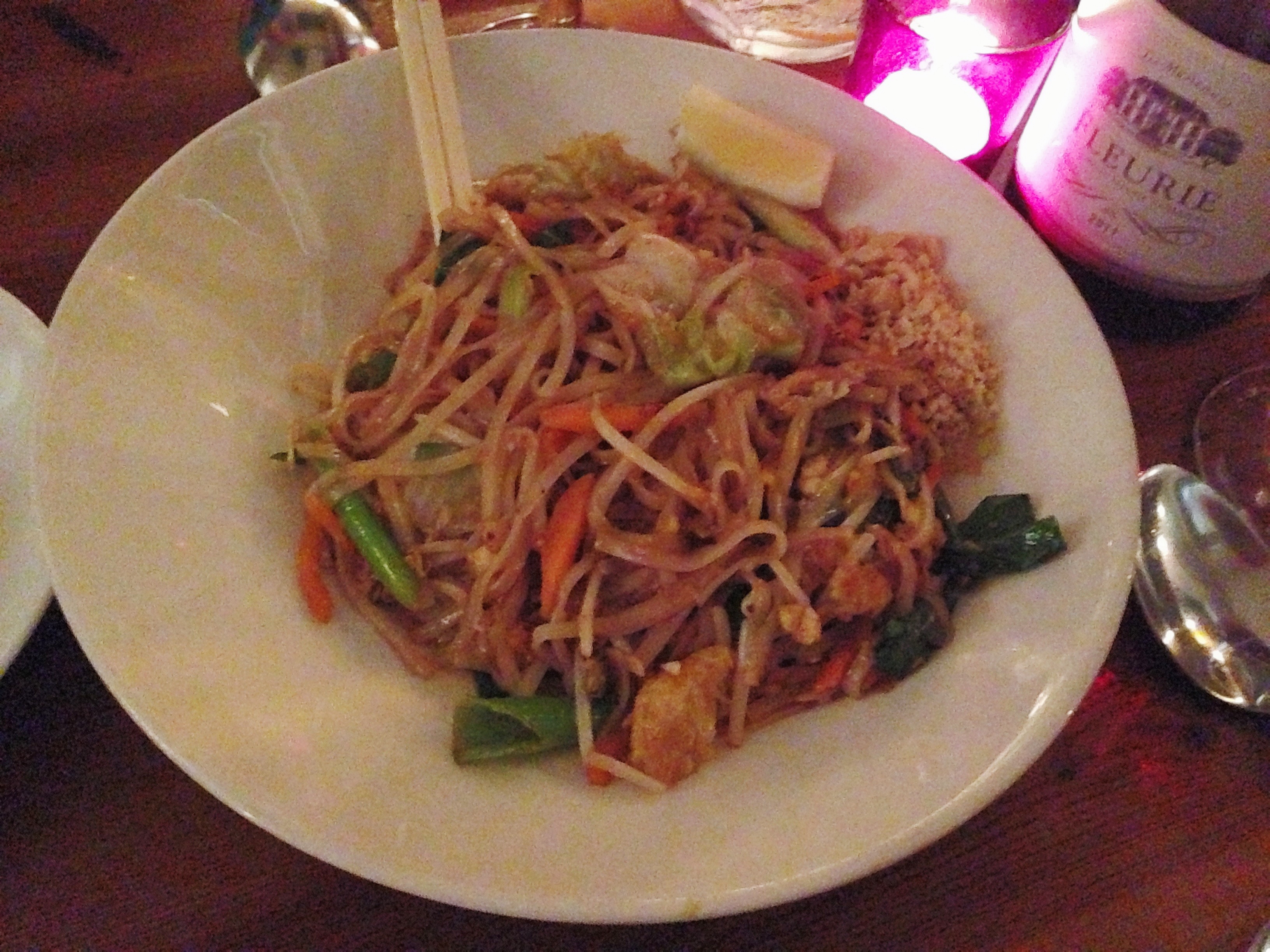
Processed with VSCOcamThe side dishes were good but not amazing, but they really weren’t the feature attraction, so it didn’t matter. Coconut rice was nice but unremarkable. The vegetarian pad thai, with cabbage and (yet more) tamarind sauce was better – fine noodles, tasty sauce and delicious cabbage, but it was a bit pricey at seven pounds. The Warwick doesn’t treat vegetarians all that well, I thought: the vegetarian dishes all hover around the seven pound mark (broccoli in oyster sauce for about seven pounds felt especially stiff). The mains we ordered were both £12.50, though there are plenty of dishes that are considerably cheaper than that.

Processed with VSCOcamI’ve said the ambience is a tad romantic, but really this feels like a place to go with friends. They have a number of different set menus for two or more people giving you the opportunity to try loads of different things, and that’s what this kind of food should be about (they also do daily offers ranging from buy one get one free to a free bottle of house wine with some of their set menus). Even with just the two of us, it was one of those meals where you want your dining companion to taste your food, so they can do that nod and point thing where something you’ve picked is really good.

As it was, there was lots of swapping and sharing, though I did have to put my foot down when I offered my companion an extra piece of duck and his fork hovered towards the super crispy shard of duck that I had been saving for the last mouthful (I’m nice but not that nice). And I was right to save it – so salty and crispy but offset by the sweet tamarind sauce. Yes, I know I’m repeating myself but there’s something about constructing the perfect final mouthful when you go out for dinner, and it was so, so good.

We skipped dessert, partly because we had no room and partly because the dessert menu was pub food not Thai food – chocolate brownies, sticky toffee pudding and the like (although possibly preferable to the frozen delights you often get in Thai restaurants – who can forget the dubious pleasures of the “Funky Pie” at Thai Corner?). Instead we finished up the wine, got the bill – £69 for two courses and a bottle of half decent red – paid up and left. If it looks expensive, it probably is – it’s possible to eat a lot cheaper there, and based on what I had you’d probably eat very well.

All in all, The Warwick is a mixed bag. You do feel like you’re eating somewhere that isn’t quite a pub, isn’t quite a restaurant. The furniture isn’t inviting. The service is a bit unpolished – probably partly because they were doing a brisk trade, even on a Wednesday night – but it did feel like a struggle at times. It’s on the edge of town, in a town that has a fair few other Thai restaurants (though not as many as it did before Thai Nine closed down). And yet, and yet… when I think back to that duck dish, it becomes an awfully hard place not to like. Even before I’d left a part of me was wondering what I’d choose next time, and that tells its own story. So I’d say go with friends, order carefully, don’t expect to be too comfortable (or if you are, don’t expect to get a good look at your food) and you should have a very enjoyable meal indeed.

Oh, and probably best to stick to the beer.

The Warwick – 7.2
77 – 79 Kings Road, RG1 3DD
0118 9566969

http://www.aroythai.co.uk/

Picasso

Picasso closed in October 2019. I’ve left the review up for posterity.

One of the editorial decisions I had to make when I started Edible Reading sounds like a minor one, but it prompted much deliberation. Not where to eat, or which font to use, or whether to put captions underneath my terrible pictures, but something more basic: where do you put the mark out of 10? I quite liked the idea, like Pitchfork for example, of putting the mark right at the top so you knew before reading whether I thought the restaurant was any good. In the end, I went with the conventional method of putting it at the bottom. The idea is that people read on to the end, curious about whether I’m going to turn out to be a fan of Pepe Sale, ZeroDegrees, London Street Brasserie etc.

Most of the time this works out fine, but the only exception is when you give a bad review. People love bad reviews, and I’m no exception; there’s a certain pleasure to be had from reading one. So I think I should warn you from the outset that this is a bad review. Picasso is not a good restaurant. I won’t go again, and I’d actively encourage you to follow my example. Got that? Right, on we go then.

I started out reviewing places I’ve been before – not new places, not unknowns – partly because I wanted to find my feet and partly because I wanted to pick places you might have been, so you could get an idea whether we liked the same stuff and you trusted my judgment. But this couldn’t go on forever, so I asked for suggestions about where I should go next. “Try Picasso”, someone said on Twitter, “I’ve heard mixed reviews and I’ve never been able to bring myself to try it.” Good idea, I thought. What’s the worst that can happen?

It turns out the worst that can happen is eating dinner at Picasso.

It’s one of those places, ironically, that ought to fill a gap in the market. Reading has never had a decent tapas restaurant, unless you count La Tasca (and, having eaten there before it closed, I don’t). Picasso has been going a long time, tucked away in a quiet little spot just over Caversham Bridge, so it must be doing something right. So I booked a table for 8 o’clock on a Saturday night and wandered across town, stopping in the Moderation for a pre-prandial gin and tonic. Eating somewhere you’ve never been before always has that feeling of excitement and anticipation, like that point at Christmas when you sit on the sofa, ready to unwrap a present in front of all your relatives.

The inside of Picasso, I would guess, hasn’t changed in over thirty years; basic furniture in a long thin room, pictures on the walls, cloth napkins, tables not too close together. A few tables were in dark corners, and I carefully avoided being led to one of those. Although it was unprepossessing I was determined not to judge the book by its cover: after all, Pepe Sale does great food and is never going to feature in Elle Decoration. The interior Picasso reminded me most of was the recently departed Nino’s, in Market Place, in fact, another old school restaurant where I’ve somehow never managed to have an inspiring meal.

Everything started well: the service in Picasso is very good, authoritative, old-fashioned service. The waiter recommended a Ribero Del Duero which was not on the wine list, was only £22 and was probably the best thing about the whole evening. He also – and this has to be a first – cautioned us against ordering too much food. Two tapas per person was enough for an evening meal, he said, so we should go easy on them.

In hindsight, I should have known at this point that something was amiss. Tapas are not meant to be big. That’s the whole point of them, and their whole appeal because it means you can try dozens of little things without being stuck with a giant portion of anything. After all, if you wanted that you’d go to a restaurant that served starters and main courses, wouldn’t you? A look at the menu proved that either the tapas were far too big or they were far too expensive: most of them were between eight and ten pounds. This is definitely the point where alarm bells began to ring, just as other couples started to take their tables. A lot of them had clearly been here before, though, so I must just have been worrying unduly. Mustn’t I?

When the tapas turned up it became apparent that they were both too big and too expensive, and worse still just not very good. A plato combinado of jamon serrano and chorizo was limp and insipid. The chorizo was barely an evolutionary step up from luncheon meat with a sun tan, bouncy and tasteless. The jamon serrano was even more of an insult, with the shiny dampness of something that had spent the previous few hours in a plastic catering pack of some description, each slice sandwiched between leaves of plastic. I wasn’t expecting them to have a leg of jamon hanging over the bar (hoping maybe, but certainly not expecting) but I did at least want to feel like this was good quality stuff. I could have walked back into town, gone to Marks & Spencer and got more, better, jamon for under three pounds. I finished it out of sheer stubbornness and almost immediately regretted it.

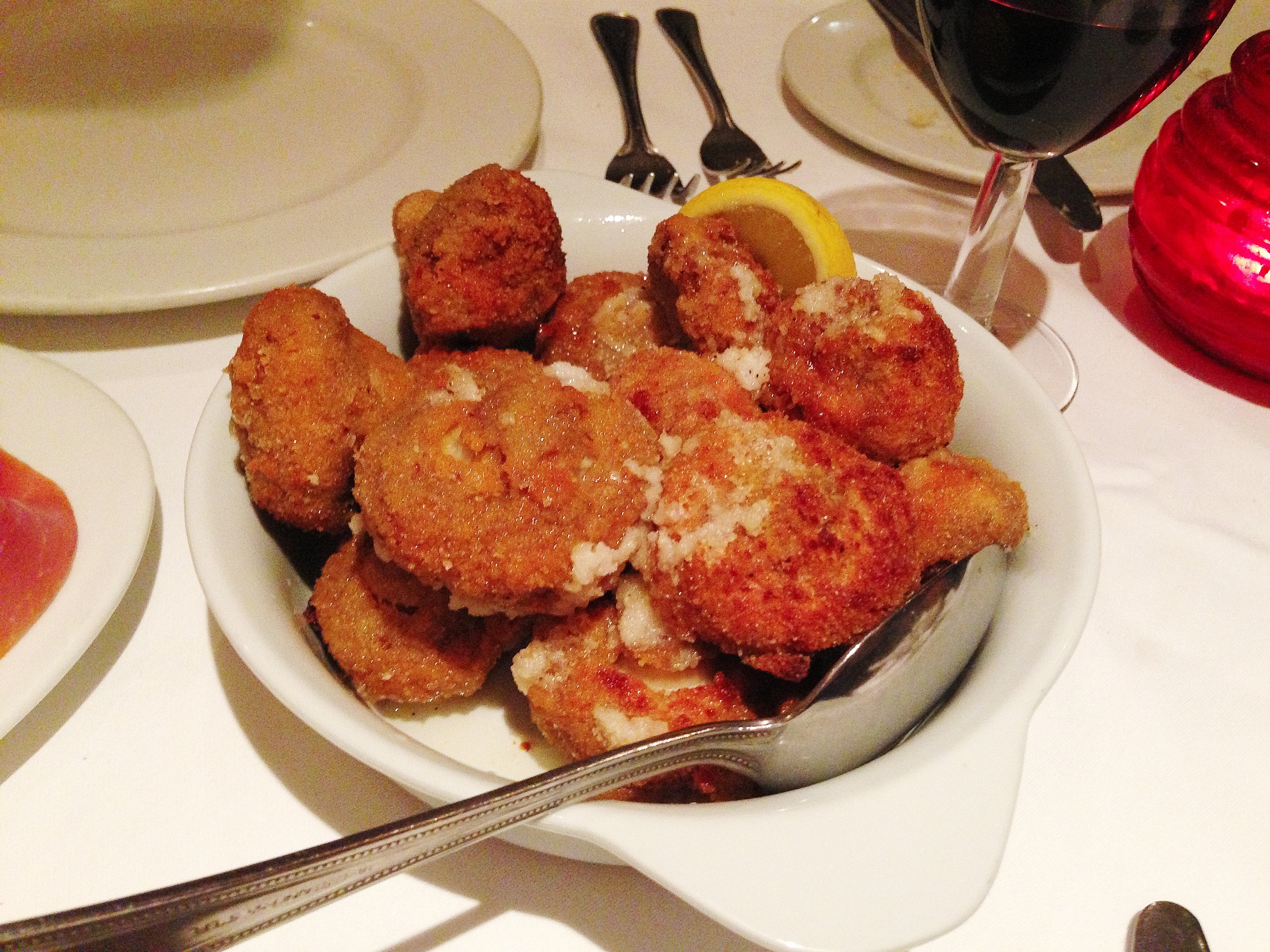
If the jamon was sub-M&S, the mushrooms with garlic butter were sub-Iceland, and even then I am probably being kind. A huge bowl of breadcrumbed mushrooms with a few visible patches of melted garlic butter was plonked in front of us, with a wedge of lemon in case you had pretensions about that kind of thing. Cutting them open they were flabby and damp, and the whole thing had the feel of party food at a party you wished you didn’t have to attend. A funeral, perhaps. We didn’t eat them all.

I looked again at the red wine. It was good, but it wasn’t that good.

Picasso 1

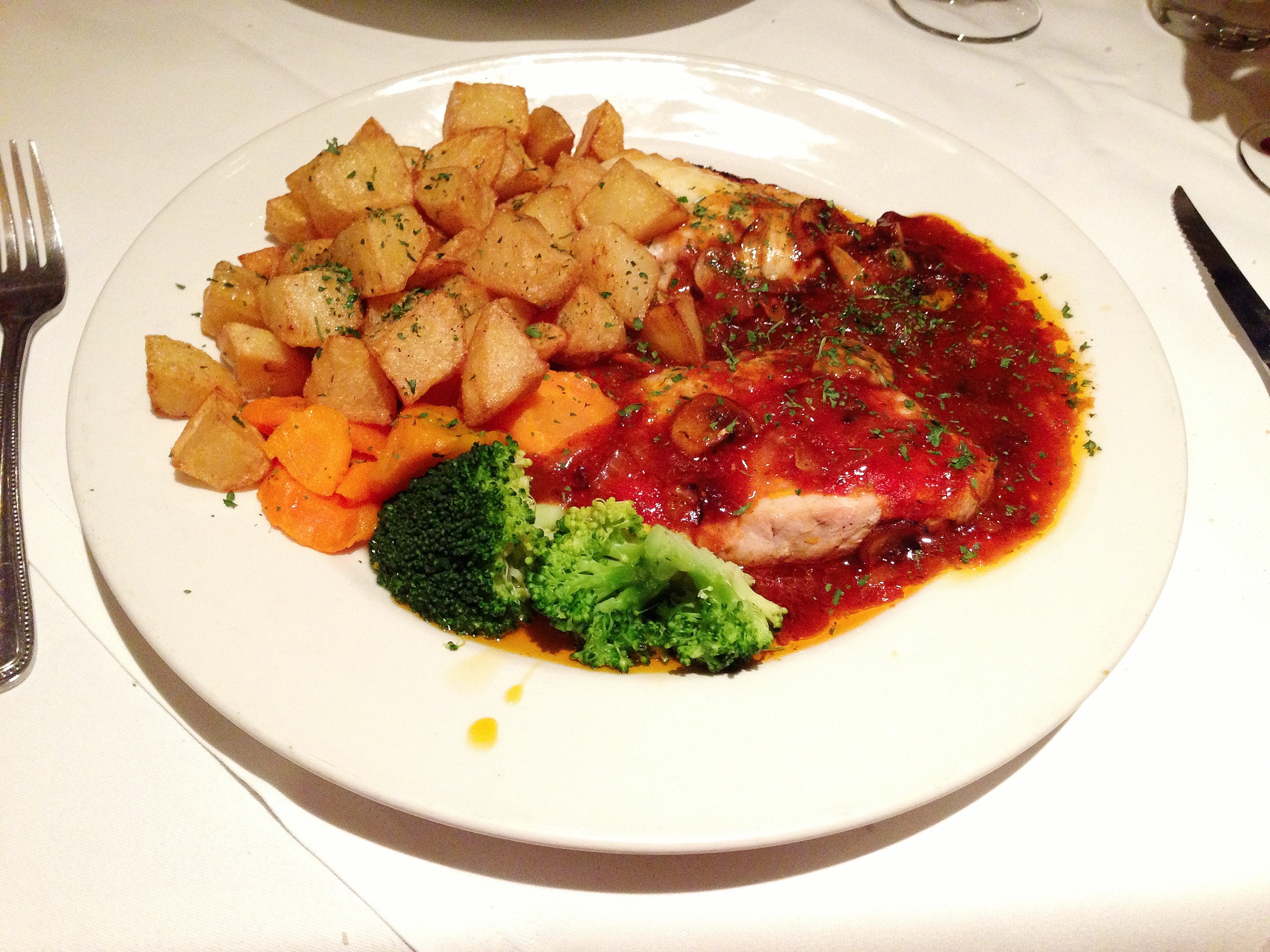
The mains came almost as quickly as the starters had done, and were no better. Cerdo Asturiano was billed as pork fillet cooked in cider and cheese sauce. I was hoping for tenderloin, what I got was two thick slabs of steak with another slab of cheese melted on top of them. The sauce had no evidence that either cider or cheese had been used in it at all, it was the sort of anonymous red sauce that used to be made by Homepride and is now made by Dolmio. For all I know it could well have been. Accompanying it was a gigantic pile of fried cubed potatoes (presumably exactly the same thing you’d get if you ordered patatas bravas), some carrots which either came from a tin or had been cooked to closely resemble those that do, and some broccoli. It was clear that nobody left Picasso hungry, but that it was unlikely they left it satisfied either.

Swordfish in a cream, onion and mushroom sauce was just as disappointing. The swordfish was bland and flavourless and the sauce managed, if anything, to be less than the sum of its parts – thin, watery, with a hint of dill that might well have come out of a Schwartz jar. Swordfish, done well, is a beautiful thing but this was just boil in the bag cod in parsley sauce with delusions of grandeur. It came with the same piles of forgettable vegetables as the pork; in fact, I only took a photograph of one of the main courses but they were virtually identical, the single difference being which inadequate protein and sauce combination you’d been unlucky enough to plump for. The only things worth finishing in the whole restaurant, it seemed, were the wine and the experience.

Picasso 2

It’s worth stressing what bad value Picasso is. Most of the tapas, as I said, were just shy of a tenner. The two mains were eighteen and sixteen pounds respectively. You can eat better for the same money in Reading without having to try very hard, and I’ve already reviewed two places where you can do exactly that. I couldn’t quite believe all the other diners in the restaurant didn’t appreciate this, to the extent where I wanted to stop by their tables on the way out and actively encourage them to go somewhere else next time. As I didn’t do that, I’ll have to console myself by doing it here instead.

I’ll say one thing for Picasso, it was mercifully quick. From sitting down to deciding to pass on the dessert menu took an hour and twenty minutes, on a Saturday night, a peak time for restaurants when people want to sit down and have an enjoyable, leisurely meal. The high point of the weekend when we want to sit in lovely cosy room somewhere, escaping from X-Factor and the contents of our fridge and being spoiled and taken care of by other people. There were lots of things about Picasso that were very very wrong, but the worst of all is how it betrayed that promise that every restaurant implicitly makes, that it will whisk you away from all that. It was like eating in a friend’s house, if your friend wasn’t a very good cook, had gone to about four downmarket supermarkets to get all the ingredients and tried to charge you eighty quid for the privilege. If you had a friend like that, you’d stop seeing them. If you knew a restaurant like that, you’d stop going. Believe me, Picasso is that restaurant.

Picasso – 4.1
6 Bridge Street, Caversham, RG4 8AA
Telephone 0118 9484141

http://www.picasso-tapas.co.uk/